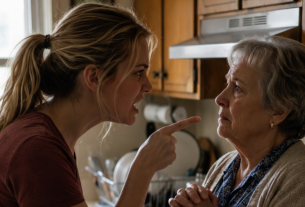
“Lizochka, please don’t be angry with me,” Lyudmila Semyonovna’s voice was so honey-sweet that Liza felt like checking whether someone had replaced her during the night. “I understand everything. I’m a mother, I can feel these things. You’re like my own daughter, you know that.”
Liza stood in the hallway and looked at her mother-in-law. A year. An entire year — not a call, not a message, not even a glance on the street. And now she was standing on the doorstep with a cake in her hands, wearing a new blouse, her hair done, smiling so widely as if they had hugged each other only yesterday.
“Come in,” Liza said. Briefly, without emotion.
Lyudmila Semyonovna came in, looked around, and placed the cake on the table. She examined the kitchen with the expression of someone assessing a piece of real estate. She ran her finger along the windowsill — and Liza noticed it, of course she noticed.
“Is Yegorushka home?” her mother-in-law asked, already sitting down without being invited.
“At work.”
“Well, that’s good. I actually came to see you. To talk woman to woman.”
That was when Liza felt something cold under her ribs. “Woman to woman” was the first warning sign. In three years of marriage, she had learned Lyudmila Semyonovna’s vocabulary by heart. “Woman to woman” meant: here it comes.
It had all begun two weeks earlier, when Liza’s uncle, Veniamin Trofimovich, had died — a lonely, childless man who had spent his whole life in a large apartment in the city center. Liza had not visited him often, but he loved her. He used to say she was the only relative who came not with empty hands and not with empty eyes. After he passed away, it turned out he had left the apartment to Liza. Not to her mother, not to the cousins who appeared immediately after the funeral with mournful faces — but specifically to her.
The apartment was a good one. Three rooms, high ceilings, a view of the park. At current prices — a very good one.
And three days after the notary read out the will, Lyudmila Semyonovna appeared on the doorstep with a cake and the words “like my own daughter.”
“Lizochka,” her mother-in-law folded her hands in front of her as if at negotiations, “I want to tell you something important. I understand there have been… misunderstandings between us. But family is above everything. You are now a woman of means, and that is wonderful. But you understand that Yegor is your husband. And what is acquired during marriage is shared.”
Liza poured herself some water. Slowly. She put the glass down.
“Inheritance is not considered marital property,” she said calmly.
Lyudmila Semyonovna blinked. Apparently, she had not expected Liza to know such things.
“Well, that depends on how it’s arranged,” she smiled. “I’m simply saying that a family should live together. Maybe you could sell your two-room apartment, add some money from the inheritance, and buy something bigger? There would be enough room for all of us.”
All of us. So she meant herself too.
“I’ll think about it,” Liza said.
She said nothing more that day.
Yegor came home at eight. His mother was already waiting for him — she had stayed, citing tiredness and “aching legs, impossible to catch a bus.” In three hours, she had managed to move a vase in the kitchen, criticize the curtains, and twice hint that the apartment felt “somehow not cozy.”
“Mom, why did you come without calling?” Yegor said, but without any real displeasure. Just for show.
“Son, I missed you,” Lyudmila Semyonovna pressed her hands to her chest. “Can’t a mother visit her son?”
Liza watched them from the doorway. There they sat side by side — mother and son, both broad-built, both with the same expression when they wanted to get something. Yegor was not cruel — he was weak, which in essence was worse. A cruel person can be stopped. A weak one simply goes with the flow, and his flow always moved toward his mother.
For three years, Liza had watched him agree with every word she said. Watched him nod when she said that “Lizka’s cooking is so-so.” Watched him stay silent when his mother took his phone and read his messages. Watched him once — once! — say, “Mom, don’t,” and then, under her gaze, immediately add, “Although fine, never mind.”
A year ago, they had argued over a vacation. Liza had wanted to go to St. Petersburg with just the two of them, but Lyudmila Semyonovna decided she would go with them. Yegor said, “She’s my mother, what’s the big deal?” Liza said, “I’m your wife.” Lyudmila Semyonovna said to Liza — quietly, in the hallway while Yegor was putting on his jacket: “You are temporary here.”
After that came a year of silence.
And now — cake. A smile. “Like my own daughter.”
The next morning, Liza went to the city center. Not shopping — to the notary’s office, to the very specialist, Ilya Konstantinovich, who had handled her uncle’s will.
“I’m interested in one question,” Liza said, sitting down across from him. “Can my husband claim the inherited apartment?”
Ilya Konstantinovich shook his head.
“Property received by inheritance is not included in marital property. Even during marriage. If you do not re-register it jointly or invest it into shared property, it remains yours.”
“And if there is a divorce?”
He looked at her carefully.
“Then the apartment will remain yours.”
Liza nodded. She was silent for a second.
“I need a consultation on one more matter,” she said. “What is needed to begin the procedure?”
She did not specify which procedure. But Ilya Konstantinovich understood. He opened a folder and began to speak — just as slowly, precisely, and without unnecessary words.
That evening, Lyudmila Semyonovna called again.
“Lizochka, Yegor and I have been thinking…”
Yegor and I. So they had already discussed it.
“…that the apartment you inherited would be best rented out. The money would go into the family. We calculated it — if you rent it monthly, it would bring in a decent amount. I could handle the tenants myself, I have experience…”
“Lyudmila Semyonovna,” Liza interrupted. Calmly, without raising her voice. “I’ll call you back.”
And she hung up.
She sat for a minute. Then she opened her phone and typed in the name of the real estate agency whose address Ilya Konstantinovich had given her. Reliable, he had said. They work quickly.
Uncle Veniamin’s apartment stood empty. Three rooms, high ceilings, a view of the park.
Liza had not yet decided what to do with it. But one thing she knew for sure — she would decide herself.
Yegor came home earlier than usual. That alone was strange — he rarely came back before eight, but now he appeared at half past six, looking as if he had spent the entire metro ride rehearsing a speech.
Liza was cooking in the kitchen. She heard him fussing in the hallway for a long time — taking off his jacket, hanging it up, taking it down again, hanging it differently. Stalling.
“Liza,” he finally said, entering. “We need to talk.”
“Sit down.”
He sat down. Put his hands on the table, looked at them, then at her.
“Mom says you were rude to her on the phone.”
Liza turned around.
“I said I would call her back. And hung up.”
“Well, exactly. She got upset.”
“Yegor.” Liza turned off the stove and sat across from him. “Your mother did not speak to me for a year. A year. Do you remember that?”
He grimaced — the way people grimace when a topic is uncomfortable.
“Well, there was tension, yes. But she came, she made peace…”
“She came three days after everyone found out about the inheritance.”
Silence. Yegor looked at the table.
“A coincidence,” he finally said.
Liza did not answer. She simply looked at him. And in that second, something inside her finally settled into place — like a bone that had long been dislocated and finally clicked back. Painful, but right.
That night she did not sleep. She lay there listening to Yegor breathing beside her — evenly, peacefully. He always fell asleep quickly; he had the ability to switch off as soon as his head touched the pillow. No worries. No questions for himself.
Liza thought about Uncle Veniamin.
He had been a strange man — everyone in the family thought so. He never married, lived alone, worked as a design engineer, and went to the theater on weekends. The relatives called him “an oddball” and pitied him a little. But he, it seemed, pitied no one in return — he simply lived as he wanted, and that was all.
When Liza was little, he used to tell her, “The most important thing is not to confuse comfort with a trap. They look very similar from the outside.”
Back then, she had not understood. Now she did.
In the morning, Nastya called — a friend from university. Nastya worked as a lawyer at a small company, was sharp, quick, and never wasted words.
“Well?” she said instead of hello. “Have the vultures appeared?”
“They’ve arrived,” Liza answered.
“I knew it. Listen, when are you free? We need to meet, not over the phone.”
They agreed to meet for lunch. A café on Pokrovka, where they used to sit after classes — by some miracle, it had survived all the waves of closures and renovations and still stood in the same place with the same wooden tables.
Nastya was already there when Liza arrived. She was sitting with coffee, scrolling through something on her phone, but when she saw Liza, she immediately put it aside.
“Tell me.”
Liza told her. Everything — about the cake, about “like my own daughter,” about the call suggesting they rent out the apartment and put the money “into the family,” and about the conversation with Yegor.
Nastya listened silently, only raising one eyebrow once — when Liza got to “Yegor and I have been thinking.”
“So he is already on her side,” she said when Liza fell silent.
“He has always been on her side. It’s just that before, the stakes were lower.”
“Liza.” Nastya put down her cup. “You understand that pressure is going to start now, right? That was only the first approach, reconnaissance. It will get more serious next.”
“I understand.”
“And what are you planning to do?”
Liza was silent for a moment.
“I went to the notary,” she said. “I found out about the inheritance. Now I want to find out about everything else.”
Nastya looked at her carefully.
“You are already thinking about that?”
“I started thinking about it a year ago. When she told me in the hallway that I was temporary here.”
“Why didn’t you tell me then?”
“Because back then I still hoped I was wrong.”
Nastya took on her case — that was exactly what they called it, businesslike and without unnecessary softness, which was exactly what Liza needed. They sat in the café for another hour and sorted everything out: what existed, what had to be done, and in what order.
Uncle’s apartment was registered to Liza and only Liza. That was the foundation.
On the way home, Liza stopped by Taganka — the real estate agency the notary had recommended was there. A small office on the second floor, a manager named Kostya, young, businesslike, with the habit of writing everything down by hand in a notebook.
“A three-room apartment in the center, in good condition?” he repeated. “No problem. We can list it either for rent or for sale. What are you considering?”
“For now, rent,” Liza said. “But I want to understand the numbers for both options.”
Kostya nodded and began calculating. Liza looked at the figures on his computer screen and felt a strange calm — the kind that comes when you stop being afraid and start acting.
Lyudmila Semyonovna called again that evening. This time her voice was different — not honeyed, but with a slight metallic edge, the way it sounds when a person realizes the first attempt has failed.
“Liza, I want all of us to get together and talk calmly. As a family. I’ll cook, set the table…”
Liza imagined that table. Lyudmila Semyonovna at the head. Yegor beside his mother. And herself — opposite them, alone, as if under interrogation.
“All right,” she said. “On Sunday.”
Let her come. Let her set the table.
By Sunday, something would change. Liza would make sure of it.
She dialed Nastya.
“Family lunch on Sunday,” she said. “Will you come?”
“In what capacity?” Nastya clarified.
“As my lawyer.”
A pause. Then a short laugh.
“I’ll be there with documents.”
Sunday began with Lyudmila Semyonovna arriving an hour earlier than agreed.
Liza opened the door and saw her mother-in-law with heavy bags, wearing a dressy jacket and a hairstyle that had clearly been done specially for the occasion. Behind her stood Yegor, with the guilty face of a person who knows something is wrong but cannot understand exactly what.
“I came early so I’d have time to cook,” Lyudmila Semyonovna announced, already stepping inside. “Do you have a large pot?”
“I do,” Liza said. “But there’s no need to cook. I ordered food.”
Her mother-in-law stopped.
“What do you mean, ordered? Ordered where?”
“Delivery. Everything is already here.”
Lyudmila Semyonovna looked around the kitchen, where containers from a good restaurant were indeed standing on the table, and something in her plan clearly broke. She had expected to enter as the mistress of the house — stand at the stove, fill the space with herself, set the tone. But here everything was already ready, and she was not needed.
“Well,” she finally said, “as you wish.”
And she went into the room.
Nastya arrived exactly at the appointed time. She rang the doorbell, came in with a folder in her hands, shook Liza’s hand — briefly, businesslike — and greeted the others.
“Who is that?” Yegor quietly asked Liza.
“My lawyer.”
He looked at her. Then at Nastya. Then back at Liza.
“Why is there a lawyer at a family lunch?”
“For order,” Liza said.
Lyudmila Semyonovna, who had heard everything, straightened on the sofa. Her gaze changed — sharp, wary. That is how a person looks when they came for an easy stroll and suddenly realized they had entered someone else’s territory.
They sat at the table. Laid out the food, poured tea. For several minutes, they talked about nothing — the weather, the road, the fact that the city had closed some street again. Lyudmila Semyonovna held herself together, but her fingers drummed on the table — quietly, almost imperceptibly.
Finally, she could not hold back.
“Liza,” she said, “I would like to discuss the apartment. Since we are all gathered here.”
“Let’s discuss it,” Liza agreed.
“Yegor and I think…” her mother-in-law began.
“Excuse me, but on what grounds are you and Yegor thinking anything regarding this apartment?” Nastya interrupted quietly.
Lyudmila Semyonovna looked at her with terrible irritation.
“This is a family matter.”
“That is exactly why I am here.” Nastya opened the folder. “The apartment was received by Liza under a will as the sole heir. It is personal property and is not subject to division. Under no circumstances do third parties — including the spouse’s relatives — have anything to do with it.”
“I am not a third party, I am his mother!” Lyudmila Semyonovna’s voice immediately rose several tones.
“Legally, you are a third party,” Nastya said calmly. “That is not a value judgment. It is a legal fact.”
Yegor remained silent. He stared at his plate as if studying the pattern on the porcelain.
Lyudmila Semyonovna stood up. She paced the room — and there was something in the movement of a person looking for something to grab onto.
“So that’s how it is,” she said, turning around. “So that’s how you are. We accepted you into the family, Yegor loves you, and you bring lawyers and wave documents in our faces. Fine. Fine, Liza. I’ll remember this.”
“Remember it,” Liza said. Quietly, without anger.
“Yegor,” her mother-in-law turned to her son, “why are you silent? Say something to her.”
Yegor raised his head. He looked at his mother. Then at Liza. There was something in his face — tired, like a person who had been running for a long time and suddenly stopped.
“Mom,” he said. “Enough.”
Lyudmila Semyonovna froze.
“What?”
“Enough.” He said it without shouting, without strain. “The apartment is Liza’s. You did not speak to her for a year. You came with a cake because you found out about the inheritance. Do you think I don’t understand?”
“You…” his mother-in-law began to say something, but he continued.
“I stayed silent all the time. Always. You spoke — I agreed. But this — no. This is not yours.”
The room became quiet. Lyudmila Semyonovna looked at her son as if he had said something in a foreign language.
Then she grabbed her bag.
“All right. I see how you are doing here without me. I see it very clearly.”
She left, slamming the door — not hard, but distinctly.
Nastya gathered the papers and finished her tea.
“I think I’ll go,” she said to Liza. “You two should talk.”
Liza nodded. She walked her to the door. They hugged briefly, in their own way, the way only old friends can.
“You did well,” Nastya whispered.
“You did well.”
“We both did well,” Nastya smirked and left.
Yegor was sitting in the kitchen. In front of him stood untouched tea, no longer steaming.
Liza sat across from him. She was silent for a while.
“Why now?” she asked. “Why not a year ago? Not three years ago?”
He did not answer for a long time.
“I don’t know.” His voice was quiet, without defensiveness. “Maybe it had to come to this.”
“It did,” Liza said. “Only I don’t know, Yegor, what to do with it now. Do you understand? I don’t know if it is possible to keep living like this — waiting until something happens again and you stay silent again.”
He looked at her. There was something alive in his eyes — perhaps for the first time in a long while.
“I didn’t stay silent today.”
“Today — no.”
“Give me a chance,” he said. Simply, without embellishment. “One real chance. I understand I deserve less. But give me one.”
Liza stood up. She went to the window. Beyond the glass, the city was humming; somewhere far away, a car with open windows passed by, music bursting out for a second and disappearing.
She thought about Uncle Veniamin. About what he had said about comfort and traps. About the fact that he had lived alone and, it seemed, had been happy in his own way. But she did not want to be alone. She had never wanted to be alone — she simply wanted a person beside her, not his shadow.
“I’ll make an appointment with a family psychologist,” she finally said without turning around. “If you want a chance, we’ll go together.”
A pause.
“All right,” Yegor said.
Liza rented out her uncle’s apartment two weeks later. Kostya from the agency found tenants quickly — a young couple, quiet, with a cat. They signed the contract on Friday. Liza received the first payment and transferred it to a separate account — the one nobody knew about.
Not out of malice. Simply out of caution. Life had taught her.
Lyudmila Semyonovna did not call anymore — at least for now. Maybe she was offended. Maybe she was thinking. Maybe she was waiting for a new moment.
But Liza was no longer afraid of that moment.
She knew her rights. She knew Nastya’s phone number. She knew that the apartment with high ceilings and a view of the park was hers, and hers alone.
As for the rest — they would see.
Life was only beginning to become her own.
The psychologist received clients in a small office near Chistye Prudy — third floor, a window facing the garden, a cactus on the windowsill. His name was Ilya Fyodorovich, he was about forty-five, and he spoke little and precisely.
During the first session, Yegor was silent almost the entire time. He answered briefly and looked away. But he came. And he came to the second session. And to the third.
Liza noticed that.
In general, she started noticing other things too — how he stopped answering the phone without reminders when his mother called for the tenth time in one evening. How one day he said, “She’ll call tomorrow, nothing terrible will happen.” A small thing. But before, that had never happened.
Lyudmila Semyonovna reappeared a month later. No cake, no smile — she called dryly and said she wanted to talk to her son. Only her son.
Yegor went to her alone. He came back two hours later, stayed silent for a while, then said:
“She thinks you turned me against her.”
“And what did you answer?”
“That nobody turned me against her. That I can see for myself.”
Liza nodded. She did not ask anything else.
At the end of the summer, they went to St. Petersburg. Just the two of them. Without anyone’s permission, without negotiations — they simply bought tickets and went.
Three days, rain every other day, coffee in small cafés, long walks along the canals. Yegor was different — or maybe Liza was seeing him for the first time without the familiar weight beside him. He laughed. He listened to her. Once, he took her hand himself, just like that, for no reason.
On the return train, Liza looked out the window at the flickering groves and thought: this, probably, is how it should be. Not feats, not dramas — just a person beside you who chose you. Consciously. Finally.
The apartment with high ceilings and a view of the park remained rented out, and the money went into a separate account. Liza was in no hurry to make any decisions.
Uncle Veniamin had been right. The most important thing is not to confuse comfort with a trap.
She had not confused them.