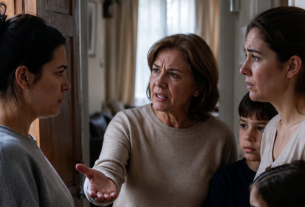
Lena thought she was marrying for love. Her older sister Vika thought otherwise. And she brought a flash drive to the wedding that changed everything.
Lena was ironing her dress on the balcony when Vika called.
“Are you absolutely sure?”
“Vik, we’ve already discussed this.”
“I don’t mean the wedding. I mean him.”
Lena hung up and ran the iron over the lace hem. Steam rose toward the ceiling and dissolved. Behind the wall, the television was on; Kostya was watching football, and every now and then a short “Come on, come on” could be heard from there.
She loved those evenings. Quiet, ordinary, about nothing. Kostya on the sofa, her on the balcony. Two years together, and not a single scandal. Her friends envied her.
The wedding was set for June. The Beryozka restaurant on Kashtanovaya Street, sixty guests, live music. Lena had been saving for it for a year and a half, putting aside twelve thousand from every paycheck. Kostya said he would contribute later, once he paid off the loan for his car. She nodded. She always nodded.
Vika was seven years older. She was one meter seventy-six tall, with broad shoulders and dark eyebrows that almost met at the bridge of her nose. Her voice was low, slightly hoarse, as if she had just woken up or had been silent for a long time. She spoke little, but once she started, it was impossible to stop her.
She worked as an appraiser at a real estate agency. Apartments, houses, and plots of land passed through her hands every day, and in twelve years she had learned to see right through people. Not because she was smarter than everyone else. Simply because she had a habit of listening not to the words, but to the pauses between them.
She had disliked Kostya from the very first meeting. Not because he was rude or behaved provocatively. On the contrary. He was too proper. He held out coats too perfectly on time, smiled too evenly, and agreed too quickly to move into Lena’s one-room apartment on Leningradskaya Street.
“He latched on to the apartment, not to you,” Vika once said.
“You’re paranoid.”
“I’m an appraiser. It’s a professional deformation.”
Lena laughed. Vika did not.
The apartment on Leningradskaya had come to them from their grandmother. More precisely, to Lena. Vika had given up her share five years earlier, when she bought herself a two-room apartment with a mortgage. She signed a waiver at the notary’s office, and since then the apartment had belonged entirely to Lena.
Forty-one square meters, third floor, windows facing the courtyard. Grandmother’s renovation: wallpaper with tiny flowers, linoleum the color of baked milk, a chandelier with three shades, one of which was always missing a lightbulb. Lena had never changed the wallpaper. It seemed to her that her grandmother was still there, in those walls, in the smell of cinnamon that would not leave the kitchen cabinet.
According to Vika’s latest appraisal, the market value was four million two hundred thousand. For their district, that was a lot. A new metro station, a park across the road, a school five minutes away.
Kostya moved in with her eight months after they met. He arrived with one suitcase and a box of tools. He fixed the faucet in the bathroom, hung up a shelf, and said:
“It’s good here. This is where we’ll live.”
Lena felt something warm spread inside her. She hugged him. He patted her on the back, the way people pat a child they are comforting.
Kostya’s mother, Galina Petrovna, gradually appeared in their lives. First came the phone calls. Three times a day, always to Kostya, never to Lena. He would go out to the balcony, speak quietly, then return and explain nothing.
Then came the visits. Once a week, on Saturdays. Galina Petrovna arrived with bags: jam, cutlets, socks for Kostya. For Lena, she brought remarks. Not rude ones, no. Careful ones, like pins.
“Your curtains are certainly interesting. Your grandmother’s?”
“Yes.”
“Well, your grandmother apparently liked that sort of thing. To each their own.”
Or:
“Do you cook borscht? Kostya is used to mine. I’ll write down the recipe for you, otherwise later he’ll be holding his stomach.”
Lena smiled and accepted the recipes. She cooked borscht her own way, but Galina Petrovna did not know that.
The woman was fifty-nine, short, about one meter sixty, plump, with a short perm and a habit of wearing burgundy. A burgundy cardigan, a burgundy bag, burgundy lipstick. She spoke quickly, swallowing her endings, and often did not finish her sentences, as if the person she was talking to was obliged to understand her from half a word.
“Well, you understand, Len. An apartment, after all…”
“What?”
“Well, it’s not new. Of course, it could use renovations. But I’m just saying, I’m not insisting.”
When Lena retold these conversations to Vika, Vika silently twirled a pencil between her fingers.
Three months before the wedding, Vika came to Lena’s without warning. It was around nine in the evening, a Tuesday. Kostya had gone to his mother’s to help with some pipes.
Vika sat down in the kitchen without taking off her jacket. Lena put the kettle on.
“I have an acquaintance, Seryozha. He installs video surveillance systems. He puts cameras in apartments and offices.”
“So what?”
“He told me something interesting.”
Lena turned around. Vika was looking at the table, at the pattern on the tablecloth, running her finger along the edge of a cup.
“Three weeks ago, Kostya called the New Home agency. He asked how much it would cost to appraise the apartment on Leningradskaya.”
“Maybe he wanted to find out for renovations. Insurance, a mortgage…”
“Len. He gave them the address. Your address. And asked how quickly a one-room apartment in your district could be sold.”
The kettle boiled. Steam burst from the spout and settled on the glass. Lena did not move.
“It could be a coincidence.”
“It could. Or it could not.”
Vika took her phone out of her bag, opened a recording, and pressed play.
Kostya’s voice, muffled, as if he were covering his mouth with his hand: “Mom, I found out. Four million and change. If we wait about three months after the wedding, we can list it. She won’t sign right away, but I’ll find the right approach.”
Galina Petrovna’s voice, clear and businesslike: “Three months is a long time, son. Start the conversation right after the registration. Gently. You know how. Say you want to expand, that a two-room apartment is better for a family, and that you should sell this one and add the money.”
“And what if she refuses?”
“She won’t refuse. You’ll be her husband. By law, half is yours.”
A pause. Rustling.
“Mom, premarital property isn’t divided by law.”
“And who’s going to enlighten that little fool? Her sister? By then, you’ll push the sister away from her. I’ll help.”
The recording cut off.
Lena stood by the stove. Her arms hung at her sides. The fingers of her left hand trembled slightly, and she clenched them into a fist, hiding it behind her back.
“Where did you get this?”
“Seryozha. Kostya called him to install a camera in his mother’s entrance hall. They got to talking, and Kostya made the call in front of him. Seryozha remembered it because he knows my last name. Then Kostya called him a second time, this time to Galina’s place, and while Seryozha was setting up the system in the hallway, they thought he had headphones on.”
“He recorded someone else’s conversation.”
“Yes. And gave it to me.”
“That’s illegal.”
“Selling someone else’s apartment through deception isn’t very legal either, Len.”
Lena sat down on a chair. The tablecloth under her elbows gathered into tiny folds. Water dripped from the faucet. One drop per second, evenly, like a metronome.
She did not talk to Kostya that evening. Nor the next day. He came home at ten, smelling of cigarette smoke and soup, kissed the top of her head, and went to bed. She lay beside him with her eyes open and listened to him breathe.
Even breathing. Calm. A person with a clear conscience does not breathe like that. A person who is sure everything is going according to plan breathes like that.
In the morning, she made coffee and thought. Her thoughts did not come in order, but in pieces, as if someone had cut up a film reel and glued it back together in the wrong sequence.
The first year. He brought her daisies, real ones from a field, with soil on the stems. She put them in a pickle jar and was happy.
The tenth month. He said, “Let me register at your place so the clinic will be nearby.” She agreed.
One year and two months. Galina Petrovna used the word “we” about the apartment for the first time. “It’s certainly cramped here for us.” Lena paid no attention.
One year and eight months. Kostya started talking about renovations. “Let’s at least redo the kitchen. I found out how much it costs.” Lena was glad: it meant he was settling in, it meant this was serious.
And now the recording. Kostya’s voice, quiet and calculating. Galina Petrovna’s voice, commanding. “Little fool.” That word lodged somewhere between Lena’s ribs and would not come out.
Vika called every day.
“Cancel the wedding.”
“I can’t. The restaurant is paid for. The dress is bought. The invitations have been sent.”
“Len, are you serious? The restaurant? That’s what you’re thinking about right now?”
“I’m thinking about the fact that if I cancel, I’ll have to explain. To Mom. To Aunt Sveta. To his relatives. To all sixty people.”
“And if you don’t cancel, you’ll marry a man who wants to sell your apartment.”
“Maybe he’ll change his mind. Maybe it was just a conversation.”
Vika fell silent. Lena could hear her breathing through the phone: slowly, with effort, as if she were holding something back.
“All right. You’re an adult. Decide for yourself.”
And she hung up.
But Vika did not know how to retreat. That was her main trait and her main problem. She did not know how to watch a person walk toward a cliff and stay silent.
Two weeks before the wedding, Lena found a printout on the kitchen table. Kostya had forgotten it under a newspaper. Or had not forgotten.
It was a commercial offer from the New Home agency. Appraisal of the apartment at 14 Leningradskaya Street, apartment 37. Market value: four million one hundred fifty thousand rubles. Recommended sale price: three million nine hundred thousand. Listing period: two to three months.
At the bottom of the page, in Kostya’s handwriting, was written: “Call after July 15.”
July 15. Three weeks after the wedding.
Lena folded the sheet in four and put it back under the newspaper. Her hands did not tremble. Something inside her became very quiet and very cold, like water in a well in winter.
She called Vika.
“You were right.”
“I know.”
“What should I do?”
“There are two options. First: you leave. Second: you make him leave.”
“Is there a third?”
Vika was silent for a moment.
“There is. But you won’t like it.”
The wedding was on Saturday. The sun beat down so hard that the asphalt in front of the Beryozka restaurant softened, and the guests’ heels left small dents in it. Lena stood by the entrance in a white dress with a lace hem, the same dress she had ironed on the balcony a month earlier. Kostya stood beside her in a blue suit, tanned and smiling. A beautiful couple.
Galina Petrovna arrived first. A burgundy suit, a burgundy bag, new earrings with stones that looked like garnets. She hugged Lena and said:
“Welcome to the family, my dear daughter.”
Lena caught the smell of her perfume: something sweet, heavy, with vanilla. The scent settled on her dress and stayed there until the end of the evening.
The guests took their seats. The tables were covered with white tablecloths, and in the center of each stood a small vase with field daisies. That had been Lena’s idea, like in their first month together.
Vika came in a dark blue dress, without jewelry, with a small bag across her shoulder. She congratulated Lena, hugged her briefly, and nodded to Kostya. He nodded back.
“It’s beautiful,” Vika said, looking around the hall.
“Thank you.”
“I’m serious. Very beautiful.”
She sat at table number three, closer to the exit. In her bag lay a flash drive.
The first two hours went like all weddings. Toasts, glasses, dancing, shouts of “Bitter!” Lena smiled, kissed Kostya, and accepted gifts. Envelopes, envelopes, one set of bed linens, more envelopes.
Galina Petrovna gave a toast. A long one, with a story about little Kostya, who at the age of five had said, “Mom, I’ll only marry the very best girl.” Everyone laughed. Lena did too.
The toastmaster announced a contest. Then another. Then the bride’s dance with her father, who was replaced by Uncle Sasha, because Lena’s father had left when she was eleven. Uncle Sasha smelled of cologne and wore shoes half a size too big, and they squeaked with every step.
And then the toastmaster said:
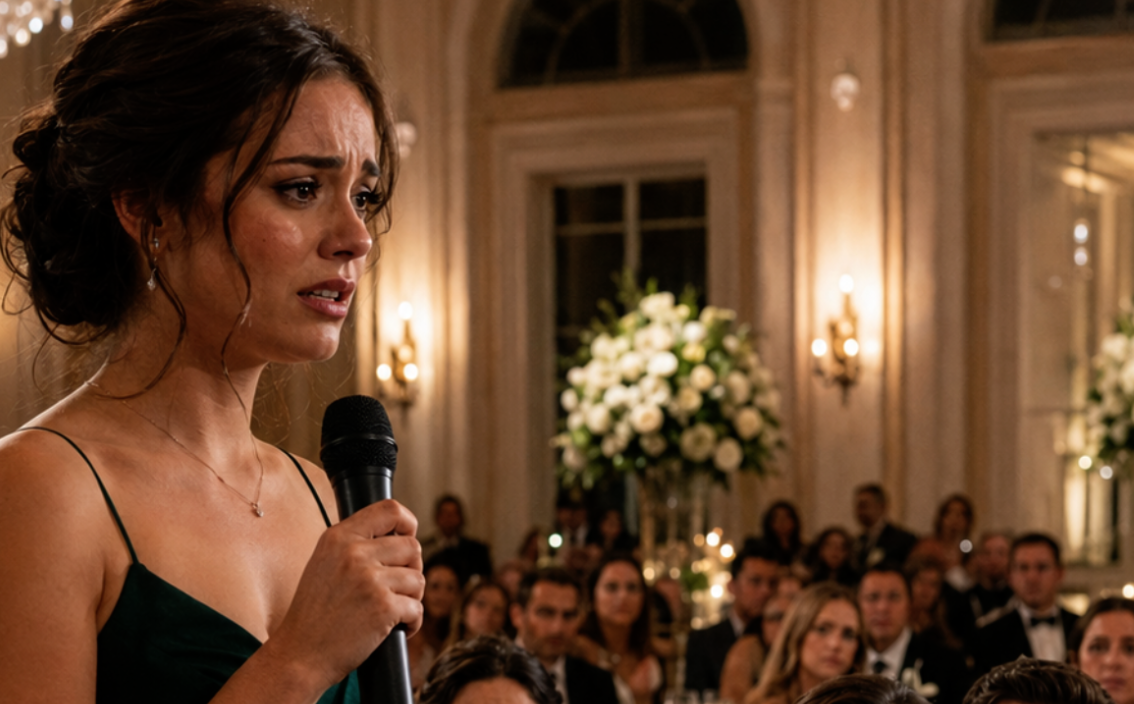
“And now the bride’s sister would like to say a few words.”
Vika stood up. The hall quieted a little. She walked over to the speaker, where the DJ’s laptop stood, and asked him for the microphone.
“I won’t take long,” she said. Her voice was even, slightly lower than usual. “I want to give my sister a gift. I want her to know who she is marrying.”
Lena sat at the head table. The fork in her right hand froze above her plate of salad. She looked at Vika. Vika was not looking at her. She was looking at Kostya.
“I’m not going to say pretty words. I’ll play a recording. Listen.”
She inserted the flash drive into the DJ’s laptop. The DJ, a young guy with a little beard and headphones around his neck, looked at her in confusion, then at the toastmaster, then at Lena. No one stopped her.
Sound came through the speakers.
First, rustling. Then Kostya’s voice, familiar, ordinary, domestic: “Mom, I found out. Four million and change.”
The hall did not understand right away. Someone continued eating. A woman in a green dress at the fourth table poured herself more wine.
But Kostya understood immediately. He went white. Not red, not sweaty. White, as if something holding his face together had been pulled out of him. His hands lay on the table, palms down, fingers spread, like a person trying to keep his balance.
“If we wait about three months after the wedding, we can list it.”
Now the hall was listening. Silence spread from table to table like a stain across a tablecloth. Lena’s mother, Tamara Ivanovna, who was sitting by the window, slowly lowered her glass.
“She won’t sign right away, but I’ll find the right approach.”
Galina Petrovna’s voice struck the hall: “Start the conversation right after the registration. Gently. You know how.”
Someone at the sixth table quietly whistled.
“And what if she refuses?”
“She won’t refuse. You’ll be her husband. By law, half is yours.”
A pause in the recording. A pause in the hall.
“Mom, premarital property isn’t divided by law.”
“And who’s going to enlighten that little fool?”
Lena closed her eyes. Around her was the hall, sixty people, the smell of roasted meat and flowers, music that someone had forgotten to turn off in the background, barely audible, something about love. She sat in a white dress at the head table and heard herself being called a little fool.
“By then, you’ll push the sister away from her. I’ll help.”
The recording ended.
The first three seconds after the silence were the longest in Lena’s life. Later, she would often remember them: the ticking of the wall clock above the bar, the smell of jasmine from the bouquet on the table, the way someone’s child called for their mother behind the partition.
Then Galina Petrovna stood up. Her chair rolled back and hit the wall.
“It’s fake! It’s spliced together! She set all this up!”
She pointed at Vika. Her finger trembled. Her burgundy lipstick was slightly smudged at the left corner of her mouth.
“Kostya! Tell them!”
Kostya sat still. He did not move. He stared at the plate where his crab-stick salad was growing cold. With the index finger of his right hand, he traced the rim of his glass, and the glass rang softly.
“Kostya!”
He raised his head. He looked not at his mother, but at Lena.
“Len, I…”
“Don’t,” she said.
Her voice was even. Her hands lay on her lap. She was not crying. She was not shouting. Something inside her had become so dense and heavy that there was simply no room left for tears.
“It’s taken out of context,” Kostya said. “We were just discussing options. Theoretically.”
“Was ‘little fool’ theoretical too?” Vika asked from beside the speaker.
Galina Petrovna grabbed her bag and headed for the exit. Halfway there, she turned around.
“You’ll regret this,” she said to Vika. “Both of you will regret it.”
The door did not slam behind her. It closed slowly, with the door closer, with a soft click.
The guests began to leave. Not all at once. First, Kostya’s relatives: his uncle, his cousin with her husband, his childhood friend Vitaly, who took a bottle of cognac from the table and left without a word.
Then Tamara Ivanovna’s neighbors. Then Lena’s colleagues. Each one came up and said something. Lena nodded. The words passed through her like water through a sieve.
The toastmaster packed up his equipment and left quietly, without even saying goodbye. The DJ handed the flash drive back to Vika and said:
“Powerful.”
Vika put the flash drive in her bag.
Kostya was still sitting at the table. The glass in front of him was empty. He had unbuttoned the top button of his shirt and was looking somewhere out the window, where someone in the parking lot was trying to drive out and could not pass another car.
Lena walked up to him. She stood opposite him. He raised his eyes.
“I really did want to live with you,” he said quietly.
“With me, or in my apartment?”
He did not answer.
“When did you start planning this?”
“It was my mother. She… she pressured me. She said a one-room apartment was too cramped for two people, that we had to think about the future, that the money from the sale…”
“When?”
“About six months ago.”
Lena nodded. Six months. For six months he had lain beside her, kissed her, said “good night,” and thought about how to list the apartment faster.
“Pack your things by Tuesday,” she said. “Leave the key with the neighbor. Aunt Nadya.”
“Len…”
“By Tuesday.”
She turned and walked toward the exit. Her heels clicked against the wooden floor. The sound was clear, rhythmic, like the steps of a person who knows exactly where she is going.
Vika was waiting for her on the porch. She was smoking, even though she had quit two years earlier. The cigarette was someone else’s; she had bummed it from one of the departing guests.
“Are you okay?”
“No.”
“That’s normal.”
They stood side by side. The sun was setting, and the sky above the rooftops had turned pink, so deliberately beautiful that Lena wanted to look away.
“You knew I wouldn’t cancel the wedding,” Lena said. It was not a question. It was a statement.
“I knew.”
“And you decided to do it yourself.”
“Not for you. For your sake.”
Lena leaned against the railing. The lace hem of her dress collected dust from the concrete porch. She did not care.
“Why like this? In front of everyone?”
“Because if I had shown it to you in private, you would have forgiven him. You would have found an explanation. You would have said, ‘He was just under his mother’s influence.’ And then a year later, you would have woken up and discovered that the apartment had been sold, that you were living in a rented room and cooking borscht according to Galina Petrovna’s recipe.”
Lena turned her head and looked at her sister. Fine wrinkles had appeared at the corners of Vika’s eyes over the past year. Her lips were pressed together. The cigarette had replaced the pencil she usually twirled in her fingers during meetings.
“You could have been wrong,” Lena said.
“I could have. But I wasn’t.”
Kostya moved out on Monday, one day before the deadline. He took his suitcase, the box of tools, and the set of bed linens that his aunt had given him at the wedding. He left the key with Aunt Nadya, as he had been told.
When Aunt Nadya handed the key to Lena, she said:
“He cried on the stairs. Stood there and cried for about five minutes.”
Lena took the key. The metal was warm from someone else’s hands.
“Do you want tea?” Aunt Nadya asked.
“No. Thank you.”
She entered the apartment. It was quiet. Kostya’s smell still lingered in the hallway, a mixture of shower gel and leather belt. His baseball cap was left on the coat rack, gray, with a worn brim. He had forgotten it. Or left it on purpose.
Lena hung the cap back up. Then took it down. Put it in a bag. Put the bag in the closet. Let it stay there.
In the kitchen, on the windowsill, stood a pickle jar. Empty. The daisies had dried long ago and been thrown out. For some reason, she had not put the jar away. Transparent glass, a trace of the label on the side, a small crack near the bottom.
She opened the window. The evening air smelled of cut grass and distant barbecue. In the courtyard, a boy of about ten was kicking a ball between puddles.
A week later, Galina Petrovna called. Lena saw the number and stared at the screen for a minute before answering.
“Lena, listen. I want to explain.”
“I’m listening.”
“I’m a mother. I was thinking about his future. About your future. It’s hard for two people in a one-room apartment, you understand that. I just wanted you to live better.”
“At my expense.”
“That’s not true! The money from the sale would have gone into the shared budget. You would have bought a bigger apartment, closer to the center, with a good renovation…”
“Galina Petrovna. You called me a little fool.”
Silence.
“I didn’t mean…”
“You meant exactly what you said. Goodbye.”
She pressed end call and placed the phone on the table, screen down. Her fingers were dry and calm. No trembling. Something had changed that week. Something had fallen into place, like a bone after a fracture: painful, but right.
Vika came on Saturday. With wine and pizza.
“How are you?”
“Strange. Quiet. Empty, but not bad.”
“It will pass.”
“The emptiness?”
“No. The strangeness. The emptiness won’t last long. Then it will fill up.”
They sat in the kitchen. Lena drank wine, Vika ate pizza, dropping cheese onto the grandmother’s tablecloth.
“People at work tell me I acted cruelly,” Vika said.
“And what do you think?”
“I think staying silent would have been cruel.”
Lena looked at her sister. At her broad shoulders, her dark eyebrows, her hands holding a slice of pizza as if it were the last food on earth. Vika always ate that way: greedily, quickly, without getting distracted. A habit from her student days, when lunch lasted fifteen minutes.
“You ruined my wedding.”
“Yes.”
“Thank you.”
Vika raised her glass.
“To Grandmother’s apartment.”
“To Grandmother’s apartment.”
They clinked glasses. The wine was cheap, tart, with a taste of cherry and something else Lena could not identify. Maybe it was the taste of freedom. Or maybe just tannin.
A month later, Lena sat on the balcony ironing laundry. The iron hissed, steam rose toward the ceiling. Behind the wall, it was quiet. No football, no “come on, come on.” A silence she was slowly getting used to, the way people get used to new shoes: at first they rub, then you stop noticing.
On the shelf by the mirror stood the pickle jar. Lena had put new daisies in it. Real ones from a field, with soil on their stems. She had picked them herself while driving back from her mother’s past a vacant lot.
She ran the iron over a pillowcase and looked out the window. Evening. Sunset. The boy in the courtyard was kicking the ball again.
The phone on the table vibrated. Vika.
“Have you had dinner?”
“Not yet.”
“I’m on my way. I’m bringing dumplings.”
“Store-bought?”
“How dare you. Aunt Sveta’s.”
Lena smiled. For the first time that day, but genuinely.
Steam from the iron settled on the glass of the balcony door, and a minute later it dried, leaving no trace.
Kostya’s baseball cap was still lying in the closet, in the bag. Lena knew it was there. Every time she opened the closet for towels, she saw the gray bag on the top shelf out of the corner of her eye.
She had not thrown it away. Not because she was waiting or regretting. She simply had not gotten around to it yet. Or something else had not gotten around to it, something that did not yet have a name.
But the jar on the shelf held flowers. And the key to the apartment lay in her pocket, warm, familiar, and hers alone.