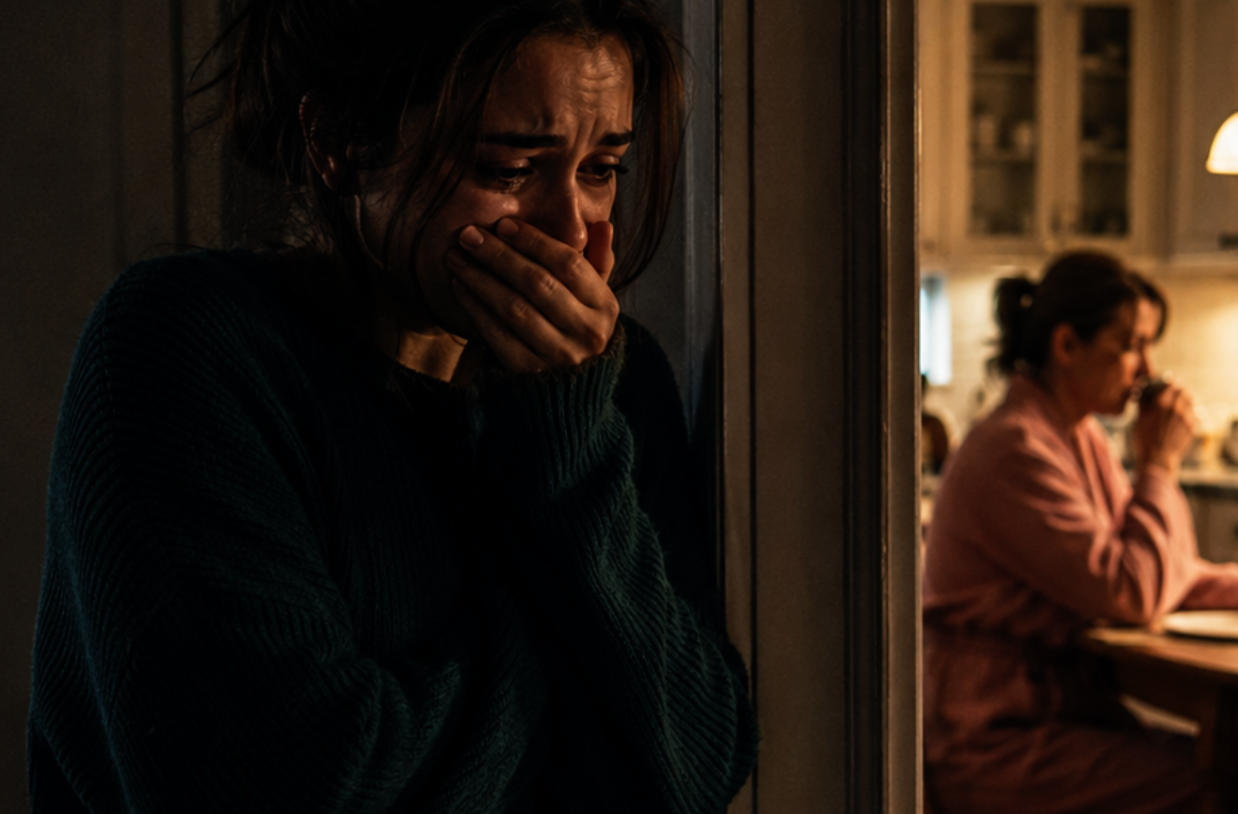
Marina accidentally heard something that was never meant for her ears. Her mother-in-law was talking to a lawyer about the apartment where the whole family lived. And Zinaida Pavlovna’s voice was calm and businesslike, like that of a person who had made up her mind long ago.
Marina heard it by chance. She was walking back from the bathroom, barefoot, across the old parquet floor, which usually creaked, but for some reason was silent that evening.
The kitchen door was slightly open. Zinaida Pavlovna sat with her back to the entrance, the phone pressed to her ear. Her voice was quiet and even. That was how people spoke to doctors—or to someone they paid by the hour.
“Yes, Igor Semyonovich, I understand everything. But I need the deed of gift to be completed by the end of the month. In Kostya’s name. Only Kostya’s.”
Marina stopped. Her toes pressed into the cold floor.
“No, the daughter-in-law is not involved. And she shouldn’t be. This is a family matter, you understand.”
Zinaida Pavlovna fell silent, listening to the answer. Then she nodded, although the person on the other end could not see her.
“All right. I’ll come by on Thursday. I have the documents with me.”
She hung up. Marina took one step back, then another, softly, hardly breathing. She went into the bedroom, closed the door behind her, and sat down on the edge of the bed.
Her hands lay on her knees. She stared at her fingers and could not understand why they looked so white.
The apartment belonged to her mother-in-law. A three-room apartment on Profsoyuznaya Street, with high ceilings and windows facing the courtyard. Zinaida Pavlovna had inherited it from her mother, and her mother had inherited it from her own mother, and so on, the way people pass down family silver or the habit of drinking tea at six in the evening.
Marina and Kostya had lived there for seven years. Since the day they got married. Their daughter Polina was five. She slept in the small room next to the kitchen, surrounded by pink walls and unicorn stickers.
Kostya worked as a manager at a logistics company. His salary was average, not enough for a separate apartment. They did not say that out loud. It was one of those things everyone knew but no one named.
Zinaida Pavlovna occupied the large room. She got up at six, cooked porridge, washed the hallway floor with a wet rag tied to a mop, and by eight she was already sitting in her armchair with a newspaper. She was sixty-two. Five feet two, thin, with short-cropped salt-and-pepper hair. Her eyebrows were thick and almost straight. When she was silent, it seemed as if she was thinking about something important. When she spoke, it turned out that she really was.
Marina got along with her. They were not friends, and they were not enemies. They simply got along—the way one gets along with the weather or the train schedule. Marina accepted her as a fact of life.
The next morning Marina behaved as usual. She made coffee, sliced cheese into thin pieces, and placed a bowl of porridge in front of Polina. Her mother-in-law sat opposite her, stirring her spoon in her cup. Tea without sugar, as always.
“Mom, are you going to the clinic today?” Kostya asked from the hallway while tying his shoelaces.
“On Thursday.”
“And today?”
“Today I’m staying home.”
He nodded and left. The door slammed shut. Polina lifted her head from her plate.
“Mom, why is Dad always in a hurry?”
“Work, sweetheart.”
“And you don’t have work?”
Marina did work. Remotely, from home, translating technical documentation from English. The pay was not much, but it was steady. After taking her daughter to kindergarten, she sat down at her laptop and worked until lunch. Sometimes longer.
Zinaida Pavlovna looked at her over her cup. Her gaze was sharp and quick, like a bird’s.
“You’re pale.”
“I didn’t sleep well.”
“Open the window at night. It’s stuffy.”
Marina nodded. She cleared the dishes, wiped the table, got Polina ready, and took her to kindergarten. On the way, she thought about what she had heard the night before. Every word stood separately in her head, like a nail driven into a board.
Deed of gift. In Kostya’s name. Only Kostya’s. The daughter-in-law is not involved.
She did not call her husband. She did not google “wife’s rights when an apartment is gifted.” She did not cry, scream, or demand answers. Instead, she took her daughter to kindergarten, returned home, sat down at her laptop, and opened her work file.
The translation was about industrial ventilation systems. Words lined up into sentences, sentences into paragraphs, paragraphs into pages. She translated and thought.
They had lived in that apartment for seven years. They had renovated it with their own money. They had completely redone the kitchen: tiles, backsplash, a stone countertop that Kostya had ordered from a workshop on the outskirts of town. Twelve car trips, because the craftsman kept mixing up the measurements.
The bathroom too. And they had glazed the balcony. Marina had been pregnant with Polina then, and her mother-in-law had said, “Glaze it. It’s drafty in winter. It’s not good for the baby.”
So they glazed it. With their own money. Kostya took out a small loan and paid it off in six months.
And now the apartment, into which they had poured money, time, and nerves, was supposed to become a gift. To Kostya. Only to Kostya.
Marina closed the ventilation file. She opened a new tab and typed: “division of property in divorce if apartment is gifted to one spouse.”
Her fingers trembled slightly over the keyboard.
She read for two hours. The law was as clear as glass: gifted property is not divided. If Zinaida Pavlovna transferred the apartment to Kostya as a gift, it would become his personal property. In a divorce, Marina would receive nothing. Not a single meter, not a single ruble in compensation for the renovations, unless she could prove the investment.
And proving it would be difficult. Receipts from seven years ago—who keeps those? Kostya had paid in cash. The craftsman on the outskirts of town was unlikely to remember who ordered a countertop in 2019.
Marina got up and walked to the window. Children were playing in the courtyard, someone’s dog was barking at pigeons, and an old woman on a bench was eating ice cream. An ordinary day. An ordinary world in which she had just realized she was standing on thin ice.
She was not planning to get divorced. She had not thought about it. Kostya did not drink, did not hit her, did not cheat on her. Or she did not know. But this was not about divorce. It was about the fact that her mother-in-law, calmly and efficiently, was removing her from the equation. Like an unnecessary variable.
That evening Kostya came home at eight. He took off his jacket, hung it on the hook, and sat down at the table. Marina placed a plate of cutlets and buckwheat in front of him. Polina was already asleep.
“Tired?”
“I’m fine. What’s wrong with you?”
“What do you mean?”
“You’re quiet.”
She sat opposite him and looked at him. A round face, short stubble, ears slightly sticking out. Kind eyes, a little sleepy. He was thirty-six, and he looked exactly thirty-six: not older, not younger. A man who went to work every day, came home, ate dinner, and went to bed. And had no idea his mother was calling a lawyer.
Or did he?
“Kostya, do you know anything about the apartment?”
“What apartment?”
“This one.”
He lifted his head from his plate. His fork froze halfway to his mouth.
“What do you mean?”
“Did your mother talk to you? About registering documents, paperwork, anything like that?”
He was silent for one second. Then two. Marina counted.
“She did,” he said, putting down his fork. “She wants to transfer the apartment to me as a gift. So there won’t be problems later. With inheritance and all that.”
“And me?”
“What about you?”
“Where am I in this arrangement?”
Kostya looked at her as if she had asked what color the sky was.
“Marish, it’s Mom’s apartment. She has the right.”
“I’m not asking about her rights. I’m asking about mine.”
Silence settled between them like a tablecloth on the table. White, smooth, with invisible folds.
“Why are you making trouble? We’re family.”
“Exactly.”
She got up and went to the bathroom. She turned on the water. Not because she wanted to wash her hands, but because she needed a sound loud enough to drown out everything else.
The next day, while Zinaida Pavlovna was at the store, Marina called her friend. Lena worked as a lawyer at an insurance company—not exactly in that field, but she had a clear head.
“Lena, I need legal advice.”
“For work?”
“For life.”
She told her everything. Lena listened silently, without interrupting. That was one of the qualities Marina valued in her: the ability to listen until the very end.
“All right,” Lena said when she finished. “If the deed of gift is executed, the apartment becomes your husband’s personal property. That’s Article 36 of the Family Code. In a divorce, there is nothing to divide.”
“And the renovations? We invested in them.”
“You can try to prove a significant improvement of the property using marital funds. Article 37. But it’s difficult. You need receipts, contracts, witnesses. And even with them, the court may refuse.”
“And if I’m not getting divorced?”
“Then formally nothing changes. You live as you lived. But the apartment is not yours. If something goes wrong, you’re out on the street. With a child.”
Marina was silent. Something rustled on the other end of the line. Lena was probably moving papers around.
“Marish, I don’t want to scare you. But you need to think two steps ahead. This is not about trust. It’s about security.”
“What should I do?”
“First, gather every renovation document you can find. Receipts, card statements, messages with contractors. Anything that confirms the investments. And think about a prenuptial agreement.”
“Kostya won’t agree.”
“Then think about what that means for you.”
Marina hung up. Outside, rain was falling. Fine and quiet, as if someone were scattering grain across the windowsill.
She began looking for documents that same day. She opened the box on the mezzanine shelf, the very box where she kept everything “just in case.” It was a blue boot box with worn corners.
Inside was the contract for glazing the balcony. With a stamp, a signature, and an amount. One hundred forty thousand rubles, 2019.
A bank statement from April of that same year. A transfer to the craftsman’s card: twenty-eight thousand. It had been part of the payment for the kitchen.
Messages with the countertop craftsman. Marina found them on an old phone lying in a dresser drawer. The screen was cracked, but it still turned on. She scrolled through the messages: measurements, color, price, delivery date.
There were also photographs. Before and after the renovation. She had photographed every stage: bare walls, torn-up linoleum, new tiles, electrical outlets Kostya installed himself—crookedly, but installed.
Marina put everything into a folder. A yellow folder with a snap button. The kind sold in stationery shops for a hundred rubles. She placed the folder in the drawer of the bedroom desk, under a stack of bed linen.
Her heart beat evenly. Her hands did not tremble. She was doing what had to be done, and she was surprised by how simple it was when you understood why you were doing it.
Zinaida Pavlovna returned from the store with two bags. Milk, bread, chicken thighs, onions. She put the bags on the table and began unpacking.
“I’ll make soup,” she said without turning around. “Chicken soup. Polina likes it.”
“Thank you.”
Marina sat at her laptop, pretending to work. The screen glowed with text about air ducts and filtration systems. Her mother-in-law moved around the kitchen with familiar precision, like a metronome. The knife tapped against the cutting board: tap, tap, tap.
“Marina.”
“Yes?”
“When did you last visit your mother?”
“Last month. Why?”
“No reason. Just asking.”
Marina looked at her. Zinaida Pavlovna was peeling an onion, and her eyes were watering. But her hands did not stop. The knife moved accurately, confidently, without a single unnecessary motion.
Marina thought: that was exactly how she dealt with the lawyer. Accurately, confidently, without unnecessary motion. She decided, called, arranged a meeting. As simple as peeling an onion.
She felt cold, although the kitchen was warm from the stove.
On Wednesday evening Marina approached Kostya again. Polina was drawing in her room, and her mother-in-law was watching television.
“We need to talk.”
“About the apartment again?”
“Yes.”
He sat on the sofa and crossed his arms over his chest. A gray T-shirt with a coffee stain on the stomach. Marina sat beside him, but not too close.
“I want us to sign a prenuptial agreement.”
Silence. Behind the wall, the television muttered something about harvests and subsidies.
“Why?”
“Because if your mother transfers the apartment to you as a gift, I will be left with nothing. If anything happens.”
“If anything happens? Are you planning to divorce me?”
“No. But I want to know that my child and I are protected.”
Kostya rubbed his forehead. It was a habit he had had since youth: whenever he was nervous, he rubbed his forehead with his right hand, from temple to temple.
“Marish, that’s kind of… I don’t know. Ugly.”
“What’s ugly is that your mother is calling a lawyer and discussing how to remove me from the equation while I stay silent.”
“She’s not removing you. She’s just…”
“What?”
“Protecting the family.”
“I am the family. Or am I not?”
He did not answer right away. And that pause said more than any words. Two seconds, three, four. Marina counted. On the fifth, she stood up.
“Think about it. I’m serious.”
She went into the bedroom and lay down on the bed without undressing. The ceiling was white, with a crack in the corner. The crack had appeared two years earlier, after the neighbors upstairs flooded them. Marina remembered Kostya standing on a stepladder and covering it with putty. It had not helped. The crack had appeared again, like all cracks do.
On Thursday morning Zinaida Pavlovna dressed more carefully than usual. A gray suit, which she wore to Polina’s parent-teacher meetings and to funerals. Black low-heeled shoes. A bag with documents.
“I’m going out on business,” she said from the hallway.
“All right,” Marina answered from the kitchen.
The door closed. Marina stood by the window and watched her mother-in-law cross the courtyard. A straight back, a determined step. Her bag swung in rhythm.
She was going to the lawyer. To Igor Semyonovich. To arrange the deed of gift.
Marina picked up the phone and called Lena.
“She left. To the lawyer.”
“Did you gather the documents?”
“Yes.”
“Then listen. There is another option. You can submit a request to Rosreestr to prohibit registration actions with the apartment without your consent. As a person registered at that address and as the legal representative of a minor child.”
“Is that legal?”
“It’s not a ban on gifting the apartment. It’s a statement that there is an interested party. It can delay the process and give you time to negotiate. It’s not one hundred percent protection, but it’s better than nothing.”
“And if she transfers it anyway?”
“Then you go to court. With the renovation documents, photographs, and bank statements. You prove a significant improvement using marital funds. It will be long and not guaranteed, but there is a chance.”
Marina was silent. Outside the window, sparrows were fighting on a poplar branch. Small, gray, angry.
“Lena, I don’t want to fight with my mother-in-law.”
“She’s already fighting with you. Just quietly.”
Marina went to the multifunctional public services center that same day. She left Polina with their neighbor, Olga Nikolaevna, a pensioner who was always happy to help.
The center smelled of paper and something sour, like a school cafeteria. The line moved slowly. Marina sat on a plastic chair, holding the yellow snap-folder on her knees.
When her turn came, she explained the situation calmly, point by point. The employee, a woman of about forty-five with tired eyes and a pen tucked behind her ear, listened attentively.
“We can accept a statement from an interested party. But you understand that this does not block the transaction?”
“I understand.”
“All right. Fill this out.”
Marina filled out the form. Her handwriting was even, the letters the same size. She had always written neatly, even in school. Her Russian teacher used to give her a separate grade for penmanship.
She handed in the form. Received a receipt. Stepped outside, and the sun hit her eyes so sharply that she squeezed them shut. She stood for a moment, adjusting. Then she walked toward the bus stop.
That evening Zinaida Pavlovna returned. She took off her shoes in the hallway and placed her bag on the small cabinet. Her face was calm, without a trace of worry.
“Should I warm up the soup?”
“I’ve eaten,” her mother-in-law answered. “Put the kettle on.”
Marina put on the kettle. Took out two cups. Her mother-in-law sat at the table and folded her hands in front of her. Long fingers, neat nails. A wedding ring on her right hand, although her husband had died eleven years ago.
“Marina, sit down.”
She sat.
“Rosreestr called me today.”
The air in the kitchen became thick, like cotton wool. The kettle began to hiss, and the sound filled the whole space.
“They said a statement had been filed. By you.”
Marina looked her in the eyes. She did not look away. It took effort, because Zinaida Pavlovna’s gaze was heavy. Not angry, exactly—heavy, like a stone at the bottom of a river.
“Yes. By me.”
“Why?”
Marina picked up a cup, although the tea was not ready yet. She simply needed to hold something in her hands.
“Because I heard your conversation with the lawyer. On Monday evening.”
Her mother-in-law did not flinch. Did not turn pale. She only blinked a little more slowly than usual.
“You were eavesdropping?”
“The door was open. I was coming from the bathroom.”
“And what did you hear?”
“A deed of gift to Kostya. Only to Kostya. The daughter-in-law is not to know.”
Zinaida Pavlovna stood up, went to the kettle, and turned it off. She poured boiling water into the cups. Her movements were precise, as always. Not a single unnecessary gesture.
“You misunderstood.”
“What exactly did I misunderstand?”
“I am not against you. I am for my son.”
Marina gripped the cup with both hands. The porcelain was hot, almost burning.
“And in your opinion, am I against him?”
Her mother-in-law sat down and looked out the window. Darkness was settling behind the glass, and the courtyard lamp blinked yellow.
“Marina, I lived with my husband for thirty-four years. He was a good husband. He died, and the apartment remained. It is the only thing I have. I want it to go to my son. That is normal.”
“What would have been normal is talking to me.”
“Why? You would have argued.”
“I would have talked. Those are different things.”
They sat opposite each other while the tea cooled in the cups. Polina was asleep in her room. Kostya was not home yet; he had been delayed at work.
Zinaida Pavlovna was silent for a long time. Then she said:
“My friend Tamara’s daughter got divorced. Her husband sued for half of the apartment Tamara had gifted. She registered her son-in-law there, gifted it to both of them, and then he left and took his share. Tamara is seventy-one. She lives in a one-room apartment on the outskirts now.”
“I understand.”
“No, you don’t. You’re young. You think everything will be fine. I know that anything can happen.”
Marina placed the cup on the table carefully, without a sound.
“Zinaida Pavlovna, I am thirty-four years old. I have a daughter. I have lived in this apartment for seven years. I have put money, time, and my own hands into it. I am not asking for half. I am asking not to be erased.”
“No one is erasing you.”
“A deed of gift only to Kostya is erasing me. If something happens tomorrow, Polina and I are on the street.”
“Nothing will happen.”
“You said it yourself: anything can happen.”
Her mother-in-law looked at her. And for the first time, Marina saw not stubbornness in those eyes, but confusion. It flashed and disappeared, like a ripple on water.
“What do you suggest?”
“A prenuptial agreement. Between Kostya and me. It should state that in the event of divorce, I have the right to compensation for the investments made in the apartment. A specific amount, supported by documents.”
“That is…”
“That is fair. And it protects everyone. You, Kostya, me, and Polina.”
Zinaida Pavlovna said nothing. The clock on the wall ticked. The kitchen faucet dripped: drip, drip, drip. Marina heard every sound separately, like notes.
Kostya came home at nine. Marina met him in the hallway.
“We need to talk. The three of us.”
He looked at her, then at his mother, who was standing in the kitchen doorway.
“What happened?”
“Sit down.”
They sat at the table. Three cups, three people, one apartment.
Marina spoke first. Calmly, without accusations, only facts. She told them what she had heard, what she had done, and what she proposed. She placed the yellow folder on the table.
Kostya listened, and his face changed. First surprise, then confusion, then something that looked like shame.
“Mom, did you really call a lawyer?”
Zinaida Pavlovna nodded.
“And you didn’t tell me?”
“I was going to.”
“When? After everything was registered?”
She did not answer. And that silence was the answer.
Kostya looked at Marina. At the folder. At his mother.
“Marish, I didn’t know.”
“You knew. You told me yourself that your mother wanted to transfer the apartment to you. You just didn’t think about what that meant for me.”
“I thought we were family.”
“Family is when you don’t have to protect yourself from each other.”
He lowered his head. He rubbed his forehead, from temple to temple.
The conversation lasted two hours. Sometimes everyone spoke at once. Sometimes they were silent so long that Polina could be heard talking in her sleep in the next room.
Zinaida Pavlovna did not give in easily. She gave examples from the lives of friends, from television, from newspapers. Every example ended the same way: a woman left and took half.
Marina listened and answered the same thing each time.
“I am not planning to leave. But if you are afraid, let’s write it into the agreement. Specifically, legally, on paper. Then everyone is protected.”
Kostya was silent for most of the conversation. Then he said:
“Mom, she’s right.”
Zinaida Pavlovna looked at her son for a long time, as if seeing him for the first time.
“Are you on her side?”
“I am not on anyone’s side. I want this to be fair.”
He turned to his wife.
“Marish, find a lawyer. A proper one, not from the internet. We’ll discuss everything and sign it.”
Marina nodded. Her throat tightened, and she took a sip of cold tea so it would not show.
On Friday morning Zinaida Pavlovna was making porridge. Marina entered the kitchen, and they looked at each other in silence. Neither of them smiled.
“The porridge will be ready in five minutes,” her mother-in-law said.
“Thank you.”
Marina sat at the table, in the place where she always sat. Sunlight fell across the countertop—the same stone countertop they had ordered from the workshop on the outskirts of town. Twelve trips. She remembered every one.
Polina came running in barefoot and climbed onto a chair.
“Grandma, with raisins?”
“With raisins, sweetheart.”
An ordinary morning. Ordinary words. But something had shifted. It had not gone away, had not disappeared—just shifted, like furniture after a renovation. Everything seemed to be in place, but you walked differently.
A week later, they were sitting in a lawyer’s office. A small office on the first floor of a residential building, with a sign that read: “E. V. Kozlova, Family Law.” Elena Viktorovna, a woman of about fifty in thin-framed glasses, spoke clearly and without unnecessary words.
“So the situation is as follows. The owner wants to transfer the apartment to her son as a gift. The daughter-in-law is asking for guarantees of compensation for investments in the event of divorce. Correct?”
“Correct,” Kostya said.
Zinaida Pavlovna sat straight, her bag on her knees, her face like stone.
“The best option is a prenuptial agreement specifying the list of improvements made to the apartment and their value, supported by documents. In the event of divorce, the wife receives compensation equal to half the cost of those improvements. The apartment remains with the husband as gifted property.”
Marina took out the yellow folder and placed it on the table.
“Here is the contract for glazing the balcony, a bank statement, messages with the craftsman, and before-and-after renovation photographs.”
The lawyer opened the folder and looked through the documents.
“This is good. This is substantial. We can work with this.”
Zinaida Pavlovna looked at the folder. At the yellow cardboard, at the snap button, at the neatly folded papers. And Marina saw her mother-in-law tilt her head slightly. Not a nod. Just a tilt. As if something heavy she had been holding up had lowered a little.
“I agree,” Zinaida Pavlovna said. “Prepare it.”
The agreement was drafted in ten days. Marina reread every clause three times. Kostya signed without arguing. Zinaida Pavlovna came to the notary in the same gray suit.
The deed of gift was completed at the beginning of the following month. In Kostya’s name. As planned.
The prenuptial agreement lay in a safe deposit box that Marina rented in her own name. She kept the key in her wallet, in the small pocket for coins.
Life did not change. Morning, porridge, kindergarten, work, dinner, sleep. Polina grew, drew unicorns, learned letters. Kostya went to work and came home. Zinaida Pavlovna cooked soup and washed the floor.
But Marina now knew: beneath this ordinary life, there was a foundation. Not concrete, not eternal, but paper. Fragile, like everything made by people. But it was her foundation.
One day, a month after everything had been completed, Zinaida Pavlovna stopped her in the hallway. She simply touched her elbow.
“Marina.”
“Yes?”
“Well done.”
And she went into her room. The door closed quietly, without a click.
Marina stood in the hallway. Barefoot on the old parquet floor. The same floor that usually creaked.
It creaked.
She smiled. Just a little. And went to the kitchen to put on the kettle.
The folder was in the safe deposit box. The key was in her wallet. The crack in the ceiling showed through the putty.
And the kitchen smelled of chicken soup. It was the smell of the home she lived in. Not someone else’s. Not temporary. Her own.