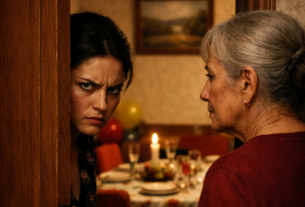
“So, are you stupid, or are you just pretending?”
That was the first thing Ilya said when he walked into the apartment. Not “hello,” not “how are you” — just that. He threw his jacket at the coat rack, missed, and the jacket slid onto the floor. He did not even look at it.
Ksyusha was standing by the stove, stirring something in a pot, lost in her own thoughts. She was thinking about the fact that tomorrow she had to make the next mortgage payment. Twenty-seven thousand. And she had exactly twenty-nine thousand on her card.
“What are you talking about?” she asked calmly, although there was no calm inside her at all.
“I’m talking about you calling my mother and saying something to her about money. Why?”
Ksyusha turned around. Ilya was standing in the middle of the kitchen — tall, with that permanent crease between his eyebrows that, in recent months, seemed never to smooth out anymore.
“I didn’t call your mother,” she said. “I sent you a message. About the mortgage. You didn’t answer.”
He grimaced, as if she had said something unpleasant.
“Then don’t stick your nose where it doesn’t belong.”
They had married four years earlier. Back then, everything had seemed right, the way it was supposed to be. Ilya worked as a foreman for a construction company, earned good money, and knew how to speak beautifully. Ksyusha worked at the tax office — not romantic, but stable. They took out a mortgage on an apartment. Their apartment, as they used to say back then. Our apartment.
The first year, everything went normally. They paid together, honestly. Then something began to shift — quietly, like furniture being moved one centimeter at a time. Ilya started saying more and more often that “the money was gone.” That “this month it isn’t working out.” That “Mom asked for help, you understand.”
Ksyusha understood. Her mother-in-law, Nina Anatolyevna, lived alone, her pension was small — how could they not help? Ksyusha herself suggested it: let’s chip in for groceries, let’s go visit, let’s help.
But visiting never worked out. For some reason, Nina Anatolyevna was always busy. “Not now,” “another time,” “Oksana and I are tired.”
Oksana was Ilya’s sister. Thirty-two years old, and she refused to work on principle. She said she was “finding herself.” She lived with her mother. She ate, slept, and scrolled through something on her phone.
Everything came out by accident — as usually happens.
Ksyusha went to the bank to renew the mortgage insurance. The manager — a young woman named Vera, very attentive — opened the system and suddenly said:
“Wait, there’s something interesting here. Are you aware that for the last eight months, the payment has been coming from only one card? Yours.”
“What?”
“Well, look.” Vera turned the monitor toward her. “Initially, there were two payers, but since March of last year, it has only been you. Your husband made his last payment in February.”
Ksyusha stared at the screen and could not immediately understand what exactly she was seeing. Numbers, dates, columns. Eight months. Twenty-seven thousand a month. Only her.
“Could it just be showing that way technically?” she asked.
“No,” Vera said gently but firmly. “These are real transactions. The money comes from your account. No one else’s.”
Ksyusha rode home on the metro, staring at her hands. Ordinary hands, a little tired — she had been typing all day. On her ring finger was the ring Ilya had placed there four years ago with such a serious expression, as if it had been the most important moment of his life.
Eight months.
She counted in her head. Twenty-seven times eight — two hundred sixteen thousand. Two hundred sixteen thousand rubles. She had paid it alone while thinking they were paying together.
And where had his half gone?
That question spun inside her all evening — while she cooked, while Ilya sat in front of the television, while they ate dinner in silence, each thinking their own thoughts. She did not ask. Not yet. She did not know how. She was not ready for what he might answer.
The answer came on its own a week later.
Ksyusha stayed late at work and was coming home late. The bus was taking too long, so she got off early and decided to walk through the park. And there, by the café on the corner of Ozyornaya Street, she saw Nina Anatolyevna.
Her mother-in-law was sitting at a table on the terrace — wearing a new, obviously expensive coat, with a glass of wine in front of her. Beside her was Oksana, in a jacket with a fur collar, laughing at something on her phone. On the table were plates, appetizers, everything beautifully arranged.
Ksyusha stopped.
Nina Anatolyevna did not notice her. In general, she rarely noticed her daughter-in-law — she looked through her as if through glass. But now she was animatedly telling her daughter something, gesturing, smiling. A completely different person — not the gloomy woman who, at rare family gatherings, pursed her lips and tossed out a brief, “So, how are things with you?”
Ksyusha took out her phone. She took a picture — just like that, almost automatically. Then she went home.
That same night, she opened their shared banking archive. They had once connected joint access to their transfer history, and Ilya seemed to have forgotten about it. Or he had not thought she would look.
But she did look.
The picture was clear, like a table in a report. Every month — a transfer. Fifteen, sometimes eighteen thousand. To Nina Anatolyevna’s card. Regularly, like a salary. At the same time, there was the mortgage, which Ksyusha had been covering alone.
She sat and looked at those numbers for a long time. Outside the window, the city hummed — cars, someone’s voices below, distant music. Ilya was asleep in the bedroom.
He had been feeding them. His mother and sister. While she dragged the mortgage on her shoulders.
There was no anger yet. There was something else — cold, sharp, very calm. As if something inside her had switched to another mode.
She copied all the statements. Saved the screenshots. Wrote Vera from the bank a short message: “Can we meet again? I need a consultation about the documents.”
The reply came a minute later: “Of course. Tomorrow at 10?”
Ksyusha wrote: “Yes.”
She closed her phone. Lay down. She did not sleep for a long time — just lay there, listening to Ilya breathe in the dark. Evenly, deeply, without the slightest worry.
It’s all right, she thought. Let him sleep. Morning will be interesting.
Vera turned out to be exactly as Ksyusha remembered her — attentive, without unnecessary words. She listened, looked at the screenshots, and nodded.
“This can all be formalized as documentary confirmation of unequal participation in repaying the loan,” she said. “If it goes to court, you have a strong position. Eight months, all recorded in the system.”
“And if I want to divide the apartment?”
Vera was silent for a moment.
“Then you need a lawyer. But honestly, in cases like this, the bank usually sides with the person who paid. And you paid.”
Ksyusha left the bank and stopped on the steps. The city buzzed around her — trolleybuses, people with coffee, someone’s dog pulling its leash toward the grass. An ordinary morning. And inside her, something was slowly but irreversibly falling into place.
She found a lawyer through a colleague at work. His name was Anton Sergeyevich — around forty-five, quiet, with a habit of looking slightly to the side when he was thinking. He received her in a small office on the second floor of a business center, where it smelled of coffee and old folders.
Ksyusha laid everything out — the bank statements, screenshots, the photo from the café. Anton Sergeyevich looked through it all for a long time, turning pages, occasionally making notes with a pencil.
“So the apartment is registered to both of you?” he clarified.
“Yes. Joint ownership.”
“And the mortgage is in both your names?”
“Yes. But I was the only one paying for the last eight months.”
He nodded.
“This is called unjust enrichment at the expense of a spouse. In your case, it is very clear. Bank statements are the best evidence one can imagine. Judges like numbers.”
“And the transfers to my mother-in-law?”
“That is a separate matter. If we prove that it was systematic — and you already have, here they all are — it can be qualified as spending joint funds without the spouse’s consent.” He put the pencil down. “Tell me, do you want a divorce now, or just compensation?”
Ksyusha answered without thinking.
“First, the truth. Then we’ll see.”
She returned home around lunchtime. Ilya was already there — unexpectedly, since he usually appeared in the evening. He was sitting in the kitchen, eating cold chicken straight from a container. He saw her, nodded, and stared back down at his plate.
“You’re early today,” she said.
“We finished the site. They let us go.”
Ksyusha put the kettle on and took out a mug. She could feel his gaze on her back — he glanced over from time to time, as if checking something.
“Listen,” he suddenly said, “Mom asked me to help at the dacha this weekend. Fix the fence and some other things.”
“Mm-hmm,” Ksyusha said.
“You could come too. Since, you know.”
She turned around. Looked at him calmly, attentively. For some reason, he looked away.
“No,” she said simply. “I won’t be able to.”
He did not ask why. And that, too, said a lot.
The unexpected turn came on Thursday.
Ksyusha was coming home from work, riding up in the elevator, thinking about her own things, when she saw an email on her phone from an unfamiliar address. Subject: “You need to know this.”
She opened it right there in the elevator.
“Hello. My name is Svetlana. I work as an accountant at the company where your husband works. We do not know each other, but I have wanted to write to you for a long time. I know this is none of my business. But I went through this myself — and back then I stayed silent, and I regret it very much. Since last year, your husband has been receiving part of his salary unofficially. In cash. It is about a third of his real income. I cannot sign my name — you understand why. But if necessary, I will find a way to confirm it.”
The elevator opened. Ksyusha stood inside and did not get out until the doors closed again and the cabin began to go back down.
She reread the email three times.
Unofficial part. In cash. A third of his income.
That meant what she had seen in his official transfers to his mother-in-law was not even the whole picture. There was another hidden part. One he had buried deeper.
How much in total had gone there — to his mother, to his sister, to their dacha with barbecues and a pool?
Ksyusha got off on her floor, walked to the door, and stopped. Behind the door was Ilya. She could hear the television.
She did not go in right away — she stood in the hallway, leaning against the wall. She took out her phone and forwarded the email to Anton Sergeyevich with a short comment: “New circumstances. Call me when you can.”
The reply came eight minutes later: “Seen. This changes the situation. Tomorrow at 9, if you can.”
She wrote: “I can.”
She put her phone away. Exhaled. Only then did she open the door.
Ilya was sitting in front of the television in old sweatpants, drinking beer. He glanced at her.
“What took you so long?”
“I was held up,” she said.
“Will there be dinner?”
Ksyusha went into the kitchen and opened the refrigerator. She looked at the shelves and saw nothing. One thought spun in her head: he lives here, eats, drinks beer, asks about dinner — and all this time…
“I’ll heat up yesterday’s food,” she said evenly.
“Fine.”
That was the whole conversation. Four years of marriage — and that “fine,” tossed at her back while he stared at the screen again.
Ksyusha put the container into the microwave. She watched the plate spinning inside and thought that tomorrow at nine in the morning, Anton Sergeyevich would tell her what to do next. And now she had more than bank statements.
She had a witness.
One Ilya did not know about.
Anton Sergeyevich met her with papers already printed out on his desk.
“Here is how it is,” he said without preamble. “The unofficial part of the salary is serious. If Svetlana agrees to give testimony, even in writing, we have grounds to demand a division of property based on his real income, not what he shows on paper. Plus the eight months of mortgage payments — that was your money, Ksenia. The court will see it.”
“When should we file?” she asked.
“The sooner, the better. Before he suspects anything.”
Ksyusha nodded. Inside, there was a strange feeling — not fear, not anger. Something like determination. Cold, even, like ice underfoot.
She filed the petition on Friday. She said nothing to Ilya.
On Saturday, he left for his mother’s place — to help with the fence, as planned. He left in the morning, cheerful, with tools in the trunk. He kissed her on the temple — automatically, out of habit. She smiled — also out of habit.
When the door closed behind him, Ksyusha sat down in the kitchen and, for the first time in several weeks, felt that she could simply breathe.
She made coffee. Opened the window. Watched the street — passersby, children on bicycles, someone walking a red dog. An ordinary Saturday. And inside her, something was ending. Slowly, but finally.
The summons arrived for Ilya on Tuesday.
Ksyusha was at work when he called. She saw his name on the screen and answered calmly.
“What is this?” His voice was sharp, somehow unfamiliar. “You filed for divorce?”
“Yes.”
“Without a conversation? Just like that?”
“There was a conversation. Several times. You didn’t hear it.”
He was silent. Then:
“You don’t understand what you’re doing.”
“I understand perfectly well,” she said. “Anton Sergeyevich explained everything in detail.”
Another pause. A long one.
“What Anton Sergeyevich?”
“My lawyer,” Ksyusha said. “Goodbye, Ilya.”
And she hung up.
Nina Anatolyevna appeared two days later. She called herself — something she had never done in four years. Her voice was sweet, almost affectionate, which was strange in itself.
“Ksyushenka, why are you doing this? Why take it to court? We’re family. We could have talked like civilized people.”
Ksyusha listened and thought about the café on Ozyornaya Street — the new coat, the glass of wine, Oksana with the fur collar.
“Nina Anatolyevna,” she said evenly. “For eight months I paid the mortgage alone. Two hundred sixteen thousand rubles. Part of that money went to you. If you want to talk like civilized people, let’s do it in the courtroom. That is exactly what it is for.”
There was silence on the other end. Then the call ended.
Her mother-in-law did not call again.
The court took three hearings.
At the first, Ilya came alone — a little confused, wearing a jacket he clearly rarely put on. He looked at Ksyusha strangely — not with anger, but rather with surprise, as if he were truly seeing her for the first time.
Anton Sergeyevich worked precisely. Statements, screenshots, Svetlana’s letter — she had, after all, decided to submit written testimony and had it notarized. The judge — a woman around fifty, with short hair and the eyes of someone who had seen all kinds of things in her career — leafed through the documents carefully, without rushing.
“So, for eight months, the mortgage was repaid only by the plaintiff?” she clarified.
“That is correct,” Anton Sergeyevich said. “The bank documents confirm it.”
The judge looked at Ilya.
“What do you have to say?”
He shrugged. Said something vague about “a difficult period” and “temporary circumstances.” His lawyer — an older man with a tired face — stared down at the table.
At the third hearing, everything was decided.
The apartment remained with Ksyusha, taking into account her real contribution to repaying the mortgage. Ilya was awarded compensation for his share, but exactly those two hundred sixteen thousand she had paid alone were deducted from it. The remaining amount was laughable. He left the courtroom silently, without looking at her.
Nina Anatolyevna was waiting for him in the corridor — wearing that same coat. She saw Ksyusha, pursed her lips, and turned away.
Ksyusha walked past. She did not stop. She said nothing.
There was no need.
Life after the divorce did not begin with fireworks or a feeling of flight. It began with silence.
Ordinary, normal silence in an apartment where everything was her own.
For the first few weeks, Ksyusha simply got used to it. To being able to go to bed whenever she wanted. To the fact that the refrigerator always contained what she had bought, and no one ate everything in silence without asking. To not having to spend Sunday waiting for him to finally tear himself away from the television so they could go somewhere together — only for them not to go anywhere at all.
She enrolled in professional development courses — something she had wanted for a long time but kept postponing. She started going to the gym in the mornings before work. There she met Regina — a loud, cheerful woman who trained as if the gym were her personal property. They started talking in the locker room, then had coffee after a workout, then again — and somehow, without noticing, they began meeting once a week for no particular reason.
“You look good,” Regina said one day, studying her from across the café table. “Not in the sense that you lost weight or changed your hairstyle. Just — good. Different.”
Ksyusha thought about it.
“I suppose I finally got some sleep,” she said.
Regina laughed. And Ksyusha laughed too — easily, without effort.
She heard about Ilya sometimes — through mutual acquaintances, in passing. They said he still lived with his mother. That Oksana had finally found some part-time job. That Nina Anatolyevna had been ill in winter and complained to everyone around her about her hard-hearted daughter-in-law who had destroyed the family.
Ksyusha listened to this and noticed that she felt nothing. No offense, no spiteful satisfaction. Just nothing. As if it were a story about strangers.
Maybe it was.
In May, she renovated the apartment — nothing major, but it was hers. She painted one wall in the living room dark green, put up shelves, bought the floor lamp she had long been eyeing. She arranged the books the way she wanted — not by size, but by the color of their spines. It turned out unexpectedly beautiful.
In the evening, she sat in the armchair under the floor lamp, reading and drinking tea. It was getting dark outside; the city was gradually calming down. On the shelf stood a small cactus — she had bought it the day she left the courthouse. Just because she wanted to.
The cactus had already produced a small side shoot.
Ksyusha looked at it and smiled.
Still growing, she thought.
And turned the page.
Svetlana wrote to her herself six months after the trial. Briefly: “How are you?”
Ksyusha answered honestly: “Good. Thank you for deciding to do what you did back then.”
They met in a small café not far from the center. Svetlana turned out to be a short woman of about forty, with tired eyes and a very straight back — the posture of people who are used to not showing that they are tired.
“I was afraid you wouldn’t use it,” she said, stirring her coffee. “Or that it wouldn’t change anything.”
“It changed things,” Ksyusha said. “A lot.”
Svetlana nodded. She was silent for a little while.
“I couldn’t do it myself back then. My husband also… well, it doesn’t matter. I just wanted someone else to be able to.”
Ksyusha looked at her — and suddenly understood that this woman had come here for a reason. Not out of curiosity.
“Do you need Anton Sergeyevich’s number?” she asked quietly.
Svetlana looked up. Something trembled in her eyes.
“Yes,” she said. “Probably yes.”
Ksyusha took out her phone and, without another word, forwarded the contact.
She walked home on foot — slowly, without headphones. The city lived its ordinary life around her. Music played somewhere, children laughed, the door of a café slammed shut.
Ksyusha thought about how, a year ago, she had stood by the stove and counted in her head — twenty-seven thousand, twenty-nine on the card. She had been afraid she would not make it in time. Afraid she would not manage. Afraid to say out loud what she already knew.
Now the mortgage was hers alone. And the apartment was hers alone. And her life was hers alone, too.
Was it frightening? No. Not at all.
She stopped at a flower kiosk and bought a sprig of mimosa — simply because she wanted to. The saleswoman smiled, and Ksyusha smiled back.
She walked home with the mimosa in her hand and thought: sometimes the most important decision in life is simply not to stay silent.
The bank saw it. The judge did too.
And everything else, she did herself.