A light September rain was drizzling outside the window, tapping against the cornice, and the monotonous sound made her want to howl. Elina stood at the stove, stirring a chicken casserole with a wooden spatula, feeling the dull ache in her lower back. After a twelve-hour shift in the treatment room of the city hospital, her legs were throbbing, and white coats and endless stacks of referrals still seemed to swim before her eyes. She worked as a nurse and loved her job, even though it exhausted her until she felt like a squeezed lemon.
But today was a special day.
Today she turned twenty-nine, and all she dreamed of was climbing into a hot bath with a mug of tea and then going to bed.
“El, are you almost done in there? Mom and Larisa are already coming up to the building,” Dima’s voice called from the hallway.
Elina flinched and instinctively reached for her apron to straighten it.
She wasn’t expecting guests. She wasn’t expecting anyone at all.
But that morning Dima, her husband, had announced that his relatives wanted to congratulate her on her birthday and that he couldn’t refuse them.
Or rather, he hadn’t even tried.
Over three years of marriage, Elina had learned one simple truth: the wishes of his mother and sister were law, while her own wishes were merely an annoying inconvenience that could safely be ignored.
The front door flew open, and two people came bustling into the hallway.
Valentina Petrovna, Elina’s mother-in-law, a large woman with raven-black hair and permanently pursed lips, immediately began unbuttoning her raincoat without even looking at her daughter-in-law.
Behind her came Larisa, Elina’s sister-in-law, shaking raindrops from her umbrella directly onto the laminate floor. Larisa was an exact copy of her mother, only twenty years younger and with an even more quarrelsome expression.
Then Alisik, Larisa’s seven-year-old son, came running in, sniffling. He was a chubby boy who immediately rushed into the living room and began grabbing things from the shelves.
“Take off your shoes and come in,” Elina said quietly, leaning her back against the kitchen doorframe.
“We know how. It’s not our first time here,” Valentina Petrovna snapped as she pulled off her shoes. “What is that smell? Chicken? With seasonings again? You know perfectly well your spices give Larisa heartburn, and Alisik gets a rash. Is it really so difficult to remember the most elementary things?”
Dima, who was standing nearby, hunched his shoulders and pretended to sort through the mail.
Elina said nothing.
She took the casserole off the stove and placed it on the table.
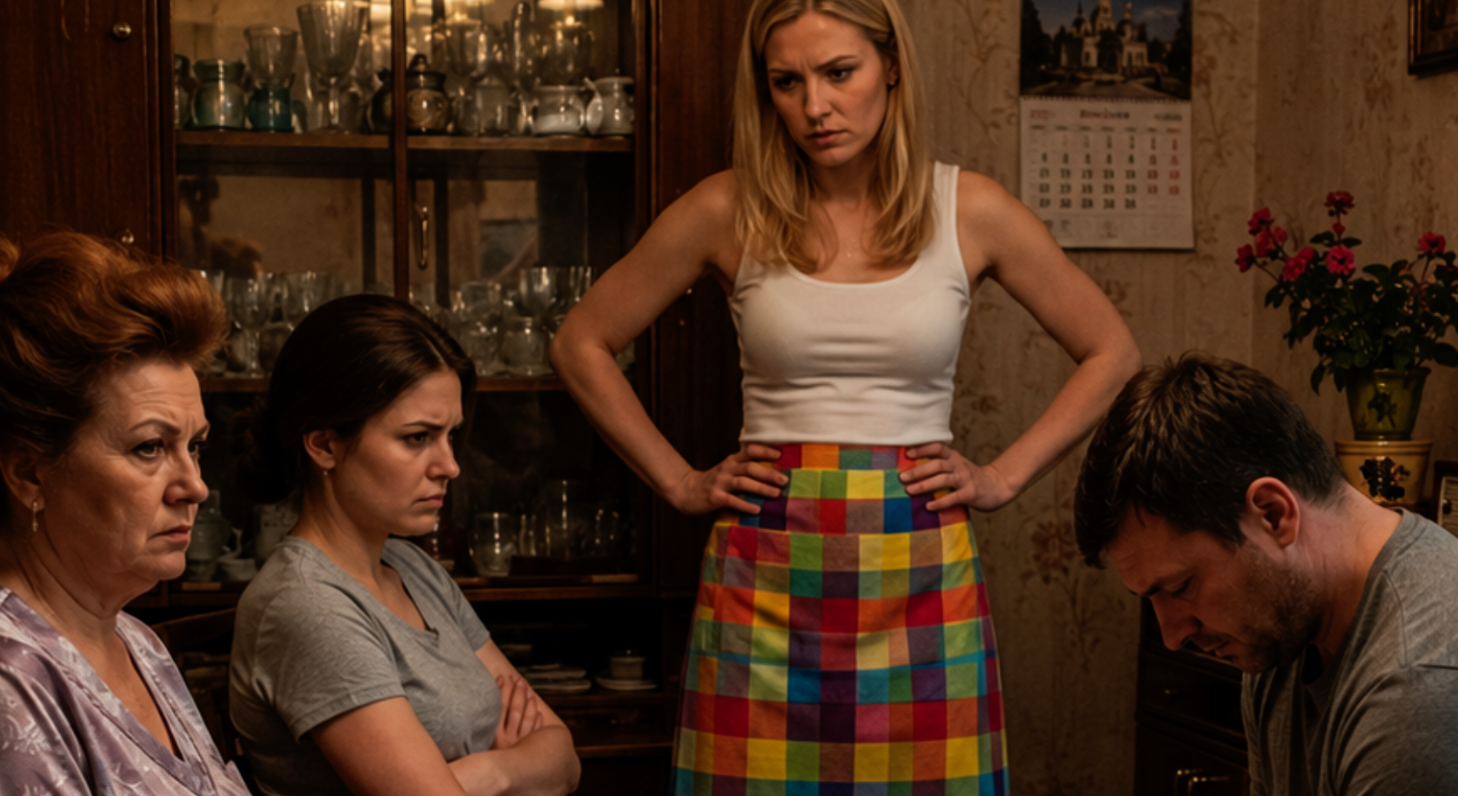
Five minutes later, everyone was sitting in the living room. Larisa disdainfully poked around her plate with a fork, picked out a piece of chicken fillet, and demonstratively pushed everything else to the edge.
“Listen, couldn’t you cook something separately for Alisik?” Larisa asked without even looking at Elina. “I’ve told you a hundred times. He needs dietary meat, steamed, practically without salt. And what is this supposed to be? Some kind of slop?”
“It’s a vegetable casserole,” Elina replied calmly. “There’s nothing unhealthy in it.”
“Of course. You’ll say anything to get out of responsibility,” Valentina Petrovna snorted. “You’re a medical professional, after all. You know everything. But the fact that the child has a delicate constitution means nothing to you. Fine, forget the food. Let’s talk business.”
Everything inside Elina tightened.
Whenever her mother-in-law wanted to “talk business,” it never meant anything good.
Valentina Petrovna put down her fork, wiped her lips with a napkin, and looked at Dima.
“Dimochka, did you prepare the documents?”
Dima hesitated, muttered something under his breath, and pulled a folder of papers out of a drawer.
Elina’s heart sank.
It was the folder containing the documents for the apartment.
Their apartment.
The very apartment for which she had made the down payment three years earlier by selling the country house her grandmother had left her.
The apartment she had furnished while saving every kopek from her hospital shifts.
Dima had been paying the mortgage because his mother had insisted at the time:
“Don’t be offended, Elinochka, but the man must be the head of the family. We’ll put the apartment in Dima’s name. It’s safer that way.”
And like a fool, Elina had agreed.
She had believed in family.
“So, Elina,” Larisa said in a businesslike tone, her voice creaking like an unoiled door. “Mom and I discussed everything and made a decision. Alisik will be starting school soon, and we need him registered in this district. You understand, the prestigious gymnasium and all that. It makes no difference to you, but this is about the child’s future. We need your share of the apartment. You have to sign a waiver at the notary’s office on Monday. We’ve already arranged everything. They’re expecting you at eleven.”
Elina slowly shifted her gaze from Larisa to her mother-in-law and then to Dima.
Dima refused to look at her.
He stared at his phone and pretended to read a message.
His fingers were trembling slightly.
“Dima,” Elina said quietly. “Are you hearing this?”
“Oh, El, don’t start,” he muttered without lifting his eyes. “Mom would never give bad advice. It’s for my nephew. You understand that. Family has to help each other.”
“What family, Dima?”
Elina stood up from the table.
“This is my apartment. I sold my grandmother’s country house so that we could live here. You and me. The two of us. Not your sister and her son.”
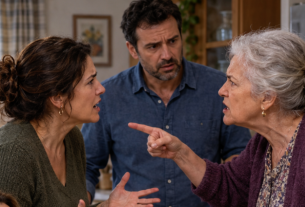
“Oh, what exactly did you sell?” Larisa exploded. “That dilapidated shack of yours? It was worth next to nothing! My brother is paying the mortgage, so technically the apartment is his anyway. You’re just living here as a freeloader, so sit down and keep quiet.”
“Exactly,” Valentina Petrovna agreed. “Elina, calm down. Nobody is throwing you into the street. You can live here for now. But you will have to sign the paper. Dima is the head of the family, and he will make the decision himself.”
Silence fell over the room.
Alisik, having gotten hold of the tablet, loudly turned on some game, and its electronic sounds exploded in Elina’s ears.
She looked down at her hands.
They still smelled of rubbing alcohol and chicken.
For three years, she had tried to become part of this family.
For three years, she had endured humiliation, fulfilled their every whim, and worked herself to exhaustion.
And when she lost her baby in the third month of pregnancy after a scandal her mother-in-law had caused over her supposedly “incorrect test results,” Valentina Petrovna had merely said:
“If you couldn’t carry it, you must have been too weak.”
And Dima had remained silent then.
Just as he remained silent now.
Elina slowly untied her apron.
She folded it neatly and placed it on the edge of the table beside Larisa’s untouched plate.
Then she walked to the coat rack, took down her old denim jacket, and slipped it over her shoulders.
Her movements were calm, almost sluggish, as though she were moving underwater.
“And where do you think you’re going?” Larisa asked suspiciously.
Elina turned around.
She looked at her husband, who had finally lifted his gaze from his phone and was now staring at her in confusion.
“And now, Dimochka, try living without me,” she said in an icy voice without the slightest tremor.
Then she walked into the hallway.
She slammed the door behind her.
She took the stairs instead of waiting for the elevator because the elevator in their building was always slow, and she needed fresh air as quickly as possible.
It was still raining outside.
Tiny drops immediately settled in her hair, but Elina didn’t feel the cold.
She walked toward the bus stop, clutching her mobile phone in her pocket as it began vibrating with calls from Dima.
She didn’t answer.
She boarded a half-empty bus, rode to the outskirts of the city, got off beside a gray nine-story apartment block, and climbed to the fifth floor.
The door was opened by Katya, her school friend, whom she had known since the days when they wore matching hair bows and skipped physical education classes together.
Katya was wearing a stretched-out T-shirt and had wet hair from the shower.
When she saw Elina’s face, she asked no questions.
She simply stepped aside and let her friend into the hallway.
“Tea? Or something stronger?” Katya asked, closing the door.
“Tea,” Elina breathed.
And suddenly her knees began to shake.
She collapsed onto a stool in Katya’s tiny kitchen and covered her face with her hands.
There were no tears.
There was only exhaustion that had been accumulating for years and had now crashed down onto her shoulders like a concrete slab.
Katya placed a mug of cheap instant coffee in front of her, although both of them knew Elina had asked for tea, and sat down opposite her.
“Talk,” she said simply.
And Elina told her everything.
About the waiver.
About being called a freeloader.
About Dima’s silence.
About three years of marriage that had become nothing more than serving someone else’s family.
Katya listened silently, occasionally shaking her head but never interrupting.
When Elina finished, her friend stood up, walked to the window, looked at the rainy sky, and asked only one question.
“Are you going to cry, or are you going to start a business?”
“What business?” Elina gave a bitter laugh.
“Have you forgotten what your grandmother taught you?” Katya turned toward her. “You have golden hands. Massage, body contouring. You do it for your colleagues at the hospital for free. People pay money for that. I’m serious. While you were tiptoeing around those people, you buried yourself alive. It’s time to dig yourself out.”
Elina remained silent for a long time, staring into the dark surface of the coffee.
Her grandmother really had taught her.
She came from the old Soviet school, from a time when massage therapists were rare and those who existed were regarded almost like magicians.
Elina knew a great deal.
But during her marriage, she had grown accustomed to thinking of herself as worthless.
Her mother-in-law was always repeating:
“Who would ever need you with that personality?”
And Elina had believed her.
Meanwhile, back in the apartment she had just left, a different performance was unfolding.
When the door slammed behind Elina, Larisa sat open-mouthed for another minute before bursting into laughter.
“What a hysterical woman!” she said, pulling a candy dish closer. “Mom, did you see that circus? She’ll go for a walk and come back. Where else can she go? No man, no home, no money.”
“Oh, she’ll come back,” Valentina Petrovna nodded. “They all come back. Because they know their place. Dimochka, don’t even think about running after her. Let her throw her little tantrum and cool down. You’re a man. You have to show some backbone. She’s completely climbed onto your neck. She refuses to cook proper food, she can’t have children, and now she thinks she has the right to argue. Don’t worry, son. Your mother would never give you bad advice.”
Dima sat on the sofa, feeling something unpleasant and sticky growing inside him.
He couldn’t understand what it was.
Maybe fear.
Maybe shame.
But his mother and sister spoke so confidently, so calmly, that he pushed the feeling deep down.
Mom was right.
Elina would calm down and come back.
Three days passed.
During those three days, Elina didn’t turn on her phone even once.
She was afraid she would break down, call Dima, and beg to come home.
Every morning she woke up in Katya’s small room on a folding sofa and spent the first few minutes staring at the ceiling, adjusting to the realization that there was no way back.
Katya didn’t pressure her.
She simply lived her life, worked remotely, watched TV series in the evenings, and on the third day placed a newspaper full of classified advertisements in front of Elina.
“They’re renting out a room in an old hair salon,” she said. “It’s tiny, but enough for us to start. I’ll borrow money from a friend for the deposit. You can start seeing clients. You don’t have to. You can just keep living like this. But if you really want to change something, there it is.”
And Elina made up her mind.
She went to the address, looked over the shabby little room with peeling wallpaper and an old chair, and suddenly felt something click inside her.
This would be her place.
Small and poor, perhaps, but hers.
She bought a secondhand massage table, sheets, and oils, and hung a sign on the door:
“Body Contouring. Therapeutic Massage.”
The sign was homemade and handwritten, but to Elina it looked more beautiful than any expensive storefront.
The first few days were quiet.
Nobody came.
Elina sat in the empty room, drank cheap tea from a thermos, and stared out the window.
Then a miracle happened.
Or perhaps it wasn’t a miracle.
Just word of mouth.
One of her former hospital patients, whom Elina had once helped with back pain, heard about the opening from Katya and booked an appointment.
Then came her neighbor.
Then another woman.
Meanwhile, the apartment that was still formally Elina’s home had turned into hell.
Taking advantage of the owner’s absence, Larisa quickly decided that the empty room was being wasted.
The very same room Elina had once wanted to turn into a nursery.
Before the miscarriage.
Before she realized she would never become a mother in that home because her child mattered to no one there.
“Why should it stand empty?” Larisa announced, carrying in a suitcase of clothes and a bag of Alisik’s toys. “Alisik needs sunlight, and these windows face south. We’ll live here for now.”
“Lar, this doesn’t feel right,” Dima tried to object timidly. “What if Elina comes back?”
“And where else would she go?” his sister waved him off. “She’ll come back and make room. She’s not royalty. She’ll survive. And it’s convenient for me. Mom is nearby, and so is Alisik’s school. So stop whining, Dimochka, and help me with the bag.”
And Dima helped.
He always helped.
He was a good son.
A good brother.
He had simply never been a good husband because he had no idea what being one meant.
Larisa didn’t just move into the room.
She immediately began imposing her own rules.
The first thing she did was throw open the wardrobe where Elina’s belongings were hanging.
Her wedding dress, carefully packed in a garment bag.
Summer dresses.
Shoes.
And a small handbag Elina had bought for herself for her birthday two years earlier.
It was an imitation of an expensive brand, but it looked almost genuine.
Elina treasured it, had worn it only a couple of times, and then placed it on the shelf.
“Well, what do we have here?” Larisa pulled out the handbag and turned it over in her hands. “Not bad. Why does a nurse need something like this? It’s just collecting dust anyway. Mom, look how pretty!”
Valentina Petrovna looked into the room, took the bag, and examined it.
“It’s nice,” she agreed. “But why would Elina need it? It isn’t even real. Maybe I’ll take it to a parent-teacher meeting. Or you can use it, Larisa. You need it more than that…”
Her mother-in-law paused, searching for the right word.
“She can buy herself another one.”
“Exactly!” Larisa exclaimed happily. “I’ll take it with me this weekend. I’m going to a café with the girls. And this wedding dress is awful. Some sort of synthetic junk. Maybe we should cut it up for rags?”
“Wait, don’t cut it,” her mother stopped her. “Try selling it first. Put it on Avito or somewhere else. Extra money never hurts.”
Dima, who could hear the conversation from the hallway, wanted to say something.
But the words stuck in his throat.
He remembered when Elina had bought that dress.
How happy she had been.
How she had twirled in front of the mirror, and he had looked at her and thought:
“She’s so beautiful.”
But now his mother stood nearby, looking at him with that heavy gaze of hers, and he said nothing.
As always.
“Dimochka, go make dinner,” Larisa ordered as she left the room. “Mom and I are tired. We’ve been cleaning up your pigsty all day.”
And Dima went into the kitchen.
He took out a frying pan and threw in some frozen dumplings.
Standing there breathing in the steam, he suddenly caught himself remembering how Elina, exhausted after a shift, had still found the strength to cook something every evening.
And she always smiled at him.
He had never even thanked her.
He had simply taken it for granted.
A month passed.
For Elina, that month changed everything.
The tiny office in the former hair salon was no longer empty.
First came friends of her original clients.
Then colleagues.
Then complete strangers who had heard about the miracle massage therapist who could fix a bad back, relax a stiff neck, and give health advice so useful that people joked there was no need to see a doctor afterward.
Elina was genuinely excellent at recognizing problems.
At the hospital, nobody cared.
Here, in private practice, clients listened to her every word.
One day, the door opened and a woman entered who looked like someone Elina had previously only seen in magazines.
Well-groomed, wearing an expensive coat, with perfectly styled hair, but a pale face and dark shadows beneath her eyes.
She introduced herself as Alla and immediately said she had come on a recommendation.
“My head is splitting,” Alla complained as she sat down. “The migraines are unbearable. The doctors just shrug, and the pills don’t help. I was told you have golden hands.”
Elina asked her to sit up straight and ran her fingers over her neck and shoulders.
Years of experience immediately told her that the problem wasn’t in the head.
“You may have cervical osteochondrosis,” she said calmly. “The blood vessels could be compressed, which may be contributing to the migraines. I can work on the muscles, but you should also have your eyes examined and get imaging done, just in case.”
A week later, Alla returned.
But this time she wasn’t in pain.
She was smiling and carrying a huge bouquet of flowers.
“You know, Elina, you were right,” she said, sitting on the treatment table. “I had the imaging done, and it turned out there really is a serious problem. If it hadn’t been for you, I might have ignored it until things got worse. Now tell me, why are you sitting in this hole? You have real talent. My husband, by the way, was very impressed by your story. He works in the legal field. Should you ever need help, let me know.”
Elina didn’t pay much attention to those words at the time.
She simply kept working.
More and more clients came.
Soon she was able to pay the rent, repay her debts to Katya, and even put some money aside.
For the first time in a very long while, she felt alive.
And at that very moment, just as her life was beginning to improve, her phone rang.
The screen showed:
“Dima.”
Elina stared at it for a long time, feeling her heart pound.
She didn’t answer.
The phone stopped ringing and then began vibrating again.
This continued for several minutes.
Then a message arrived:
“El, please answer. It’s urgent. I can’t take this anymore. They’re eating me alive.”
Elina called him back.
She didn’t even know why.
Perhaps she wanted to hear his voice.
Or perhaps she simply wanted to make sure he was alive.
Dima answered immediately.
His voice sounded unfamiliar and desperate.
“El, get me out of here,” he said into the phone, and Elina could hear Larisa shouting in the background. “Please. My sister brings men into our apartment, and Mom is demanding that I sell the place and buy a house in the countryside for all of us. They’re driving me insane. I understand now that I was a fool. I understand everything.”
“All right,” Elina said after a pause. “Let’s meet. But without them.”
They agreed to meet the following day in a small café in the city center.
Elina arrived early, took a table by the window, and ordered coffee.
When Dima walked in, she barely recognized him.
He looked gaunt, wore a wrinkled shirt, and had dark bags under his eyes.
He dropped into the chair opposite her and grabbed her hand, but she pulled her fingers away.
“I’m an idiot,” he began quickly, as if afraid she wouldn’t let him finish. “I’ll fix everything. I’ll tell Mom and Larisa to leave. We’ll put the apartment in your name. Or split it equally, whatever you want. Just come back. I can’t live without you.”
Elina looked at him and felt nothing.
No joy.
No anger.
Only emptiness.
“Are you ready to throw out your sister and mother?” she asked. “Right now?”
“I am!” Dima assured her passionately. “I’ll tell them everything. I’ll change. You’ll see.”
And she almost believed him.
Almost.
But when she went to the restroom to wash her hands, something made her stop.
She didn’t go straight back into the dining area.
Instead, she quietly stood behind a divider and looked toward the table through the glass partition near the bar.
Dima was sitting there, quickly typing something on his phone.
A few minutes later, his screen lit up with an incoming message, and Elina, whose eyesight was excellent, managed to read the first lines:
“Don’t worry, Mom, I’m here. Everything is going according to plan. Soon she’ll be ours.”
Something snapped inside Elina.
She returned to the table, but she was a different person now.
She calmly finished her coffee, listened to several more passionate promises, and then stood up.
“I’ll think about it,” she said. “In the meantime, Dima, solve your own problems.”
She left him sitting there in confusion.
That same evening, Katya called and said that someone had sent a message to her social media page.
A woman claiming to be a friend of the family said that Elina was a fraud who had abandoned her husband and was trying to steal his apartment.
“Who is it?” Katya asked.
“Larisa,” Elina said with a bitter smile. “Or my mother-in-law. What difference does it make? They’ve started a war. Fine, then they’ll get one.”
The following day, Elina called Alla.
The same Alla who had mentioned her lawyer husband.
And Alla didn’t refuse to help.
Two days later, Elina was sitting in a spacious office at a law firm opposite a thin man in glasses, an attorney specializing in family disputes.
“The situation is clear,” he said, examining the documents. “The apartment was purchased during the marriage, but the down payment came from your personal funds obtained through the sale of inherited property. Bank statements prove that. Your husband paid the mortgage, but you also contributed to the family budget. We will file for division of marital property. As for the registration of the nephew, it was done without your consent, which may be challenged. We’ll have it revoked if the legal grounds allow.”
Elina listened and felt the spring inside her, wound tightly for three years, finally beginning to release.
She was no longer a victim.
She was the plaintiff.
Meanwhile, a storm was brewing in the apartment.
The court summons arrived in the morning while Larisa was finishing her coffee.
When she saw the document, she turned pale, then purple, and screamed so loudly that Alisik burst into tears.
“She’s throwing us out into the street!” Larisa shrieked. “Mom, do you see this?! That bitch wants to leave us homeless! We took her in, and this is how she repays us!”
Dima stood in the doorway and said nothing.
He knew he had recorded his conversation with Elina on a voice recorder because his mother had told him to.
He knew that his mother and sister had planned to deceive his wife.
But now, looking at the summons, he suddenly realized that he had lost.
And it wasn’t the apartment he had lost.
He had lost himself.
The court hearing took place a month later.
Elina arrived with her lawyer.
Every member of her husband’s family showed up: Valentina Petrovna, Larisa with Alisik for dramatic effect, and Dima himself, looking as dejected as a beaten dog.
Larisa tried to throw a tantrum right there in the hallway, shouting that her child was being thrown into the street and that Elina was a heartless monster.
But when the lawyer coldly informed her that any unlawful registration arrangements could create legal consequences, she immediately fell silent.
“My dear,” Alla added, having come to support Elina, “the fact that you don’t work and have no ownership interest in this apartment would be obvious even to a first-year law student. Your right to use the premises is being challenged. Pack your belongings.”
Larisa’s hands began to tremble.
She looked at her mother for support, but Valentina Petrovna herself appeared bewildered.
Nothing was going according to her plan.
She was accustomed to controlling Dima.
She was accustomed to her word being law.
And now some nurse named Elina had suddenly made fools of them all.
The court ruled that the apartment was subject to division.
Either Dima would pay Elina half of its market value, or the apartment would be sold.
However, because the mortgage had not yet been fully repaid, the court gave the parties time to negotiate.
After court, Dima returned to the empty apartment.
Larisa and his mother were sitting in the kitchen whispering, but they fell silent when they saw him.
He sat down at the table, poured himself some water, drank it, and looked at them.
“Mom,” he said quietly. “You need to move out. And you too, Larisa. Otherwise I won’t be able to pay Elina her share. We’ll lose the apartment.”
“What?!” Larisa jumped to her feet. “You’re throwing us out?! Your own mother and sister?! Because of that bitch?!”
“It’s my apartment,” Dima said. “And my wife. Or rather, she was my wife. And if it weren’t for you, she never would have left.”
“What nonsense are you talking about?!” Larisa shrieked. “Mom, say something!”
Valentina Petrovna stared at her son for a long time.
She saw something new in his eyes.
Not obedience.
Despair mixed with determination.
And it frightened her.
“Dima, you understand that Larisa and I can’t live without our own room,” she said more gently now. “Rent us an apartment, son. And we’ll register Alisik here. You have to secure your nephew’s future.”
“Enough!”
Dima suddenly screamed so loudly that the dishes rattled.
“Enough of making decisions for me! I don’t want to see either of you anymore! Get out! Get out of my home!”
He jumped up, grabbed the tea set his mother had given them as a wedding present, and hurled it onto the floor with all his strength.
The cups shattered into pieces.
Larisa squealed and grabbed Alisik.
Valentina Petrovna pressed her hands to her chest.
And Dima stood among the shards, breathing heavily as tears streamed down his cheeks.
At that moment, a key turned in the lock.
The door opened, and Elina entered the hallway.
She had come to collect the documents she had left behind.
When they saw her, everyone froze.
Dima looked at her with desperate hope.
Larisa hissed, but remained silent.
Elina went into the room that had once been her bedroom.
She took a folder of papers from the shelf and turned around.
She looked at her husband sitting on the floor.
At the broken pieces.
At the frightened faces of her mother-in-law and sister-in-law.
“I’ll lend you enough money to rent a studio apartment for a while,” she told Dima calmly. “But I can never live with you again. You became a man too late, Dima.”
And she left.
Six months passed.
Elina stood by the window of her new treatment room.
It was no longer a shabby corner in an old hair salon, but a small, cozy wellness center where three massage therapists now worked.
She had rented the premises, taken out a loan, repaid it, and was now making plans for the future.
At her feet stood a handbag.
The same kind as before, except now it was genuine rather than a counterfeit.
She had bought it for her birthday.
Her real birthday.
Not the one her relatives had ruined.
Katya occasionally sent her news.
Dima had quit his job, moved out of the apartment, left for another city, and found work in construction.
For the first time in his life, he worked with his hands, sweated, grew tired, and gradually paid Elina what he owed her.
Larisa had gotten divorced, been left with nothing, and now worked as a supermarket cashier.
Alisik attended an ordinary school rather than a prestigious gymnasium.
Valentina Petrovna wrote long posts on social media about ungrateful young people and how everyone had betrayed her.
Elina never read them.
She wasn’t interested.
Her phone rang.
The screen displayed:
“Dima.”
She watched the screen while listening to the summer rain outside the window, so much like the rain on the evening she had walked away.
The call ended.
Elina placed the phone face down and smiled.
For the first time in her life, she didn’t have to explain anything to anyone.
Not even to him.