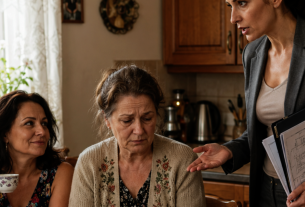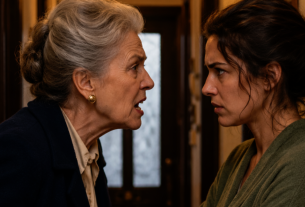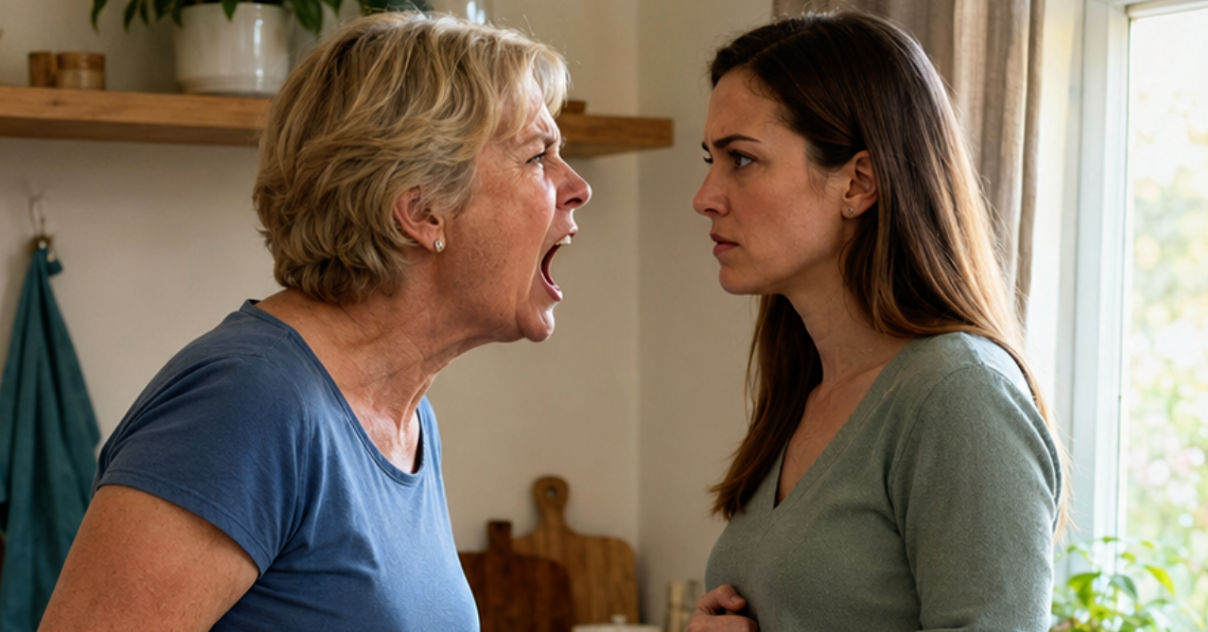
“Your beets, Veronika, are kind of… from the supermarket or something? They’ve got no flavor of their own. Bland,” Tamara Pavlovna’s voice, thick and sluggish like cooled jelly, filled the entire small kitchen. She held a spoonful of borscht suspended in the air like an expert taster delivering a verdict on a defendant.
Under the table, Veronika felt her fingers curl into a fist of their own accord, her nails digging into her palm until pale crescents appeared. She did not lift her eyes from her plate. The tip of her knife scraped unpleasantly against the earthenware as she cut off another piece of meat that she could no longer force down her throat. It was Sunday. A day that, by every rule, should have been a day of rest had become her weekly Golgotha.
“Ordinary beets, Tamara Pavlovna. From our local market,” she replied evenly, putting not a drop of emotion into her voice. Emotion was fuel for this fire, and she had long ago learned to keep her reserves locked away.
Igor, her husband and Tamara Pavlovna’s only son, seemed to exist in a separate reality protected by an invisible soundproof dome. He was intently constructing an elaborate arrangement of meat, potatoes, and thick sour cream on his plate, carefully ignoring the mounting tension. He was there at the table, yet at the same time he was absent. Whenever his mother and wife occupied the same space, he turned into a function, a body consuming food.
“Well, I don’t know, I don’t know…” his mother-in-law drawled, finally putting the spoon into her mouth. She chewed slowly, with the expression of a martyr. “I always put a pinch of sugar in my borscht, for color and flavor. And I sauté everything in pork fat, not in that odorless oil of yours. Borscht should smell like home, but yours is… somehow sterile. Like cafeteria food. But don’t be offended, sweetheart. I mean well. I’m only trying to teach you.”
Veronika took a deep, almost imperceptible breath.
Teach her.
During the three years she and Igor had been married, Tamara Pavlovna had tried to “teach” her everything: how to wash floors properly—only by hand, because mops were for lazy people; how to iron men’s shirts—collar first, then cuffs; how to pickle cucumbers; and even how to breathe correctly so that “female energy wouldn’t stagnate.”
Every word she spoke, wrapped in the sticky packaging of concern, was a tiny poisonous sting.
Setting down her spoon with a deliberately light tap, Tamara Pavlovna shifted her assessing gaze from her plate to Veronika herself. Her eyes, small and sharp like a bird’s, swept over her daughter-in-law’s face and settled on her hair.
“What’s this new fashion? You cut your hair?” There was no question in her tone, only the announcement of a depressing fact. “So short… You used to have such beautiful braids. Igor loved them so much. And now… you look like a boy. Well, it’s your business, of course. As long as your husband likes it. Right, Igoryosha? You like it, don’t you?”
Igor, rudely dragged from his gastronomic shelter, flinched and looked up. He glanced at his wife, then at his mother, and his face showed a sincere desire for the ground to swallow him whole.
“It’s fine,” he muttered before dropping his eyes back to his plate, making it clear that he had exhausted his quota of participation in the conversation.
“‘It’s fine,’” Tamara Pavlovna mocked with a bitter smirk. “That’s how all you young people are. Freedom or captivity, it’s all ‘fine’ to you. Then you wonder why men start looking elsewhere. A man needs a woman beside him, not a coworker. You already spend all day sitting behind that… computer of yours, ruining your eyes. The least you could do is look feminine. You’ve completely neglected your family. This household doesn’t rest on your shoulders, Veronika. It merely stands because Igor carries it on his.”
The accusation that she had neglected her family hung over the table, dense and poisonous like mercury vapor.
Veronika felt something tighten inside her chest, hardening into a small icy stone. She was holding a knife, and for one brief second it stopped being cutlery and became a tiny cold weapon. She imagined driving it into the snow-white tablecloth. Simply to violate the suffocating, sticky perfection of Sunday dinner.
Igor continued his silent feast.
He did not defend her.
He did not even cough.
He simply pretended his mother’s words were background noise, like an engine running outside the window or children shouting on a playground.
And his silence hurt more deeply than any reproach from his mother.
It was betrayal taking place in real time, right before her eyes.
Tamara Pavlovna, seeing that her attack had reached its target and that there was still no resistance, decided to deliver the decisive blow. She pushed her plate away, folded her arms across her chest, and assumed the posture of a judge preparing to pronounce a sentence.
“And here’s what I think, Igoryosha,” she began, addressing her son while never taking her eyes off Veronika. “Time is passing. You’re already thirty-two. I should be looking after grandchildren by now, but with you two—silence. All my friends are already pushing baby carriages around, and what about me? I sit alone at home. This won’t do. A family means continuation. It means children. Without children, it isn’t a family. It’s just cohabitation.”
She paused, giving her words time to soak into the air and corrode it to its foundations.
“Maybe you should get yourself checked, Veronika?” Her voice suddenly became soft and syrupy with false concern, which was worse than any shouting. “Medicine is very good these days. They treat everything. And your clock is ticking. My Igoryosha is a healthy man. He needs an heir. And if his wife can’t give him one, then…”
She left the sentence unfinished, but pursed her lips meaningfully, and that unspoken “then” was more frightening than any direct threat.
That was it.
Rock bottom.
The point beyond which patience turned to dust.
Slowly, with absolute, almost inhuman calm, Veronika placed her knife and fork on the plate. She did not throw them down. She laid them there carefully, crossing one over the other.
The sound of metal against earthenware was quiet, but in the deafening silence, broken only by Igor’s chewing, it sounded like a gunshot.
She lifted her head and, for the first time during the entire meal, looked her mother-in-law directly in the eyes.
“Tamara Pavlovna,” she said, her voice even and cold as steel. There was no hurt in it, no anger, only an absolute, measured statement of fact. “How we live and when we have children is for us to decide. Without your advice.”
For one second, Tamara Pavlovna froze, as though her brain refused to process what she had just heard.
She opened her mouth, closed it, then opened it again like a fish thrown onto shore.
Obedience, silent agreement, even tears—she had been prepared for all of those.
But not this.
Not a calm, icy rebuff.
Her face, pale and pinched only moments earlier, rapidly turned crimson. Blood rushed into her cheeks and temples, making the fine wrinkles around her eyes tremble.
“Wha-a-at?” she hissed, the sound resembling fabric being torn apart.
She shot up from her chair, knocking over a glass of fruit compote. The dark-red liquid spread across the snow-white tablecloth in an ugly, bloodlike stain.
Her chest heaved with rage, with outrage at such unheard-of, unimaginable insolence.
This girl, this hanger-on living in her son’s apartment, had dared to tell her what to do.
“Don’t you dare raise your voice at me, you little brat! I’ll do something to you right now that’ll leave your own mother unable to recognize you!”
The threat spilling from her thin lips, twisted with malice, was not merely words.
It was the sound of a dam breaking.
All the bile Tamara Pavlovna had accumulated over the years under the guise of “life experience” and “motherly concern” burst outward in a filthy, uncontrollable flood. Her face became a crimson mask from which two sharp eyes stared, filled with pure, unclouded fury.
She did not wait for an answer.
Words were exhausted.
Her right hand, thin and covered with gold rings that now looked like brass knuckles, flew into the air. The movement was abrupt and practiced, like that of someone who had no doubt about her right to use violence.
She aimed for Veronika’s cheek—for that smooth skin, that calm jawline, that silent defiance.
She wanted to leave her mark on that face, a crimson sign of her authority.
Veronika did not recoil.
She watched the hand flying toward her as though everything were happening in slow motion. She saw the light glinting from the stone in one of the rings, the tense tendons on the back of the hand.
Her body instinctively coiled like a spring, ready to absorb the blow, but her eyes remained open, fixed on her mother-in-law’s face.
She would not let her see fear.
But the blow never landed.
Another hand caught Tamara Pavlovna’s wrist in midair—a broad, masculine hand, painfully familiar and yet completely foreign.
Igor.
He was no longer picking at his plate.
He was no longer an amorphous spectator.
He had moved with such lightning speed that it seemed as though he had simply materialized between the two women. His fingers closed around the thin bones of his mother’s wrist with a force devoid of filial respect or hesitation.
Time stopped in the kitchen.
Tamara Pavlovna froze with her raised arm caught in his grip, her face displaying absolute, universal bewilderment.
She stared at her son as though seeing him for the first time.
This was not her Igoryosha. Not the gentle, compliant boy who always lowered his eyes and agreed with her.
A man sat before her.
A stranger. A hard man with eyes cold as steel.
It was a look she had never seen before, and now feared more than anything in the world.
He stared straight at her, and there was nothing in his gaze but ice and contempt.
He did not see his mother.
He saw an enraged woman who had lost control and tried to strike his wife.
His wife.
In his home.
“Mom.”
He did not shout.
He hissed the word, and there was more menace in that whisper than in any scream.
He uttered it not as a form of address, but as a sentence.
“Get. Out. Of. My. House.”
He pronounced each word separately, hammering it like a nail into the deafening silence.
Tamara Pavlovna jerked as though struck.
Her mind refused to accept reality.
Her son.
Her own son.
Was choosing that woman… over her.
She tried to pull her hand away, but Igor’s grip was iron.
“Igoryosha…” she babbled in shock, instinctively using his childish pet name in an attempt to return him to the reality in which she was in charge and her word was law. “What are you…?”
“I said get out!”
His voice broke, cracked under the monstrous internal pressure that was escaping for the first time in thirty-two years.
He jumped to his feet, forcing her up with him and making her back away from the table. His face was only inches from hers.
“And I don’t want to see you here again until you learn to respect my wife.”
Igor’s final words, hurled with force and disgust, shattered what remained of the world in which Tamara Pavlovna had been the center of the universe.
Slowly, almost impossibly slowly, she lowered her arm.
Igor released her wrist.
There was no longer any physical contact between them, only a scorched field where the ruins of their family bond still smoldered.
The shock on her face transformed into something else.
Something cold, crystal clear, and infinitely vicious.
She was no longer the victim, and he was no longer her Igoryosha.
She looked at him the way one looks at a traitor, a defector, a monster she herself had mistakenly raised and nurtured.
“Respect?” she repeated.
Her voice had changed too.
The shrillness was gone. So was the hysteria.
It had become low and dull, full of ringing metal.
“Respect this emptiness? This woman who wormed her way into my home, into my family, and sucked everything out of you? Look at yourself. Look at what you’ve become. A shadow. A puppet on her strings.”
She spoke only to Igor, completely ignoring Veronika, as though she were merely a piece of furniture, an inanimate cause of every misfortune.
“She feeds you slop, and you eat it and smile. She put that ridiculous shirt on you, and you wear it. She chopped off her hair, and you say, ‘It’s fine.’ You don’t have an opinion of your own anymore, Igor. She has stripped away everything masculine in you, everything that came from me. Now you’re just an extension of her. Her possession. And you want me to respect that? You expect me to bow to her for turning my son into a spineless creature?”
She was not asking for an answer.
She was delivering a verdict.
Each word was a carefully chosen stone hurled at the fragile structure of his new life. She was not aiming at him, but at the seam between him and Veronika, desperately trying one last time to split their union apart.
Igor listened in silence.
He did not interrupt.
He allowed her to say everything, to pour out every last drop of poison.
When she finally fell silent, breathing heavily, he stepped back toward the table and braced both hands against it.
He looked at the plate of cold borscht, at the bloodlike stain of fruit compote on the tablecloth, then at his wife, who sat with her back perfectly straight, staring at a single point in front of her.
“Are you finished?” he asked quietly.
Tamara Pavlovna snorted contemptuously.
“Now it’s my turn,” he continued in the same even, lifeless tone. “You’ve spent my entire life teaching me things. How to hold a spoon. How to tie my shoelaces. How to choose my friends. How to talk to girls. How to make your borscht. There was always only one correct opinion—yours. Every desire I had, every thought of my own was wrong, immature, stupid. I wasn’t supposed to become myself. I was supposed to become an extension of you. Convenient. Obedient. Proper.”
He raised his eyes to her, and there was neither anger nor hurt in them.
Only emptiness.
A wasteland burned down to ash.
“Then Veronika appeared. And she never told me how to live. She simply lived beside me. And for the first time in thirty years, I realized that you can breathe without asking permission. That you can love borscht that doesn’t taste like yours. That you can wear a shirt because you like it. That you can be happy simply because you are happy, not because you obeyed someone’s command.”
He straightened.
His voice became firm.
“You didn’t take care of me. You owned me. And you don’t hate her because she’s bad. You hate her because she took me away from you. Because she made me free.”
He paused.
“So here it is. This is my house. This is my wife. This is my family. And you… you are no longer part of it. Leave.”
Tamara Pavlovna understood.
This was the end.
Final and irreversible.
Not a single muscle moved on her face.
She measured them both with one long, heavy stare containing nothing but cold hatred.
Then, slowly and with royal dignity, she turned, picked up her handbag from the cabinet, and walked toward the exit.
She did not look back.
The front door closed behind her with a soft, neat click.
Dead silence settled over the kitchen.
Igor sank heavily into a chair.
He stared at his hands resting on the table as though he no longer recognized them.
Veronika remained silent.
Then she stood, picked up her mother-in-law’s plate of untouched, cold borscht, walked over to the trash can, opened it, and dumped the entire contents inside with a sharp clatter.
The red liquid ran down the sides of the garbage bag, leaving only greasy streaks behind on the plate.
It was the end of Sunday dinner…