Ivan Stepanovich was a man of iron. The kind of man people say has a character like a cast-iron crowbar—you can’t bend it, only break it. He had spent his entire life in a remote village in the north of the republic, working first at a lumber mill, then at a sawmill, and later as a foreman. He had built his house with his own hands, from the foundation to the ridge of the roof. He kept livestock: a cow, piglets, chickens. He buried his wife early—her heart had failed—and was left alone with his daughter Katya. He adored her, but he never let her get away with anything. He raised her strictly.
“You’re the only one I have, Katerina. One person who has to make up for everyone. Don’t ever make me ashamed of you.”
Katya grew up obedient. She did well at school, never stayed out late, and helped around the house. She dreamed of studying medicine—her mother had once had the same dream, but life had not allowed it. Ivan Stepanovich did not object.
“Being a doctor is a respectable profession. You’ll finish your studies, come back to the village, and treat us.”
That was exactly how he imagined it. His daughter would return and live nearby. In his mind, everything had already been planned out.
Until she brought Denis home.
It happened in July. Ivan Stepanovich had just come home from work, tired and hungry. The moment he stepped inside, he sensed that something was wrong. Katya was unusually nervous, and the table was covered with the special tablecloth they normally took out only once a year at Easter. There was a pie baking in the oven.
And a young man was sitting at the table.
Ivan Stepanovich entered and stopped in the doorway.
The young man stood up. He was thin and wiry, with black hair reaching his shoulders. Blue tattoos covered the parts of his arms exposed by the short sleeves of his T-shirt. Another tattoo was visible on his neck beneath the collar. His face was sharp and high-cheekboned, with an expression that was difficult to understand.
Not arrogant.
No.
More like cautious and expectant.
“Hello,” the young man said.
Ivan Stepanovich did not answer. He looked at his daughter.
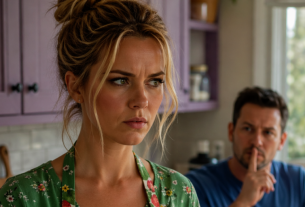
“Dad, this is Denis,” Katya said, and her voice trembled. “We… we’re together. I wanted you to meet him.”
Ivan Stepanovich slowly took off his boots. He walked over to the table, sat down, and stared at the young man for a long time.
At the tattoos.
At the long hair.
At the thin arms with prominent veins.
“Ever been in prison?” he asked.
“No,” the young man answered calmly. “I’ve never been in prison. They’re just drawings.”
“I know those drawings. They make the same ones in prison.”
“Dad!” Katya exclaimed.
“You keep quiet,” Ivan Stepanovich snapped. “I’m asking him.”
He turned back to the young man.
Denis was still standing. He had not sat down. His gaze was direct—not insolent, but firm.
“What do you do?”
“I’m studying.”
“Where?”
“At the medical institute. In the capital. Second year.”
Ivan Stepanovich smirked.
“Medical institute. With hands like those. Who are you planning to treat? Gangsters?”
“Dad, stop it!” Katya jumped to her feet. “You don’t know him at all! He’s a good person, he—”
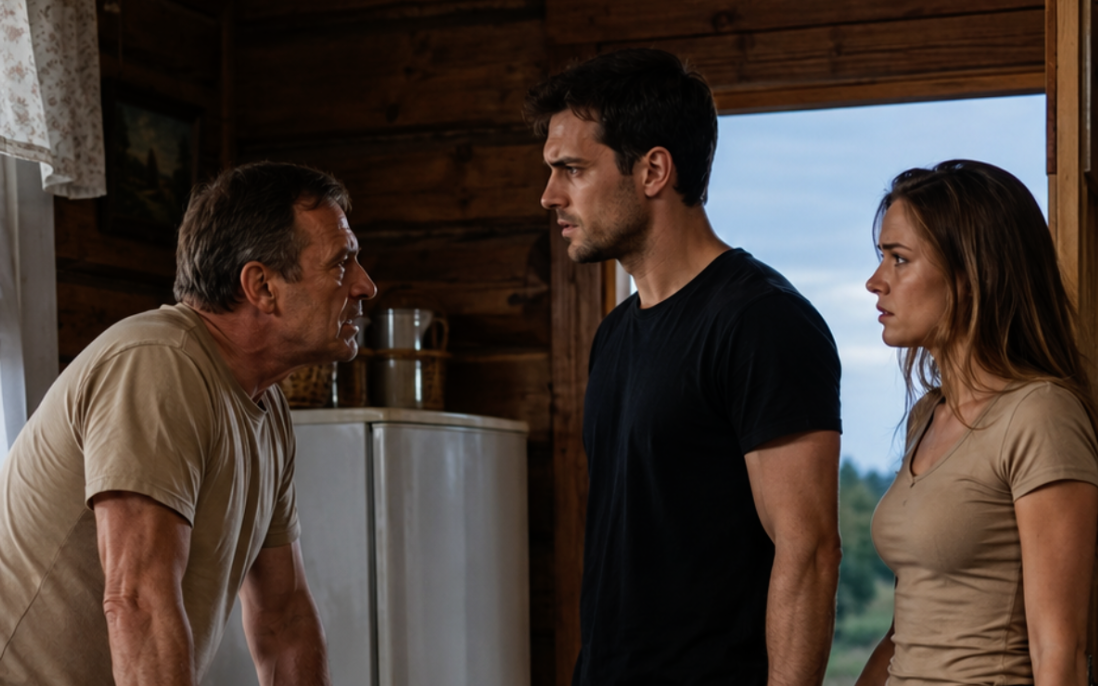
“Good?” Ivan Stepanovich stood up too. “You say he’s good? Show me your hands!”
Without changing his expression, Denis stretched his arms out in front of him.
The tattoos ran from his wrists to his elbows—patterns, strange symbols, a dragon, a snake, and something else.
Ivan Stepanovich stared at them, his jaw muscles tightening.
“I don’t need a son-in-law like you,” he said quietly. “And I don’t want to see you in my house ever again.”
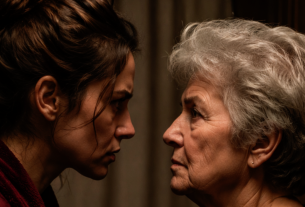
“Then you won’t see me here either,” Katya said.
Silence fell so heavily that they could hear a fly buzzing against the window.
“What did you say?” Ivan Stepanovich asked.
“I said it’s either him or no one. I love him, Dad. And I’m leaving with him.”
Ivan Stepanovich stared at his daughter as if he no longer recognized her.
She had always been obedient. Always quiet.
But now she stood before him straight-backed and pale, her eyes burning.
And in those eyes he saw the same stubbornness his late wife had once possessed.
She, too, had always known how to stand her ground.
“Go,” he said. “Both of you. Get out of my sight.”
Katya grabbed her bag, took Denis by the hand, and left.
The door slammed shut.
Ivan Stepanovich remained alone.
He sat at the table, staring at the pie and the special tablecloth, saying nothing.
Then he picked up the pie and hurled it against the wall.
Apple filling splattered across the wallpaper.
He sat there a while longer.
Then he went outside.
He stood in the yard and stared down the road they had taken.
The road was empty.
They left for the capital of the republic.
Katya enrolled in a medical vocational school to train as a nurse. Denis continued studying at the medical institute.
They lived in poverty, in a dormitory, surviving on scholarships and whatever odd jobs they could find.
At night, Denis washed floors. He unloaded freight cars. He worked as a hospital orderly.
Katya did sewing jobs, babysat other people’s children, and accepted any work she could get.
They went hungry.
They froze.
But they stayed together.
Ivan Stepanovich knew none of this.
He erased his daughter from his life.
No phone calls.
No letters.
No messages.
Whenever his kindhearted neighbor, Granny Zina, tried to talk to him about Katya, he cut her off.
“I don’t have a daughter. She’s dead.”
And he would walk away.
The years passed.
The village slowly emptied.
Young people moved away.
The school closed.
The local medical station closed.
Ivan Stepanovich remained.
Alone in his large house.
The cow died. The chickens were wiped out by some disease.
He was still working, but no longer as a foreman. Now he was just a security guard at the same sawmill.
He began drinking.
At first only a little.
Then more and more often.
The house deteriorated.
The fence leaned to one side.
The roof began to leak.
And still, he waited.
He would never admit it even to himself, but he waited for the gate to creak open and for the familiar voice to call:
“Dad, I’m back.”
But the gate never creaked.
Denis became a surgeon.
It was no accident.
He had known exactly what he wanted from the very first day he entered the anatomy lab.
He turned out to be gifted.
The hands Ivan Stepanovich had once examined so contemptuously held a scalpel as though they had been born to do it.
His professors were impressed.
“You have a natural gift, young man. Don’t waste it.”
He didn’t.
Internship.
Residency.
Then postgraduate study.
His specialization was vascular surgery, one of the most difficult fields in medicine.
Then came advanced training in Moscow at a federal medical center.
Afterward, he returned home.
By then he had already earned his Candidate of Sciences degree.
Clinics in the capital tried to recruit him and promised him extraordinary salaries.
But he returned to the republic.
Katya was there.
Their children were there.
And there was something else.
He remembered the way he had once been looked at in that remote village.
The way people had judged him because of his tattoos and long hair.
He wanted to prove something.
Not to Ivan Stepanovich.
To himself.
To prove that a person was more than pictures drawn on their skin.
A person was what was inside.
Denis never had the tattoos removed.
They remained on his arms—faded and slightly blurred with age, but still recognizable.
No one could see them beneath his surgical gown.
But he knew they were there.
He remembered.
Katya gave birth to two children.
A boy and a girl.
Ivan Stepanovich did not even know he had grandchildren.
Katya tried to write to him several times, but every time she tore the letter up.
Pride.
The very same pride she had inherited from her father.
Like father, like daughter.
Sometimes she called Granny Zina.
“Your father’s doing badly,” the old woman would tell her. “He drinks. The house is falling apart. He’s completely alone.”
Katya would cry into the phone, but she still did not go home.
She couldn’t.
She remembered the day he had thrown her and Denis out.
Denis never pressured her.
He understood that some things could not be repaired with words.
Only actions could repair them.
And time.
Sometimes time healed things that medicine could not.
Ivan Stepanovich fell ill at the beginning of December.
At first he ignored it.
His heart hurt—so what? It happened.
He took some Corvalol and lay down until he felt better.
But a week later, the pain came back.
This time it was so severe that he could not stand.
Granny Zina, who had stopped by to check on him, found him lying on the floor, pale, his lips turning blue.
She called an ambulance.
The ambulance arrived from the district center four hours later.
A young doctor wearing glasses examined Ivan Stepanovich and shook his head.
“Abdominal aortic aneurysm. You need emergency surgery. We can’t do that here. We’re taking you to the republican hospital.”
The journey took another six hours.
Ivan Stepanovich lay on the stretcher, staring at the white ceiling of the ambulance.
“So this is it,” he thought. “My time has come.”
He was not afraid of death.
There was only one thing he feared.
Dying without ever seeing his daughter again.
At the republican hospital, he was taken directly into surgery.
The case was serious.
The aneurysm was enormous and could rupture at any moment.
They were counting hours—perhaps even minutes.
The surgeon assigned to perform the operation was the head of the vascular surgery department.
Denis Arkadyevich.
When Denis saw the name on the medical chart, he stopped breathing for a second.
He stood in the doctors’ room staring at the paper.
Surname.
First name.
Patronymic.
Year of birth.
Everything matched.
It was him.
Ivan Stepanovich.
Katya’s father.
The grandfather of Denis’s children.
The man who had thrown him out of his house twenty years earlier.
Denis closed his eyes.
Twenty years.
For twenty years, he had carried that resentment inside himself.
He never showed it.
Never complained about it.
But he carried it.
He remembered every word.
“I don’t need a son-in-law like you.”
He remembered the smell of apple pie.
He remembered Katya crying as they walked along the dusty road toward the highway, hoping to hitch a ride into town.
He remembered everything.
And now that man was lying on an operating table.
Whether he lived or died depended on Denis.
Denis could refuse.
He could hand the operation over to a colleague.
No one would have blamed him.
There was a deeply personal history between them.
But Denis knew that if he refused, he would never forgive himself.
Because he was a doctor.
Because a surgeon did not choose whose life was worth saving.
Because a human life was not something to be used as payment for old grievances.
“Prepare the operating room,” he told the nurse. “I’m taking this patient.”
The operation lasted four and a half hours.
Denis worked in silence.
The scalpel moved in his hands with absolute precision, without a single unnecessary motion.
The aneurysm turned out to be even more complicated than they had expected.
The wall of the aorta had become so thin it was almost transparent.
It was barely holding together.
One wrong movement, and there would be massive internal bleeding.
There would be no saving him then.
But Denis’s hands did not shake.
His hands remembered everything he had learned over those twenty years.
Everything he had spent nights studying in that freezing dormitory.
Everything Katya had saved every last coin to help him accomplish.
Everything he had endured because he had refused to let himself break that July day when a village man had looked at him as though he were worthless.
The damaged section of the aorta was replaced.
Blood flow was restored.
The sutures were placed—straight and precise, like stitches in expensive fabric.
“Blood pressure?” Denis asked.
“One twenty over eighty. Stable.”
“Good. We’re finishing.”
He pulled off his gloves and dropped them into a tray.
He looked at the sleeping old man.
At the face cut through with deep wrinkles.
At the gray eyebrows.
At the large hands permanently stained from a lifetime of working with wood.
And suddenly Denis felt something.
Not triumph.
Not spiteful satisfaction.
Not, “Well, what do you have to say now?”
He felt pity.
Simple human pity for an old, sick, lonely man.
“Postoperative monitoring in intensive care,” he said. “I’ll check on him in an hour.”
Ivan Stepanovich regained consciousness the next day.
He was lying in the intensive care unit.
White walls.
A white ceiling.
An IV bag hanging above his head.
Wires.
Monitors.
There was pain in his chest, but it was not the same pain as before.
It was different.
The kind of pain that came after surgery.
That meant he was alive.
At first, he saw no one except nurses.
They came over to check his blood pressure and adjust the IV.
Then, toward evening, a doctor entered the room.
Tall.
A white coat over blue surgical scrubs.
A surgical cap.
The mask had not yet been removed; it had only been lowered beneath his chin.
His hair was cut short and had begun turning gray at the temples.
His face was calm and tired, with intelligent dark eyes.
“Ivan Stepanovich,” the doctor said. “How are you feeling?”
The voice sounded familiar.
But from where?
“Alive,” Ivan Stepanovich rasped. “Thank you, Doctor. You… well… you pulled me back from the other side.”
“That’s the job,” the doctor replied.
And smiled.
There was something in that smile.
Something from the past.
Ivan Stepanovich narrowed his eyes and looked more closely.
The cheekbones.
The eyes.
The shape of the shoulders…
“Wait,” he said. “Wait a minute. Do I know you?”
The doctor was silent for a moment.
Then he removed his surgical cap.
Slowly, almost as though giving the old man time to recognize him.
“Denis,” he said. “Twenty years ago. You threw me out of your house. You said you didn’t need a son-in-law like me.”
The room became silent.
So silent that they could hear the drops falling through the IV tube.
Ivan Stepanovich stared at him.
His lips trembled.
He tried to say something, but his throat tightened.
“You operated on me?” he finally asked.
“I did.”
“You knew it was me?”
“I knew.”
“And… you didn’t refuse?”
“No. I didn’t.”
Ivan Stepanovich closed his eyes.
A tear rolled slowly down his cheek.
A rare tear.
He had not cried in many years.
He had not cried when he buried his wife.
He had not cried when his daughter left home.
But now he cried.
“Forgive me,” he whispered. “Forgive an old man.”
Denis stood there, unsure what to do.
He had waited twenty years for this moment.
He had imagined what he would feel.
Triumph.
Vindication.
Satisfaction.
But he felt none of those things.
Only exhaustion.
And something else.
Relief.
As if the stone he had carried on his shoulders for all those years had suddenly crumbled into dust.
“I forgave you a long time ago,” he said. “You know… I understand you. Back then. You just wanted what was best for your daughter. And then you saw me. Someone strange. Someone you didn’t understand. Covered in tattoos. How could you have known that I was more than the pictures on my arms?”
Ivan Stepanovich stared at him.
And now he no longer saw the thin young man with the defiant-looking face.
He saw a grown man.
A man exhausted after an extremely difficult operation.
A man who had saved his life.
And something shifted inside the old man’s soul—slowly and heavily, like a millstone beginning to turn.
“And Katya?” he asked. “She…”
“She’s here. She’s waiting in the hallway. She’s been here for two days. She refuses to leave.”
“Call her,” Ivan Stepanovich whispered. “Please call her.”
Katya entered the room, and time stopped.
She stood in the doorway.
A woman of forty now, with a touch of gray in her light-colored hair and fine lines around her eyes.
But she still had the same stubborn gaze Ivan Stepanovich remembered from her childhood.
She looked at her father.
Her father looked at her.
“Katyusha,” he said. “My little girl.”
“Dad.”
She walked over.
She dropped to her knees beside his bed.
She took his hand—large, rough, marked with age spots—and pressed it against her cheek.
“You’re alive,” she said. “My God, you’re alive.”
“Forgive me,” Ivan Stepanovich said. “Forgive me, Katyusha. For everything. For the pie. For what I said. For never coming to find you.”
“Shh,” she said. “Shh, Dad. It’s over. It’s all over now.”
The three of them cried.
The old man in the hospital bed.
His daughter kneeling beside him.
And the surgeon standing in the doorway.
They cried silently, without sobbing, restrained tears like those shed by adults who have kept too much inside for far too long.
Then came the long recovery.
Ivan Stepanovich remained in the hospital, and Katya visited him every day.
She sat beside his bed and told him about his grandchildren, about her work as a nurse in that same hospital, and about how they had lived during those twenty years.
He listened.
Nodded.
Sometimes smiled.
One day she brought the children.
A boy and a girl.
Teenagers.
The older boy was fifteen, the younger girl thirteen.
They looked at their grandfather with curiosity and caution.
They knew the story.
They knew that their grandfather had once thrown their father out of the house.
But now, seeing an old and helpless man dressed in hospital pajamas, they felt no resentment.
Only compassion.
“Hello, Grandpa,” the boy said.
“Hello,” Ivan Stepanovich replied. “You… you look like your father. Very much like him.”
“And I look like Mom,” the girl said. “Everyone says so.”
Ivan Stepanovich looked at his grandchildren and felt something inside his chest soften.
For twenty years, he had lived alone.
For twenty years, he had had no daughter.
No son-in-law.
No grandchildren.
And now here they were.
Alive.
Real.
Beside him.
Ivan Stepanovich was discharged three weeks later.
Before he left the hospital, Denis came into his room.
This time not as his doctor, but as his son-in-law.
He sat on the edge of the bed.
“Ivan Stepanovich,” he said. “There’s something I want to show you.”
He rolled up the sleeves of his coat.
He stretched out his arms.
The tattoos were still there, faded after twenty years but clearly recognizable.
A dragon on his left forearm.
A snake on his right.
Patterns.
Symbols.
Lines.
“There,” Denis said. “The same tattoos. Back then, you looked at them and decided what kind of person I was. Now I want you to understand something. These hands save people every day. And these hands saved your life too. Tattoos are not a sentence. Do you understand?”
Ivan Stepanovich stared at his son-in-law’s hands.
The same hands he had once ordered him to display.
Now he looked at them differently.
Almost with reverence.
“I understand,” he said. “Late, but I understand.”
He took Denis’s hands in his own.
“Thank you,” he said. “For everything. For Katya. For the grandchildren. For not abandoning her back then. And for not abandoning me now. Thank you, son.”
And that word—“son”—was worth more than any award.
More than his academic degree.
More than his position as head of the department.
Because it meant that he had been accepted.
Acknowledged.
Forgiven.
Ivan Stepanovich is seventy-five now.
He still lives in the same house, but he is no longer alone.
Katya and Denis visit every weekend. It is only a three-hour drive from the republican center.
The grandchildren love the village.
The forest.
The river.
The open space.
They repaired the house.
Put on a new roof.
Replaced the fence.
Ivan Stepanovich is still quite energetic. He works in his vegetable garden and tends his bees.
But the most important thing happens in the evenings.
When the whole family gathers around the table, he looks at them all and remains silent.
Then sometimes he says quietly, almost to himself:
“My God, what a fool I was. I lost twenty years.”
And Denis replies:
“You didn’t lose them. Those twenty years made us who we are. They made you wiser. They made me stronger. They made Katya more loyal. None of it was for nothing, Ivan Stepanovich. None of it was for nothing.”
And when the neighbors ask Ivan Stepanovich:
“Who keeps coming to visit you?”
He straightens his shoulders proudly and says:
“My daughter. My son-in-law. My grandchildren. And do you know who my son-in-law is? A surgeon. The best in the republic. He saved my life. With these very hands.”
And he points to his own hands.
Even though the hands are different.
But that does not matter.
What matters is that now he understands a person’s true worth.
Not by their clothes.
Not by their tattoos.
But by what is inside.