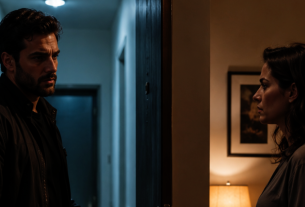
Polina bought the apartment when she was twenty-nine. She had saved for six years—first setting money aside from her first decent salary, then taking an evening job, and finally getting a little help from her parents. When she received the keys, she stood outside the door and simply ran her fingers over the lock. It was hers.
She met Anton a year later. He worked in logistics for a transport company and was dependable: no rash decisions, no empty promises. After they married, he moved into Polina’s apartment. They had agreed before the wedding that it would remain in her name. Anton had no objection. It was her home, he said, and that was that.
For three years, they lived peacefully. Polina worked as a lawyer at a small company, while Anton managed his routes and schedules. They furnished the apartment gradually. Polina replaced the kitchen, they bought a new sofa, and they put up new wallpaper in the bedroom. They made the decisions together, but Polina paid for everything because Anton was paying off a car loan. That was their arrangement.
Ksenia Stanislavovna arrived in October.
She called Anton on a Friday evening while Polina was still at work. When Polina came home, her husband met her in the hallway wearing the guilty expression that meant, I have something awkward to tell you.
“Mom called,” Anton began.
“I can see that from your face. What happened?”
“She’s having problems. She was living with Alexandra—her cousin—and Alexandra… told her to leave. Said she needs the space. Mom has nowhere to live now.”
Polina put down her bag and took off her coat. She thought for a moment.
“She told her to leave for good?”
“That’s what Mom says. She asked if she could stay with us temporarily, until she finds something.”
Polina knew Ksenia Stanislavovna fairly well. She was sixty-four, a large woman with a loud voice and firm opinions about how people ought to live. Their relationship was cordial, though never close. Her mother-in-law had visited several times and behaved perfectly well. At least, she had never given Polina any obvious reason to worry.
“What does ‘temporarily’ mean?” Polina asked.
“Until she gets settled. Maybe a month, maybe a little longer.”
“All right,” Polina said. “Tell her she can come.”
Anton let out a breath of obvious relief.
Ksenia Stanislavovna arrived on Sunday with two large suitcases and several shopping bags. Looking at the amount of luggage, Polina silently wondered whether it was really meant for a month or a little longer. But it felt awkward to ask about a departure date the moment her mother-in-law stepped through the door.
She settled into the spare room, a small office Polina used when she worked from home. It had a desk, a computer, and several shelves of files. Polina moved what she needed into the bedroom to make space.
The first week was quiet. Ksenia Stanislavovna got up early, made breakfast, cleaned up after herself, and barely got in the way. In the evenings she watched television in her room and kept out of their conversations. Polina thought it was fine. The woman was going through a difficult time. They could be patient.
A month passed. Ksenia Stanislavovna said nothing about moving out. Whenever Polina cautiously asked, Anton said his mother was looking at places and would find something soon. Polina nodded.
In the fifth week, Ksenia Stanislavovna rearranged several kitchen shelves.
Polina discovered it one morning when she went to make coffee and couldn’t find the cups in their usual place. Her mother-in-law had decided they would be “more convenient” on a lower shelf. The upper shelf now held cereals and grains. Polina stood before the open cabinet for a moment, then poured her coffee and said nothing.
Three days later, the familiar rug in the hallway was gone. In its place lay a thick beige one Ksenia Stanislavovna had brought with her. Then a crocheted cloth appeared on the living room coffee table. After that came a new coat rack in the hallway, which nobody had asked her to buy.
Each thing was small on its own. Together, they formed a picture Polina liked less and less.
“Anton,” she said one evening after Ksenia Stanislavovna went to her room, “your mother is moving things around without asking.”
“She’s just trying to help,” Anton said, looking at his phone. “Don’t worry about it.”
“This is my apartment. I put my things where I wanted them.”
“Polina, she’s an older woman and she’s bored. She needs something to do.”
“Rearranging someone else’s home isn’t a hobby.”
Anton set down his phone. He looked at his wife with weary patience rather than irritation.
“Give it a little more time. She’ll find somewhere soon and move out.”
Polina decided to wait.
The sixth week passed. Then the seventh.
Ksenia Stanislavovna began calling the apartment “Anton’s home.” She did it only occasionally, almost in passing. “It’s always cold in Anton’s home; we should buy a heater.” “I noticed a bathroom tile has come loose in Anton’s home.” Every time Polina heard it, she felt a small sting.
Once, when a neighbor stopped by for something, her mother-in-law said, “It’s my son’s apartment. We live here.” Polina was standing right there in the hallway. The neighbor nodded and left. Polina closed the door.
“Ksenia Stanislavovna,” she said. “It isn’t your son’s apartment. It’s mine. I bought it before we married.”
“Of course, of course,” her mother-in-law replied pleasantly. “I only meant that you live here together. Nothing more.”
“I understand. I just want to be clear.”
“You’re very particular,” Ksenia Stanislavovna said with a smile. “Perhaps that’s a good thing.”
Then she went into the kitchen. As far as she was concerned, the conversation was over.
When Polina told Anton, he again asked her to be patient.
“She’s older, Polina. She speaks without thinking. Don’t take it seriously.”
“Anton, she says it regularly. It isn’t a slip of the tongue.”
“I’ll talk to her.”
“When?”
“Soon.”
Polina never heard such a conversation. Perhaps it happened; perhaps it didn’t. Either way, the phrase “Anton’s home” did not disappear.
By the end of the second month, Ksenia Stanislavovna had stopped mentioning a move altogether. When Polina gently asked how the search was going, her mother-in-law gave a vague answer: “I’m looking. Everything’s expensive, and nothing’s suitable.” Then she changed the subject.
Polina noticed something else. Ksenia Stanislavovna had mentioned registering her address at the apartment several times, always casually. Once, she told Anton they ought to make everything official, “the proper way.” Anton replied, “Mom, not now.” She fell silent, but Polina remembered it.
That Thursday, Polina came home from work early. A client had postponed a meeting, so she left the office shortly after four. Anton was still at a work site. The apartment was quiet as she took off her coat and walked down the hallway. She could hear Ksenia Stanislavovna talking on the phone in the kitchen.
Polina stopped. She had caught a familiar word.
“…Alexandra thought I’d just agree and leave,” Ksenia Stanislavovna was saying. “But I’ve settled in nicely here. Anton doesn’t mind, and as for my daughter-in-law—well, what can she do? She’s not the real mistress of this place, whatever that piece of paper says…”
There was a pause while the person on the other end replied.
“That’s exactly what I’m thinking about,” Ksenia Stanislavovna continued. “Once I register my address here, it’ll be a different story. Then no daughter-in-law will be able to tell me what to do.”
Polina stood in the hallway. Above her head was a hook holding someone else’s coat. From the kitchen came a voice calmly explaining how to secure a place in someone else’s apartment.
She walked slowly back to the front door, put on her coat, and stepped out onto the landing, closing the door quietly behind her.
She stood by the window. It was November, and darkness came early. Streetlamps glowed below while a caretaker raked leaves by the curb. An ordinary evening in an ordinary courtyard.
Polina took out her phone and called Anton.
“Are you far away?” she asked.
“No, I’m on my way. About twenty minutes. Did something happen?”
“We need to talk.”
She put her phone away and remained on the landing a little longer. Outside, the caretaker methodically scooped the last leaves into a bag. Watching him, Polina thought: That’s the way to do it. No fuss. Just clear away what doesn’t belong.
She went back inside. Ksenia Stanislavovna was still in the kitchen. Her phone call had ended, and she was stirring something in a saucepan. She turned at the sound of Polina’s footsteps.
“Oh, you’re home already? I thought you’d be later. Dinner’s nearly ready.”
“Ksenia Stanislavovna,” Polina said, “I heard your conversation.”
Her mother-in-law froze, the spoon suspended over the pan. Then she resumed stirring, a little faster than necessary.
“What conversation?” she asked without turning around.
“The one on the phone. Just now. About registering your address here.”
A pause.
“You misunderstood.”
“I heard you clearly.” Polina walked to the table and rested her hands on the back of a chair. “You said that once you registered here, no daughter-in-law could make you leave. Those were your exact words.”
Ksenia Stanislavovna put down the spoon and turned around. Her face showed a mixture of embarrassment and irritation.
“Polina, don’t make such a fuss. I was just chatting with a friend. People say all sorts of things…”
“You were explaining how to establish a claim to someone else’s apartment. My apartment.”
“It isn’t someone else’s apartment,” her mother-in-law said, her voice growing firmer. “My son lives here.”
“Your son lives here with my permission,” Polina replied. “And so do you. For now.”
Ksenia Stanislavovna folded her arms.
“Are you saying I made up the whole story about Alexandra?”
“I don’t know what happened with Alexandra. I know you’ve lived here for two months without talking about moving. You call my apartment your son’s home, and I just heard you explain on the phone how you plan to register here so no one can make you leave.”
“You were eavesdropping!”
“I came home,” Polina said calmly. “This is my kitchen. I have every right to stand in it.”
Ksenia Stanislavovna approached the table with the rigid dignity of an offended person.
“Polina, I don’t understand your tone. I’m an older woman in a difficult situation. I asked my son for help. That’s perfectly normal.”
“Asking for help is normal. Planning to register here without my consent so I can’t make you leave is not.”
“You’re planning to throw me out?” Ksenia Stanislavovna raised her voice. “This is Anton’s apartment too!”
“No.” Polina shook her head. “It isn’t. I bought it before our wedding. It’s in my name alone. It’s property I owned before marriage.”
“Listen to you, talking like that!” Ksenia Stanislavovna threw up her hands. “You’re already thinking about divorce!”
“That isn’t what we’re discussing. We’re discussing the fact that you need to pack your things.”
Her mother-in-law fell silent. She looked at Polina with an expression Polina had learned to recognize: calculation. She was working out what she could do, where she could apply pressure, and who might help her.
“I’m not going anywhere,” Ksenia Stanislavovna finally said. “I have nowhere to go. Anton will be home soon, and we’ll see what he says.”
“Anton doesn’t decide who lives in this apartment,” Polina replied. “It belongs to me. Only me. And you’re leaving today.”
“You can’t throw me out!”
“I can,” Polina said, taking a step toward the door. “Please start packing.”
Ksenia Stanislavovna did not move.
“We’ll wait for Anton,” she said.
“All right,” Polina replied. “We’ll wait.”
She went into the room where Ksenia Stanislavovna had been staying, opened the wardrobe, and began taking out her clothes, carefully, one item at a time. She pulled the large suitcase her mother-in-law had arrived with from under the bed, opened it, and started packing.
Ksenia Stanislavovna appeared in the doorway.
“What are you doing?”
“Helping you pack,” Polina said without turning around.
“Those are my things! Don’t you dare touch them!”
“Then pack them yourself. I’ll wait.”
“I’ll call the police! You’re evicting me illegally!”
“You aren’t registered at this address.” Polina stopped and looked at her. “If you want to call them, go ahead.”
Ksenia Stanislavovna said nothing. The threat of calling the police hung between them.
“I take it you won’t,” Polina said, returning to the suitcase.
Packing all of Ksenia Stanislavovna’s belongings took about twenty minutes. Her mother-in-law shouted, paced around the room, and seized on various objects as though pointing out how thoroughly she had made herself at home. Polina worked steadily, without rushing. She folded clothes, packed shoes, and took down the robe her mother-in-law had hung above the door. All the while, Ksenia Stanislavovna spoke loudly about her son, about family, and about young people’s duty to respect their elders.
Polina did not argue. She kept packing.
Once the first suitcase was closed, she started on the second. Ksenia Stanislavovna went quiet, apparently realizing that words would not stop her.
Anton arrived to find both suitcases and three bags in the hallway.
He opened the door and took in the scene: his mother sitting on a chair, red-faced, and Polina standing beside her with a composed expression.
“What’s going on?” he asked.
Ksenia Stanislavovna spoke first, rushing through an account of how Polina had eavesdropped, caused a scene, and packed her things without permission.
Anton listened, then turned to his wife.
“Polina, what happened?”
“I came home and heard your mother telling a friend on the phone that she plans to register her address here. She said that once she does, no daughter-in-law will be able to make her leave,” Polina said. “Those were her words.”
“You misunderstood!” Ksenia Stanislavovna sprang up.
“Anton,” Polina continued, “I let your mother stay because I felt sorry for someone in a difficult situation. For two months I put up with her rearranging things, calling my apartment your home, and making no plans to move. I thought it would pass. Today I heard what she’s planning.”
Anton was quiet for a moment. He rubbed his forehead.
“Mom, did you really say that?”
“Anton, I was just talking to my friend, and Polina took it all the wrong way. She was deliberately listening, and—”
“Mom.” Anton raised a hand. “Did you say it?”
Ksenia Stanislavovna fell silent.
“I see,” Anton said.
He went into the other room. Polina heard him moving around. His mother remained in the hallway. A few minutes later, he came out.
“Polina,” he said, “she’s my mother. She has nowhere to go.”
“Anton, she created this situation herself. She took advantage of my trust.”
“You’re overreacting. You’re throwing her out over one phone call?”
“It wasn’t just one phone call. It was two months. The call was the last straw.”
“She isn’t leaving tonight,” Anton said firmly. “Where is she supposed to sleep?”
“She’ll have to work that out,” Polina replied.
“You’ve lost your mind.” Anton shook his head. “She’s my mother. I can’t put her out on the street.”
“Then take her to a hotel, to a friend, or back to Alexandra. Work something out. But she isn’t staying here tonight.”
“Polina.” Anton stepped closer and lowered his voice. “You understand she’s my family? I can’t turn against her.”
“You’re turning against me,” Polina said. “You’re defending someone who planned to register in my apartment without my consent.”
“She only talked about it. She hasn’t done anything!”
“She hadn’t had the chance.”
Anton fell silent. He looked at his wife, then at his mother, then back at his wife.
“I’m asking you for one day,” he said. “Let her stay tonight. We’ll figure something out tomorrow.”
“No.”
“Polina.”
“No, Anton. And if you keep insisting, there’s something you need to understand. You’re telling me your mother can stay in my apartment against my wishes. Do you realize what that means?”
Anton stared at her.
“It means you think you can decide what happens in my apartment instead of me,” Polina said. “In that case, pack your things too. You’re both leaving.”
At first, Anton did not seem to understand. Then he did. Something shifted in his face, but it was not remorse. It looked more like stubbornness.
“You’re serious.”
“Completely.”
Ksenia Stanislavovna started talking again about ingratitude and how Anton ought to defend his mother. Anton listened, then went into the bedroom. Polina heard the wardrobe open and items being put into a bag. It took about ten minutes.
He emerged with a travel bag over his shoulder.
“Call me if you change your mind,” he said.
“I won’t,” Polina replied.
Anton picked up one of his mother’s suitcases and helped her with a bag. Ksenia Stanislavovna was still muttering, though more quietly now. Even she seemed to understand that the time for arguments had passed.
The door closed.
Polina stood in the hallway for a moment. She picked up the thick beige rug, rolled it, and set it against the wall. Then she took her own gray striped rug from the storage cupboard and laid it where it had always been.
In the kitchen, the cups were still on the lower shelf where Ksenia Stanislavovna had put them. Polina moved them back up.
She put the kettle on.
The apartment papers were in a folder in her desk drawer. Polina took them out and held them in her hands: the ownership certificate, the sale agreement, the handover document. Everything bore her name. She had bought the apartment before the marriage.
A colleague recommended a divorce lawyer. Polina met with him three days later, bringing her folder of documents and explaining what had happened. He looked through the papers and nodded.
“The apartment belongs entirely to you.”
“I knew that,” Polina said. “I just wanted to hear it again.”
Anton sent messages for several days. First he asked to talk. Then he admitted he had been wrong, only to begin defending his mother again. Polina read his messages but did not respond to the parts about Ksenia Stanislavovna. She sent one short reply: You can file for divorce, or I will.
Anton went quiet for a week, then told her he would hire a lawyer.
He did. Anton’s lawyer requested the apartment documents, reviewed them, and quietly explained to his client that there was nothing to divide. Polina had bought the apartment before they married, and it was registered solely in her name.
The divorce was finalized in early February. There really was nothing to divide. Anton kept the car he had owned before the wedding. Polina asked for nothing. They signed where they needed to and went their separate ways.
Ksenia Stanislavovna found a room in a shared rental apartment. Polina learned this by chance from a neutral message Anton sent after the divorce. She read it, answered with one word, and closed the conversation.
In the spring, Polina put up new wallpaper in the room where her mother-in-law had stayed. She had wanted to change it for a long time; it had never been quite the color she wanted. She chose a pale gray with a barely visible texture. A friend helped her on a Saturday. They talked and laughed as they worked and finished by evening.
Polina stood in the middle of the room and looked around.
It was her office again. Her desk, her shelves of files, her work computer. Everything was where it belonged. The gray striped rug was in the hallway. The cups were on the upper shelf. There was no crocheted cloth on the coffee table.
Just an apartment. Her apartment.
The way it had always been.