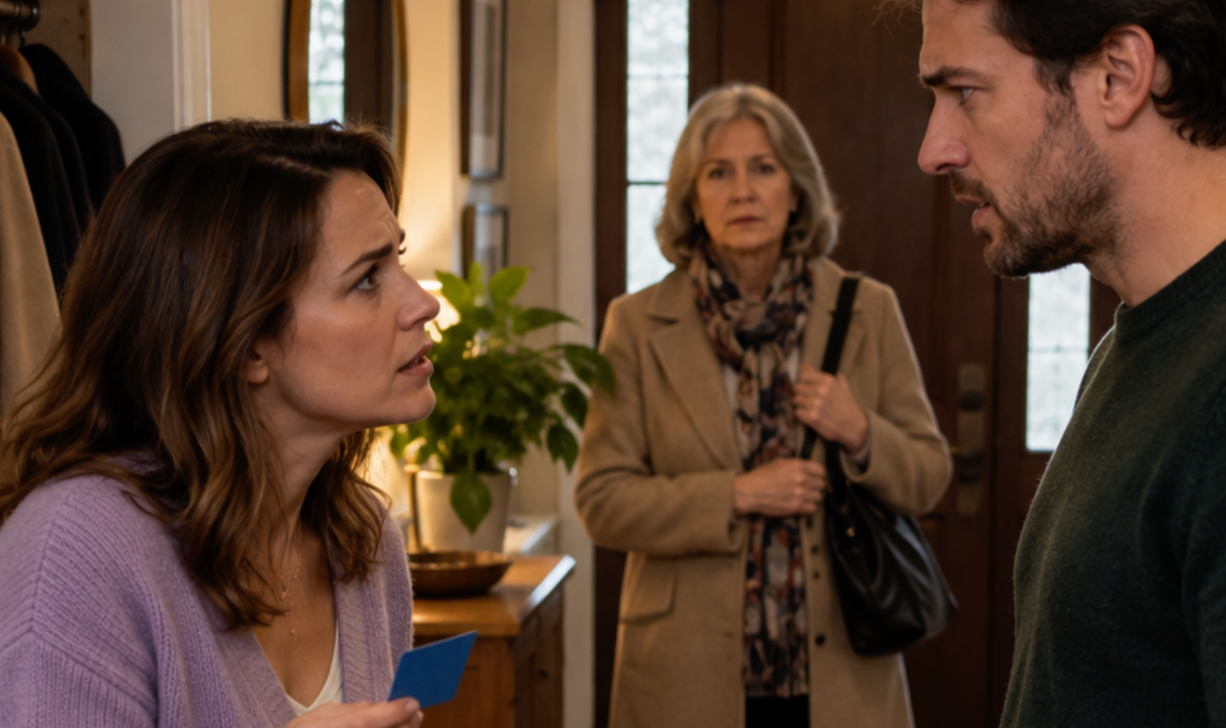
The first notification came on Thursday at around three in the afternoon, while I was standing by the printer waiting for a report. A home goods store had charged 3,280 rubles to our family card. I opened the banking app without thinking. Payday was still a week away, and on Saturday we had to pay for a month of our daughter’s classes.
Twenty minutes later, another 6,940 rubles was charged.
I couldn’t bring myself to call my mother-in-law from work. We had left her the card for the school break because she was looking after our ten-year-old daughter, Dasha, and buying groceries. That was perfectly reasonable. The home textiles store was harder to explain.
That evening, her checked shopping bag sat on the kitchen table, filled with containers. Lyudmila Pavlovna had brought Dasha cutlets, checked her math homework, and sewn a torn strap back onto her sports bag. She had always been more patient with her granddaughter than either of us, and I didn’t want to start questioning her the moment I got home.
“Lyudmila Pavlovna, did you use the card today?”
“Of course. You left it with me. I bought groceries, then stopped somewhere else on the way.”
“And the textiles?”
“A bedding set for myself. It was a very good sale. Vadim said it was a shared card, so it was fine.”
My husband hadn’t come home yet. I checked the account balance once more and closed the app.
The trouble with that card had begun long before the school break.
Four months earlier, we were going to replace our washing machine. The old one still worked, but it only spun properly half the time, and I had been saving for a new one for two months. At the store, the salesperson arranged delivery, but our family card was nearly 16,000 rubles short.
At first, we thought we had forgotten a payment. We checked the utilities, Dasha’s classes, and the groceries. Then Vadim stopped scrolling through the transactions.
“Oh, right. I paid for Mom’s microwave. And a curtain rod. She’ll pay some of it back later.”
“When did you do that?”
“A couple of weeks ago.”
There was no defiance in his voice, no attempt to justify himself. He genuinely hadn’t seen a reason to tell me.
I transferred the missing money from my salary account. We bought the machine and put off the conversation until that evening. At home, Vadim first helped Dasha build a model volcano for school, then called his mother to ask whether the curtain rod had arrived. Starting an argument in the middle of ordinary family life felt foolish.
I was the foolish one. I said nothing that night.
A few days later, Lyudmila Pavlovna sent me three links.
Oksanochka, could you order these, please? Delivery is cheaper for you.
The cart contained laundry detergent, a frying pan, and towels—about 5,000 rubles in all.
Placing the order was easy enough. Vadim said he would transfer the money after his advance payment from work. Then his car battery died, Dasha needed a dance uniform, and no one mentioned the 5,000 rubles again.
Soon it became a habit. My mother-in-law never asked for money outright. She called with phrases like “Since you’re ordering things anyway” or “Check your app; it shows things better than mine.” Once it was groceries, another time a desk lamp, then a set of kitchen jars.
Each purchase looked small on its own.
And Lyudmila Pavlovna was hardly someone who only took from us. When Dasha caught a cold, she came over every morning for three days, even though the trip took almost an hour. If we were late getting home, she would feed her granddaughter, check her homework, and leave dinner for us.
That was probably why I felt uncomfortable adding up her purchases for so long. Vadim felt even more uncomfortable.
We finally had a proper conversation when I opened three months of transactions and wrote down everything spent on his mother. The total was a little over 50,000 rubles: the microwave, the curtain rod, groceries, several household orders, ordinary cold medicine, and various small items.
The amount wasn’t the only problem. We had discussed just one of those purchases in advance.
Dasha was in her room, and we spoke quietly in the kitchen.
“More than 50,000 in three months. That isn’t ‘just little things’ for us.”
Vadim glanced down the list.
“You even put groceries on here.”
“Only the ones that weren’t for us.”
“Mom paid some of it back.”
“Show me the transfers and I’ll cross them out.”
We found two small transfers in their messages. I removed those entries, but then I lost my temper.
“Great. Now we just have to work out how much it costs us to know where our money goes.”
It came out sarcastically. Vadim shut down at once.
“This is why it’s impossible to talk to you about Mom. You can turn a bag of buckwheat into a family meeting.”
For about ten minutes, we each kept busy. He washed the dishes while I cleared the table. Then Vadim made a suggestion himself.
“How about I give her 7,000 a month without having to account for it? If she needs anything expensive, I’ll tell you first.”
We agreed.
For two months, the arrangement worked. After payday, Vadim transferred money to his mother and managed the rest of his own money himself. Unexpected purchases stopped draining the family account.
When Lyudmila Pavlovna sent me another link, I replied:
“Could you forward it to Vadim, please? He knows which money to use for the order.”
“Is it so hard for you to press two buttons?”
“No. I just don’t know what he’s already spent this month.”
After conversations like that, some requests disappeared. Vadim bought some things and postponed others. There were no major arguments, and by the autumn school break I thought the matter was settled.
Then two of my coworkers went on sick leave one after the other. Vadim couldn’t take several days off either, and we weren’t ready to leave Dasha alone from morning until evening. Lyudmila Pavlovna offered to come over.
She really did help us out.
On Monday morning, Vadim took out the family card.
“Let’s leave it with Mom. She shouldn’t have to pay for Dasha’s groceries herself.”
I had no objection. The card held money for food, household expenses, and Dasha’s classes.
On Monday, there were charges from the supermarket and bakery.
On Tuesday, there was a charge of 3,280 rubles at a home goods store, followed by almost 7,000 for textiles. Lyudmila Pavlovna explained that she had bought containers, a bathroom shelf, and a bedding set. According to her, Vadim had said she could use the card.
That evening, my husband waved it away.
“I’ll transfer the money back later. Don’t start.”
“When?”
“Oksana, do we really have to count every thousand today?”
I only reminded him that Dasha’s classes were due on Saturday.
On Wednesday, my mother-in-law took her granddaughter to the cinema with her own money and refused to accept a transfer from me. By evening, I was starting to think I might have made too much of Tuesday’s purchases.
On Thursday, another 7,500 rubles went from the card at a shoe store.
This time I called Vadim.
“Your mother bought shoes with the family card.”
“Then she must have needed them.”
“For herself?”
“Well, they’re an adult size, so they’re obviously not for Dasha.”
He was walking somewhere as he spoke, and someone nearby was asking him about a car. We ended the call with a promise to discuss it that evening.
We didn’t. Vadim got home late, Dasha couldn’t find her notebook, and then a pipe leaked in the upstairs neighbors’ apartment. Everyone in the building spent half an hour trying to work out whom to call. By night, I didn’t want to bring it up again.
On Friday morning, Lyudmila Pavlovna told me she had ordered a bedspread and two pillows. They were to be paid for with our card on collection.
That was when I asked her to leave the card on the hall table.
She froze, her coat already buttoned.
“Vadim said I could use it until the end of the week.”
“It’s Friday. We have groceries, and Dasha doesn’t need anything.”
“You should ask my son first.”
“It’s my card too.”
She put it beside the key tray, kissed her granddaughter, and left earlier than usual.
About ten minutes later, Vadim called.
“Why did you throw Mom out?”
“I didn’t throw her out. I asked her to return the card.”
“Leave the card with Mom. What difference does it make who spends the money?” my husband asked.
In a matter of seconds, I understood that explaining our shared budget again was pointless. We had already talked about it and even lived by our agreement for two months.
“All right. We’ll talk tonight.”
At lunch, I opened the banking app and downloaded the transactions from the past few months. I kept only the purchases we had previously counted as help for Lyudmila Pavlovna and the new purchases from that week.
At home, I checked the list again and crossed out expenses for Dasha, shared groceries, and the two old transfers with which my mother-in-law had repaid part of the money.
A few lines remained: the microwave and curtain rod, kitchen and bathroom orders, textiles, and shoes. I didn’t include the bedspread and pillows because she hadn’t collected them yet.
In five days of the school break, Lyudmila Pavlovna’s personal purchases had come to nearly 25,000 rubles.
Vadim came home around eight, ate, asked Dasha about the cinema, and only then noticed the sheet beside his plate.
“What’s this?”
“Your mother’s purchases.”
“You’re counting again?”
“I’ve already counted.”
He read the entries in silence.
“And what do you want?”
“Starting on the first, we each transfer the same agreed amount to the family card. Utilities, groceries, Dasha, the household—everything shared comes from there. Anything extra you want to pay for your mother comes from your own card.”
“And if she really needs help?”
“Help her.”
“How convenient.”
“I think so too.”
That last remark was unnecessary, but I didn’t take it back.
Vadim pushed the sheet to the edge of the table.
“So my money is separate now?”
“Whatever remains after your contribution to the family account, yes. The same goes for mine.”
“You were fine with things before.”
“Before, I made up the difference whenever there wasn’t enough left for our expenses. I won’t do that anymore.”
He went into the bedroom after that and spoke only to Dasha for the rest of the evening. There was no satisfying final word.
On Saturday, Lyudmila Pavlovna called about the bedspread.
“If you’ve taken the card away, how am I supposed to pay for it?”
The phone was on speaker because Vadim was peeling potatoes. He glanced at me and took it off speaker.
“Mom, I’ll pay for it. Just next month.”
I couldn’t hear her reply. He clearly didn’t like the conversation.
On the first of the month, we did what we had agreed: one card for shared expenses and two equal transfers after payday. We each kept the rest.
For the first few weeks, Vadim asked me nothing about money. He transferred the usual amount to his mother, then paid for her internet and the bedding set she had decided to keep.
Toward the end of the month, his car needed repairs. After paying the garage, Vadim had noticeably less money left. Two days later, Lyudmila Pavlovna sent him a link to a new vacuum cleaner.
I didn’t find out by looking at his phone. That evening, he stood in the kitchen with a shopping app open, comparing two models.
“Does her old one still work?” I asked.
“It works.”
I said nothing more.
A minute later, he called his mother.
“Mom, I’m not buying the vacuum cleaner yet. No, it’s not because of Oksana… Because I can’t afford it this month. The old one still works, doesn’t it? Well, use that for now.”
Lyudmila Pavlovna talked for a long time. Vadim tried several times to get a word in, then went into the hallway.
The next morning, he asked, “Can you pay for my petrol until payday? I’ll pay you back.”
Before, I would have transferred the money without a second thought.
“Is it for family trips or your commute?”
He grimaced.
“My commute.”
“Then it comes from your money.”
“I’m almost out.”
The list of purchases was still in a kitchen drawer, but I didn’t need to take it out. Vadim opened his banking app and messaged his cousin without arguing further. Later he told me he had borrowed a small amount until payday.
I didn’t like it, but I didn’t interfere. Otherwise, our new arrangement would immediately become the old one, only with longer conversations.
Things grew cooler between my mother-in-law and me. For several weeks, she pointedly brought everything she might need when she came to see Dasha: tea, bread, even paper napkins. One day I couldn’t help myself.
“Lyudmila Pavlovna, you don’t have to buy Dasha’s food with your own money. That wasn’t what this was about.”
She adjusted the strap of her bag.
“I’ll manage.”
I didn’t press it. Half an hour later, we were looking together for Dasha’s atlas, which she had somehow wedged between the sofa and the wall. Then my mother-in-law showed me the best way to take in her granddaughter’s sports trousers.
About two months later, Vadim stopped treating the new arrangement as a punishment. He simply began keeping track.
Sometimes he helped his mother with more than the agreed 7,000 rubles, sometimes less. Once, he paid to repair her refrigerator and bought almost nothing for himself that month. Another time, he refused to replace her perfectly good kettle just because she liked a new one.
I never heard him thank me for being right or admit that he had been wrong. I no longer needed him to.
Before the winter holidays, Lyudmila Pavlovna stayed with Dasha for a few hours again. As she was leaving, she told her son:
“I bought groceries. I sent you the receipt in the messenger app. You can transfer the money later.”
Vadim checked the amount and immediately sent her the money from his own card.
The family card was in my wallet. No one even thought to ask for it.