Here is the translation of the full story.
“What is a child without roots? Nobody. A ghost who, by a twist of fate, was given a body.”
“So, have you always felt like a ghost?” Mikhail asked, stirring his coffee in my sophisticated kitchen.
I looked at him: my only friend, the one who knew the whole truth. The one who had helped me find her: the woman who had carried me, then rejected me from her life like a useless rough draft.
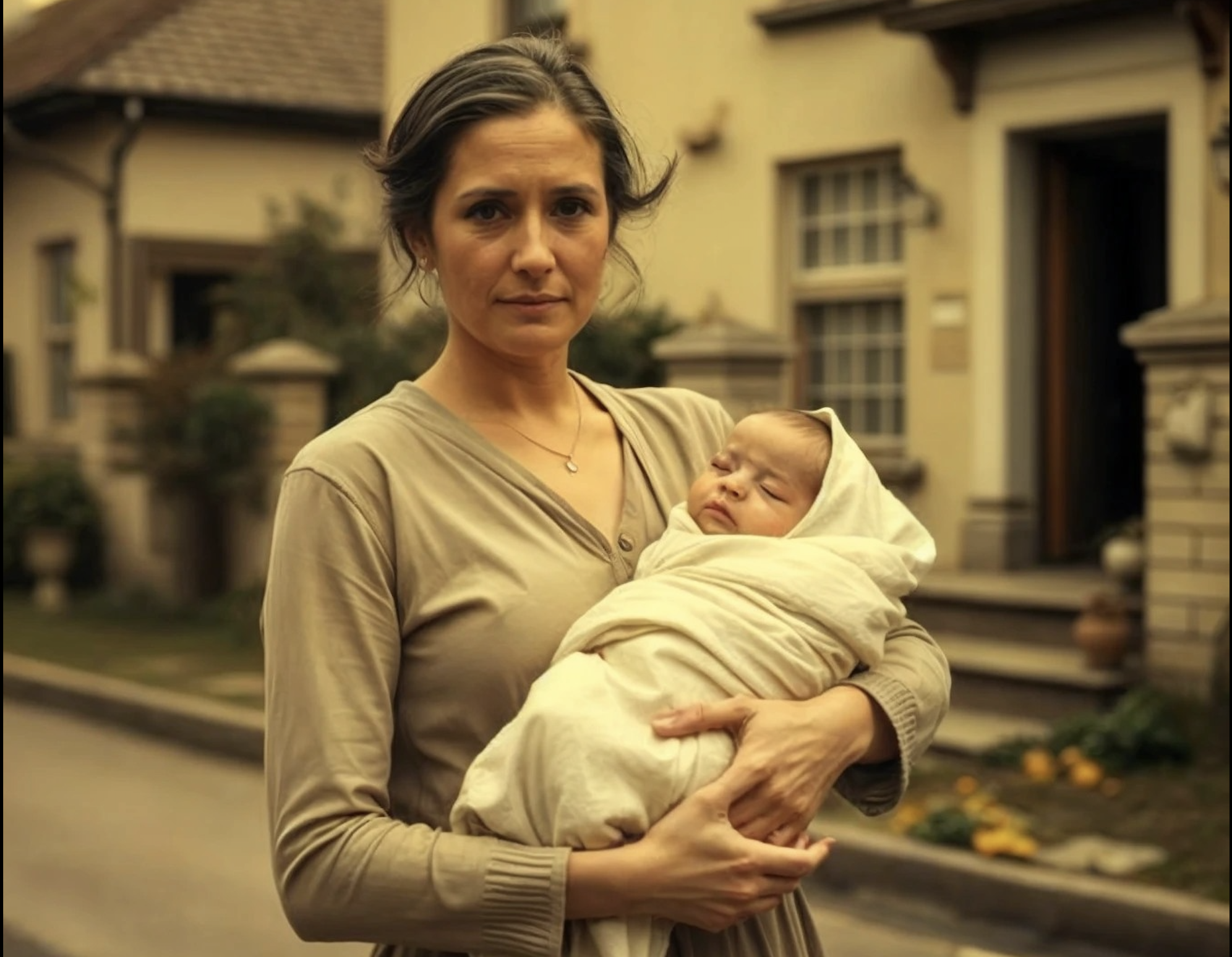
My first cry hadn’t moved her heart. All that my adoptive parents kept of me was a simple note, pinned to a cheap blanket: “Forgive me.” A single word—that was all I received from the woman who called herself my mother.
Lyudmila Petrovna and Gennady Sergeyevich, an elderly childless couple, discovered me one October morning.
They opened the door and found that bundle: alive, crying. They had enough decency not to send me to the orphanage, but not enough love to adopt me as their own daughter.
“You live with us, Alexandra, but remember: we are strangers to you, and you to us. We are simply doing our duty as human beings,” Lyudmila Petrovna would repeat every year on the anniversary of the day they found me.
Their apartment became my prison. I was assigned a corner in the hallway and a camp bed. I ate alone—after them, picking at the cold leftovers.
My clothes came from the flea market, always two sizes too big. “You’ll grow,” my adoptive mother explained. Except that by the time they fit, they were already patched and worn.
At school, I was a pariah: “the foundling,” “the tramp,” “the orphan,” my classmates whispered.
I didn’t cry. Why should I? I was building reserves: of strength, of anger, of determination. Every shove, every taunt, every icy stare fueled the fire inside me.
At thirteen, I started working—handing out flyers, walking dogs. I hid my coins under the floorboards. One day, Lyudmila Petrovna discovered them while cleaning.
“Are you stealing?” she said, brandishing the crumpled bills. “I knew it, the apple never falls far from the tree…”
“No, that is my money, I worked to earn it,” I replied.
She threw the cash onto the table. “Then you will pay for room and board. You’re old enough now.”
By fifteen, I was working every free moment I had after school. At seventeen, I entered university in another city.
I left with a single backpack and a box containing my only link to my past: a photo of me as a newborn, taken by a nurse before my biological mother abandoned me at the maternity ward.
“She didn’t love you, Sasha,” my adoptive mother told me by way of goodbye. “And neither did we. But at least we were honest.”
In the student dorms, I shared a room with three roommates. My meals consisted of instant noodles. I studied relentlessly—solely to get top honors and keep my scholarship.
At night, I worked in a 24-hour convenience store. My classmates mocked me and my threadbare clothes; I didn’t hear them. Only one thought echoed in my mind: “I will find her. I will show her what she threw away.”
Nothing is worse than the feeling of being useless. It creeps under your skin in infinitely small shards that never come out.
I played nervously with the gold chain around my neck—my only weakness, a luxury I treated myself to after my first big project. Mikhail knew my story; he had found my mother and helped me establish a plan.
“You understand that this won’t bring you peace?” he asked. “I don’t need peace,” I replied. “I need closure.”
Life is unpredictable. Sometimes it offers a chance where you least expect it. In graduate school, our marketing professor assigned us a mission to create a strategy for an organic cosmetics brand.
I went three nights without sleep, injecting all my anger and thirst for recognition into it. When I presented my work, a stunned silence filled the lecture hall.
A week later, the professor entered the room, his eyes blazing: “Sasha, investors from Skolkovo want to meet you.”
Instead of a fee, they offered me a modest share of the project. My trembling hand signed the papers—I had nothing left to lose.
A year later, the startup took off. My share turned into a sum I hadn’t dared to dream of: enough for a down payment on a property, enough to launch a new project.
Life accelerated: from one investment came two, then five.
At twenty-three, I bought a beautiful apartment in the city center, bringing only my bag and the photo box. No debris from the past: just the starting point and the road ahead.
“You know, I thought success would make me happy,” I confided to Mikhail the day we met at a conference. “In fact, it only reinforced my loneliness.”
“A ghost follows you everywhere,” he replied, describing what I couldn’t articulate.
I told him my whole story. Mikhail wasn’t just a friend; he was a private detective. He offered his help, and I accepted. Two years of searching, hundreds of false leads, and then finally: her. The one of whom nothing remained but “forgive me” and my genes.
Irina Sokolova. 47 years old. Divorced. Living in an old building on the outskirts. Working day-to-day. “Childless.” That note in her file burned my heart. Her photo: the pale face of a woman bruised by life.
In her eyes, there was none of the spark I had cultivated.
“She’s looking for work,” Mikhail announced. “Cleaning. Do you want to go through with the plan?” “Absolutely.”
The plan was simple: Mikhail posted an ad for a housekeeper and conducted the interview at my place while I watched via hidden camera.
“Do you have much experience, Irina Mikhailovna?” he asked in an official tone. “Yes,” she replied, picking at her damaged nails. “I’ve worked in hotels, in offices. I am very thorough.” “The mistress of the house is demanding. She insists on impeccable cleanliness and punctuality.” “I understand. I really need this position.”
Her tone was broken, like an old scratched record, and I despised her submission.
“You are hired on a trial basis,” Mikhail declared.
Once alone, I picked up the passport she had left for photocopying: the document of the woman who had given me life and taken away love.
“Do you still want to pursue this?” asked Mikhail. “More than ever,” I replied.
A week later, Irina started working. I watched her enter my life with her rag and bucket. The woman who was everything to me and chose to be nothing. Our first face-to-face lasted an instant: I pretended to be busy, barely nodding when Mikhail introduced us.
She gave a clumsy curtsy, her eyes already fixed on the risk of losing the job: I felt a cold satisfaction.
For two months, she remained invisible, leaving behind the scent of lemon cleaner and immaculate order. Eight cleaning sessions, eight opportunities to observe every little gesture, every sigh. I left her good tips, not out of pity, but so she would come back. So the performance would continue.
We almost never spoke. I was “too busy” or “on an important call.” Yet I saw her: how she polished my furniture, how her gaze lingered on my travel photos, my professional trophies, my portraits in front of the Eiffel Tower.
I noticed her looks were longer than necessary for a perfect stranger. Did she remember our shared features? Did she awaken the memory of her own body, which had once carried me?
Mikhail told me one evening: “You’re making her suffer, but you’re making yourself suffer, too.” Perhaps he was right. But I couldn’t stop.
Every time Irina left, it drove me to grab my birth photo, to scrutinize that tiny face, searching for the answer: Why? What was so abject about me that she chose not to love?
The answer came one day when I saw her stop in front of the bookcase in my office. On a shelf stood a silver frame with my graduation photo. Her cracked fingers brushed the glass with a tenderness that was almost frightening.
“Did you find something familiar?” I said, stepping through the door.
The frame trembled in her hands. She turned around, looking like a thief caught in the act. “Alexandra Gennadiyevna… I… I was just cleaning…”
Her eyes were shining with held-back tears.
“You have tears in your eyes,” I remarked, not asking, just stating. With a quick gesture, she furtively wiped her cheeks with her sleeve. “It’s nothing… just dust that stings…”
I stepped forward, taking my seat behind my desk. “Sit down,” I said in a cold, surgical voice.
She sat on the edge of the visitor’s chair, tiny in this world of luxury and power. “You have something… familiar,” she murmured, her gaze averting mine.
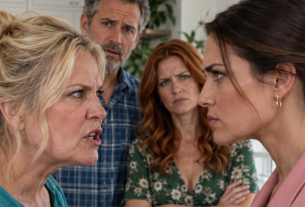
My heart clenched, then hardened. “Irina Mikhailovna, twenty-five years ago, you left a child on the threshold of an apartment. A little girl with a note: ‘Forgive me.’ That little girl was named Alexandra. Look up. Look at me.”
She raised her eyelids, bewildered, terrified. Her hand instinctively covered her mouth to stifle a sob. “That’s… impossible,” she articulated.
I opened a drawer and took out my birth photo. I placed it in front of her. “You haunted me every night,” I said. “I dreamed of asking you why… Why did you judge that I didn’t even deserve a chance? What was so horrible about me?”
Her face twisted, and she fell to her knees beside my desk. “You don’t know… I was very young. The father left me when he found out I was pregnant. My parents threw me out. I was alone, penniless, homeless. I didn’t know… how to manage.”
“So you decided to get rid of me?” My tone trembled. “I… thought it would be better for you. That someone would give you what I couldn’t: a roof, food, love…”
A bitter laugh burst out of me. “Love? You thought strangers would adopt an abandoned child? I was raised, but never loved.”
Tears streamed down her cheeks. Her hand reached out toward me, but she didn’t dare touch me. “I thought of you every day… every day for twenty-five years.”
“But you didn’t look for me,” I said coldly.
“I did!” Her cry was steeped in despair. “I came back a year later, but they told me no one had found you. So I believed…”
“That I had been sent to an orphanage and they had stopped searching.”
She lowered her head, shaken by sobs. “Forgive me… if you can. At least let me…”
“Let you do what?” I asked.
“Stay near you. Get to know you. Even as a cleaning lady. Please, don’t send me away.”
I looked at her: broken, pitiful, crushed by life and her choices. And suddenly, a lightness washed over me: as if a huge weight had flown away.
“No,” I said quietly. “I don’t want to punish you. But there is nothing to forgive. You made a choice then; I am making one now. I set you free. And I free myself from this story.”
I stood up and walked to the window. The city hummed outside, alive, full of promise. “Mikhail will see you out and pay you for the day. Please do not come back.”
When she finally left the apartment, I sat there, phone in hand. A message displayed: “Contact blocked.”
I put the small photo of my birth back under my eyes. “You did it,” I whispered to her. “You did it alone.”
Two days later, I reached for my phone again. I called her. I invited her to meet. To start over. I had let go of my pain, tried to understand her situation, tried to forgive.