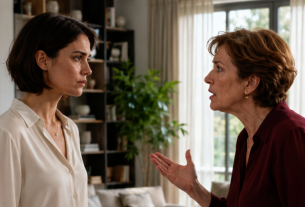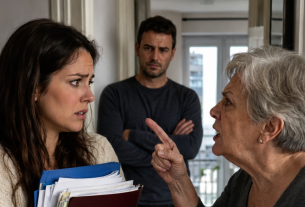
The key turned in the lock with that nasty crunch, as if they were opening not a door, but a coffin.
No one was there to greet them. No one turned on the light. The apartment smelled of mothballs, boiled chicken, and someone else’s life. And of silence — the kind in which you can hear something important trembling inside you. Maybe pride. Maybe your heart.
“Well then,” Marina said hoarsely, taking off her shoes. “We’re back.”
Her son, Dimka, fifteen years old, clutching his backpack in his hands, walked past her without looking. He did not like this apartment. And she did not like it either. Everything here smelled of the past. Of Grandma Lyuda, who had died two months ago and since then seemed either to be waiting for someone to return or taking revenge through drafts.
Marina had not cried at the funeral. Not a single tear. And all the relatives, especially Lyosha’s sister — that sullen Svetka with eyes like a toad on an icon — circled around her silently, as if preparing for an attack.
“She’s on pills, you know,” Sveta whispered to someone at the memorial meal. “She’s got everything under control, don’t worry. Cold as a surgeon.”
Marina would have slapped her then, but Dimka was standing nearby. After that, there was no time for it. Then came the inheritance.
“So, the apartment at 44 Sovetskaya Street, Apartment 6,” the notary read in a dull voice while the clock ticked behind him, “according to the will, passes entirely to Martynova Marina Igorevna, granddaughter of the deceased. The certificate of inheritance is being issued today.”
That was when Marina first felt a wave of anxiety run down her spine, as if someone had just shoved a suitcase full of drugs into her hands and said, “Now you have to live with this.”
The apartment — that very same two-room Stalin-era apartment, with high ceilings and windows facing the park — Grandma Lyuda had guarded it like her own soul. She trusted no one. Before her death, she had secretly rewritten the will, a week before the stroke.
And the relatives had thought everything would go the old way. That it would be “split equally,” “fairly,” “like family.” Ha. Family.
Sveta was the first to call.
“Masha, well, you understand this isn’t exactly fair.”
“Sveta, Grandma left it in her will. Not me. I didn’t even know, I swear.”
“Yes, yes, of course. Only for some reason, you were the one living with her for the last six months.”
“Because no one else offered, Sveta.”
“Uh-huh. Fine, then. My brother and I will think about how to handle this. Without scandals. Like family. I believe in you.”
“What do you mean?”
“Well, you’re not planning to live there alone, are you? With your son? And you still have a mortgage, don’t you? Or have you already paid it off?”
Marina ended the call.
And she understood: it had begun.
A week later, a court summons arrived.
Svetlana and Alexey — Marina’s ex-husband, by the way — filed a lawsuit to have the will declared invalid.
The grounds: “Grandmother was not of sound mind.”
“How sweet,” Marina said to the lawyer. “Grandma baked them apple charlotte, corresponded with them, and even bought Sveta a gold chain a week before she died. But she was out of her mind.”
“That’s family,” the lawyer shrugged. “Family is like a washing machine. Everything spins, everything gets mixed together, and you never know who will end up paired with whom.”
Marina knew Sveta was a snake. And Lyosha was a coward. But to this extent?
He appeared at the apartment as soon as he found out she had the key.
“I just want to pick up a few things,” he said, standing in the hallway in a jacket that had clearly been bought by another woman.
“Lyosha, are you serious? What, you don’t have keys?”
“For some reason, they weren’t left to me.”
“Because you are not an heir. Neither morally nor legally.”
“Listen, don’t start. I grew up here, actually. She was my grandmother too. I actually…”
“You actually divorced me after I gave birth,” Marina said quietly. “And disappeared for four years. And now you want to take a wardrobe?”
“My father’s medals are there!” he flared up. “Do you think I came here to steal?”
“No. I think you came to see whether I’d broken. And you’re disappointed.”
He fell silent.
Then he came in anyway.
In the kitchen, he sat down on a stool and rubbed his hands.
“Sveta thinks you’ll agree to ‘give up a share.’ She has already found a realtor. She wants to buy it through acquaintances. At a price like, ‘Come on, Masha, it’s not Moscow, don’t be greedy.’”
“I’m not giving up anything. I lived with Grandma. I lifted her, I washed her backside, excuse me. And she heard everything. And she chose.”
“You’ve become completely different,” he said, looking out the window.
“I was always like this. You just didn’t notice. Or didn’t want to.”
“I want you to think about it. Dimka will need to go to university. And you have two apartments. Is that fair?”
“You are not the one to talk to me about fairness, Lyosha. You sold your share back when we were married — and not to me.”
He stood up, raising his hands as if surrendering.
“All right, all right, don’t get worked up. Fine. Then I’ll see you in court.”
“Tell Svetka: if she thinks I’m ‘without a husband, without money, with a child’ and therefore easy to bend, let her remember who sat with her in the same hospital ward when she was having that ‘female surgery’ because her husband had gone on a trip and turned off his phone. And who held her hand then.”
He stopped in the hallway. For a long time, he did not move.
“It’s a shame it all turned out this way,” he said as he left.
“It’s a shame you didn’t think earlier. Now it’s too late,” she answered, locking the door behind him.
Late that evening, Dimka came out of his room.
“Mom, are we really staying here?”
“I don’t know, Dim.”
“And what if they take it away?”
“Then we’ll fight.”
“We’re alone, aren’t we?”
She wanted to say no. She wanted to lie. But she could not.
“For now, yes. But we are strong.”
He silently hugged her. For the first time in a long while, Marina broke down crying — into his thin shoulder, which smelled of childhood, sneakers, and a new life.
“Mom, where are you going dressed like that?” Dimka peeked out of his room, looking at her cautiously.
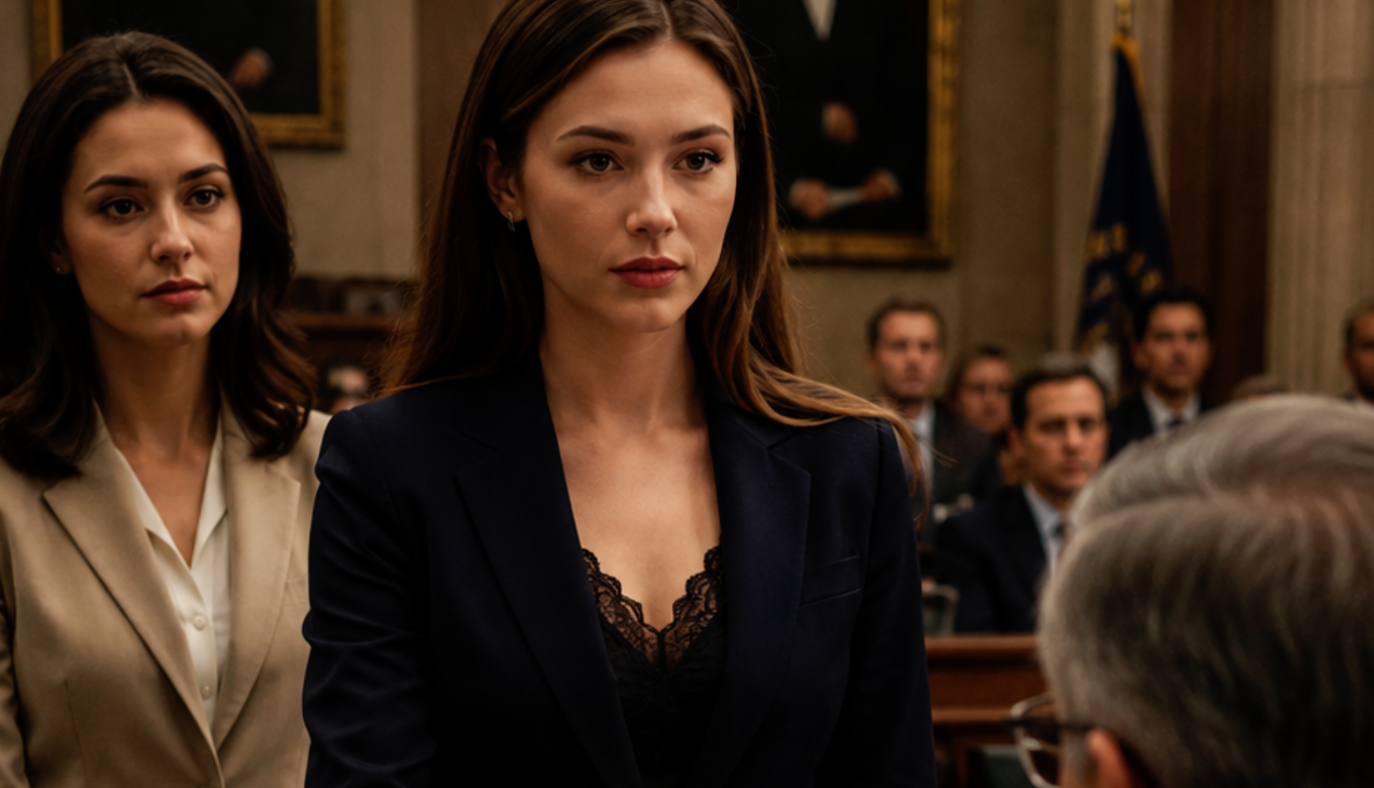
“To battle, son,” Marina tightened the belt of her black blazer and adjusted the collar. “Today is court.”
“Are you going to shout?”
“I’ll try to hold myself together. But if I start yelling, know this: it’s not weakness, it’s ancestral memory.”
He smirked. But his eyes were anxious. He was a teenager. And in his world, “inheritance” was a word from a crossword puzzle, not the reason his mother had stopped sleeping at night.
“I’m not going with you?”
“No, Dim. This is an adult war. You have school, football, and dreams of a student dormitory without cockroaches. Let it stay that way.”
He nodded. And she left.
The court was in the building of a former district party committee. Everything was peeling, and it smelled of smoked plastic and other people’s lives — lives that could no longer be washed clean.
Sveta arrived early. Dressed as if for a corporate party at the tax office: a jacket the color of “drown my hopes,” and a hairstyle in the style of “I don’t care, but you’re still a loser.”
Beside her was Lyosha. He did not smile. He did not look at her.
Marina sat opposite them. Their eyes did not meet even once. Only Svetka’s lip twitched slightly when Marina took copies of receipts out of her bag: medicine, a nurse, groceries — everything she had bought for Grandma. And finally, a certificate from the clinic dated three days before the stroke:
“Mental state stable, no complaints. Full understanding of events.”
“The plaintiffs claim that the will was written under pressure,” the judge mumbled, a woman in glasses who had already eaten three caramel candies that morning. “Did you know about the will?”
“No. I found out only after Grandma’s death. The notary called me in.”
“Why, then, were you the one living with her?”
“Because there were no other volunteers. Svetlana Gennadyevna was on vacation in the Maldives, and Alexey Sergeevich was living with his new wife and was not answering calls.”
“That’s a lie!” Sveta cried out. “We visited! I brought medicine! I have receipts!”
“Once,” Marina clarified. “On March 8. You brought Nurofen and a box of Raffaello. Then you posted a story saying, ‘Visiting beloved Granny.’ Shall we submit the photo?”
The judge pursed her lips. Lyosha turned away.
“I just believe,” Sveta changed tactics, speaking quietly, almost crying, “that my mother could not simply take everything and disinherit us like that. It’s a family apartment. We grew up there with her. Dad died there. His photo is hanging there. Everything there is ours!”
Marina looked at her with tired pity.
“That’s true. Everything there is yours. Your promises that you’d ‘come on the weekend.’ Your ‘later.’ Your ‘I can’t right now, I’m working, I’m divorced, I’m tired.’ All of it is yours. Only once she was in the coffin did you remember where the kettle stood. Before that — not a word, not a kopeck.”
“I wasn’t obligated to live with her!” Sveta shouted. “I have my own life!”
“And I was obligated?”
“You? Nothing. You are nobody. You just happened to be nearby at the right time!”
“Oh, really?” Marina stood up. “And what about the fact that I lived with her not ‘at the right time,’ but for the last three years? While my marriage was falling apart, while you were running from clinic to clinic, treating your ‘nerves’ and screaming that you were tired? I washed her feet, held her head when she was choking on her cough, signed papers at the hospice. Where were you then?”
“Enough!” the judge barked. “This is not a talk show!”
Marina sat down. Tears were already running into her mouth. She did not wipe them away. Let them see.
After the hearing, Lyosha caught up with her.
Outside the entrance. The same look: a little tired, a little pathetic, apologizing far too late.
“Masha, I… I wanted to say. I didn’t want it to turn out like this.”
“It did. Everything you didn’t want has already happened.”
“I didn’t know she would push this so hard. Sveta. I thought we would just divide the apartment and that would be it.”
“You thought? Have you thought at all lately?”
“Masha, I’m not your enemy.”
“Really? Then who was sitting across from me in court?”
He said nothing.
She turned, wanting to leave, but he grabbed her arm.
“Wait. Someone has come. I didn’t know he would return. But… he wants to talk.”
“Who?” Marina asked, confused.
“Uncle Artyom. From Petersburg. Grandma Lyuda’s older brother.”
Marina froze.
“He died.”
“No. They quarreled. He simply cut her off. And she convinced everyone that he was ‘no brother of hers.’ But he’s alive. He’s seventy-six. He’s come back. And he says he has documents.”
“What documents?”
“A will. Another one.”
The next day, the doorbell rang in the apartment.
She went to the door. On the threshold stood an old man. With a cane, a hat, and eyes that looked as if he had seen everything. Even what he had not wanted to see.
“Hello, Marina,” he said.
“Artyom Pavlovich?”
“You look like her. In her youth. Only your gaze is different. Harder. That means it was not all for nothing.”
He handed her a folder.
“What is this?”
“A will. Official. Registered in Petersburg. With stamps. The apartment passes to you. And not only that one. There is another. On Ligovka.”
“What? What apartment?”
“Lyuda sold the dacha. Invested in the Petersburg apartment. Registered it in my name. Then transferred it to you. Because you are the only one who did not betray her.”
Marina stood rooted to the spot. She read the lines. Her hands were trembling. There it was, in black and white:
“To Martynova Marina Igorevna, I leave the apartment in Moscow and a share in the apartment in Saint Petersburg.”
“Why were you silent?” she whispered.
“Because Lyuda asked me to. She was afraid they would start dividing everything while she was still alive. She wanted to leave quietly. And I didn’t make it in time.”
“Does everyone know now?”
“They will tomorrow.”
Marina closed her eyes. Everything collapsed. There would be no more trial. The will had been registered earlier. The relatives would run straight into a wall.
“And what am I supposed to do with this?”
“Whatever you want. But remember one thing,” he placed his hand on her shoulder. “Betrayal does not always shout. Sometimes it simply does not come. You stayed. That is the answer.”
He left.
That evening, Dimka found her on the balcony.
“Mom, well? What happened?”
“We won. Without even starting.”
“What do you mean?”
“We have two apartments now. And a paper that puts everything in its place.”
“Are we rich now?”
“No. We are simply no longer poor.”
“Can I go sleep over at Max’s? To celebrate?”
“Only without any ‘celebrating.’ And no vodka.”
He laughed and ran off to pack his things.
And Marina sat there. For a long time. Silently.
The words pounded in her head:
“Now the real thing begins. The division. Not of the apartment. Of kinship.”
Marina woke up to the doorbell. The apartment was cool, the kettle had gone cold, and outside the window there was a gray morning drop on the glass. That kind of rain does not pour; it breathes down your neck — sticky, stubborn.
Sveta was standing on the threshold. No makeup. No shouting. In her hands was a folder; in her eyes, exhaustion, as if someone had taken out her batteries and forgotten to put them back in.
“Will you let me in?” she asked.
Marina stepped aside. Not out of pity — out of curiosity. It was like the moment when a wolf enters a house, takes off its skin, and says, “Can I just sit down?”
Sveta did not sit down — she collapsed. Quietly, like dust. Onto the stool by the window, next to the ficus.
“I’m withdrawing the lawsuit,” she said.
“Why?”
“Because I don’t see the point. You have the will. Lyosha and I have nothing. And… I’m ashamed. You carried Grandma in your arms, and I was posting photos from the pool. What else is there to say?”
Marina was silent. Pain dulls quickly, but bitterness… bitterness sits under the tongue and comes out in the taste of everything.
“We aren’t even enemies, you know,” Sveta continued. “We are simply different. You stayed. I ran away. And I’ve been running away my whole life.”
“You didn’t run away. You simply chose yourself.”
“And you?” Sveta asked.
“I chose not to be alone. Though sometimes loneliness is easier.”
A pause hung between them. The window creaked in the wind. Sveta looked at the floor.
“Do you know what I’m afraid of?” she suddenly spoke in a different voice. Quiet. Almost childish. “That no one will remember me. Not my children. Not my grandchildren. That I’ll leave, and no one will even notice. That’s why I clung so hard to this apartment. I wanted at least something… something that would remain.”
“Wouldn’t it have been easier to build something yourself?” Marina asked calmly. “So that what remained would not be an apartment, but you?”
Sveta pressed her lips together. She stood up. Reached for the folder.
“I printed the withdrawal. Will you sign it? I just need everything to be done properly.”
Marina took the pen and signed.
That was it.
The war was over. Without a winner.
Sveta put on her raincoat, but stopped at the door.
“We won’t be sisters anymore, will we?”
“Were we ever?”
“I wanted… when we were children… for you to become one. And then… it didn’t work out.”
“Nothing worked out, Sveta. Not with you, not with Lyosha. Only Grandma worked out. She always knew what each of us was capable of.”
“And she still chose you?”
“She still did.”
Sveta left. Marina closed the door slowly, as if cutting off a bandage.
That evening, Lyosha called.
Not with accusations. Not with apologies. Just with the kind of voice people use in the dark, when they cannot see faces and cannot lie.
“Masha… I remember how you took Grandma to the clinic. She was yelling that she wouldn’t go, and you said, ‘You’re still going to a sanatorium with me.’ She laughed. Back then I thought, what a fool you were. And now I think — what an idiot I was.”
“It’s too late, Lyosha.”
“I know. I just… forgive me. For everything. For the divorce. For the way I left. For choosing someone else instead of you. Although…”
“Although?”
“You were real. And I always liked glossy things.”
Marina sat down on the windowsill. She was not allowed to smoke — her heart had been acting up — but in that moment she wanted to take a drag from a cigarette and spit on everything.
“We’re adults, Lyosha. This is no longer about what you ‘liked.’ This is about ‘too late.’”
“Can I visit Dimka?”
“He doesn’t remember you.”
“Then not for his sake. For mine.”
“Come. But don’t expect forgiveness. It isn’t handed out against a signature.”
He hung up.
A week later, a letter arrived.
Simple. No stamp. Inside was a copy of an old letter from Grandma.
“Marinochka. I know it will be hard for you. But know this: I did everything not out of spite, but out of love. You were there when everyone else turned away from me. Do not forget yourself. Do not dissolve the way I did. Love. Allow yourself, at least once, to be selfish. And do not be afraid of loneliness — it is temporary. But you are forever.”
Signed: Lyuda.
Marina sat with that letter for a long time. It smelled of a dusty box and Krasnaya Moskva perfume. It smelled of old age. Of history. Of memory.
That evening, she invited Lyosha over.
No theatrics. No hysteria. He came like a boy who had been given a second chance — but without any promise that he would not waste it.
“Do you want tea?” she asked.
“If it’s with lemon, yes.”
“And with cyanide?”
“That’ll do too. As long as it’s with you.”
She put the kettle on.
Dimka came out of his room, glanced at Lyosha, and muttered:
“Oh. Dad has risen from the dead.”
“And you’ve grown,” Lyosha replied.
“I waited so long for you to come back, I had time to grow up.”
They both fell silent. And that silence was the most honest thing that had existed between them in many years.
In the kitchen, over tea, Marina said:
“You know, I’ll sell that apartment. The one in Petersburg. We don’t need that much. And with the money, I’ll open an agency. A small one. Private. Elder care. No negligence. Done humanely.”
“Do you think it’ll work?”
“I don’t know. But if Grandma left me her memory, I have to put it somewhere. Not just into a wardrobe.”
He nodded.
“And us?”
“Us — we’re on standby. No guarantees. No gloss. Everything as it is.”
Lyosha smiled. The gray at his temples suited him. He had become quieter. And possibly, for the first time, grown-up.
In the morning, Marina opened the window. Outside, it was overcast, but the air was clean.
Life was not ending.
It was beginning.
Not with a scream.
But with silence.
A silence in which, at last, one could breathe.