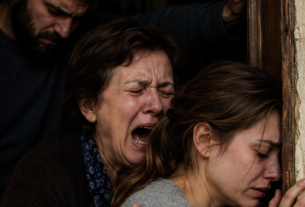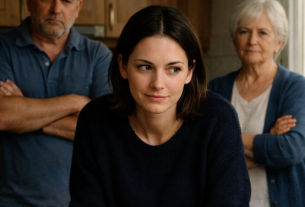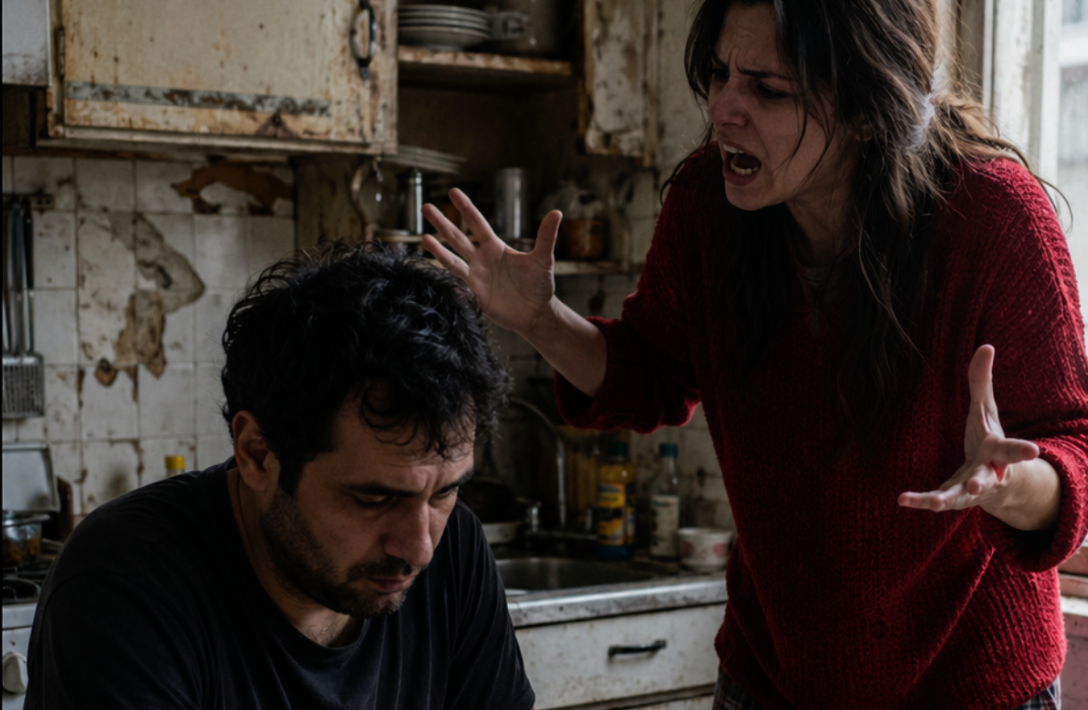
— Did you buy ground meat on sale again? The kind with more fat and gristle than actual meat? — Elena stood by the stove, mechanically stirring the gray mass in the frying pan. The smell of cheap pork fat hung in the small kitchen like a heavy, sticky cloud, soaking into the faded curtains and vinyl wallpaper.
— Lena, don’t start. It’s normal ground meat. Meat is meat, protein, — Dmitry walked over to the table without even washing his hands and heavily dropped onto the creaking stool. He looked indecently pleased with himself, glossy, as if he had just won the lottery and not come home to a place where his wife had been calculating grams of grain for dinner for the third day in a row.
Elena looked at her husband. He was wearing a fresh shirt he had bought for himself a week earlier “for business meetings,” and he smelled not of the metro and exhaustion, but of expensive perfume and coffee shop air. The contrast between his radiant appearance and the poverty of their dinner hurt her eyes. In the next room, one-year-old Antoshka stirred, but fortunately did not wake up.
— I asked for diapers. Size four. There are two left in the pack. It won’t be enough for the night if he suddenly gets an upset stomach, — Elena’s voice was even, without shrieking. It was the kind of exhaustion where there simply weren’t enough calories left for emotions.
— I forgot, — Dmitry said lightly, breaking off a piece of bread and dipping it straight into the frying pan Elena had placed in the center of the table. — I’ll buy them tomorrow. Or go yourself, take a walk to the store. Fresh air would do you good. You sit here within four walls, souring away. Soon you’ll turn into this ground meat yourself.
— With what money, Dima? — Elena sat across from him without touching the food. She had no appetite. — You transferred me two thousand for the week. Fifteen hundred went on formula because my milk is disappearing from stress, three hundred on this “normal” ground meat of yours, and the rest on bread, milk, and potatoes. I have eighteen rubles on my card.
Dmitry stopped chewing and grimaced with displeasure. The good mood he had brought home had run straight into the wall of everyday problems, and it clearly irritated him.
— Oh, why are you whining? As if we’re starving. Look, a whole pan of food. Some people don’t even have that. You’re always exaggerating, Lena. Making drama out of nothing. By the way, I did a great thing today. Settled the issue with Alisa’s college. That’s it, the semester is paid for. We can breathe.
He took out his smartphone, unlocked the screen, and turned it toward his wife with the pride of a philanthropist. A transaction receipt glowed in the banking app. Elena narrowed her eyes. The amount had six digits.
— One hundred seventy thousand? — she pronounced the number as if tasting poison. — You paid one hundred seventy thousand for half a year of studies?
— Well, it’s not just tuition, — Dmitry took the phone back and lovingly wiped the screen with his sleeve. — It’s a prestigious department, international relations. Plus the dormitory, a deluxe one, block-style, so the girl doesn’t have to live with just anyone in some corridor system. And I added thirty thousand for pocket money so the child doesn’t feel inferior among the rich kids. It’s an investment, Lena! The future! I’m her father. I’m obliged to give her a start.
Elena felt the floor sway beneath her. One hundred seventy thousand. Plus thirty. Two hundred thousand rubles with one click. While yesterday she had stood for half an hour by the baby food shelf, choosing a jar of puree that was three rubles cheaper.
— Two hundred thousand, — she repeated, looking at his well-fed face. — Dima, we owe two months of utility bills. My winter boots are falling apart, the sole is coming off. Antoshka needs the massage course the neurologist prescribed a month ago. And you… you just take everything and give it there?
— Not “there,” but to my daughter! — Dmitry slammed his palm on the table, making the forks clink. — Alisa is already grown up. She needs to match her level. And your Antoshka is one year old. He doesn’t care at all what he lies in or who rubs his back. You can do the massage yourself. There are tons of videos online. Boots? Go to a repair shop and have them glued. You’ll make it through the season. No need to waste money when there’s a crisis in the country.
He scooped up more pasta, generously pouring ketchup over it to hide the taste of cheap fat.
— Waste money? — Elena stood up. The chair scraped unpleasantly across the linoleum. — I haven’t been to a hair salon in six months. I’m wearing clothes I bought before pregnancy. We eat these damned noodles five days a week. And you talk to me about a crisis while paying for a deluxe dorm for a girl who has a mother, a stepfather, and two grandmothers?
— Don’t count other people’s money! — Dmitry snapped, not looking up from his plate. — I earn it, so I decide how to distribute it. And if you don’t have enough for your little wishes, you could get moving too. Seryoga’s wife does nails at home while on maternity leave and makes fifteen thousand a month. Or go mop the floors in the entryway in the evenings. They need cleaners now. One hour of work and your diapers are in your pocket. I’ll sit with the little one. I won’t fall apart. I’ll scroll on my phone. You’ve gotten used to sitting on my neck and only demanding: give me, give me, give me.
Those words fell into the stuffy kitchen like heavy boulders. Dmitry didn’t even understand what he had said. To him, it was a logical suggestion from an efficient manager: if there’s a cash gap, find a source of income. He calmly chewed, convinced he was right.
Elena looked at him and saw not a husband, not the father of her child, but a strange, indifferent official distributing a budget according to his own twisted priorities. Something clicked inside her. It did not tear, did not break, but clicked exactly like a switch on an electrical panel, cutting power to the zone responsible for patience and understanding.
She stepped right up to the table, braced her hands on the tabletop, and spoke quietly, but so clearly that every word drove itself into the kitchen like a nail.
— You paid for an elite college for the children from your first marriage, and you suggested that I return to work early from maternity leave because “we don’t have enough for food”?! You feed us pasta so they can eat caviar! I endured this for five years, but enough! I will not let my child be deprived! Go live with the people you invest all your resources in!
Dmitry froze with his fork near his mouth. A strand of pasta slapped back onto the plate, splashing drops of greasy sauce onto the tablecloth.
— What? — he raised his eyes to her, and in them was genuine confusion mixed with emerging anger. — Are you serious right now? You’re kicking me out because of money?
— Not because of money, Dima. Because we don’t exist for you. To you, we’re an annoying expense item that needs to be cut. Finish eating. Then pack your things.
Elena turned and left the kitchen, leaving her husband alone with the cooling pasta and the receipt for two hundred thousand on his phone. She knew this was only the beginning, and now the most terrible part would start — bargaining for the right to be right.
Dmitry followed his wife into the room, slowly chewing a piece of bread. He did not look frightened or upset. Rather, he wore the condescending weariness of an adult forced to explain to a capricious child why they cannot eat candy before dinner. He stopped in the doorway, leaned his shoulder against the frame, and crossed his arms over his chest, watching Elena take a stack of baby cloths from the wardrobe.
— Lena, did you seriously just make this circus over pasta? — genuine boredom showed in his voice. — Or are your postpartum hormones still acting up? Come on, tell me how hard it is to sit at home while I bust my back at two jobs to provide for everyone.
Elena carefully placed a cloth on the changing table. Her movements were precise, mechanical. Instead of the usual hurt, a cold, ringing emptiness was spreading inside her. She turned to her husband and looked at him with dry eyes.
— You’re not busting your back for everyone, Dima. You’re busting your back for one specific family. And it isn’t us. I kept quiet when you bought Alisa a new iPhone for her birthday and told me my five-year-old Samsung would last if I changed the battery. I kept quiet when you paid for their trip to Turkey “so the child could improve her health,” while Antoshka and I spent the entire summer in this stuffy apartment, walking only to the park and back. But a two-hundred-thousand college payment when we have nothing to eat — that’s the end.
Dmitry rolled his eyes as if he had heard the most absurd nonsense.
— You’re comparing things that can’t be compared! — he pushed away from the doorframe and stepped into the room, looming over her with the authority of a breadwinner. — Alisa is eighteen! She is at the most important stage of her life. She needs a start, connections, status. If she goes to a vocational school or some backwater institute now, she’ll lose years. And your Anton is one! He absolutely doesn’t care whether he has a branded snowsuit or wears hand-me-downs from a nephew. He doesn’t care whether we eat marbled beef steaks or pasta. The main thing is that we’re fed.
— And me? — Elena asked quietly. — Am I supposed to not care either? I wear a jacket with a broken zipper and fasten it with safety pins so the wind doesn’t blow through. I save on sanitary pads, Dima. Do you even understand how humiliating that is?
— Don’t try to play on my pity, — he grimaced as if from a toothache. — You sit at home. You don’t need to look presentable in front of clients. You don’t need to spend money on gasoline, business lunches, suits. You have “all inclusive” here: a roof over your head, internet, hot water. What are you lacking? And if you’re bored or short on money for your women’s things, I offered you an option.
— Mopping floors? — she clarified, feeling nausea rise in her throat at his cynicism.
— What’s wrong with that? — Dmitry shrugged, genuinely not understanding the problem. — Your crown won’t fall off. Wave a mop around for two hours in the neighboring entryway and there’s a thousand in your pocket. For pads, a manicure, or whatever else you need. I’ll sit with Anton. Well, I mean, he’ll play in the playpen and I’ll keep an eye on him. At least you’ll add to the budget. You’ve all gotten used to thinking a man is an eternal engine and a bottomless wallet. My resources aren’t unlimited, by the way.
Elena looked at him and was stunned that she had lived with this man for three years and had not seen this abyss. He sincerely believed her contribution to the family was zero because she did not bring in cash. Laundry, cleaning, cooking out of nothing, sleepless nights with an infant — all of that, to him, was “sitting at home,” rest, a vacation.
— So, according to your logic, — she said slowly, trying not to let her voice break, — I’m supposed to go out to work, clean other people’s dirt, and earn money for our food while you give seventy percent of your salary there? You want me, your wife with a baby, to sponsor your former family?
— You’re sponsoring our family! — Dmitry roared, losing patience. Red blotches appeared on his face. — Stop dividing money into “mine” and “yours.” We’re one team. If I have big expenses there right now, it means we need to tighten our belts here. It’s temporary. Alisa will finish her studies, get on her feet…
— Four years, Dima, — Elena interrupted him. — Alisa will study for four years. And then two more years of a master’s degree, you said so yourself. Are we supposed to “tighten our belts” for six years and eat plain pasta? Anton will be seven. He’ll go to school in hand-me-downs because Alisa will have an internship in London?
— You’re a mercenary, petty woman, — Dmitry spat, looking at her with disgust. — You’re just jealous of a child. You envy a girl whose life is only beginning. I thought you were smarter, kinder. But you… you count pennies like an old woman at the market. “The ground meat is wrong,” “you forgot diapers.” I’m trying for you! I could just go live with my mother and pay you official child support — three kopecks from the white part of my salary. Then I’d see how you survive on that.
That was his trump card. The threat of poverty. He used it every time Elena tried to talk about money. Before, it had worked. Before, she got scared, apologized, tried to be more economical. But today, after the receipt for two hundred thousand, the fear disappeared. Only disgust remained.
— You’re right, Dima, — she said unexpectedly calmly. — You try very hard. But your arithmetic is lame. You see yourself as a benefactor, but let’s face the truth. You live in my premarital apartment. You drive a car whose loan we paid off with my maternity money. You eat, drink, and use electricity and water, which I pay for from my allowance. And still you dare to reproach me over a piece of bread?
Dmitry was taken aback. He was used to considering himself the master of the situation, the main investor in this project called “family.” The reminder of whose living space this was struck painfully at his pride.
— Ah, so that’s how we’re talking now? — he narrowed his eyes, and his face became angry and ugly. — Now you’re throwing the apartment in my face? If it weren’t for me, you would have starved here with your allowance! Who brings you groceries? Who pays for the internet?
— The internet was paid by me for a year in advance before I gave birth, — Elena parried. — And groceries… Dima, you eat more than you bring. You are not a provider. You are an expensive house pet whose upkeep costs more than the benefit it brings.
A heavy silence hung in the room. Not ringing, not theatrical, but thick, stuffy, the silence of a communal quarrel when words have been said that cannot be taken back. Dmitry looked at his wife, and in his eyes was not remorse, but cold calculation. He was figuring out how to twist the situation so he could remain the victim.
— Fine, then, — he hissed through his teeth. — If I’m such an animal, if I’m eating you out of house and home, I’ll leave. Just don’t come crawling back later. Don’t call and whine that Anton has a fever or the faucet is leaking. You’ll handle it yourself. I’ll see how you howl after a week without a man in the house.
He waited for her to get frightened. For her to throw herself at his neck as usual, start apologizing, say she had spoken in the heat of the moment. But Elena stood motionless, arms folded over her chest, and looked at him the way one looks at an overflowing trash can that should have been taken out long ago.
— I won’t howl, Dima. I’ll exhale, — she answered. — Go pack your things. The suitcase is on the mezzanine.
Dmitry slammed the old suitcase onto the floor, raising a cloud of dust. He demonstratively sneezed, using his whole body to show the unbearable conditions under which he was forced to pack. His movements were sharp and jerky: he opened the wardrobe, snatched hangers with shirts, and threw them into the suitcase without even folding them. It was a one-man show designed for a viewer who was supposed to shout “Stop!” any second and start apologizing.
— Do you even understand what you’re doing, Lena? — he spoke loudly so she could hear him in the kitchen. — You’re destroying the family over your pathetic resentments. Over money! That’s low. I thought we were above that petty bourgeois nonsense. I thought we had love, support, and you’re shoving a calculator in my face.
Elena entered the bedroom. In her hands was not a calculator, but an ordinary school notebook with squares and a pen. She looked calm, frighteningly calm. There was none of the hysteria Dmitry had been waiting for, no tears. Only the cold focus of a surgeon before an amputation.
— Sit down, Dima, — she said, pushing his jeans off the bed with her foot to clear a space.
— Why should I sit? I’m leaving! Isn’t that what you wanted? Enjoy it! You’ll sit alone in your Khrushchev-era dump, — he continued stuffing socks into the side pocket of the suitcase.
— Sit down, — she repeated more firmly. — Before you leave as a proud martyr, I want you to see reality. So later you don’t tell your friends how your evil wife threw a noble breadwinner out onto the street.
Dmitry snorted, but sat on the edge of the bed, crossing his arms over his chest. His face expressed a mixture of contempt and boredom.
— Come on, surprise me with your accounting.
Elena opened the notebook. Columns of numbers were written there in even handwriting.
— Look here, — she pointed with the pen to the first column. — Your salary is one hundred twenty thousand. Net. This month you transferred two hundred thousand to your first family, including the college payment. That means you took money from the savings, from your “stash” I allegedly didn’t know about. Fine, let’s move on. In a normal month, you give seventy percent there. That’s eighty-four thousand. You have thirty-six left.
— So what? — Dmitry interrupted. — It’s my money. I have the right to dispose of it as I see fit. I have obligations!
— Wait. You have thirty-six thousand left, — Elena continued without raising her voice. — Of that, ten thousand goes on gasoline because you don’t like public transport. Five thousand on your lunches at work because “food containers” are for losers and you’re a manager. Another three thousand on cigarettes and coffee. So you have eighteen thousand rubles left in your hands. Eighteen, Dima.
Dmitry was silent, looking away. The numbers were dry and unpleasant, like sand on his teeth.
— And now your household expenses, — Elena turned the page. — Utilities for three people are nine thousand in winter. You let the water run for forty minutes in the shower, and the lights are on everywhere. Food. You like meat, you don’t eat yesterday’s leftovers, you need sausage, cheese, beer on Fridays. I calculated it: feeding you costs our budget at least twenty-five thousand a month. And that’s with me cooking myself and looking for discounts.
She raised her eyes to him. Her gaze was direct and heavy.
— Eighteen minus nine — your share of utilities — and minus twenty-five for food. That comes to minus sixteen thousand rubles. Every month, Dima, you don’t just fail to bring money into this home. You take it from me and Anton. You live in the red. You eat on credit. You shower on credit.
— You… you count every bite I eat? — Dmitry hissed. His face flushed red. He felt ashamed, but the shame burned and transformed into aggression. — You’re reproaching me with food? How can you even say that? I’m a man! I need to eat properly to work!
— To work for whom? — Elena snapped the notebook shut. The sound cracked like a slap. — You work to provide for Alisa and Olga. Here, you are an unprofitable project. You’re a parasite, Dima. A real one. You live in my apartment, sleep on my sheets, eat food bought with my maternity allowance, and then demand that I go mop floors because you don’t have enough for your daughter’s beautiful life.
— I thought we were a family… — he muttered, but his voice sounded uncertain. The arguments had run out. You cannot argue against mathematics. He was used to feeling like a hero saving everyone, but he had turned out to be a dependent living off his wife and infant son.
— We were a family until you decided we were second-rate, — Elena replied. — I endured it for a long time. I thought: fine, his older daughter is there, she needs more, and we’ll manage. But today you showed that we are not simply in second place. We are not on your list of priorities at all. There is only you and your guilt before your first wife, which you plug with money. My money, Dima. Because when you eat cutlets bought with Anton’s allowance, you steal from your son.
Dmitry jumped up. The room suddenly felt unbearably stuffy. The truth stung his eyes, cut his hearing, destroyed his self-esteem. He urgently needed to accuse her, make her guilty, to regain his balance.
— You’re so petty! — he shouted, grabbing his deodorants from the shelf and throwing them into the suitcase. — You presented me with a bill! Damn accountant! I’ve done so much for you… I… And you begrudged me a piece of bread! Olga was right when she said you weren’t a match for me. At least she appreciated me!
— She appreciated your wallet, — Elena noted calmly. — And when it got thin, she threw you out. Now you filled it again, but at our expense. And now you’ll go back. The circle is closed.
— Go to hell! — Dmitry slammed the suitcase lid with force. The lock jammed. He yanked it, broke the zipper pull, and cursed. — I’ll leave! But remember this moment. When you’re sitting without a kopeck and howling from loneliness, you’ll remember how you kicked your husband out over a bowl of soup!
— Not over soup, Dima. Because you became a suitcase without a handle. Too hard to carry, but a pity to throw away. But now — no pity.
He grabbed the suitcase and picked up his laptop bag. At the door, he turned around, hoping to see at least a shadow of doubt in her eyes. But Elena had already turned away and was straightening the blanket in the baby crib. To her, he had already disappeared. He had become the past, a mistake in the calculations she had just corrected.
Dmitry flew into the hallway, almost knocking down the coat rack. The coat Elena brushed clean for him every morning before he left swayed as if saying goodbye, and one of the jackets slipped to the floor. He did not even stop to pick it up. His movements had that nervous, destructive fuss of a person who understands he has lost but is trying to convince everyone around him that this is his strategic retreat.
— Where are my car keys? — he barked, patting his trouser pockets. — Did you hide them? Decided to blackmail me so I wouldn’t leave? It won’t work, Lena! I’ll walk, but I won’t stay in this madhouse another minute!
Elena silently went to the small cabinet in the hallway, took the keys lying in plain sight right under the mirror, and held them out to him. Her hand did not tremble. This gesture — calmly handing over the object — enraged Dmitry even more. He needed drama. He needed tears, grabbing at his sleeve, pleas for forgiveness. He needed confirmation of his own importance, and he never got it.
— Here, — she said shortly. — And leave the supermarket discount card. It’s registered to my number.
Dmitry snatched the keys, almost scratching her palm, and threw the plastic card onto the floor with a contemptuous laugh.
— Choke on your discounts! — he began putting on his boots without untying the laces, aggressively crushing the heels inward. — You think you punished me? You punished yourself! You’re staying alone, with a child, in this dump, with pennies in your pocket. And I… I’ll find somewhere I’ll be valued. Somewhere they won’t count every bite that goes into my mouth!
He straightened, picked up his laptop bag and the suitcase with the broken zipper, a shirt sleeve sticking out of it, and grabbed the front door handle. For a second he froze. Deep down, where beneath the layer of selfishness a few crumbs of common sense still remained, he waited. He waited for her to say “Stop” at this last moment. He waited for fear of loneliness and poverty to overpower her pride.
But the apartment was silent. Only the steady ticking of the clock came from the room, and somewhere behind the wall a neighbor’s television hummed. Elena stood with her shoulder against the wall, arms crossed over her chest. She looked at him not as a beloved husband who was leaving, but as a problem that had finally solved itself. In her gaze there was fatigue mixed with disgust — the way one looks at a stain that could not be scrubbed off for a long time and has finally disappeared.
— You’ll regret this, Lena, — he hissed, opening the door. A draft smelling of dampness and someone else’s tobacco smoke rushed into the stairwell. — When you run out of formula, when they cut off your internet for nonpayment, don’t you dare call me. I’ll block this number. You are dead to me. Do you hear? You’re nothing. A zero. An empty place.
— I hear you, Dima, — she answered quietly, but every word fell into the hallway like a heavy stone. — I hear how afraid you are. You’re not going “somewhere” right now. You’re going nowhere. You got used to living at my expense while hiding behind beautiful words about duty to your older daughter. But now the shop is closed. Go. Your “investments” have been waiting for you.
Those words hit the target. Dmitry jerked as if struck by a whip. The truth was unbearable, it burned, and he hurried to slam the door behind him, cutting himself off from that calm, piercing voice.
The door struck the frame with a heavy metallic clang.
Elena did not move. She stood and looked at the closed door. The lock clicked — one turn, then a second. She locked it mechanically, on autopilot. That sound — the turning of the key — rang through the silence of the apartment like the shot of a starting pistol.
She waited for it to overwhelm her. For her legs to give way, tears to burst out, panic to squeeze her throat with an icy hand: “How will I live now?” She listened to herself, searching for that pain. But there was no pain.
There was a strange, unfamiliar feeling of lightness. As if a huge, dusty, bulky wardrobe had been carried out of the apartment — one that had stood in the middle of the room for years, blocking the light, something everyone always stumbled over but feared throwing away because “it’s a memory,” “it’s family.” And now the wardrobe was gone. A dent remained in the linoleum, a little dust remained, but suddenly there was so much air.
Elena slowly exhaled. Her chest expanded, taking in this new air — air without the smell of cheap tobacco, without tension, without the eternal expectation of reproaches. She looked at her hands. They were not shaking.
In the kitchen, the faucet was dripping — the very faucet Dmitry had promised to fix six months ago but never found time for between “business meetings” and saving the world. Elena smirked.
— Well then, — she said into the empty hallway. — I’ll fix it myself. Or call a handyman. With the money I won’t spend on your cigarettes.
She pushed herself away from the wall and went into the room where her son was sleeping. Life, real life, without falsehood and the mathematics of betrayal, was only beginning. And in this new life there was no place for suitcases without handles.
Dmitry yanked the front door handle as if he wanted to tear it out by the roots. The corridor smelled of dust and old shoes — a smell he now, in a fit of self-justification, associated exclusively with Elena’s “poverty.” He stood on the stair landing, breathing heavily, his face twisted with anger, a broken suitcase in his hand. Behind him, the lock clicked. One turn. A second. A dry metallic sound cutting him off from his old life, from his son, from the obligations he had never learned to fulfill.
— Rot in there, then! — he shouted at the closed door, hoping she was standing there with her ear pressed to the peephole. — You’ll crawl back yourself when you’ve got nothing to eat!
No answer came. Only the hum of the elevator somewhere on the upper floors broke the silence of the stairwell. Dmitry spat onto the concrete floor, adjusted the strap of his laptop bag, and pressed the call button. While the cabin descended, he thought frantically. Going to a hotel at night was stupid — unnecessary expenses, and after his grand gesture of paying for college, there was almost nothing left on his card. His mother’s place? Listen to lectures? No.
He took out his phone. His finger hovered over the contact “Olga.” His ex-wife. The woman who had thrown him out five years earlier because he was “not ambitious enough,” but with whom he now had excellent, businesslike relations. After all, he had just paid for her daughter’s ticket into life. He was a hero. He had the right.
— Hello, Ol? Are you awake? — Dmitry’s voice sounded cheerful, but with a pleading note.
— Dima? It’s midnight. What happened? Is something wrong with Alisa’s dorm? Did the payment not go through? — Olga’s voice was businesslike, cold, immediately getting to the point. No “hello,” just a transaction check.
— The payment went through, calm down. I… listen, I had a fight with Lenka. A serious one. Basically, I left. For good. Can I crash at your place for a couple of days? Until I find an apartment.
Silence hung on the line. Dmitry heard Olga breathing, heard the television working in the background. He could practically see the calculator gears turning in her head. An ex-husband on the sofa was an inconvenience. But an ex-husband who had just handed over two hundred thousand and worked in a decent position was a resource. Free grocery delivery, a “man for an hour” for small repairs, complete control over his income. If he lived with them, money would not leak into “that” family.
— You left, you say? — Olga finally said slowly. Something resembling the satisfaction of a predator cornering prey appeared in her voice. — Well, if you left… Come over. The sofa in the living room is free. Only, Dima, pick up something for tea on your way. And buy milk, Alisa eats cereal in the morning and I forgot. And by the way, the faucet in our bathroom is leaking. Could you take a look tomorrow?
— Of course, Ol. No problem. I’ll stop by the twenty-four-hour store now, — Dmitry broke into a smile. There it was! He was valued. He was expected. They immediately found a use for him. He was needed. Not like that hysterical woman counting every kopeck.
— We’re waiting. You remember the intercom code? — and she hung up.
Dmitry walked out of the building, inhaled the cold night air, and felt like a winner. He was sure he had punished Elena. He had left her alone with a child, without support, without a man’s shoulder. He walked toward the car, anticipating how he would return to the familiar, established routine of his first family, where everything was clear: you pay, and you are tolerated. He did not understand one thing: he was not returning home. He was voluntarily walking into a debt pit, where he would be milked dry as long as he was useful, and then thrown out again like used material. He was not a husband and not a father. He was a function. An ATM on legs, temporarily allowed to stand in the hallway.
Elena stood in the corridor, leaning her back against the door. She heard his shout, heard the elevator leave. Her heart beat evenly, calmly. No tachycardia, no tears. She had expected it to be frightening. She had expected panic to hit: “How will I manage alone?” But instead of fear came an intoxicating feeling of relief. As if a huge, dusty, useless wardrobe had been carried out of the apartment, one that had taken up half the room and blocked the light.
She went to the kitchen. On the table stood the frying pan with cold, clumped pasta — a monument to their family life. Elena took it and dumped the contents into the trash with one motion. Without regret. Tomorrow she would buy buckwheat. Or vegetables. She would cook soup that she could eat for two days, and no one would make a face demanding steak.
She sat at the table and opened the banking app. Eighteen rubles on the account. The number had not changed. But the mathematics of her life had changed. The line item “expenses for husband’s ego” had disappeared. Cigarettes, gasoline, business lunches, endless “give me” and “I need” had disappeared.
Elena took the sheet of paper on which, half an hour earlier, she had written the budget of their collapse. She turned it over to the clean side.
— Right, — she said aloud, and her voice sounded confident in the silence of the apartment. — Allowance — fifteen thousand. Night copywriting work — another five. Mom promised to help with vegetables from the dacha. We’ll survive.
A quiet sob came from the room — Anton had woken up. Elena smiled, sincerely and warmly for the first time that evening. She stood and went to the nursery.
She did not know that Dmitry was now buying milk for someone else’s daughter, considering it a manifestation of freedom. She did not know that in a month he would ask her to lend him money, and she would not give it. She did not care. She had not locked the door behind him only with a key. She had closed the door behind him inside herself.
Elena took her son in her arms, pressed his warm, sleepy head to her chest, and walked to the window. Down below, a car was driving away with the man who had chosen to be a resource instead of a family. The headlights flashed in the darkness and disappeared around the corner.
— Well, that’s it, Antoshka, — she whispered, rocking her son. — Dad has gone to pay his bills. And you and I are starting to live for free. But truly.
The apartment finally became quiet. Not oppressive, but peaceful. The air cleared. The scandal was over, and life had begun. Harsh, frugal, but honest. Without pasta so others could have caviar…