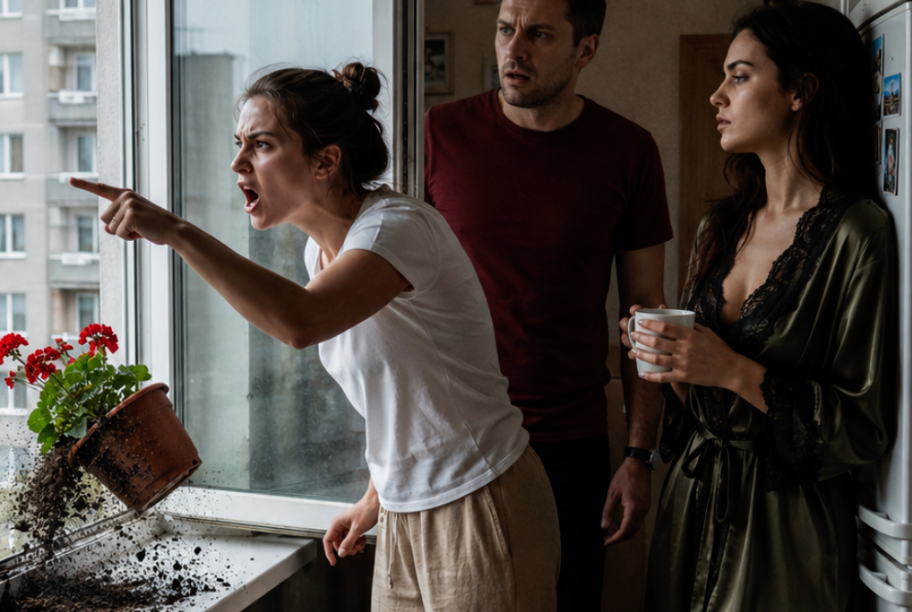
The geranium in the clay pot flew downward in silence. It didn’t scream, didn’t cling to the windowsill. It simply vanished into the gray rectangle of the open window, leaving a dirty streak of black soil on the plastic frame. One second later came a dull slap against the asphalt.
“Don’t clutter up my house with your trash, Glasha,” Sveta said, wiping her palms on her jeans as if she had touched something sticky. “There’s already no air to breathe in here. Flowers, little napkins, jars… You’ve turned this place into some orphanage.”
I stood by the kitchen table, clutching an empty mug in my hands. My head was quiet. Not the kind of silence in films, where silence rings in your ears, but simply empty. As if someone had turned off the sound and left only the picture: Sveta in her brand-new tracksuit, breathing heavily from righteous anger, and Vadim, my husband, carefully studying the label on a jar of instant coffee.
Vadim wasn’t looking at me. For the past six months, he had generally tried not to look me in the eye. Maybe he was afraid of catching my “illness.” In Kiselyovsk, depression wasn’t considered an illness.
“You’re just spoiled, Glasha,” my mother used to say.
“You need to work more, then all that nonsense will get blown out of your head,” my father-in-law advised.
And I did work. As a technologist at a bread factory. Every day by six in the morning, surrounded by the smell of hot dough and sticky vanilla. Yeast had seeped into my pores, into my hair, into my very skin. Even after a shower, it seemed to me that I still smelled like sponge dough.
“Vadim, tell her,” Sveta turned to her brother. “Tomorrow we’re ordering a new kitchen. This junk is going to the dump. And all these pots too. I’m going to live here like a normal person, not like I’m in a crypt.”
Vadim finally raised his eyes, but not to me. He looked at the window through which my favorite geranium had just flown. That geranium had been given to me by Klavdia Petrovna, our old workshop supervisor, when I first went on sick leave because of my “condition.”
“Glasha, honestly,” my husband’s voice sounded like a worn-out record. “Sveta is right. Something needs to change. You can see yourself what state you’re in. You don’t want anything. You just sit and stare at one spot. But Sveta—she’s energetic. She’ll help us make the place cozy. After all, this is her… our home.”
I looked at my hands. They were pale, with short nails stained with flour. My fingers weren’t trembling. Strange. They used to always tremble when Sveta started giving orders in our apartment. She had come “for a week” three months ago, when something in Novosibirsk had gone wrong for her. And that week had smoothly turned into forever.
“Your home?” I said quietly, almost to myself.
“Whose else would it be?” Sveta snorted, opening the refrigerator like the mistress of the house. “Vadim is registered here. He’s my brother. Mom said I have the right to be here. And you… you’re just an attachment. A sick attachment to these square meters.”
I set the mug down on the table. It clinked against the countertop—a sharp, dry sound. Something inside me slowly turned. Not anger, no. More like realization.
I remembered how we had bought this apartment five years ago. Or rather, how I had bought it. Vadim had just quit the mine back then and was surviving on odd jobs, while I had a “stash”—an inheritance from my grandmother in Prokopyevsk. We sold that old shack, added my savings, and bought this two-room apartment on the outskirts. I registered Vadim here “for decency’s sake,” so he wouldn’t feel like a kept man.
All these years, I had tried to be good. I baked pies, endured visits from my sister-in-law, listened to my mother-in-law’s lectures. And then the emptiness came. Doctors called it clinical depression. I called it “I disappeared.” I went to the factory, checked the quality of baked goods, stamped journals, and inside me there was nothing but gray fog.
“You know, Sveta,” I walked over to the window. “Down there on the asphalt, those aren’t just flowers. That was Klavdia Petrovna’s gift.”
“Oh, I’ll buy you a new geranium,” my sister-in-law waved me off. “We’ll go to Leroy Merlin and buy one. A plastic one. At least it won’t smell or dry out.”
I looked at the clock on the microwave. 6:14 p.m. In my head, slowly, like on old scales, numbers began to move.
“Vadim, do you remember whose name the apartment is registered under?” I asked, looking at his back.
He flinched. His shoulders tensed.
“Glasha, why are you starting this? What difference does it make? We’re family.”
“There is a difference,” I felt a chill run down my back. Not from the open window, but from the clarity that had suddenly broken through the fog. “Sveta said this is her home. She threw out my things. In front of you.”
“It’s just flowers!” Sveta shrieked. “Junk! You’re just like that junk yourself!”
I didn’t answer. I left the kitchen and went into the hallway. My old work jacket hung on the hook, smelling of bread and of a home that, as it turned out, I no longer had. In the pocket were my keys and my phone.
I stepped out onto the stairwell. The entrance smelled of fried fish and old whitewash. I sat down on the step; the cold concrete burned through my jeans. I took out my phone and opened the banking app. Then my email. Somewhere there, in the archives, were scans of the documents.
Inside, it felt strange. The fear that had lived with me for the last few years—the fear of being alone, the fear of not coping, the fear that no one would love me—suddenly began to melt. As if I had already died, and now there was nothing left to fear.
I looked at the screen. 6:22 p.m.
“You have forty-one minutes to understand,” I thought, but immediately remembered the doctor’s advice: don’t set conditions for others, set them for yourself.
So I simply sat there. The neighbor from the third floor, Aunt Lyusya, walked past with a trash bucket.
“Glasha? What are you doing here? Forgot your keys?”
“No, Aunt Lyusya. I’m getting some air.”
“In the stairwell? Go outside, spring is starting.”
“I’ll go soon,” I answered.
I knew that behind the door, a battle was happening now. Sveta was probably convincing Vadim that I had “completely lost my mind.” Vadim was silent. He was always silent when a decision needed to be made. He was a good guy, honestly. He just had never really been mine. He was part of that “proper” world I had tried to build to drown out the smell of yeast and loneliness.
I opened the file on my phone.
Certificate of state registration of ownership.
Object: apartment.
Owner: Kashina Glafira Rodionovna.
Share: 1/1.
Basis: purchase and sale agreement.
I pressed “send.” The recipient’s address was Vadim’s email. I knew he had notifications turned on.
The smartphone in my pocket vibrated impatiently. Delivery notification. Somewhere there, behind the thin metal door, Vadim’s phone answered in his pocket. I imagined him taking it out, squinting as he peered at the small print on the screen. I imagined how his face—always a little sleepy, good-natured—slowly changed.
I kept sitting on the steps. Outside the entrance window, Kiselyovsk was sinking into twilight. At the bread factory, the shift was changing right about now. The girls from the first shift were taking off their white coats, changing shoes, complaining about aching legs. I was supposed to be there tomorrow morning. Checking the moisture of the crumb again, watching the temperature in the ovens. But now it seemed unreal, as if it were happening on another planet.
The door to my apartment opened. Vadim stood on the threshold. No jacket, just socks. In his hands, he clutched his phone like a grenade with the pin pulled out.
“Glasha… Why did you send this?” His voice was hoarse, cracked.
I raised my head.
“So that you don’t get confused in your testimony, Vadik. Sveta said this was her home. I just clarified.”
Sveta appeared from behind his shoulder. Her face was red, her eyes burning.
“What did she send? Vadim, don’t listen to her, she’s doing this on purpose! She’s not sane. She needs treatment, not downloading documents!”
“Sveta, shut up,” Vadim said quietly. “Go into the room.”
“Why should I? I have the right—”
“Sveta, go!” Vadim almost shouted.
My sister-in-law stopped short. She rarely heard that tone from her brother. Snorting, she disappeared into the depths of the corridor, but I was sure she had hidden around the corner, warming her ears.
Vadim came out onto the landing and pulled the door half-closed behind him. He sat down one step above me.
“Glasha, why are you doing this? We had an understanding… I help you. I work. I buy groceries. And now you… Do you want to throw us out onto the street? Your own family?”
I looked at my knees. There was a flour stain on my jeans.
“Vadim, ‘family’ doesn’t throw gifts from people close to you out the window. ‘Family’ doesn’t say ‘don’t clutter up my house’ to the owner of that house. I kept quiet for three months. I waited for you to tell her yourself. For you to explain to your sister that she is a guest here.”
“She’s in trouble, Glasha!” Vadim threw up his hands. “She has debts in Novosibirsk. Debt collectors are looking for her! Where is she supposed to go?”
“To Mom in Belovo. To a dormitory. To friends. Anywhere, Vadik, but not onto my head. I don’t have the strength to carry her troubles too. I have nowhere to put my own.”
The emptiness inside me began to fill with a strange warmth. It wasn’t the joy of victory. It was the relief of someone who had finally dropped a heavy, wet sack of sand from their shoulders.
I realized that I didn’t need their approval. I didn’t need Sveta to think I was good. I didn’t need Vadim to pity me.
“You know what’s strangest?” I turned to him. “I’m not scared right now. Not at all. For three years, I lived with the feeling that if I were left alone, I would simply crumble into pieces, like a dry cracker. But now I’m sitting on the cold floor in the stairwell, and I feel… fine.”
Vadim was silent. He was always like that—if a problem didn’t solve itself, he froze.
“The apartment was bought with my money,” I continued, and my voice sounded even, without breaking. “You know that. Your mother knows that. And Sveta, I’m sure, knows it too. It was just convenient for all of you to think that because I’m ‘sick,’ I’m no longer a person. That I’m just furniture you can move around.”
“We didn’t think that,” he muttered.
“You did. You were deciding what kitchen to buy without asking me. You were throwing out my flowers. You were managing my life while I couldn’t lift my head from the pillow.”
I stood up. My legs had gone numb, and there was a sharp ache in my knees.
“I’m going inside now. And Sveta is going to pack her things. Right now.”
“Glasha, it’s almost night!” Vadim jumped up. “Where will she go?”
“To the station. To the Kiselyovsk Hotel. I don’t care. She has forty minutes. Exactly as long as I sat here.”
I opened the door and entered the apartment. The smell of air freshener hit my nose—Sveta adored “Sea Breeze,” which always gave me a migraine.
Sveta stood in the middle of the living room. She was no longer shouting. She understood that the air had changed.
“You have no right,” she hissed, but fear splashed in her eyes. The very same fear I had fed inside myself for years. Now it had passed to her. “I’m registered in this city at Mom’s!”
“Then go to Mom,” I said, walking past her into the bedroom.
My bed was covered with her clothes. Sveta loved “trying on” my things while I was at work. I simply gathered up her pile of rags and dumped them onto the floor in the hallway.
“Pack, Sveta. Vadim will see you off.”
“Vadik!” she screamed. “Tell her! Are you a man or what?”
Vadim entered the apartment. He looked ten years older. He looked at his sister, then at me. I stood by the window, looking at the empty windowsill. Down there on the asphalt, under the streetlamp, lay the shards of my pot.
“Pack, Sveta,” he said quietly. “I’ll call you a taxi to the station.”
“You… you traitor!” She grabbed the suitcase she had never fully bothered to unpack. “You’ll both regret this! I’ll tell Mom everything!”
“Tell her,” I smiled for the first time that evening. “And don’t forget to mention the geranium. Mom loves flowers.”
The next half hour passed in chaos. Sveta rushed around the apartment, throwing things into bags, cursing me, the factory, Kiselyovsk, and the whole world. She tried to take my curling iron and my perfume, but I simply took them silently from her hands and put them back on the shelf. No shouting. No hysterics.
Vadim stood by the door, leaning his shoulder against the jamb. He wasn’t helping her. He was just waiting.
When the final lock clicked shut on her suitcase, the apartment suddenly became very quiet. Even the “Sea Breeze” seemed to have faded away.
“Is that everything?” I asked.
“Everything,” Sveta jerked the suitcase strap onto her shoulder. “Choke on your little hole of an apartment, you damn technologist.”
She left, slamming the door loudly. Vadim lingered for a second.
“I’ll see her off. And… Glasha… I’ll probably spend the night at Mom’s.”
“Probably,” I agreed.
I didn’t tell him that “probably” meant forever. We both understood it. The tension that had bound us all those years snapped without a sound.
I walked over to the window and closed it. The room became warm.
I looked at the clock. 6:55 p.m. Exactly forty-one minutes since my geranium had flown out the window.
I was alone. For the first time in three months, there was no one else’s breathing in the apartment, no rustling of Sveta’s magazines, no endless voice chats with her girlfriends.
I went into the kitchen. A black streak of soil still darkened the windowsill. I took a damp cloth and slowly, centimeter by centimeter, wiped the plastic clean.
Clean.
In the refrigerator, I found a pack of cottage cheese and an opened carton of milk. I wasn’t hungry, but I knew I had to eat. Depression is when you forget that the body needs fuel. But today the fog had retreated. There was a strange, almost frightening clarity in my head.
I washed Vadim’s mug. Thoroughly, with baking soda, scrubbing away the dark coffee stain. I put it in the cupboard. Then I took out my own—the old one with a crack in the handle, the one Sveta had wanted to “dispose of.” I poured tea.
I sat down at the table. A night moth beat against the window. Somewhere in the distance, the city hummed. Kiselyovsk never fully slept; the mines and factories worked in shifts. Tomorrow at six in the morning, I had to be at the checkpoint again. But today I didn’t feel the usual lead in my legs.
The phone on the table came alive. A message from Vadim.
“Dropped her off. She’s at Mom’s. I’ll come for my things tomorrow. Sorry about the geranium.”
I looked at the screen. The message hung there, lighting up the darkness of the kitchen. I didn’t reply. Not out of revenge. Just… the words had run out. Everything that needed to be said, I had said there on the stairwell, when I realized that the concrete floor of the entrance was not the end of the world.
Strangely, the strongest feeling wasn’t the joy of liberation, but silence. Inner silence. My heart was beating evenly, calmly. I placed my hand on my chest. For the first time in several years, I felt that rhythm not as an anxious knock at the door, but as the normal work of a living body.
I got up and went to the bathroom. I washed my face with cold water. In the mirror, a woman with a pale face and dark circles under her eyes looked back at me.
Glafira Rodionovna Kashina.
Technologist of sewing… no, bakery production.
Thirty-two years old.
Alone in her own apartment.
I smiled at my reflection. Not “happily,” not “radiantly.” Just normally. That was better than any triumph.
That night I dreamed of the smell of fresh bread. Real bread, without additives or improvers. I stood in the middle of the workshop, and the huge ovens breathed heat, while Klavdia Petrovna waved at me.
“That’s good sponge dough, Glasha! Real!”
I woke up five minutes before the alarm. The room was gray and quiet. I made the bed carefully, smoothing out every fold. I put on my work jacket. The hallway still faintly smelled of Sveta’s perfume, but I knew it would pass soon.
Outside it was cold. March in Siberia is always a battle between snow and mud. I walked to the bus stop, listening to the crunch of the icy crust beneath my boots.
At the entrance, under the kitchen window, I stopped. In the light of the morning twilight, rusty patches of soil and shards of clay were visible. The flowers were gone—maybe one of the neighbors had picked up the remains, or maybe passersby had simply trampled them.
I picked up one shard. It was cold and rough. I put it in my pocket.
Bus No. 14 was half-empty. I sat by the window. Gray five-story buildings, slag heaps, and factory fences drifted past. My city. My imperfect, difficult life.
At the bread factory checkpoint, Valya, the security guard, greeted me.
“Morning, Rodionovna. Why are you glowing today? Did you finally get some sleep?”
“I did, Valya. For the first time in a long while.”
The workshop was already busy. Huge tubs of dough slowly turned, filling the air with a thick, sour aroma. I went to my station and opened the logbook.
“Glafira Rodionovna!” Katya, the young intern, ran up to me. “The sensor by the third oven is acting up. Could you take a look?”
“I’m coming, Katya. We’ll fix everything now.”
During the day, my mother-in-law called. I saw her name on the screen and… didn’t answer. I simply set the phone aside and continued checking the delivery notes. In the evening, Vadim would pick up the rest of his things. I would leave the keys with the neighbor. I didn’t need to listen to her excuses or accusations.
After my shift, I stopped by the little flower shop on the corner. It was warm inside and smelled of damp soil.
“I’d like a geranium, please,” I told the saleswoman. “The brightest one. Red.”
“Here, take a look,” the woman said, placing a lush bush on the counter. “Just arrived. Strong one. It’ll bloom for a long time.”
I bought the flower and a new pot. Heavy. Ceramic.
At home, the first thing I did was place the geranium on the kitchen windowsill. In that very spot. The red blossoms against the gray Kiselyovsk sky looked like a challenge. Or like a full stop at the end of a very long and confusing sentence.
I poured myself some tea. Sat by the window.
The apartment was mine.
The life was mine.
Even the depression, which still sat somewhere deep inside me, was mine too—but now I knew how to negotiate with it.
On the table lay the electricity bill. I picked up a pen and boldly wrote my surname in the payer’s field.
Tomorrow I would wake up at six again.
And that was already a lot.
Six months passed.
The apartment was sold. I bought a small one-room apartment closer to the factory. Vadim moved to Belovo. We don’t call each other.
Sometimes, while checking the quality of the baked goods, I remember that evening in the stairwell. But my heart beats calmly.
Maybe that is what freedom is.
I wonder if Sveta has already found whose home she can command now.