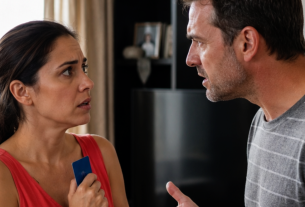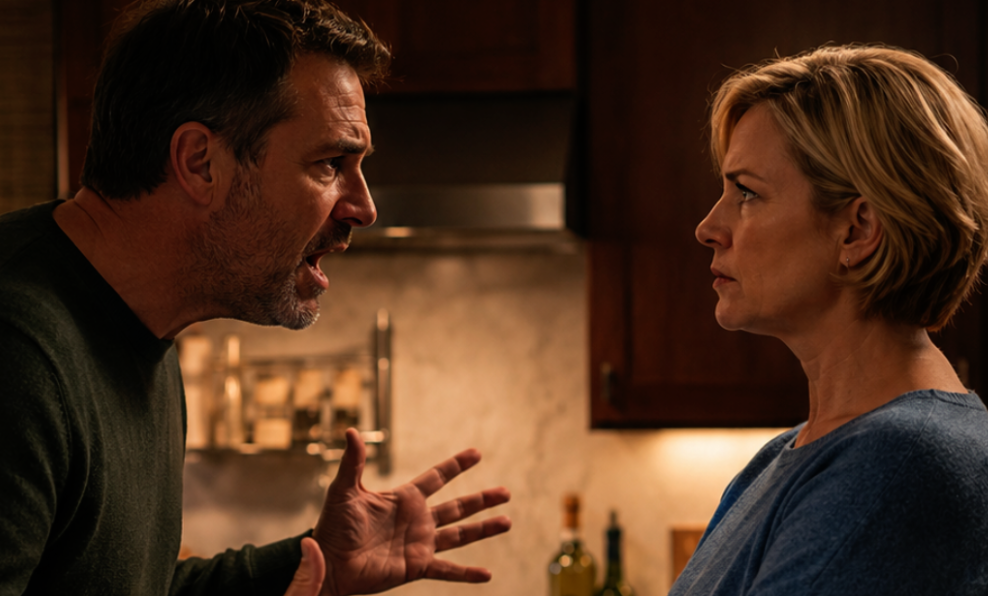
“Don’t you dare point at my pendant, Igor,” Daria said. She took off the chain and placed it on the kitchen table. “This is not evidence in your family accounting records.”
Igor stood by the sink in a T-shirt, as if his conscience had already started charging him interest.
“My mother could lose her apartment, and you’re buying jewelry,” Igor said hoarsely. “Two million, Dasha. A loan secured by the apartment. The bank has already sent a demand notice. Next comes court.”
“I’m an accountant, Igor,” Daria replied. “Words like ‘loan,’ ‘collateral,’ and ‘court’ don’t scare me. Your mother signed the contract voluntarily. She also voluntarily took the money to those miracle investors. What do my savings have to do with it?”
“They have to do with the fact that you’re my wife,” Igor said sharply. “Family is supposed to help.”
“What a remarkable institution family is,” Daria said. “When your mother was teaching me to clean the stove with a toothbrush, I was ‘that Daria of yours.’ But when my money was needed, I suddenly became family. Quite the career growth, and without an interview.”
“If you don’t help, I’ll file for divorce,” Igor said, and frightened even himself with the words.
The phrase hung between them not as a threat, but as a diagnosis. Daria looked at him, and something clicked inside her: the light went out in the room where she had spent years waiting to be protected.
“Go ahead,” Daria said. “We don’t have any minor children together. The apartment is yours, bought before the marriage, and I won’t claim it. I’ll pack my things now.”
“Are you out of your mind?” Igor asked, stepping after her. “That’s not what I meant.”
“But that is exactly what I heard,” Daria said. “At our age, it’s useful to believe people’s words.”
She took out a gray travel bag. It was the same one she had arrived with at Igor’s five years earlier — a forty-eight-year-old woman who had survived her first divorce, raised an adult daughter, endured her mother’s hospital stays, and lived through other people’s promises. Back then, it had seemed to her that a late marriage would be a quiet refuge. The refuge turned out to be a passageway, where Nina Stepanovna appeared every Friday.
Her mother-in-law entered Daria’s life without knocking. A pensioner with a hairstyle stronger than concrete and the voice of the chairwoman of an apartment-block court.
“Hello, Daria,” Nina Stepanovna said at their first meeting, looking over her coat and face. “You’re tidy. That’s something, at least. Do you know how to cook, or do you only shuffle papers?”
“Reports also need to be prepared,” Daria replied.
“You’ve got character,” Nina Stepanovna said without smiling. “We’ll see how long that lasts.”
It did not last long. Fridays became a trial. Her mother-in-law arrived at six forty because “seven is already late,” and began her inspection.
“Daria, the bathroom mat is damp,” she would say, touching it with the toe of her slipper. “And then you wonder where illnesses come from.”
“I’m fifty-two, Nina Stepanovna,” Daria would reply. “I’m not exactly young anymore.”
“Exactly,” the woman snapped. “At your age, it’s time to understand the basics.”
At such moments, Igor would disappear into his phone, as if the button to save the marriage were hidden there.
One day, Daria turned the sofa toward the window so that in the morning she could see the poplars instead of the wall with the television.
“What circus is this with the furniture?” Nina Stepanovna asked as she entered the room. “The sofa should stand against the wall. It has always stood there.”
“I wanted more light,” Daria said.
“She wanted light,” her mother-in-law said. “A woman in the house should want order. Light is sold in stores. They’re called lightbulbs.”
“Mom, let her put it wherever she wants,” Igor said lazily.
“Igor, are you a man or an attachment to the sofa?” Nina Stepanovna asked. “Today it’s the sofa, tomorrow your tools will be thrown in the trash.”
“The tools are in the kitchen drawer next to the bags,” Daria said. “There’s already a museum of Russian technical despair in there.”
Igor chuckled, but immediately hid his smile. His mother noticed and coldly said that a good wife does not make her husband laugh — she supports him.
That night, Daria lay awake. The most painful thing was not the nitpicking. A stranger can strike you with a word and leave. But when someone close stays silent beside you, the word becomes heavy, like a wet coat.
Daria had an adult daughter, Lena. She lived in Balashikha, was raising two boys, and spoke to her mother directly.
“Mom, don’t you dare give them your money one day,” Lena said over the phone. “You’ve spent your whole life owing someone something.”
“I’m managing,” Daria replied.
“Mom, ‘managing’ is when you’re living, not when you’re enduring,” her daughter said more softly.
Daria was offended then. Later, she thought about it.
The first push came with a promotion. Her boss, Marina Sergeyevna, called Daria into her office.
“Daria Alexeyevna,” the boss said, looking over her glasses. “You are a rare person: you love numbers, tolerate people, and aren’t afraid of management. We’re offering you the position of senior accountant. The salary is almost twice as high. The workload is bigger too, so the joy doesn’t seem suspicious.”
Daria left with the feeling that someone had returned her passport, which had spent many years lying in someone else’s nightstand. At home, Igor congratulated her sparingly.
“Well done,” he said. “Now we can renovate the hallway.”
“I was thinking of buying myself a coat,” Daria said cautiously. “The old one is completely worn out.”
“A coat is possible too,” Igor said. “Just don’t get carried away. Prices are crazy now.”
“Don’t get carried away” became the household anthem. Daria paid for groceries, utilities, medicine for her mother, and sometimes helped Lena, but she also began saving. Into a separate account, which Igor knew about and considered her little woman’s stash for “nonsense.” Men often underestimate women’s little stashes. Sometimes new decisions grow out of them.
Her first joy was a silver bracelet with blue stones. The saleswoman fastened it around Daria’s wrist and smiled.
“It suits you,” the saleswoman said. “Calm, but noticeable. Like a woman who has understood everything and reports to no one.”
“Do you say that to everyone?” Daria asked.
“No,” the saleswoman replied. “To men I say, ‘Take it, she’ll forgive you.’ That works too.”
Then came a coat, a hairdresser, shoes, lipstick, and earrings. Nina Stepanovna noticed immediately.
“New bracelet?” her mother-in-law asked. “Living beautifully, are we?”
“We try not to live disgracefully,” Daria replied.
“Have you tried buying Igor a shirt?” Nina Stepanovna asked. “Or is a husband now a disposable item, like a dish sponge?”
“Igor is an adult. The stores are open,” Daria said.
“There it is, modern happiness,” her mother-in-law pronounced. “The man buys his own shirt, the woman buys herself little stones.”
“Divorces don’t happen because of little stones,” Daria said. “Sometimes they happen because of words no one stopped.”
A year later, Daria became chief accountant. At work, she was respected. At home, she was tolerated. In the office, she argued with banks and the tax authorities; in Igor’s apartment, she once again became the woman whose “soup is too thin” and whose “curtains are gloomy.” Only inside her, the mechanism was already working differently. She was not saving for jewelry. She was saving for an exit.
Trouble came on a Friday. Nina Stepanovna appeared without her battle-ready hairstyle. Her hair had come loose, her lips were trembling, and the scarf in her hands was crumpled like a white flag — although surrender was not something she knew how to do.
“Igoryok, I’ve been deceived,” she said, sinking into an armchair. “Now, it seems, I may be left without an apartment.”
“Mom, what happened?” Igor asked, jumping up.
“An acquaintance from the clinic told me about an investment program,” Nina Stepanovna said, sobbing. “Her nephew worked there. Good interest rates. I took out a loan secured by the apartment. Two million. I thought I’d pay it off in six months and still have some left for treatment and the dacha.”
“Did you read the contract?” Daria asked, standing in the doorway.
“I’m not a fool,” her mother-in-law snapped. “Everything looked proper. Stamps, an office, a girl in a suit. They even offered coffee.”
“So coffee is now a legal guarantee,” Daria said. “That should be written into the law.”
“Dasha, not now,” Igor said.
“When, then? When the bailiffs come?” Daria asked. “Collectors have no right to threaten her. She needs to file complaints with the bank, the bailiffs, and the prosecutor’s office. The contract should be shown to a lawyer. The bank may possibly agree to restructuring.”
“There,” Igor brightened. “Dasha understands this. She’ll help.”
Daria looked at him. He said “help” so easily, as if they were talking about printing out a receipt.
“I’ll help find a lawyer,” Daria said. “But not with money.”
The room went silent.
“What do you mean, not with money?” Igor asked.
“Exactly that. I will not pay off Nina Stepanovna’s loan.”
“Daria,” her mother-in-law said in an icy voice. “I understand you don’t love me. But this is a human misfortune.”
“A human misfortune does not erase human memory,” Daria replied.
Nina Stepanovna left almost without a word. Igor spent the whole night pacing around the apartment: opening the refrigerator, closing it, drinking water, sighing as if he were carrying an entire apartment building on his shoulders.
And a few days later, a detail surfaced that made the story no longer just a story about scammers. Daria saw a message from his mother on his phone:
“Tell her to at least return the seven hundred. You’re not a stranger to her.”
“Seven hundred what?” Daria asked.
“Nothing,” Igor said too quickly. “Mom is nervous.”
“Seven hundred thousand is nervous?” Daria clarified. “Igor, I love numbers. They rarely pretend.”
He sat down, covered his face with his hands, and confessed. Out of those two million, Nina Stepanovna had given her son seven hundred thousand. Six months earlier, he had gotten involved in a “quick money” scheme through an acquaintance from the factory: invested, borrowed, covered one debt with another, and then “didn’t manage to get out in time.” In men’s financial adventures, the phrase “didn’t manage to get out in time” usually means: he walked into a pit and was surprised that it was dark there.
“I wanted to return it,” Igor said. “I thought I’d make a profit and pay off Mom’s loan.”
“You knew you were taking money from your mother against her apartment?” Daria asked.
“She offered it herself,” he said.
“Of course,” Daria smirked. “A pensioner woke up one morning and thought, ‘Why don’t I invest my son into an abyss? Life is boring.’ Do you hear yourself?”
“Don’t start,” Igor said. “I’m already on edge.”
“And I’m supposed to take out my savings, cover your family pyramid scheme, and then thank you for allowing me to participate in the rescue?” Daria asked.
He grabbed her by the elbow — not painfully, but sharply. Daria looked at his hand, and he let go.
“Don’t touch me,” she said quietly. “Today you have a bad habit of grabbing what belongs to others: your mother’s money, my savings, my arm.”
That was when the conversation about the pendant happened. Igor threw out the word “divorce,” expecting tears, bargaining, fear. Instead, Daria packed her bag.
“Dasha, I lost my temper,” Igor said in the bedroom. “Where will you go at night? You’re not twenty anymore.”
“That is exactly why I’m going,” Daria replied, putting her documents away. “At twenty, I would have stayed to prove that I was good. At fifty-three, I feel sorry for wasting time on an exam with no committee.”
“Mom will apologize,” he said. “I’ll talk to her.”
“No need,” Daria said. “She’ll say, ‘If that’s how you understood everything, then forgive me.’ That’s not an apology. That’s a small repair job on the conscience.”
Igor tried to take the bag from her. He did not hit her, did not push her, but he clutched the handle as if it were disputed property. Daria pulled it toward herself. From the side pocket, pills, keys, lipstick, and a passport in a worn cover spilled out. The passport fell between them.
“You see,” Daria said, picking it up. “Even the state is reminding me: I have a separate identity.”
She left. The elevator was not working. On the third floor, Daria met her neighbor Raisa Petrovna with a trash bag.
“Moving out?” the neighbor asked with concern that was twenty percent sympathy and eighty percent pure curiosity.
“Getting some air,” Daria said.
“Right thing to do,” Raisa Petrovna nodded. “Men need to be aired out more often. My late Nikolai sat stagnant on the sofa so long that they carried him out.”
Irina, her friend from the days when quarterly reports were submitted on floppy disks, took Daria in without questions.
“How much?” Irina asked, putting the kettle on. “I understand drama better with numbers.”
Daria told her everything: the loan, the collateral, the seven hundred thousand, the ultimatum, the passport on the floor.
“So his mother trained you for five years, the son took a chunk of the money, the scammers disappeared, and you’re supposed to pay,” Irina summed up. “A family enterprise in the name of holy shamelessness.”
The next day, Daria went to a lawyer. He confirmed that Igor’s apartment, purchased before the marriage, would not be divided; her savings from her salary could theoretically be recognized as joint property, but in a dispute they would look at payments, family expenses, bank statements, and transfers.
“Don’t sign anything without checking it first,” the lawyer said. “And don’t withdraw money from an ATM in a sack. Family law doesn’t like theatrics.”
“I don’t sign anything without glasses and anger anymore,” Daria replied.
A week later, Igor wrote: “Mom wants to talk.”
They met in a café near the metro. Nina Stepanovna came in an old coat, but her back was still perfectly straight.
“Daria,” she said, clasping her fingers. “I have thought a lot. Perhaps I was strict.”
“Perhaps?” Daria asked.
“All right, I was strict,” Nina Stepanovna forced out. “But I wanted Igor to have a proper home.”
“Proper for whom?” Daria asked. “For you? For the neighbors? In your proper home, I was an eternal trainee with no right to pass the test.”
“You answered sharply too,” her mother-in-law said. “Don’t pretend you were some poor little lamb.”
“I am not a lamb, Nina Stepanovna,” Daria said. “That is exactly why we are sitting here.”
“I’m asking you to lend me money,” her mother-in-law finally said. “With a written agreement. I need time.”
“Start with Igor,” Daria replied. “He is the one who took seven hundred thousand from you and kept silent.”
“He is my son,” Nina Stepanovna said.
“And I am not your daughter,” Daria said. “You explained that to me perfectly well.”
“Dasha, at least be humane,” Igor said painfully.
“Humanely, I gave you phone numbers for a lawyer, complaint templates, and advice on restructuring,” Daria said. “I will not give money. And I will not return to the marriage.”
The divorce was finalized quickly. At first, Igor threatened to divide her account, but after consulting a lawyer, he quieted down: along with the division, his debts and the transfers from his mother would come to light. Daria collected the rest of her things in the presence of Raisa Petrovna, who volunteered “to stand as a witness” and assessed Igor’s hallway like this:
“Without a woman, you can immediately see where a person lives and where he simply stores himself,” the neighbor said, adjusting her bag of slippers.
Nina Stepanovna did not lose the apartment. The lawyer helped negotiate restructuring with the bank. Igor sold his car and garage, then the dacha plot with its crooked little house. It was long, humiliating, and expensive.
Daria rented a one-room apartment near a park. A creaking floor, a small kitchen, windows overlooking linden trees. No one opened her cupboards. No one asked why she needed earrings. No one commented on her tea. At first, the silence seemed suspicious. Then it became medicine.
Lena came on Sunday with the boys. The grandsons raced around the room, testing the acoustics, while her daughter looked at Daria closely.
“Mom, you look younger,” Lena said. “Not your face. Your back.”
“My back realized it no longer has to carry other people’s furniture,” Daria replied.
“Do you regret it?” Lena asked.
“I do,” Daria said honestly. “I regret not leaving earlier. But everyone has their own speed of enlightenment. Some ride a scooter, some hobble on crutches.”
In the spring, Daria was invited to become financial director. She bought a small studio apartment in a building under construction — not luxurious, but her own. She signed the contract slowly, carefully, wearing glasses and with that very anger, which she now considered not a flaw, but a working tool.
Igor called in June.
“Dasha,” he said quietly. “I’m not asking you to come back. I just wanted to say: I understand now that I was a coward. I sold the garage and paid off part of the debt. Mom is holding on. I got a side job.”
“It’s good that you understood,” Daria said. “It’s a pity it cost so much.”
“How are you?” he asked after a pause.
Daria looked at the basil on the windowsill, the folder with documents, and the bracelet on her wrist.
“I’m learning to live without constant reporting,” she said. “It feels unfamiliar, but the balance comes out right.”
A year later, she moved into her own studio. Lena and the grandsons helped unpack things, Irina commanded the assembly of a shelving unit, and the upstairs neighbor was already drilling, because happiness in Russia rarely comes without a hammer drill. By evening, everyone had left.
Daria put the kettle on, turned the sofa toward the window, and took out a cup with a blue bird on it. Everything stood exactly as she had decided: documents in the top drawer, the bracelet on the dresser, curtains not bought at all yet — and no one had died from that aesthetic crime.
Her phone blinked with a message from Lena:
“Mom, are you home?”
Daria looked out the window. The world had not fixed itself. Husbands still confused help with the right to control, mothers-in-law confused care with inspection, banks confused trust with interest rates, and women confused patience with love. But in this room, no one was adding corrections to her life with a red pen anymore.
Daria wrote back to her daughter:
“Yes. Now I’m definitely home.”
And she placed a period not only in the message, but also inside herself, in the place where for many years there had been a comma after which other people dictated who she was supposed to be.