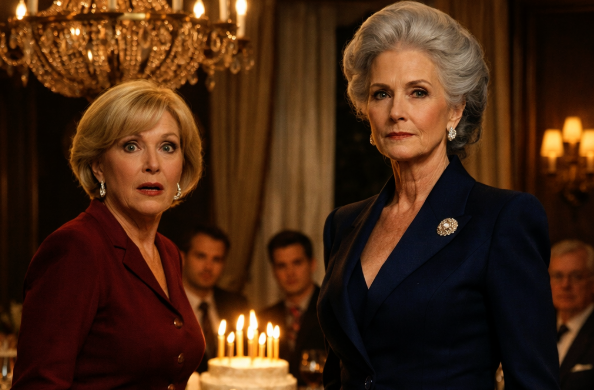
The air smelled of fried pies, expensive perfume, and strained, ringing politeness. Twelve people sat around the table, laden with my mother’s salads and my apple charlotte. It was Lyudmila Stepanovna’s anniversary. Fifty-eight years of grandeur.
I was carrying the cake. Candles. “May all your wishes come true, Lyudmila Stepanovna.” A smile stretched so tight it hurt my cheekbones. She accepted the gifts with a queen’s nod. Her new blouse was silk, probably bought by Sergey. My two weeks’ salary as a teacher.
“Yulia, why is the borscht so watery today?” she asked without touching her spoon. Her voice was sweet vinegar.
Everyone fell silent. Aunt Tanya, my mother-in-law’s sister, leaned forward with interest.
“Mom cooked the borscht,” I said quietly. “I was at work, at a parent-teacher meeting.”
“Ah,” Lyudmila Stepanovna drawled. “Work. Thirty-eight thousand. Sergey alone pays twenty for the apartment.”
Sergey, sitting across from me, buried himself in his phone. His profile was a familiar bastion behind which he had been hiding for the last seven years. Ever since we moved to this military town, into the apartment he inherited from his colonel grandfather.
“Mom,” he muttered without lifting his head, “enough.”
“Enough of what? I’m telling the truth. And the son you raised…” she nodded toward Danil, our fourteen-year-old, who was staring into his plate, “he’s a bookworm. He’ll never become a real man.”
Inside me, everything tightened into a hot, burning ball. But I unclenched my jaw.
“Danil studies well. He dreams of going into IT.”
“Dreams!” my mother-in-law snorted. “And who sat him down in front of a computer? You. Instead of letting him run around outside with the boys. He’s practically forgotten how to talk.”
Danil blushed to the roots of his hair. He really had grown quieter over the last year. He had seen too much.
“All right, all right,” Aunt Tanya cut in, though her eyes sparkled with pleasure. “Don’t ruin the celebration.”
The celebration went on. Toasts. To health. To family. Lyudmila Stepanovna caught admiring glances and adjusted her expensive brooch. I washed dishes in the kitchen, listening to her tell the guests how she had “invested” in our apartment renovation. Invested—meaning that three years ago she had given Sergey one hundred thousand rubles, which we then spent two years paying back in installments. I kept track of every ruble in a notebook with a blue cover. In that same notebook I wrote down other things too: the small amounts Sergey asked for “for business” that later resurfaced in the form of gifts for his mother.
“Are you feeling bad?” Anna, my colleague from school, asked quietly as she dried a plate beside me. She was the only one from my side I had invited. A safety measure.
“The usual,” I said, and my voice trembled.
“It’s time, Yulia. Time to do something.”
I nodded. But what? Leave? With Danil, a teacher’s salary, and the hundred thousand rubles I had managed to save over five years? Go where? To a rented apartment in the same little town where everybody knows everybody? Where Lyudmila Stepanovna was a respected person, a former accountant at the military unit?
Laughter came from the living room. It was Sergey’s brother, Andrey, who had come from the region. He was always on his mother’s side.
“Yulia!” my mother-in-law called. “Come here. The guests want tea.”
I wiped my hands. Walked in. Everyone was looking at me. With curiosity, pity, contempt.
“Lyudmila Stepanovna,” I said, “the kettle is boiling.”
She leaned back in her chair. Looked at me for a long, appraising moment.
“You know, Yulia,” she began in a singsong voice, “I was thinking. All my life I’ve done everything for the family. I raised my husband, buried him properly. Brought up my sons. And now I have no strength left. My health is failing.”
Everyone nodded with sympathetic faces.
“And I see no gratitude. Especially from you. I’m like a mother to you. And you? So cold. So distant.”
“I respect you,” I forced out.
“Respect me?” she smirked. “That’s not respect. Respect is when you come and bow at my feet for all the good I’ve done. For the son I raised for you. For the roof over your head. And what are you? A schoolteacher. Counting pennies.”
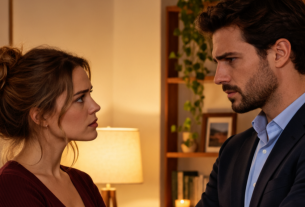
Silence hung over the room. Even Andrey stopped smiling. Sergey lifted his head from his phone. His face was blank, like a screen that had gone dark.
“Mom,” he said tonelessly. “What are you doing?”
“No, Seryozhenka,” my mother-in-law’s voice rang out. “I want to understand. I want to see her gratitude. Right now. In front of everyone.”
She pushed back her chair, planted her feet on the floor, and straightened up.
“Come here, Yulia. And bow at my feet. Properly. Like a grateful daughter-in-law should.”
Time stopped. I saw beads of sweat on Aunt Tanya’s temple, Danil’s frightened eyes as he curled in on himself, Andrey’s indifferent stare. I saw Anna’s face—she was staring at me, eyes wide.
I looked at Sergey. Straight into his eyes. He looked away. He picked up a cigarette and a lighter from the table. Clicked once, twice. It wouldn’t light.
That clicking became the final point. The one after which neither fear nor hope remains. Only a cold, clear emptiness.
I didn’t say a word. I turned around. Walked past stunned Anna, past the mirrored wardrobe where my pale reflection flickered. Took my cheap jacket and my bag from the coat rack. Pulled on my sneakers.
“Where are you going?” my mother-in-law’s shout finally broke loose.
I opened the door. Stepped out onto the landing. The door slammed behind me, muffling the scandal just beginning inside.
Outside, it was a cold autumn evening. I walked without feeling my legs. I breathed in ragged gasps, like after a long run. I had no plan. Not even a thought. There was only action: one step, then another, then a third. Away.
SERGEY’S CHAPTER
She left. She simply got up and left. The door shut with such a quiet click that he heard it through his mother’s screams.
“How dare she! In front of guests! I’ll show her! Sergey, do you hear me? Go bring her back and make her apologize!”
His mother was red with fury. Her splendid anniversary had been ruined. Her authority undermined. Andrey stood up and muttered uncertainly, “Calm down, Mom.” Aunt Tanya shook her head, lamenting, “What has the world come to? Young people have gotten completely out of hand.”
Danil sat pressed against the wall. His face was waxy. Sergey caught his son’s gaze—and for the first time in a long while saw not hurt there, but something else. Something hard. Like steel.
“Dad,” Danil said quietly. “She’s not coming back.”
“What?” Sergey replied.
“Mom. She’s not coming back.”
“Oh, be quiet!” Lyudmila Stepanovna shrieked. “All of you are against me! I’ve fought alone all my life!”
Sergey stood up. His head was pounding. He went into the hallway and poured himself water from the filter. His hands weren’t shaking. They had stopped shaking a long time ago, about five years earlier, when he realized that between the hammer and the anvil, it was easier to become part of the anvil.
He hadn’t wanted things to turn out this way. But Mom… Mom always pushed it to the limit. And Yulia… Yulia had been like stone this last year. She didn’t argue, didn’t cry. She was silent. And that silence angered him more than shouting ever had. Because inside it was a quiet, relentless judgment. Of him, of his life, of his role in it.
He was forty. He owned a building materials store he had opened with his mother’s money after the army. Business was decent. Eighty thousand a month, sometimes one hundred twenty. But every ruble was accounted for. Every major deal required her approval. Because she could “sense” people. Because she had invested.
He went back into the living room. The guests, embarrassed, were gathering their things. Anna, Yulia’s friend, already had her coat on.
“Sergey,” she said, looking at him without a trace of her former friendliness, “today you crossed a line. Or rather, you allowed one to be crossed.”
“That’s none of your business,” he snapped.
“Yulia is my friend. And what I saw today…” she shook her head. “Good luck with this family.”
She left. The celebration was falling apart before his eyes like a house of cards. Mom was sobbing in her armchair, demanding sedatives. Andrey was trying to comfort her. Aunt Tanya was grumbling in the kitchen as she rewashed already clean dishes.
Sergey went to the window. Outside it was dark. Where was Yulia? At the bus stop? At Anna’s place? Or just walking through the streets of this sleepy town where every lamp post knew their story?
He remembered how they had met. He had come to her college for an alumni event—he needed to meet with the dean about building materials for repairs. She was an intern, giving a tour to schoolchildren. Laughing, adjusting her glasses. He had asked her out for coffee. She had said yes without flirting, directly. He liked that.
Then came the quick marriage. His mother was against it: “A schoolteacher! No money, no status!” But he insisted. For the first time in his life. Yulia seemed like a quiet harbor after the endless storms with his mother. She didn’t demand, didn’t pressure. She listened.
And then it began: the move to the town, Danil’s birth, Mom “helping.” At first with advice. Then with money. Then with her presence. Every day. Every single day. Yulia tried to resist—softly, in her own way. She set boundaries. But he, exhausted by conflicts at work, by his mother’s pressure, by responsibility, looked for peace. And he found it in neutrality. “Mom is Mom.” “She’s older, she deserves respect.” “That’s just how she shows care.”
And now Yulia had left. She hadn’t slammed the door. Hadn’t shouted accusations. She had simply walked out. And that quiet departure was more terrifying than any hysterics.
“Seryozha,” his mother called, sniffling. “Call her. Tell her to come back. Tell her to come apologize tomorrow. Otherwise… otherwise I’ll sue over the property! The apartment was Granddad’s, it doesn’t belong to her!”
He turned around. His mother was looking at him with wet but sharp eyes. There were no tears in them. Only calculation.
“What property, Mom?” he asked tiredly. “She has nothing.”
“Moral damages! Public insult! We have witnesses!”
He suddenly realized she was not joking. She was capable of it. Capable of turning their lives into a court battle simply because someone had disobeyed her.
“All right,” he said. “I’ll call her tomorrow.”
“No, now! This very minute!”
“Mom,” his voice cracked, “enough! Tomorrow!”
She leaned back, stunned. He had never raised his voice at her. Never.
A heavy silence filled the room. Danil rose from the table.
“I’m going to bed,” he said flatly, and left without looking at anyone.
Sergey remained alone in the middle of the wreckage of the party. He took out his phone. Dialed Yulia’s number. Long ringing. Then: “The subscriber is temporarily unavailable.”
He sat down on a chair and dropped his head into his hands. One thought pounded in his head: What have I done? But immediately, like a well-rehearsed mantra, another answered: Nothing. She’s the one at fault. She shouldn’t have pushed things this far. She should have bowed. Just bowed, and everything would have been fine.
But for some reason he knew it wouldn’t have. It hadn’t been fine for a long time.
YULIA’S CHAPTER
I walked wherever my eyes took me. The town was asleep. The windows in the five-story apartment blocks glowed with sparse yellow dots. I was cold in my thin jacket, but I didn’t feel it. All I felt was a strange, icy lightness. As if I had dropped a heavy backpack I’d been carrying for years, and now the wind moved freely through the empty space behind my shoulders.
I came to the school. My school—a three-story brick building from the postwar years. The gate was locked, but I knew about the hole in the fence by the sports ground. I slipped inside and sat on the cold steps of the entrance. Took out my phone. Turned it off. I didn’t want to hear calls or messages.
What now?
The plan I had been carrying in my head for the last six months was simple and naive. Wait until Sergey went on a business trip for a week. Take Danil. Take my things—not many. Take my savings: one hundred seven thousand rubles on a card nobody knew about. And leave. Go to the region, to my childhood friend who had invited me to stay until I got on my feet. Get a job there as a teacher. Start over.
But tonight had shattered everything. I broke too early. Left impulsively, without my things, without money—the card was at home—without my son.
My son.
My breath caught.
I pictured his face at the table. His hunched shoulders. He had seen everything. All those years, he had seen everything. And I, fool that I was, had thought I was protecting him by keeping the family together. But what had I been preserving? A humiliating model of relationships where Grandma was the tsar, Father a mute soldier, and Mother the one who just endured.
It’s your own fault, a voice inside me whispered. A voice that sounded very much like my mother-in-law’s.
Yes. My fault. My fault for allowing it. My fault for not leaving earlier. My fault for thinking my patience and love would change anything. They hadn’t changed anything. They had only corrupted things. They had shown that this was how people could treat me.
I remembered my own mother. My real mother. She had endured too. Endured the constant reproaches and control of my grandmother—my father’s mother.
“Mom, why don’t you leave?” I had asked as a teenager.
“You can’t, sweetheart. For your sake. And then… where would I go?”
She died five years ago, never having lived to see either freedom or gratitude. And it seemed I had followed in her footsteps. The same cycle. The same dead end.
No. I would not die here on the cold steps of a чужой school. I would not die like my mother, in fourteen square meters of kitchen, listening to reproaches.
I turned my phone back on. Ten missed calls from Sergey. Three from an unknown number—my mother-in-law, probably. One message from Anna: Yul, I’m home. Come over. There’s room.
I didn’t go to Anna’s. I didn’t want to drag her deeper into my problems. Instead, I called a taxi. Gave an address: 15 Gagarin Street, apartment 12. To my former mother-in-law? No. To Aunt Galya, the elderly neighbor downstairs, who once, after my first fight with Lyudmila Stepanovna, had quietly said to me on the staircase: “Hang in there, dear. She treated her own husband the same way. Drove him to his grave.”
Aunt Galya didn’t open immediately. She peered at me through the chain.
“My God, Yulechka, what happened to you? Come in, come in.”
Her one-room apartment smelled of medicine, cat, and peace. She poured me tea and silently put a jar of jam on the table.
“You left?” she asked simply.
I nodded, unable to speak.
“Good. Shame you didn’t do it ten years ago.” She sighed. “Do you know why she’s like that?”
“Her character,” I whispered.
“Not just that. She has a secret. A big one. Something to do with money.”
I lifted my head.
“What secret?”
“Her husband, Stepan, left savings before he died. Not huge, but for those times—a fortune. A savings book. It was in his name and Sergey’s. It was supposed to go to his son when he came of age. But she… she cashed it out. All of it. A year after his death. What she spent it on, I don’t know. Fur coats, gold, this whole important-person act. And she told Sergey his father hadn’t left anything.”
I froze. There it was. The skeleton in the closet I had suspected but never had proof of. I’d seen old photographs, heard scraps of conversation. Stepan Petrovich had been a foreman at the factory; he had saved for a family house.
“How do you know?” I asked.
“My late husband worked his shift with him. Stepan told him before he died. About the savings book too. And then I saw Lyudka at the Sberbank branch getting the money. A sack of money, almost. That was in 1995. Sergey was sixteen then.”
I drank my tea as thoughts raced through my head like bullets. This was a weapon. A powerful one. But… not mine. It was Sergey’s secret. His father’s. His mother’s betrayal of him.
“Thank you, Aunt Galya,” I said.
“You’re welcome. Just be careful… if she senses you know, she’ll devour you alive. To save face, she’ll do anything.”
I stayed the night at her place. On an old fold-out couch. I didn’t sleep. I listened to the cat snoring behind the wall and made new plans. Not for escape anymore. For return. But on my own terms.
In the morning my phone exploded. Sergey called first.
“Yulia, where are you?” His voice was strained.
“Safe.”
“Danil is crying. Come back. Let’s talk.”
“Talk.”
“Not over the phone. Come home.”
“No,” I said firmly. For the first time in seven years, I said “no” to him in that tone. “If you want to talk, come alone. To the Cozy Café at the station. At noon.”
He was silent for a moment.
“Mom…”
“You come alone, Sergey. Or don’t come at all.”
I hung up. Immediately, the unknown number called. I answered.
“Yulia, this is Lyudmila Stepanovna,” came the icy voice, without a trace of yesterday’s hysterics. “You made a huge mistake. You publicly insulted me. Humiliated me in front of the family. We have witnesses. I will sue for moral damages. And for division of property. The apartment belongs to my son, and you’re only temporarily registered there. You’ll be out on the street.”
I listened, staring at the ceiling cracked like a lightning bolt.
“Have you said everything?” I asked calmly.
My tone threw her off.
“I demand that you return today and apologize in front of everyone. On your knees.”
“Lyudmila Stepanovna,” I said slowly, “do you remember Stepan Petrovich’s savings book? The one in his name and Sergey’s?”
There was such silence on the other end that I heard my own heartbeat.
“What?.. What savings book?” Her voice faltered.
“The one you cashed out in 1995. At the branch on 4 Lenin Street. There are witnesses. And not only witnesses.”
I was bluffing. The witness was Aunt Galya. Her testimony alone was probably not enough. But my mother-in-law didn’t know that.
“You… you’re lying!” her voice turned into a hiss. “Slanderer! I’ll destroy you!”
“Goodbye,” I said, and hung up.
My hands were shaking. But inside, I was calm. I had taken the first step. Not for revenge. For protection.
Aunt Galya looked at me approvingly.
“Good girl. Just be careful. She’ll be like a wounded beast now.”
At noon I was at the café. Sergey came ten minutes late. He looked worn out, sleepless.
“Yul,” he sat down opposite me without taking off his jacket. “Let’s not make a scandal. Come back. Mom… she was wrong, but she’s still my mother. She’ll apologize. We’ll somehow…”
“No, Sergey,” I cut in. “We won’t somehow. And she won’t apologize. And you know that perfectly well.”
He pressed his lips together.
“What do you want? Money? We’re not dividing the apartment—it isn’t yours.”
“I want a divorce,” I said plainly. “And I want Danil to stay with me.”
He smirked, but it came out crooked.
“The court will leave a teenage child with the father if the father has housing and a stable income. And what do you have? A teacher’s salary and the threat of rent?”
He was speaking in quotes. Quotes from his mother. I looked at him and saw not the confident man I had once met, but a frightened boy terrified of losing the approval of the one person who mattered most in his life.
“I have something else,” I said quietly. “Knowledge. About your father. About the money he left you.”
His face changed. First confusion, then a shadow of suspicion, and finally cold, animal fear.
“What are you talking about?”
I told him everything I knew from Aunt Galya—without naming her. About the savings book. About 1995. About the sack of money.
He listened without moving. His fingers slowly curled into fists.
“You’re lying,” he whispered. “Mom couldn’t.”
“Check. Go to the Sberbank archives. Request the information. It may not exist electronically anymore, but the paper trail is still there. Or ask her directly. Look her in the eyes.”
He stood up. Shoved his chair aside.
“Why are you doing this? To turn me against my mother?”
“You’re already turned against her, Sergey. You’re just afraid to admit it. I don’t want to turn you against her. I want you to finally see who she is. And who you are. And that Danil and I are not pawns in her game of keeping power.”
He breathed heavily, staring somewhere past me.
“Danil,” he finally said. “Does he want to be with you?”
“I don’t know. But he has the right to choose. And he has the right not to live in an atmosphere of constant humiliation of his mother.”
Sergey slowly nodded. Then turned and walked out, without looking back.
I remained sitting at the table with my unfinished coffee. Something had gone wrong, but not in the way I expected. I thought he would break. See the truth. Instead… he just left. Back into his usual reality, where Mother was sacred and Wife was the problem.
But I didn’t give up. I finally went to Anna’s. She lived in a new neighborhood, in a tiny mortgaged one-room apartment.
“I’m with you,” she said, hugging me. “I’ve got a couch. Stay as long as you need.”
“Anna, I need a lawyer. A good one. And… I need a job. Not here.”
“And what about that… that thing you mentioned? The compromising information?”
I sighed.
“That’s not my card to play. It’s his. And he apparently isn’t ready to use it.”
That evening Danil called. His voice sounded adult. Foreign.
“Mom, where are you?”
“At a friend’s place, sweetheart. How are you?”
“Okay. Grandma’s here. She’s yelling at Dad. Dad is silent. And I… I want to be with you.”
My heart clenched.
“Come. I’ll give you the address.”
“I can’t. Grandma won’t let me. She says you stole money from the family and ran off with a lover.”
I closed my eyes.
“Danil, do you believe that?”
Pause.
“No. I’ve seen how she treats you. Always. And I’ve seen how Dad stares at the floor. I don’t want to be like Dad.”
At last the tears came—hot, bitter.
“We’ll be together, son. I promise. Just give me a little time.”
We agreed he would call me secretly every day. I felt like a traitor, leaving him in the enemy’s lair. But I knew that if I went back now, everything would start over again. Only worse.
The next day I went to the Department of Education. Asked about vacancies in the region. One school in a district center was looking for a primary school teacher. Salary: the same thirty-eight thousand. But there was the possibility of getting service housing—a tiny apartment attached to the school. I sent in my résumé.
Then, through Anna’s contacts, I found a lawyer. A woman in her fifties with intelligent, tired eyes. She listened to my story.
“It’s complicated,” she said. “The apartment isn’t yours, and there isn’t much proof of systematic psychological abuse. But there is a teenage child, and his opinion will be taken into account. And… you mentioned possible concealment of inheritance by your mother-in-law?”
“Yes. But I have no proof. Only the word of one witness who, I’m afraid, won’t go to court. She’s scared.”
“I understand. We need something more. Something that shows the father’s inability to provide the child with a normal psychological environment. Or the grandmother’s dangerous influence.”
I left her with a heavy heart. Everything came down to money and time. I had one hundred seven thousand. The lawyer wanted thirty thousand for the case. Rent in the district center would be at least fifteen thousand a month. Plus living expenses. The money would last half a year at most.
And then I decided to take a risk. I called Sergey’s brother, Andrey. We had never been close, but he had always seemed less caught up in their mother’s games.
“Andrey, it’s Yulia. Can we talk?”
He was surprised, but agreed to meet. We met at the same café.
“I know you’re on her side,” I began without preamble.
“Mom is a complicated person,” he said evasively.
“She stole Sergey’s inheritance from his father.”
He choked on his coffee.
“What?”
I repeated it. Told him everything I knew.
He listened, and his face grew darker and darker.
“Damn,” he exhaled when I finished. “So that’s why she always had money when Sergey and I had nothing in college… She said Dad drank it all away.”
“Can you talk to Sergey? Open his eyes?”
Andrey thought for a moment.
“He won’t believe me. He… idealizes her. For him, Dad was a weakling, and Mom was a heroine who raised two sons alone. If I say something like that… he’ll just stop talking to me.”
“What if there’s proof? Documents?”
“Where would they come from? It’s been almost thirty years.”
A desperate, hopeless anger rose in my throat. It felt like every road was blocked. But then Andrey unexpectedly said:
“There’s one person. Uncle Kolya. Dad was friends with him. He worked at the same Sberbank. He’s retired now, lives out in the region. If anyone remembers something… it’ll be him.”
He gave me an address and a phone number. Warned me: “He doesn’t like remembering those times. Be careful.”
I went to Uncle Kolya the very next day. It was a three-hour trip by commuter train and minibus. He lived in a private house on the outskirts of the district center, the very one I might soon be moving to.
The old man—strong, with piercing blue eyes—listened to me on the doorstep without inviting me in.
“Lyudka Stepanova? Yes, I remember her. A sly devil. Her husband Stepan was a golden man. Saved for a house. Used to come often, checking the interest. And then… after his death, she came. With documents. I was a cashier back then. I saw something was off in the papers. But the manager said, ‘Pay it out, stay out of it.’ So I paid it. A large sum for those times. She could barely sign—her hands were shaking. But not from grief. From greed, I think.”
“Do you… do you remember any details? The account number? Anything that could be checked?”
He shook his head.
“The archives from those years… not all of them survived. And what will it do for you anyway? The statute of limitations is long gone.”
“Not for court. For the son. So he knows the truth.”
Uncle Kolya sighed.
“Come back in a week. I’ll dig through my old papers. Maybe I’ll find something. But I promise nothing.”
I returned empty-handed, but with a sliver of hope. And at Anna’s, a new blow was waiting for me. Sergey was standing at the door. Alone. His face drawn with exhaustion.
“Can I come in?” he asked.
Anna frowned, but let him in, staying in the hallway like a guard.
“I went to the archive,” he said without sitting down. “Requested a statement. About my father. It’s true. There was a deposit. In his name and mine. Closed in November 1995. The full amount withdrawn in cash.”
He spoke monotonously, like a machine.
“I asked Mom.”
“And?”
“She said it was a lie. That I believed you instead of her. That you were turning me against her. Then… then she collapsed. Grabbed her chest. We had to call an ambulance.”
I was silent.
“The doctors said it was a hypertensive crisis. From stress. She’s in the hospital.”
“I’m sorry,” I said sincerely.
“Sorry?” he suddenly laughed—short and bitter. “You got what you wanted. You turned me against my mother. You sent her to the hospital.”
“I didn’t do anything, Sergey! I only told the truth! How she reacted was her choice! She has always played the victim whenever she was losing control!”
“Shut up!” he shouted, and Anna stepped forward. “You were against her from the start! You never accepted her! And she… she raised us alone!”
It was useless. He couldn’t hear me. Didn’t want to hear me. It was easier for him to blame me than to admit that the image of his saintly, heroic mother was a myth.
“Why did you come?” I asked tiredly.
“To take Danil. Officially. Through the court. Mom is right—you’re unstable. You make scenes, run off at night, spread slander. The court will leave him with me.”
That was a low blow. Even for him.
“Get out,” Anna said firmly. “Right now.”
He looked at me one last time. There was no hatred in his eyes. There was despair. The despair of someone who understands the ground is slipping away beneath him and clutches the only thing left—his mother, even if she is dragging him under.
He left. I sat down on the floor in the hallway and cried. Everything had fallen apart. My attempt to act honestly, through truth, had failed. An ally—Andrey—had given me a thread, but it was too thin. My husband turned out not to be the kind of man who would open his eyes, but the kind who would prefer a comfortable lie. And I was left without a home, without enough money—the legal battle would devour all my savings—and with only ghostly chances of keeping my son.
Defeat, I thought. Total and absolute.
But two days later, a letter came. From the school in the district center. They had reviewed my résumé and invited me for an interview. They also mentioned that service housing—a small but separate apartment—would be available immediately upon employment.
And another day later, Uncle Kolya called.
“I found something,” he said hoarsely. “Not a document, no. But a photograph. One of our department’s group photos, from some company event. There are signatures on the back. And there… you’ll see for yourself.”
He sent the picture to my email through his grandson. A black-and-white photograph, yellowed with age. A group of bank workers. In the foreground—a young Lyudmila, smiling, wearing a fashionable blouse for those days. And in the corner of the photograph, circled in pen—the date: 11/15/1995. And the caption: A bonus for hard work? Or Stepan’s inheritance?
It was not evidence for court. It was testimony. Proof that someone else had known. Someone else had seen. And perhaps was ready to speak.
I didn’t show it to Sergey. I didn’t blackmail my mother-in-law. I made a copy and stored it somewhere safe. It was my insurance. For the worst-case scenario.
The interview went well. They offered me the job. I signed the contract. A week later, I received the keys to the service apartment—a tiny twenty-square-meter place in an old wooden building on school grounds.
The first thing I did when I went in was open all the windows. It smelled of dampness, old wood, and freedom.
Then I called my lawyer.
“I’m ready to file for divorce. And for Danil to live with me. I have a job and housing in another district. And… I have a witness who can confirm the grandmother’s negative influence on the child.”
“Who?” the lawyer asked.
“My son. Danil. He’s fourteen. His opinion will be taken into account.”
“Is he ready to speak?”
“I’ll talk to him.”
The conversation with Danil was the hardest of all. I invited him to a café in our town while Sergey was at work. My mother-in-law was still in the hospital.
“Mom, I want to be with you,” he said before I even asked. “But Dad… he says you abandoned us. That you destroyed the family.”
“And what do you think?”
He was silent for a long time, poking at his ice cream with a spoon.
“I think the family fell apart a long time ago. You just stopped pretending it hadn’t. And I… I’m ashamed that I stayed silent.”
“You have nothing to be ashamed of. You’re a child. It was my job to protect you. And I failed at it. But now I will. If you’ll let me.”
He nodded. Then, looking down at his plate, said:
“Grandma keeps calling Dad from the hospital. Says you’re a witch. That you almost killed her. And Dad… he believes her. He bought her a new phone, an expensive one. Says it’s so she won’t get upset.”
My heart dropped. Sergey hadn’t just stayed with his mother. He was investing in her version of reality. With money. With attention. That meant the fight for my son would be brutal.
And brutal it was.
SERGEY’S CHAPTER
She filed for divorce. Through her lawyer. Asked for their son and child support. He, through his own lawyer—his mother’s, really—filed a counterclaim, alleging that she was unfit to raise the child due to an “unstable mental state and a tendency to flee the family.” As evidence, they attached printouts about her nighttime departure—that same escape from the anniversary party—and testimony from the guests about her “inadequate reaction to fair criticism.”
The first hearing took place a month later. Yulia came with her lawyer. She looked… composed. Calm. Not the crushed woman he was used to seeing. She spoke clearly, without hysteria. Talked about the constant psychological pressure from his mother, about his passivity. Gave examples.
Her lawyer requested a psychological-pedagogical evaluation for Danil. The judge, a woman in her fifties, agreed.
After the hearing he tried to talk to Yulia in the hallway.
“Yulia, let’s stop this circus. Come back. We’ll somehow…”
“No, Sergey,” she looked at him without malice, but without warmth. “We won’t somehow. You chose a side. And it wasn’t mine.”
“I didn’t choose! I’m trying to save the family!”
“Your family with your mother? Yes, you’re saving that. Ours—you destroyed years ago.”
She walked away. He remained in the empty courthouse hallway, choking on helpless rage. Why didn’t she understand? Mom was sick. Mom needed him. And Yulia… Yulia was strong. She would manage. It would be hard, sure, but she would manage.
His mother was discharged from the hospital. She became even more demanding. Now she lived with them “so Seryozha wouldn’t be alone.” She ran the household, cooked his favorite dishes, and every evening at dinner cried about how ungrateful Yulia was, how she had blackened her good name.
Danil said nothing. At all. He answered in monosyllables, shut himself in his room. When they suggested he see a psychologist—by court order—he agreed immediately. Sergey saw this as weakness in his son. Runs in the family, he thought bitterly.
The psychologist, a young woman, called Sergey in for a conversation after several sessions.
“Your son is going through a deep internal conflict,” she said carefully. “He has a strong attachment to his mother, and at the same time feels guilty for not protecting her. The atmosphere in the home with the grandmother… he describes it as tense. He’s afraid of her.”
“Afraid? Of his grandmother? She loves him!” Sergey protested.
“Love can take different forms,” the psychologist said gently. “He says she constantly criticizes his mother in front of him, demands that he condemn his mother. For a teenager, that is unbearable pressure.”
“She just wants him to understand the truth!”
The psychologist looked at him with a trace of sadness.
“And what is the truth, Sergey?”
He had no answer.
The evaluation concluded: the teenager was psychologically stable, attached to his mother, and negatively affected by the conflict-ridden atmosphere in his father’s home caused by the grandmother’s presence and behavior. It recommended that he live with his mother, while maintaining frequent contact with his father in a neutral setting.
Sergey was furious. “They bought them off!” he yelled at his lawyer. The cynical veteran merely shrugged.
“Judges often listen to experts. Especially with children that age. We need something more substantial. Dirt on her. On her lifestyle.”
And then his mother offered her own idea.
“Find out who she’s living with over there. Surely there’s a man. Take pictures. It’ll prove an immoral lifestyle.”
At first he refused. It was beneath his dignity. But after another hearing where the judge clearly leaned toward ruling in Yulia’s favor, he agreed.
He went to the district center. Found the school. Saw her coming out with the children after the bell. She was laughing. The way she had not laughed with him for years. Then she went, not home, but to a café. And a man approached her. Young, around thirty. They spoke animatedly.
Sergey recorded it on his phone, his hands trembling. Then the man left, and Yulia stayed. And then… Andrey approached her. His own brother. They hugged like old friends. Andrey handed her an envelope.
Everything fell into place. Betrayal. His brother was in league with her. Giving her money? Information? He felt the ground slip away beneath him for good. Everyone was against him. Mom had been right.
He returned home and showed his mother the video. She was triumphant.
“You see? And your brother is a traitor. And she’s a slut. Take it to court, Seryozha! Tomorrow!”
But he didn’t take the video to court. Something inside resisted. Perhaps the remnants of shame. Perhaps a vague understanding that the man in the café could have been anyone—a colleague, a student’s parent. And Andrey… Andrey might simply have been helping. As a brother.
He called Andrey. His brother picked up after the fifth ring.
“You met with her?” Sergey asked without preamble.
Pause.
“Yes. I gave her something from Uncle Kolya.”
“What?”
“None of your business. Seryozha, come to your senses. Mom is dragging you into an abyss. Can’t you see it?”
“I see that you’re against the family!” Sergey shouted. “You’re with the one who sent Mom to the hospital!”
“Mom sent herself there! Or do you think her blood pressure went up because of Yulia? No! Because she was afraid the truth would come out! Because she has spent thirty years living a lie and was terrified of being exposed!”
Sergey hung up. He had nothing to say. Because deep down, he knew his brother was right. He had seen that fear in his mother’s eyes when she denied everything. Seen her fury when she was caught lying. But to admit it… would mean destroying his whole picture of the world. All his excuses. All his years of silence and passivity.
He didn’t bring the video to court. Instead, he went to his father. To the cemetery. Stood before the simple granite stone: Stepan Petrovich Volkov. 1948–1994. Sleep peacefully, dear husband and father.
“Dad,” he whispered. “What should I do?”
The wind rustled in the tops of the pines. There was no answer. There never had been.
The final court hearing was quick. Taking into account the evaluation, the mother’s job and housing, and the teenager’s own wishes, the court ruled that Danil would live with Yulia. Sergey was ordered to pay one-quarter of his income in child support and was granted visitation every weekend, provided the visits took place without the grandmother present.
Yulia did not demand division of property. Only the divorce and her son. She got both.
When the judge announced the ruling, his mother, who had been sitting in the courtroom, cried out, “This is unfair!” and fainted. An ambulance had to be called. Again.
Sergey stood there watching Yulia embrace Danil. There was no triumph on her face. Only exhaustion. And relief.
He approached.
“Are you satisfied?”
She looked at him.
“No, Sergey. I’m not satisfied. I’m empty. We both lost. I just lost a little less.”
She took Danil by the hand, and they walked out of the courtroom. He watched them go. His family was leaving. Forever.
Epilogue. One year later.
YULIA’S CHAPTER
The little apartment smelled of apples and wax from the new candle. I lit it every evening—a ritual reminding me that this home was mine. Twenty square meters, old wallpaper, but mine. Danil lived with me. The first months had been hard—adjusting to a new school, missing his friends, difficult conversations with his father on weekends. But he held on. He started going to the school programming club. Built his first website.
I worked at the school. Thirty-eight thousand, plus another ten tutoring on the side. It was enough. Not for luxury, but for life. Sergey’s child support arrived on time. I put some of it away—for Danil’s education.
I had no contact with my former mother-in-law. I heard from Danil that she lived with Sergey now, sick, always demanding attention. According to my son, he had grown even gloomier. The business seemed to be declining—crisis, competition.
Sometimes, at night, I dreamed of that anniversary. And her voice: “Bow at my feet!” And I would wake with the clear understanding: I had not bowed. And that was my only victory in that war. Not legal. Not financial. Personal.
I did not become happy in an instant. Happiness is not a destination you arrive at after running away. It is a road. Sometimes smooth, sometimes bumpy. On that road there was loneliness. Fear for the future. Bone-deep exhaustion. But there was also silence. The silence in which I could finally hear myself.
One day, in spring, Anna came to see me at school. We drank tea in my little office.
“You know,” she said, “I didn’t tell you everything back then. When you left that anniversary… your mother-in-law called my principal. Reported that I was immoral, that I supported the destruction of families, that I shouldn’t be a teacher.”
I froze.
“And what happened?”
“I got called in for a talk. But I… I was ready. I had my own trump cards. I said that if they touched me, I’d tell everyone the whole story about the savings book. Including the prosecutor’s office, about possible fraud. She backed off.”
“Anna, I’m sorry, I didn’t know…”
“Oh, it’s fine. I’m no angel myself. Back then… I was a little jealous of you. Your strength. The fact that you managed to leave. And I’ve been sitting in my own problems for ten years. So let’s call it even.”
We laughed. Bitterly.
At the end of the school year, I was offered a promotion—to methodologist. Another ten thousand. Not enough to build a skyscraper, of course, but life became a little easier.
One day in June, Danil came back from a weekend with his father and said:
“Grandma asked about you.”
“And?”
“She asked how you were. Then she said, ‘Well, let her live, if that’s better for her.’ And then she cried.”
I said nothing. I felt neither triumph nor pity. Just emptiness. Like after a long illness, when the pain is gone but the weakness remains.
Once a month, I get a message from Sergey. Always the same: Transferred child support. Sometimes: I’ll pick Danil up at seven on Saturday. No extra words. We have become strangers tied only by a shared child and a shared pain. Maybe that’s how it should be.
Today is Saturday. Danil is at his father’s. I sit by the open window listening to the rain drip from the roof. On the table is that same blue notebook where I once wrote down expenses. The last entry was a year ago: 100,000 — black day fund. The black day came. And passed.
I close the notebook. I don’t need it anymore.
Tomorrow morning I have to teach a lesson to my fourth graders. Cook lunch. Live. Simply live. Without bows. Without demands. Without tyranny disguised as love.
This is not victory. It is simply life. Mine. Hard-won, imperfect, but mine.
The rain grows heavier. I get up and close the window.