There were three days left until the celebration, and Olga already knew that everything would go wrong.
Not because she was a pessimist — seven years of experience simply gave her a fairly clear idea of how family gatherings at Leonid Pavlovich’s place usually went. First came the appearance of peace. Then the first little jabs, still spoken half under the breath. Then Lyubov Sergeyevna would gain momentum, and by dessert the tension at the table would be so thick that Olga would want to step outside for air and never come back.
Evgeny was sitting across from her in the kitchen, scrolling through something on his phone. Olga was washing the dishes and looking out the window at the courtyard — children were sliding down the hill, someone was laughing, someone fell and immediately got back up.
“Zhenya,” Olga said without turning around.
“Mm?”
“Maybe we should say we can’t come. That Kirill has classes, or that I have work.”
Evgeny put his phone down.
“Olya, it’s Dad’s birthday.”
“I understand that it’s your dad’s. I’m talking about your mother.”
“Mom is Mom.”
Olga turned off the water. She took a towel, dried her hands, and turned around.
“Evgeny,” Olga said evenly, “do you hear yourself? ‘Mom is Mom’ — is that an explanation?”
Evgeny winced slightly — not from anger, more from fatigue. Olga knew that expression: it was the face of a person who did not want to have a conversation, but could not escape it either.
“I’m just asking you to endure it this one time,” her husband said. “For Dad’s sake. He’s waiting for us.”
“One time,” Olga repeated.
“Yes.”
“Zhenya. I’ve been enduring it for seven years. Every time is ‘one time.’ Do you understand?”
Evgeny looked at his wife. Something flashed across his face — not agreement, but something close to acknowledgment. Then he stood up, walked over to Olga, and took her by the shoulders.
“I know,” her husband said quietly. “I know. But right now — please. We’ll talk later.”
We’ll talk later. That was familiar too.
Olga nodded. Not because she agreed — she was simply tired of explaining something that was already clear to both of them.
She spent the next two days in the kitchen. She bought groceries for four thousand from their shared budget, made three salads, roasted a chicken, cooked aspic — Leonid Pavlovich loved aspic, always praised it, said no one else made it like that. Evgeny helped as much as he could: he went to buy wine, took out the trash, set the table. The children — Kirill and Sonya — circled around nearby, both getting in the way and helping at the same time.
At dinner, Kirill asked:
“Are we going to Grandpa’s?”
“We are,” Olga said.
“Will Grandma Lyuba be there?”
Olga hesitated slightly.
“She will.”
Kirill said nothing, only nodded. Olga looked at her son and thought: even a child already understands something that the adults keep pretending not to notice.
Leonid Pavlovich’s apartment was on the other side of the city — spacious, lived-in, with a long hallway and the unmistakable smell of something homemade. Leonid Pavlovich opened the door himself — wearing a dress shirt, in a good mood. He hugged the grandchildren, shook Evgeny’s hand, hugged Olga as well, and said:
“Well, now everyone’s here.”
Lyubov Sergeyevna stood a little farther away. She looked at her daughter-in-law with that gaze Olga knew by heart: from top to bottom, with the expression of a person who had found something unexpectedly small where she had expected more.
“You came,” her mother-in-law said.
“Good afternoon, Lyubov Sergeyevna,” Olga replied.
Her mother-in-law was already walking toward the kitchen.
Besides Evgeny’s immediate family, there were other relatives too: Konstantin, Evgeny’s cousin, large and good-natured, the kind of person who was easy to be around in any company. And Polina, Konstantin’s wife, a quiet woman with attentive eyes who, as Olga had observed, noticed everything but never interfered. They sat down at the table, poured drinks, clinked glasses to Leonid Pavlovich’s health. Olga sat next to Evgeny, while Kirill and Sonya sat on children’s chairs at the edge.
The first hour passed calmly.
Almost.
Leonid Pavlovich told a story about the dacha, about the neighbors who had put up a new fence. Konstantin laughed, Polina nodded. Lyubov Sergeyevna ate in silence — which in itself was already a sign that her mother-in-law was thinking something over.
Olga tried to relax. She poured herself some juice and cut a piece of roasted chicken. The chicken had turned out well — tender, with a golden crust. Leonid Pavlovich had already taken a second helping and nodded approvingly at Olga.
“Delicious,” her father-in-law said. “As always.”
“Thank you, Leonid Pavlovich.”
“Not enough salt, in my opinion,” Lyubov Sergeyevna said without lifting her eyes from her plate.
A slight pause fell over the table.
“I think it’s just right,” Konstantin said.
“You always think things,” Lyubov Sergeyevna replied with a smile that was not a smile.
Olga picked up her fork and continued eating. Evgeny beside her tensed slightly — she could feel it in the way his posture changed.
After a while, Lyubov Sergeyevna looked at Olga and spoke as if continuing an interrupted conversation, though there had been no conversation at all:
“You cut your hair again? It doesn’t suit you.”
“I like it,” Olga said.
“Well, you know best.” Her mother-in-law shrugged in a way meant for everyone to notice. “Although your face is broad. Long hair would hide that flaw.”
Polina lowered her gaze at the table. Konstantin took a piece of bread and pretended to be very busy with it.
Evgeny said nothing.
Olga said nothing either. She took a napkin and dabbed her lips. In seven years, she had learned not to react immediately — to wait it out, the way one waits out rain under a shelter. It would pass.
But Lyubov Sergeyevna was in a special mood today.
“Kirill, come here,” her mother-in-law called to her grandson.
The boy came over. Lyubov Sergeyevna stroked his head and said in a tone clearly not meant for the child:
“All his father. Good thing he takes after his father.”
Kirill did not understand the subtext — he nodded and returned to his plate. Olga understood. Evgeny did too. Silence hung over the table again.
Leonid Pavlovich coughed.
“So, as I was saying about the fence,” her father-in-law began. “The neighbor, Viktor, you see…”
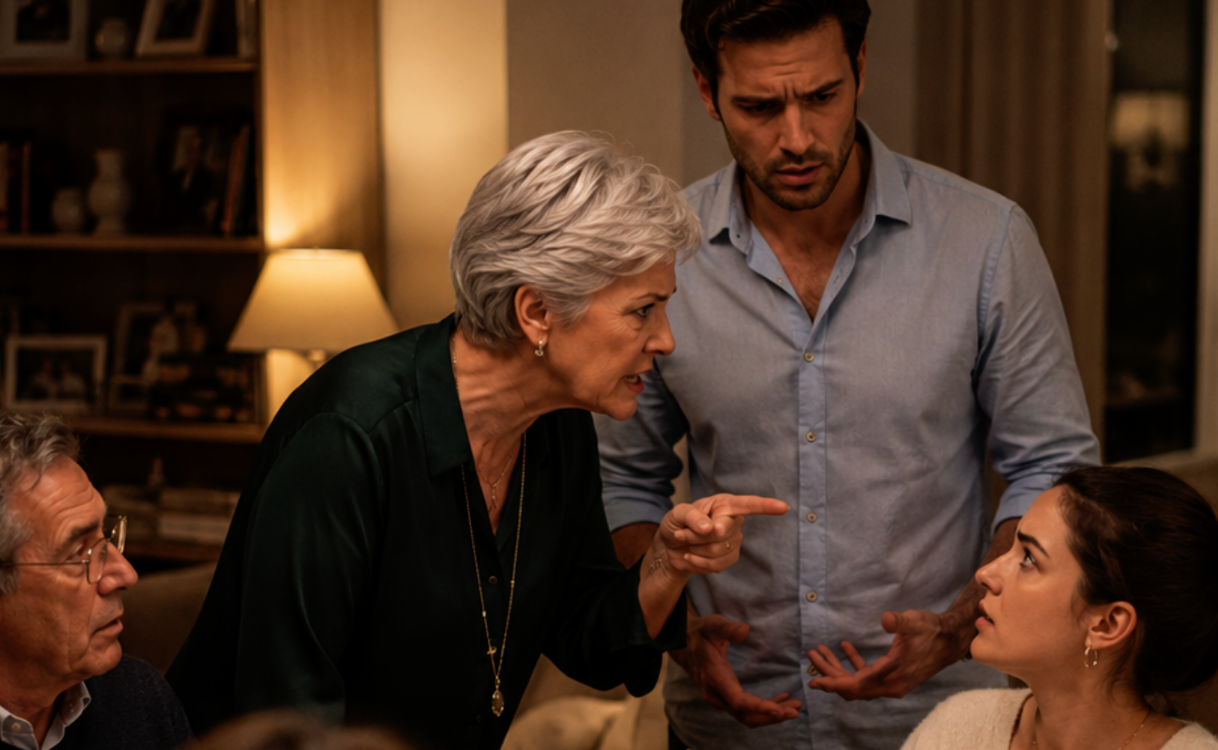
“Excuse me for interrupting,” Lyubov Sergeyevna said, and it was not a question. “I’ve wanted to say this for a long time. Here we are, sitting together, family, a celebration. But in truth, there is no family. Because in a family, relationships should be normal. And when a daughter-in-law doesn’t know how…”
“Mom,” Evgeny said.
“Be quiet, I’m speaking. When a daughter-in-law doesn’t know how to behave with people, doesn’t know how to accept her husband’s family — what kind of family is that? Lenya thinks the same, don’t you, Lenya?”
Leonid Pavlovich looked down at the tablecloth.
“I think we’re having a celebration,” her father-in-law said.
“Exactly, a family celebration,” Lyubov Sergeyevna seized on his words. “And I want everyone to understand how things really are.” Her mother-in-law turned to her daughter-in-law. She was speaking quietly now, almost confidentially, and that quietness was worse than shouting. “You live in illusions, Olya. You think you have a good family, that your husband loves you. Don’t flatter yourself — he only lives with you because of the children.”
The table froze.
Sonya quietly asked Kirill something — the boy shook his head, not taking his eyes off the tablecloth.
Olga felt the blood rush to her face — hot and sharp. Her fingers clenched the fork on their own. She looked straight at her mother-in-law and thought: there it is. The phrase that could only be said once. After that — no more.
Evgeny stood up.
Not abruptly, not with the crash of a chair being pushed back — he simply rose. Olga looked at her husband. In seven years, she had seen Evgeny walk away from conflict, turn his eyes aside, say “all right, Mom” or “don’t pay attention.” Now his face was different.
“Mom,” Evgeny said, and his voice was quiet, but without its former softness. “You just said that in front of the children. In front of everyone.” He paused. “I’m waiting for you to apologize to Olga.”
The table became very quiet. Polina lifted her head.
Lyubov Sergeyevna seemed not to understand immediately what was happening. For several seconds, she looked at her son with slight surprise — the way a person looks when a familiar piece of furniture suddenly turns out to be in the wrong place.
“What?” his mother-in-law asked.
“Apologize to Olga.”
“Zhenya…” Lyubov Sergeyevna changed her tone — it became softer, almost hurt. “Are you really reprimanding your own mother? In front of strangers?”
“Konstantin and Polina are not strangers. And even among family, I will still speak up. You said in front of the children something you should never have said anywhere, ever.”
Lyubov Sergeyevna straightened.
“So that’s how it is,” his mother-in-law said. “So your wife has turned you against me.”
“No one has turned me against anyone.”
“A year ago, you wouldn’t have said such a thing.”
“A year ago, I kept silent. That was my mistake.” Evgeny looked at Olga, then back at his mother. “I stayed silent for a long time. Probably too long. I thought peace in the family was more important. But peace in a family isn’t when everyone keeps quiet. It’s when people treat each other with respect.”
“Respect!” Lyubov Sergeyevna snorted. “She cut you off from your family, and you’re talking about respect.”
“Mom, no one cut me off from anyone. I’m a grown man.”
“You’re under her thumb.”
“No,” Evgeny said calmly. “I’m just finally saying what I think. It’s inconvenient — I understand. But that’s how it is.”
Konstantin sat quietly at the table, only shifting his gaze from one person to another. Leonid Pavlovich looked at the tablecloth and remained silent.
Lyubov Sergeyevna turned to her husband.
“Lenya, do you hear what’s happening? Say something to him.”
Leonid Pavlovich lifted his head.
Olga looked at her father-in-law — an elderly man, seventy this year, with unhurried movements and a habit of saying less than he thought. Now there was something different in his face. As if he had made a decision — not now, but long ago, only there had never been the right moment before.
“I hear, Lyuba,” Leonid Pavlovich said.
“Well then, say something to him.”
“I will.” Her father-in-law looked at his son. “Zhenya is right.”
A pause.
“What?” Lyubov Sergeyevna stared at her husband.
“I said he’s right.” Leonid Pavlovich spoke without hurry, like a man who was not afraid of being misunderstood because he had long since decided to speak precisely. “Olga is a good wife and a good mother. You know that, Lyuba. You just don’t want to admit it.”
“Lenya…”
“No.” Her father-in-law raised his hand — a quiet gesture, but one that stopped her. “I’m seventy years old today. And I want to say something, since we’ve started. I kept silent for a long time. A very long time. I got used to it — it was easier to stay quiet than to clean up the mess afterward. But I’m tired, Lyuba. Honestly — I’m tired.”
Lyubov Sergeyevna stared at her husband. Something in her face changed — first surprise, then something like confusion.
“What are you even talking about?” his mother-in-law said quietly.
“About us,” Leonid Pavlovich said. “About what I’ve wanted to talk about for a long time but kept putting off. And now — seventy years old, the children grown, the grandchildren nearby — and you say things in front of everyone that cannot be said. And I think: if not now, then when?”
“Lenya, what nonsense are you saying?”
“Lyuba.” Her father-in-law pronounced his wife’s name without anger and without reproach — simply as a name one addresses honestly. “I filed for divorce last month. The lawyer is handling it.”
The silence at the table became absolute.
Even the children felt it — Kirill lifted his head and looked at his grandfather with wide eyes. Sonya took her brother by the sleeve.
Lyubov Sergeyevna did not move for several seconds. Then she slowly turned to her husband.
“What did you say?”
“What you heard.”
“You’re… serious.”
“I am.”
Lyubov Sergeyevna got up quickly. The chair scraped. She looked around the table — at the faces of Evgeny, Olga, Konstantin, Polina — and each of their faces apparently showed her that this was not a joke and not a performance.
“Get out of my house!” his mother-in-law said sharply. “All of you! Out!”
Leonid Pavlovich looked calmly at his wife.
“The apartment is registered in my name, Lyuba,” her father-in-law said. “You know that. So I’ll have to ask you to pack your things.”
Lyubov Sergeyevna opened her mouth. Closed it.
“You…” his mother-in-law began, but did not finish.
“I’ll talk to you later. Right now, let the celebration end normally. For Zhenya and Olga. For the grandchildren.”
Olga looked at her father-in-law. She did not know what to say — and said nothing. She simply sat there and thought that in all seven years, she had never heard Leonid Pavlovich say so many words in a row. He had always stayed silent, nodded, changed the subject. And now — this.
Lyubov Sergeyevna left the room. Somewhere in the hallway, a door slammed — not the bedroom, perhaps the storage room. Then silence.
Konstantin slowly exhaled.
“Some birthday,” Konstantin said quietly, addressing no one in particular.
Leonid Pavlovich looked at the grandchildren.
“Kirill, Sonya,” her father-in-law said. “Everything is fine. The adults are talking. How about some pie?”
Sonya nodded immediately. Kirill hesitated, then nodded too.
“That’s good,” Leonid Pavlovich said and got up to get the pie.
Evgeny sat back down. He looked at Olga — for a long time, the way people look when they want to say something but cannot find the words. Olga looked back. Seven years of all this — conversations into emptiness, silence where words were needed, patience that one day runs out.
“I’m sorry,” Evgeny said quietly.
Olga nodded slightly. Not immediately — after a pause, because forgiveness is not a button one presses on demand. But she nodded.
Evgeny covered her hand with his palm. Olga did not pull her hand away.
The pie turned out to be good. Leonid Pavlovich had baked it himself — apple, with cinnamon, from a recipe he somehow remembered from childhood. Konstantin asked for a second piece. Polina finally began to speak — about something insignificant, the weather or a movie, simply so that the air at the table would become different. Gradually, it worked.
Lyubov Sergeyevna did not return to the table.
When they were getting ready to leave, Leonid Pavlovich saw them off in the entryway. He helped Sonya zip up her jacket, patted Kirill on the shoulder. At the door, he said quietly to Olga:
“You’re a good woman, Olya. I’ve wanted to say that for a long time. I didn’t say it — didn’t want to cause unnecessary trouble. But now I’ve said it.”
Olga looked at her father-in-law.
“Thank you, Leonid Pavlovich,” Olga said.
“No need.” Her father-in-law smiled slightly — tiredly, but genuinely. “Happy birthday to me, yes?”
“Happy birthday.”
They drove home in silence. The children whispered about something in the back seat at first, then Sonya dozed off, leaning against Kirill. Kirill did not move away — he sat quietly, looking out the window.
Evgeny drove. Olga watched the road.
When they had already reached home, Evgeny parked and turned off the engine, but he did not hurry to get out. He sat there, hands on the steering wheel.
“Olya,” Evgeny said.
“Yes.”
“I don’t know how to say this properly. I was silent for a long time — that’s a fact. I told myself it was for the sake of peace, for Dad, for the children. But really…” Evgeny fell silent for a moment. “It was cowardice. Just cowardice. I didn’t want conflict, that’s all.”
Olga listened, looking straight ahead.
“And you paid for it every time,” her husband continued. “Every single time — you. Not me. That was wrong.”
“Yes,” Olga said.
“I’m sorry.”
“You already said that.”
“No, I mean truly. Not just ‘sorry’ for today. For all seven years.”
Olga turned to her husband. Evgeny looked at her — without that familiar evasiveness he used to have when the conversation touched on his mother. He simply looked at her.
“All right,” Olga said after a pause. “But that doesn’t mean everything has suddenly become fine.”
“I understand.”
“Understanding is already something.”
Evgeny nodded. He took the keys. Sonya stirred in the back seat — she woke up and blinked.
“Are we home?” their daughter asked.
“We’re home,” Evgeny said. “Let’s go.”
The following weeks were strange — not bad, simply different. Like when you have lived for a long time with some background noise, and one day it is switched off, and at first the silence feels unfamiliar.
Lyubov Sergeyevna did not call. Evgeny called his mother himself after a week — briefly, without details. Olga did not hear the conversation; she only saw her husband’s face afterward: calm, but closed off. She did not ask.
Evgeny told her himself that evening:
“I spoke with Mom.”
“How is she?”
“Angry.” Evgeny paused. “Most likely, she’ll be angry for a long time. But I told her that until she is ready to speak differently, we won’t come over. And you are not obligated to endure it. That’s exactly what I told her.”
Olga listened.
“And what did she say?” Olga asked.
“She hung up.” Evgeny shrugged. “But I said it. I said it directly for the first time. That matters to me.”
Olga thought about it later, lying in the dark. Seven years is a long time. In that time, one can get used to many things: to a husband’s silence at the necessary moment, to the habit of smoothing things over, to the feeling that your boundaries are only your concern and not something shared. And when that suddenly changes, you do not immediately know how to feel about it. You do not trust it right away. That is normal.
But something had shifted all the same. Olga could feel it — not in big things, but in small ones. Evgeny began to speak differently. Not louder and not at greater length — simply more precisely. He avoided uncomfortable subjects less often. Once, when Kirill spoke rudely to Olga at dinner, Evgeny told his son calmly but bluntly, “You don’t speak to your mother like that.” Before, perhaps, he would have stayed silent.
Kirill later came up to Olga himself and mumbled an apology — awkwardly, childishly, looking at the floor.
“It’s all right,” Olga said. “Sit down and finish eating.”
Leonid Pavlovich called at the beginning of the next month. He said that Lyubov Sergeyevna had moved in with her sister — temporarily, while the documents were being processed. His voice was even, slightly tired.
“How are you, Leonid Pavlovich?” Olga asked.
“I’m managing,” her father-in-law replied. “It’s quiet now. Unusual at first. But…” He paused. “You know, Olya, quiet is good. I’d forgotten it could be like that.”
Olga could not find anything to say — she simply said they would come on Sunday, if Leonid Pavlovich did not mind.
“Come,” her father-in-law said. “I’ll be glad.”
On Sunday, all four of them came. Kirill helped his grandfather fix something in the storage room — a shelf was creaking there. Sonya drew at the kitchen table, occasionally showing her grandfather the results. Leonid Pavlovich praised her seriously, without condescension — the way people praise something when they truly like it.
Olga cooked lunch. Evgeny sat beside her, cutting vegetables — he did it slowly and clumsily, but he did it.
“Cut it like this,” Olga said and showed him.
“I’m trying.”
“I can see that.”
They exchanged glances. There was something in that look — not triumph and not relief, something quieter. Something resembling the beginning of a conversation that was still ahead of them.
Leonid Pavlovich came into the kitchen and sniffed the air.
“Borscht?” her father-in-law asked.
“Borscht,” Olga confirmed.
“Good,” Leonid Pavlovich said and sat down at the table next to his granddaughter.
Sonya immediately moved a sheet of paper with a drawing toward him.
“This is Grandpa,” Sonya explained. “And this is a hat.”
“I’m wearing a hat?” Leonid Pavlovich asked in surprise.
“You look handsome in a hat.”
Her father-in-law laughed — quietly, genuinely.
Outside the window, the February sun was shining, not yet warm, but already reminding them that something existed beyond it. Olga stirred the borscht and lowered the heat. Evgeny finished cutting the last tomato and placed it in the bowl with the expression of a person who had completed a difficult task.
“Done,” her husband announced.
“Well done,” Olga said without irony.
Evgeny threw an oven mitt at her. Olga caught it.
Kirill shouted from the storage room:
“Grandpa, the shelf is holding!”
“That’s good!” Leonid Pavlovich called back.
That’s good.