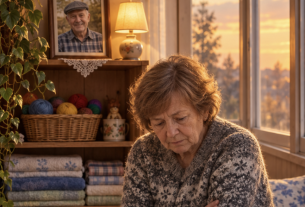
Olga loved coming home just before dusk, when long strips of light still lay across the windowsill, but outside the air already smelled of evening coolness and bread from the bakery near the bus stop. In moments like that, everything grew calm: the rustle of the curtains, the soft hum of the refrigerator, the kettle that was about to start singing. She took milk, herbs, and a couple of apples out of her bag, straightened the tablecloth on the table, and looked at the room as if she were trying silence on it for size.
She and Andrey had spent three years paying off this apartment. At first, they had lived among boxes. Then they bought a bookcase, which Andrey assembled with stubborn determination, sanding one shelf until late at night so it would sit perfectly straight. They had hung the wallpaper together; she still remembered the funny air bubbles they caught with their palms, pressing them against the wall like dragonflies.
That evening, Andrey was late. He called only once: “I’ll be home later,” and his voice was dry, like a page from a notebook. Olga turned on the water, put onions into the frying pan, added carrots, and stirred the way people stir when they need to keep their hands busy. She did not turn on the television; she did not want other people’s voices. Outside the window, the maple tree in the courtyard rustled against the glass, a thin branch tapping lightly against the frame. On the shelf, the clock ticked quietly.
The door clicked open closer to nine. Andrey came in like a man who had been standing for a long time in a damp, freezing wind: his gaze stiff, his hand reaching for the light switch, then changing its mind. He took off his jacket and, without hanging it up, dropped it onto a chair. For several seconds he stood silently in the hallway, as if gathering his thoughts. Then he went into the kitchen and did not sit down. He stayed standing, leaning his palms against the back of a chair.
“Have you eaten?” Olga asked without turning around. She could hear him breathing.
“I don’t want anything,” he answered.
The pause stretched out.
“I was at Mom’s.”
“Of course,” Olga thought, and the spatula in her hand struck the rim of the frying pan.
“And how is she?” she asked, turning off the heat and placing plates on the table, even though his “I don’t want anything” had already said everything.
“Fine,” Andrey replied.
Then he took a breath, as if before jumping.
“Listen, we need to settle something. Well, not exactly settle it—the answer is already there. I just thought I should tell you.”
He lifted his eyes to her. There was no anger in them. There was tension, the kind that appears in a person who has been repeating the same sentence inside himself for a long time.
“Say it,” Olga said, sitting down so she would not loom over him like a wall.
“We’re going to exchange our apartment and give the money to my sister for a new place. She’s tired of living with Mom at thirty,” her husband told Olga.
The spatula in Olga’s hand struck again, this time with a dull sound. She laid it beside her and only then looked straight into his face.
“What?” she said quietly.
Andrey looked away toward the glass cabinet door, where the little light from the fixture was reflected.
“Nadya is grown up now, and she’s still living with Mom. They’re cramped. They argue. Nadya works rotating shifts, comes home late, disturbs her. And we’re two people in a two-room apartment. We’ll exchange it, take something smaller for ourselves, and help her. You understand, don’t you? It’s the right thing to do. Nadya is my sister.”
“And who am I?” Olga asked.
It was astonishing how a voice could remain calm when everything inside was shaking.
“You’re my wife,” Andrey frowned. “And we are family. That’s exactly why we need to do what’s fair: help the one who needs it more. A one-room place will be enough for the two of us. Nadya needs to start her life.”
“Start her life at the expense of ours?” Olga carefully moved the hot pan from the table onto a wooden trivet. “Andrey, this apartment didn’t fall from the sky. Do you remember how we slept in sweaters in winter because the radiators barely worked and we were afraid to turn on the heater because of the bills? Do you remember how you worked extra in the evenings, and I took translation jobs on weekends? We saved every ruble. And now we’re just going to exchange it so your sister can… what? Stop arguing with her mother?”
“Don’t exaggerate,” he grimaced. “With the exchange, we’ll still get our share, just less. It’ll be enough for us. You yourself said it’s only the two of us and we don’t need much space.”
“I said that someday we would have a child’s room,” Olga reminded him. “And that we wanted to put an armchair by the window and a desk for work. Do you remember? Or does that not matter?”
Andrey exhaled noisily, as if a heavy sack had been dropped onto his shoulders.
“It matters,” he said at last. “But not now. Right now, helping Nadya matters. She’s tired. She has no corner of her own after her shift. Mom grumbles. Nadya cries. I see it.”
“And me?” Olga asked. “I see things too. I see how every time you come back from your mother’s, you bring me someone else’s ‘must.’ And how there is no me in that ‘must.’ There is only ‘my sister is tired.’ Andrey, let’s not talk in slogans. How can we help her? Realistically. Without wiping ourselves out.”
“What are you suggesting?” he stubbornly pressed his lips together. “Pay her rent? That never ends. You pay rent, and the money is gone. This way she’ll have her own place. And that’s it.”
“She has a job,” Olga said calmly. “She has hands. She has you and your mother, who can help her look, choose, cover part of the expenses for a while. I’m willing to help. But not to sell our home.”
“For you, it’s a ‘home,’” Andrey snapped, and his voice hardened. “For me, it’s a chance to help my sister. I can’t watch her live like that. That’s not a life.”
“At thirty, it’s a choice,” Olga said. “She can rent a room, a studio, a bed somewhere for a start. She can take an extra job, ask for installments. That is life too. But taking away what we built is not ‘help.’ It’s stupidity.”
He jumped up and knocked against the chair. It creaked in displeasure.
“So I’m suggesting stupidity?” Andrey’s back tensed, as if he were preparing not to leave, but to run.
“I’m saying that done this way, yes,” Olga stood up but remained in place, not moving toward him. “I will not sign a single sheet of paper about selling this apartment. We can help in another way. But not like this.”
“You…” He clenched his fists, then almost immediately unclenched them. “I thought you would understand.”
“I do understand,” Olga answered quietly. “I understand that you love your sister and that you’re used to rescuing her. I understand that your mother’s kitchen presses on you. And that it’s easier to take what belongs to someone else and give it to ‘the person who needs it more’ than to say no. But we have needs too. And I am here. And there are two of us.”
He did not answer. He went into the room, slammed a cabinet door, and began rummaging through papers. Olga stood in the kitchen and listened to the boiling water quieting as it cooled, to time audibly rubbing against the glass of the clock.
The next morning, her mother-in-law called. Her voice was enveloping.
“Olechka, hello,” she sang. “How are you, dear? I hear you and Andryusha are discussing everything. Well, that’s wonderful. I also think it’s time for Nadya to get on her feet. You know how hard it is for us in one apartment. Not to mention…”
“Mention it,” Olga said gently. “You always do.”
“What I mean is, young people need help,” her mother-in-law sighed into the phone so Olga could hear a chair scraping across the kitchen. “The two of you are fine, you have a new apartment, fresh renovations. And that poor girl… Understand me: I’m not throwing her out. But I’m an old woman, I need my own corner. And she needs her own nest. Andryusha is a good boy. He said it very correctly. We’ll exchange the apartment, and everyone will be happy.”
“You will be,” Olga said. “And us?”
“You…” Her mother-in-law faltered, but quickly found the right tone. “The two of you will have enough. You don’t have children… well, not yet. And then we’ll see. But Nadya needs it now. You’re a kind girl, my dear.”
“We can help in another way: rent her a place for a while, buy some furniture, give money for a deposit. But I do not agree to sell our apartment,” Olga said.
“Oh,” her mother-in-law sighed heavily. “Young people these days are clever. Clever, yes, but not wise. Your accounting is out of place right now. It must be done out of love. All right, I won’t argue with you. I’ll talk to Andryusha. He’s a proper boy. He understands that family is not only ‘me and my wife,’ but also ‘my sister.’”
Olga ended the call and put the phone screen-down. Her palm was trembling—not from anger, but because there was always something in her mother-in-law’s voice that could turn a grown woman back into a little girl. “Kind,” “clever,” “out of love”—all of it soft, like warm dough, but with little stones hidden inside.
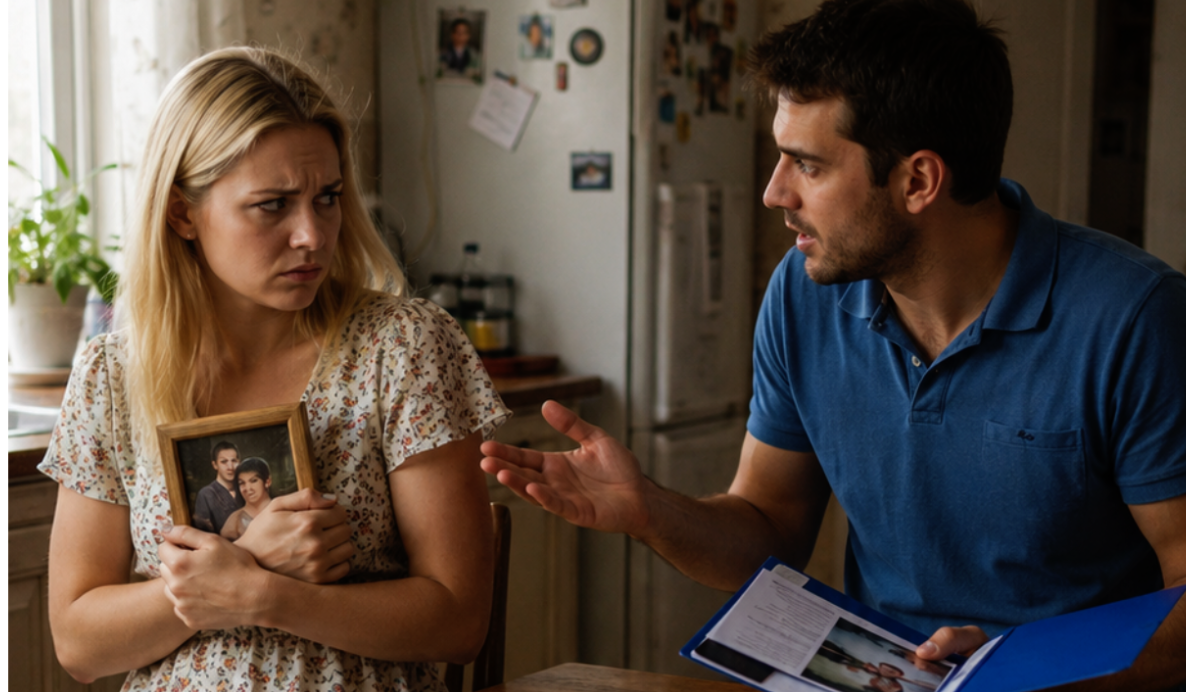
Andrey came home from work with a folder. He placed two sheets on the table: printed apartment listings.
“I went to look at some options,” he said, not raising his eyes. “For us, a one-room apartment nearby. For Nadya, a studio. Here, take a look. If we sell now, the remainder will be just enough.”
“We are not selling anything,” Olga reminded him. “Andrey, why are you deciding everything alone?”
“Because you immediately said no,” he snapped. “And this isn’t only your issue. I also have the right to choose.”
“So do I,” Olga answered.
She picked up the printouts and looked at photographs of other people’s rooms with single windows, where there was neither their bookcase, nor their armchair, nor the candles on the windowsill that they had bought in January for a ridiculous price.
“I don’t need these rooms. I need ours.”
“You need it,” he said dully. “And Nadya needs hers. Right now.”
“Right now, I also have a request of my own,” Olga lifted her eyes. “Let’s not invite a realtor behind my back. And let’s not bring strangers into our home so they can poke around and count square meters. Don’t start with that. Nothing will happen anyway while I don’t agree. Why cause pain for nothing?”
He pressed his lips together and said nothing.
But two days later, when Olga came home from work, a thin man with a folder and a measuring tape was standing in their hallway. Andrey was hastily forcing a smile, as if to say, “An appraiser just happened to drop by, what’s the big deal?” The man was already stretching the measuring tape across the floor.
“Leave,” Olga said. “I did not give my consent. This is my home. There is nothing to measure here.”
The man glanced sideways at Andrey and, embarrassed, gathered up the tape.
“I’m sorry,” he muttered, and left, leaving behind the smell of cheap tobacco.
Olga stood in the hallway, her palms pressed against the cabinet doors, and felt anger closing between her shoulder blades—not hot anger, but white anger, like snow.
“You had no right,” she said quietly. “We agreed.”
“I don’t remember us agreeing,” Andrey replied stubbornly. “I remember you forbidding it. And I live here too.”
“You do,” Olga said. “But without my consent, you cannot sell it. You know that.”
“And do you know what conscience is?” he suddenly flared up. “Do you know what it feels like when my sister texts me at night, ‘I can’t take it anymore’? When my mother cries and says, ‘I’m tired of arguing with her’? Have you seen that? No. Bookcases matter more to you.”
“What matters more to me is that we are not told to ‘put up with it’ while our home is divided among other people,” Olga answered. “That is all I can say.”
They lived in that argument for a week, then two. Every small habit of theirs suddenly became loud. Friday—once movie night, now phones, calls, Nadya’s voice on speaker. Saturday—once the market, now trips to “look at options.” Sunday—once pie at his mother’s, now silence. At night, Olga lay listening to Andrey toss and turn and thought not about apartments, but about how their “we” had shriveled like a thin thread on a favorite sweater.
One day, she could no longer stand it and went to see Yulia, an old friend who worked for a developer and understood better than Olga what other people’s decisions could do to people.
“He isn’t an enemy,” Olga said, testing the words for a long time. “He really does love his sister. And his mother. And… it’s as if he’s tired of being between us.”
“There is no ‘between,’” Yulia said, pouring tea, speaking with confidence but without pressure. “You are a separate family. Everything else is around you. Do you want advice? Define your ‘yes’ and your ‘no’ as if tomorrow someone will come with a piece of paper. Are you ready to help? For how many months and with what? Are you ready to lose the apartment? If not, then no. The clearer you are with yourself, the less anyone can shake you.”
Olga came home with a ready list of her “yes” and “no” in her head—not on paper, but in her heart. When Andrey came home that evening, she met him in the kitchen and said:
“I am ready to help Nadya with rent for three months. I am ready to pay for a refrigerator and washing machine in a rented apartment. I am ready to go with her to look for housing. I am ready to help her find extra work. I am ready to contribute to the deposit. But selling our apartment—no. Exchanging it—no. Living in a one-room apartment in order to ‘help’—no. That is my decision. You don’t have to like it, but it is mine.”
He was silent for a long time. Then he said:
“Mom said you’re a ‘solid wall.’ And that nothing can be resolved with you.”
“Let her think what she wants,” Olga answered. “I don’t have to prove anything to anyone. And I am not obliged to break down my wall if our home stands behind it.”
“And what if I sign without you?” he suddenly threw out, like a stone.
“You won’t be able to,” Olga said calmly. “You know that.”
He slammed his palm against the table.
“Fine. I’m tired of arguing. I’m going to Mom’s. I need to live with her until we resolve everything. Are you against it?”
“I am,” Olga said honestly. “But you are an adult. Do what you think is right.”
He packed quickly, as if for a business trip. He put in T-shirts, a couple of shirts, medicine, a razor. He stopped at the door.
“I’ll come back,” he said, as if promising her, not himself.
“When you come back, we’ll talk,” she answered.
The door closed, and the apartment, which had not known this kind of silence for two years, suddenly filled with it. Olga went into the room, sat down on the edge of the sofa, placed her hands on her knees, and looked at her bookcase. On the top shelf lay a photo album from their first trip: in it, they were a young couple standing by a river, wearing funny hats. She did not take the album down. She simply looked at it, then stood up. She had to get through the evening.
The days dragged on thickly, like syrup. Her mother-in-law did not call, but sent a message: “Since that’s how you are, live alone. We’ll manage without you.” Nadya wrote briefly: “I’m sorry if this is my fault.” Olga replied: “It’s not your fault. Everyone just has their own path.” She placed a geranium on the windowsill, one her neighbor had given her. Its green stubbornness in a pot was strangely calming.
A week later, Andrey came in the evening. He knocked, even though he had a key. He entered with his eyes lowered.
“I found an apartment for Nadya,” he said from the doorway. “On the outskirts. Small, but with a window facing a little park. The landlady agreed to a deposit and installment payments. I signed the contract and took part of it on myself. Mom is still against it. It’s more convenient for her when everyone is nearby.”
“Are you staying at your mother’s?” Olga asked.
“For now, yes,” he looked away. “It’s easier there. And then… I don’t know.”
“I see,” Olga said. “I’ll transfer half for the deposit. That’s what we discussed. And the refrigerator too.”
He nodded. He sat down on a chair and placed his palms on the table.
“I thought you would say, ‘Come back,’” he said unexpectedly. “But you… you just accepted it.”
“Yes, I accepted it.”
He gave a joyless smile and stood up. His gaze caught on the photograph on the wall, where he was holding her by the shoulders against the sea.
“You know,” he said, “when Mom says ‘family,’ something inside me tightens as if from cold. I grew up on her ‘must.’ You grew up on ‘you may.’ I don’t know how to live differently. Maybe I need to learn something. But right now I don’t have the strength.”
“I heard you,” Olga answered, and walked him to the door.
Time washes sharp edges smooth, like water over stones. Self-pity left first; then the arguments in the kitchen disappeared, because there was no one to argue with; then order came—a rare kind of order, when every item in the wardrobe had its place. Olga stopped “waiting.” She started living. She worked, went swimming in the evenings, and visited her mother on Saturdays. Andrey’s sister moved into her own apartment. Once, Olga ran into her at the checkout in a store. Nadya had bags of flour and grains and smiled shyly. Olga smiled too. They did not agree on anything, and they did not quarrel about anything. That happens when no one is measuring anyone else anymore.
One evening, Andrey called. His voice was different—tired, but not prickly.
“I applied for a transfer,” he said. “I’ll take on extra work. It’s hard for Nadya on her own, so I’m helping with the payment. Mom is a little ill, and I’m staying overnight with her. I won’t come to you… not yet. Not because I don’t want to. Because you can’t step into two boats at once. I understood everything too late.”
“Thank you for telling me,” Olga said. “Take care of your mother. And yourself.”
“And you?” He paused. “How are you?”
“I’m living,” she said. “And that’s better than merely surviving. I’m simply living.”
They said goodbye. Olga turned off the phone and went out onto the balcony. In the evening air, the thin silence of the courtyard rang softly. Somewhere below, teenagers were laughing, someone was beating dust out of a rug, and from the opposite window came the sound of an accordion—someone was learning, patiently repeating the same three notes.
Olga stood there, holding the railing, and thought that “our apartment” was not only walls and a bookcase. It was also the right to say no when someone wanted too much from you. And the right to say yes when you could—without destroying yourself.
In the room, on the table, lay appraisals, printouts, old envelopes that no longer had any meaning. Olga gathered them into a stack and put them in a drawer. Then she brewed tea, took an apple, and sat by the window, where the strips of light still lay across the windowsill. This home—with its warm dust and clicking lock—had remained with her. And everything else would find its place in time, even if for now it made noise and demanded things.
She tucked a strand of hair behind her ear, took the mug in both hands, and finally felt it—not victory, not defeat, but an even strength: her own. And it turned out to be exactly what she had been missing all these weeks, while other people’s voices had tried to exchange her life as if it were square meters.