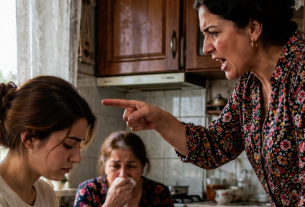
“Get this junk off my spot immediately!”
Nina Sergeyevna barged into the entryway on Friday evening—without calling, without warning, carrying two enormous suitcases and a plaid bag from which the corner of an ancient diamond-patterned blanket was sticking out. From the moment she crossed the threshold, she surveyed the hallway as though she had just returned from a short business trip rather than arrived as an uninvited guest.
Katya stood in the corridor staring at her mother-in-law, unable to understand whether she was dreaming or awake. She and Denis had lived peacefully in this two-room apartment for five years. Five years. No surprises. And now—this.
“Nina Sergeyevna, what is going on?”
“What is going on?” her mother-in-law snorted and unceremoniously shoved Katya’s sneakers aside with her foot. “I’ve come home. That’s what’s going on. Half of this apartment belongs to me, remember? Or do I need to remind you?”
Denis came out of the room after hearing the commotion. He saw his mother with her suitcases, saw his wife’s face—and did what he always did in moments like this.
Nothing.
He simply stood there, looking from one woman to the other.
“Mom, you… came?”
“No, son, I’m a hallucination,” his mother said, clearly enjoying herself as she kissed him on the cheek. “Of course I came. Help me with my bags.”
Katya stepped back toward the wall and felt something inside her click, coldly and distinctly, like a switch.
It was not anger yet.
For now, it was only understanding.
By nightfall, Nina Sergeyevna was already making herself completely at home in the kitchen. Without asking permission, she opened every cabinet, shook her head at the contents of the refrigerator, and loudly announced for the entire corridor to hear:
“Katerina, what do you even feed my son? You call this food?”
“We’re perfectly happy with it,” Katya said, walking into the kitchen and standing by the window with her arms crossed.
“You’re happy.” Her mother-in-law repeated the word as if it meant something indecent. “Denis ate properly when he was a child. Hot meals, freshly cooked, on schedule. And here you have containers and yogurts…”
“Nina Sergeyevna, let’s have a serious conversation. Are you planning to stay?”
“I already am staying.” She turned on the tap and began rinsing a mug she had just taken from the cabinet. “And I’ll take this room,” she added with a nod toward the smaller bedroom. “You’re using it as a storage room anyway, not for living.”
Katya’s desk was in that small room. She worked from home, handling accounting for several small companies. Her folders were there, her documents, her two monitors.
It was her space.
That night, lying beside Denis, Katya stared at the ceiling for a long time.
“Denis.”
“Hmm?”
“You do realize she isn’t going to leave just like that, don’t you?”
“Katya, well… Mom is Mom. Things are difficult for her right now…”
“What is difficult? She’s healthy. She has an apartment in Podolsk…”
“Well, she’s alone there, the neighbors are noisy, and she says she’s lonely…”
Katya closed her eyes. She wanted to say many things. That everyone got lonely sometimes. That she and Denis were also human beings with lives of their own.
But she already knew there was no point in talking now.
That was Denis. His mother said something, so his mother was right. It had always been that way for as long as Katya had known him.
Saturday began at seven thirty in the morning.
Nina Sergeyevna rattled around in the kitchen with the enthusiasm of someone preparing to feed an entire army company. Katya lay in bed listening to cabinet doors slamming and the squeak of an old chair her mother-in-law had dragged in from the hallway and, for some reason, placed by the window.
At nine, when Katya came out to wash up, the small room had already been invaded. The door was wide open, and Nina Sergeyevna stood in the middle, inspecting the space with a businesslike expression.
“I think we should move these desks against the wall. Then there’ll be enough room for the bed.”
“Nina Sergeyevna,” Katya said, stopping in the doorway and trying to keep her voice even, “I work here. This is my office.”
“Work, she says. Sitting at home isn’t work.” Her mother-in-law picked up Katya’s pen from the desk and twirled it between her fingers. “You can work in the kitchen. There’s a big table there.”
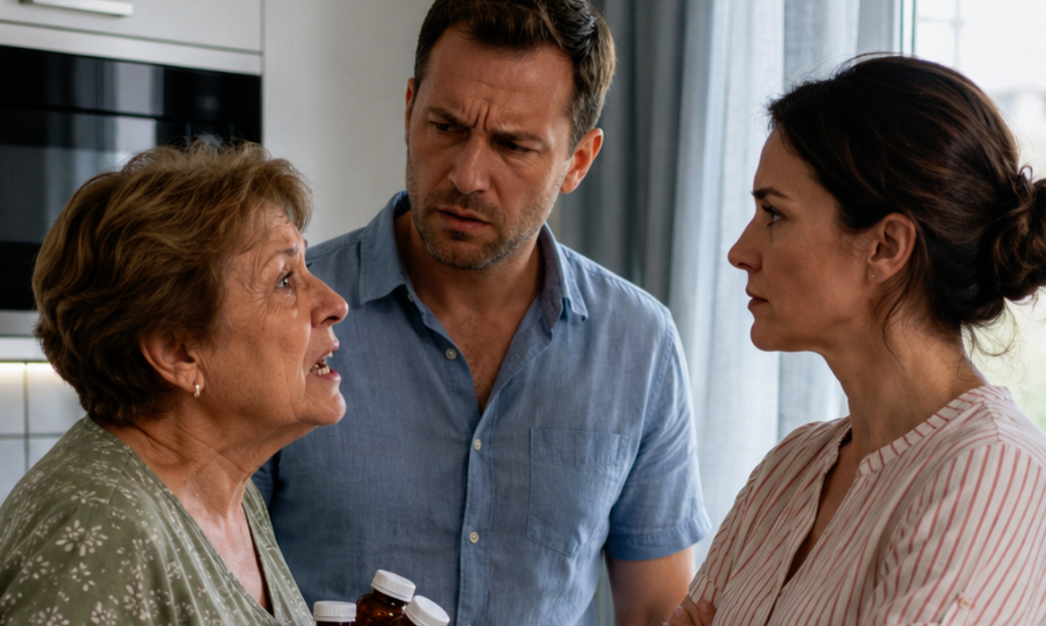
At that very moment, the kitchen table was covered with her mother-in-law’s medications, a glass containing some dark liquid, and a thick, battered address book.
Katya turned around and left.
She called Sonya from the hallway, speaking almost in a whisper.
Sonya was her childhood friend—practical, sharp-tongued, and employed at a bank. She answered immediately.
“Katka? Why are you calling so early?”
“Sonya, she came. With all her belongings. She says half the apartment belongs to her and she’s staying here.”
A pause.
“Well, is she legally right?”
“That’s exactly the problem.” Katya found her jacket and quietly slipped onto the landing. “The apartment was bought with money from Denis and his mother. She contributed a third of the price. And according to the ownership documents, they’re both owners—she and Denis. Fifty-fifty.”
“And you?”
“I’m not listed in the documents.”
Sonya was silent for several seconds.
“Katya. This is serious.”
“I know.”
“You need to see Artyom Vladimirovich. He specializes in housing matters and he’s a decent lawyer. Make an appointment with him this week.”
Katya stood on the cold concrete landing, wearing slippers and a jacket over her pajamas, staring through the cloudy stairwell window.
“But Denis? He should do something…”
“Katya,” Sonya interrupted quietly but firmly. “You’ve been waiting three years for Denis to do something on his own. He won’t. You know that.”
She did know.
Yes, she knew.
She returned home half an hour later. She had walked to the nearest café on Pervomayskaya Street, drunk an Americano, and calmed down a little. As she walked back along the quiet morning street, she thought there was something about this situation that resembled a game of chess.
Nina Sergeyevna had made her move.
Unexpected. Brazen. Precise.
She knew Denis would remain silent. She knew Katya’s name was not on the ownership documents. Everything had been calculated.
But there was one thing her mother-in-law did not know.
Three months earlier, Katya had received a small inheritance from her grandmother, which she kept separately and had never discussed with anyone. And there had been one conversation with Denis back in December—a conversation he had apparently managed to forget.
But Katya had not forgotten.
She had asked him then to add her to the ownership documents as a co-owner.
Denis had said, “Yes, of course, we need to take care of that.”
And then he had done nothing.
Now, as she approached the entrance to the apartment building, Katya understood that it was time to do it herself.
Without Denis.
Without his permission.
And possibly without him at all.
Her phone vibrated.
A message from Sonya:
“Artyom Vladimirovich. Monday, eleven in the morning. I arranged it. I’ll send you the address.”
Katya put the phone in her pocket and opened the entrance door.
Upstairs, her mother-in-law was waiting with more complaints, and her husband would pretend everything was fine.
But something had changed—quietly and irreversibly, somewhere inside her.
As Katya climbed the stairs, she thought that sometimes a person needed exactly this kind of kick: rude, uninvited, carrying suitcases and a plaid bag—to finally start taking action.
She rang the doorbell.
Nina Sergeyevna opened the door wearing Katya’s apron and looking triumphant.
“You’ve been out for quite a while. I did a little tidying up while you were gone.”
“Thank you,” Katya said with perfect calm and walked past her into the hallway.
Her mother-in-law stared after her with mild surprise. She had expected tears. Or a scandal. Or at least a pleading glance in Denis’s direction.
But Katya merely took off her jacket, hung it on the hook, and went into the room to close the door and write down everything she needed to do over the next few days.
The list was long.
Katya started Monday earlier than usual.
While Denis slept and her mother-in-law shuffled noisily through the corridor in her slippers, sighing dramatically outside the door, Katya quietly got dressed, took a folder of documents—their marriage certificate, bank statements, proof of her grandmother’s inheritance—and left the apartment without breakfast.
Outside, it was already bright and empty.
She walked to the metro, bought coffee from a vending machine at the station, and once inside the train, reread the address Sonya had sent her.
Artyom Vladimirovich turned out to be a short man of around fifty, with a neatly trimmed beard and a penetrating gaze over the top of his glasses. His small office was packed with folders reaching almost to the ceiling and smelled of old paper and good coffee.
Katya explained everything clearly and without unnecessary details.
He listened without interrupting, making notes in a notebook.
“So your name does not appear in the ownership agreement,” he finally said.
“No.”
“Do you have a prenuptial agreement?”
“No.”
He nodded and tapped his pen against the desk.
“It’s a standard situation, although I understand that doesn’t make it any easier for you. Your mother-in-law has every legal right to stay in the apartment because she is an owner. You cannot evict her. But…” He raised a finger. “That doesn’t mean you have no options.”
Katya listened carefully.
He talked about establishing a formal agreement concerning the use of the apartment, about ownership shares, and about the possibility of obtaining compensation under certain circumstances.
The terminology was legal and sometimes dry, but behind all of it Katya heard the most important thing:
There was a way out.
Not a quick one.
Not an easy one.
But it existed.
When she stepped outside, it was already noon.
She stood on the steps for a moment, squinting in the daylight, then pulled out her phone and messaged Sonya:
“I went. I need to think. Thank you.”
And then she headed somewhere other than home.
First, she went to the public services center on Leningradskaya Street to clarify a few things regarding an extract from the property registry.
At home, everything was exactly as she had expected.
Over the weekend, Nina Sergeyevna had already managed to rearrange the entryway cabinet, hang her bathrobe on Katya’s hook in the bathroom, and line the kitchen windowsill with an entire collection of bottles—vitamins, tinctures, and unmarked medicine vials.
“Katerina, where have you been?” her mother-in-law demanded, emerging from the kitchen with the expression of someone who had every right to interrogate her.
“Taking care of some things.”
“What things do you have to take care of first thing on a Monday morning?” She narrowed her eyes.
“My own,” Katya replied, walking past her toward the room.
At dinner, Denis was tense.
He could sense that something was happening, but he did not understand what. Nina Sergeyevna talked about her neighbors in Podolsk, about some Zinaida Petrovna who had “become absolutely unbearable,” and about how the air was better here.
Denis nodded.
Katya ate in silence.
“Katyusha, why are you so quiet?” he finally asked.
“I’m tired.”
Nina Sergeyevna looked at her with poorly concealed triumph.
She clearly interpreted Katya’s silence as surrender. As an acknowledgment that nothing could be done and she would simply have to get used to it.
She was wrong.
The next day, Katya went to the bank.
Sonya met her during her lunch break. They walked to the embankment, bought shawarma from a kiosk on the corner, and sat on a bench by the water.
“Well, tell me everything,” Sonya said as she unwrapped the foil.
Katya told her.
About the visit to the lawyer, the public services center, and the fact that she had already done her research and now knew how much a share of their apartment was worth on the market if things ever came down to a division of property.
Sonya listened seriously.
“So what have you decided?”
“For now, I’m gathering information.” Katya looked at the water. “But I need you to help me with one thing. I need to know whether I can open a separate account and transfer part of my income there in a way that is completely legitimate and won’t raise any questions.”
“Of course you can,” Sonya shrugged. “You’re married to a man, not to the state. Open a savings account and transfer whatever you want. It’s your money.”
“I already keep the inheritance separately.”
“Good. You did the right thing.”
They fell silent.
A woman with a stroller walked past. Two schoolchildren on scooters nearly crashed into a trash can.
“Katya,” Sonya said cautiously, “have you thought at all about what is going to happen between you and Denis? Not with the apartment. With the two of you?”
Katya did not answer immediately.
“I have,” she finally said. “For the last three years. Before, it always seemed like I could somehow… postpone it. And now Nina Sergeyevna arrived with her suitcases and put everything in its proper place.”
“What do you mean?”
“I mean that I saw exactly what the future is going to look like. This is it. She’ll give orders, he’ll stay silent, and I’ll pretend everything is fine.” Katya crumpled the foil in her hand. “I don’t want to live like that.”
Sonya nodded.
She did not add anything.
And that was the right thing to do.
That evening, Nina Sergeyevna put on another performance.
She discovered that Katya had moved her bottles from the windowsill into the corner, simply because she wanted to place there a flower that had previously been kept in the small room.
“Who gave you the right to touch my belongings?!” her mother-in-law’s voice rang throughout the entire apartment.
“It’s a shared windowsill,” Katya replied calmly. “I didn’t throw anything away. I just moved them.”
“Moved them, she says!” Nina Sergeyevna grabbed her bottles and pressed them against her chest as though Katya had tried to steal the family jewels. “Denis, do you see what she’s doing?”
Denis entered the kitchen wearing the most miserable expression imaginable.
“Mom, it’s just a windowsill…”
“It is not just a windowsill! This is my half of the apartment, and I will not allow…”
“Nina Sergeyevna,” Katya interrupted her quietly, but with such firmness that the older woman fell silent, “let’s agree on one thing. I won’t touch your belongings, and you won’t touch mine. Does that sound fair?”
Her mother-in-law stared at her with undisguised irritation.
She had clearly expected a different reaction—tears, excuses, or at least a guilty glance.
But Katya stood straight, met her gaze directly, and there was neither anger nor servility in her voice.
“You talk to me as if I were a stranger,” Nina Sergeyevna finally hissed through clenched teeth.
“I speak to you politely,” Katya answered.
“For now.”
She said the final words quietly, almost casually.
But they hung in the air.
And her mother-in-law heard them.
Denis looked at his wife as though he were seeing her for the first time.
Perhaps he was.
Katya picked up her flower, placed it on the windowsill exactly where she wanted it, and left the kitchen.
She already knew that tomorrow she would call Artyom Vladimirovich again.
Because “for now” was not a threat.
It was simply the beginning.
“Artyom Vladimirovich, I’m ready,” Katya said into the phone after stepping onto the balcony so Nina Sergeyevna would not hear her.
“Ready for what, specifically?” the lawyer asked in his usual calm voice.
“For what you suggested. A formal agreement establishing how the apartment is used. And… I want to understand what needs to be done to get my ownership share registered. For real.”
“Then we will need your husband. Without his participation—and formally, without the involvement of the second owner, his mother—the most we can do is establish a court-ordered arrangement concerning the use of the residence. It would not make you an owner, but it could protect your right to reside in the apartment and use a specific room without interference.”
“And what if he refuses?”
A pause.
“Then we work with what we have. Your inheritance is separate property. You have jointly acquired marital property. You have been married for three years. In the event of divorce, all of this would be taken into consideration during the division of assets. But, Katerina, I would leave that as a last resort.”
She thanked him and ended the call.
Down in the courtyard, a neighbor’s young son was playing in the sandbox while his mother read a book on a bench.
An ordinary life in which nobody barged in with suitcases.
Katya postponed her conversation with Denis until Saturday. She deliberately chose a moment when Nina Sergeyevna had gone to a hairdresser in the next neighborhood and had promised not to return before three.
“Denis, we need to talk. Seriously.”
He was sitting at the table with a cup of tea and immediately tensed. Her tone left no room for avoidance.
“About what?”
“About the apartment. About the fact that my name isn’t in the ownership documents. About the fact that you promised to fix that in December and never did.”
Denis remained silent, stirring the spoon around his cup.
“Katya, now isn’t really the time. Mom is already…”
“Now is exactly the time.” Katya folded her hands on the table. “Denis, your mother has been living here for three weeks without saying a single word about when she plans to leave. She gives orders in the kitchen, the bathroom, and my office. And you remain silent. Every single time. It’s been like this for five years.”
“What do you want me to do?”
“I want you either to speak to your mother about a definite date for her departure or help me obtain the ownership share you promised me. One or the other. Right now. Not ‘later.’”
Denis stared into his cup for a long time.
“I’ll… talk to Mom.”
“I’ve been hearing that for two weeks, Denis. I need a concrete action, not an intention.”
He raised his eyes, and Katya saw something she had not seen in them for a very long time.
Not guilt.
The confusion of a man who had suddenly realized that hiding was no longer an option.
“All right. On Monday, I’ll go to the notary. We’ll register a share for you.”
Katya did not believe him immediately.
It sounded too easy after three years of promises.
But she nodded.
“Good. I’m coming too. We’ll go together.”
Nina Sergeyevna returned shortly after three with a fresh hairstyle and the obvious intention of continuing her kitchen battles.
But something had changed inside the apartment during those few hours, and she seemed to sense it the moment she stepped through the door.
“Denis, why do you look so gloomy?”
“Everything’s fine, Mom.”
She shifted her gaze toward Katya, who was sitting at the table with her notebook, calm and focused, as though nothing had happened.
And it was precisely that calmness that her mother-in-law understood better than any shouting.
On Monday, they actually went to the notary.
Denis was nervous, got confused by the documents, and asked the clerk the same question twice. Katya sat quietly beside him, holding her folder containing the registry extract, marriage certificate, and printed information regarding ownership shares—everything she had gathered during those weeks on her own, without him.
Registering her share required three visits and almost a month of bureaucracy.
Nina Sergeyevna did not find out immediately.
But when she finally did, she erupted into a scandal that lasted for two hours and ended with her slamming the door of the small room so hard that a framed photograph fell from the shelf.
“You arranged all of this deliberately! Behind my back!”
“I didn’t arrange anything behind your back, Nina Sergeyevna. Denis signed the documents personally in the presence of a notary. It was his decision.”
“He would never have thought of it himself!”
“Maybe not.” Katya picked up the fallen frame and put it back in place. “But he did think of it. And that’s what matters.”
For the first time since all this began, her mother-in-law could find nothing to say.
Another two months passed.
Nina Sergeyevna did not leave, but she no longer fought the way she once had.
Something in the balance of power had shifted.
Now there were three equal owners in the apartment, and every demand she made was met not with Denis’s silence but with Katya’s calm, legally grounded “no.”
When Sonya learned the final result, she merely snorted into the phone.
“So that shawarma we ate on the bench wasn’t for nothing.”
“Definitely not.” Katya looked out the window of her room—her room again, with both monitors and all her folders back in place. “You know what I realized? My mother-in-law’s suitcases were actually a gift. Without them, I might have spent years postponing a conversation I should have started myself.”
She closed the notebook in which the list she had written that Friday had long since turned into a series of completed tasks, and for the first time in a long while, she felt that her home truly was her home—not a territory she had to fight to reclaim every single day.
Winter came.
In February, Nina Sergeyevna announced that the neighbor in Podolsk had finally sold her apartment and moved away, which meant she could now “consider going back.”
She said it as though she were doing everyone a favor.
Katya listened calmly, without gloating.
“Of course, Nina Sergeyevna. If you want to return home, that is your right.”
Her mother-in-law seemed to have expected different words—pleading for her to stay, or at least polite regret.
Receiving neither, she snorted and began packing her suitcases with the same dramatic energy she had once used to unpack them.
Denis was strangely quiet that evening.
After his mother went to bed, he sat opposite Katya in the kitchen—the same kitchen whose windowsill had once been covered with his mother’s bottles.
“I’ve wanted to say this for a long time. I’m sorry I delayed dealing with the documents. And that I stayed silent all those years when Mom…”
“Denis, you don’t need to apologize for five years in one evening.” Katya poured herself some tea. “Just remember one thing for the future: silence is also a choice. It is not a neutral position.”
“I understand. I really do.”
She was not certain that he understood completely. Things like that rarely changed over the course of a single winter.
But something had shifted.
And that was more honest than any promise.
On Saturday morning, Nina Sergeyevna left.
This time, she had given them a week’s notice, called a taxi in advance, and caused no farewell scandal.
At the door, she turned around.
“You’re not the person I thought you were, Katerina.”
“What kind of person am I?”
“Stronger.” Her mother-in-law adjusted the bag on her shoulder. “I thought you would give in. But you didn’t.”
Katya said nothing.
She simply nodded.
In that awkward, prickly admission was the most Nina Sergeyevna could ever allow herself to say.
The door closed.
The apartment became quiet.
Truly quiet.
Not the silence of waiting for the next attack, but ordinary Saturday silence.
Katya walked into her room, switched on both monitors, and took out her notebook.
The list of tasks on this page was completely different.
No lawyers.
No property-registry extracts.
Just ordinary plans for the week ahead.
And for the first time in a long while, she wrote them without looking over her shoulder at anyone.