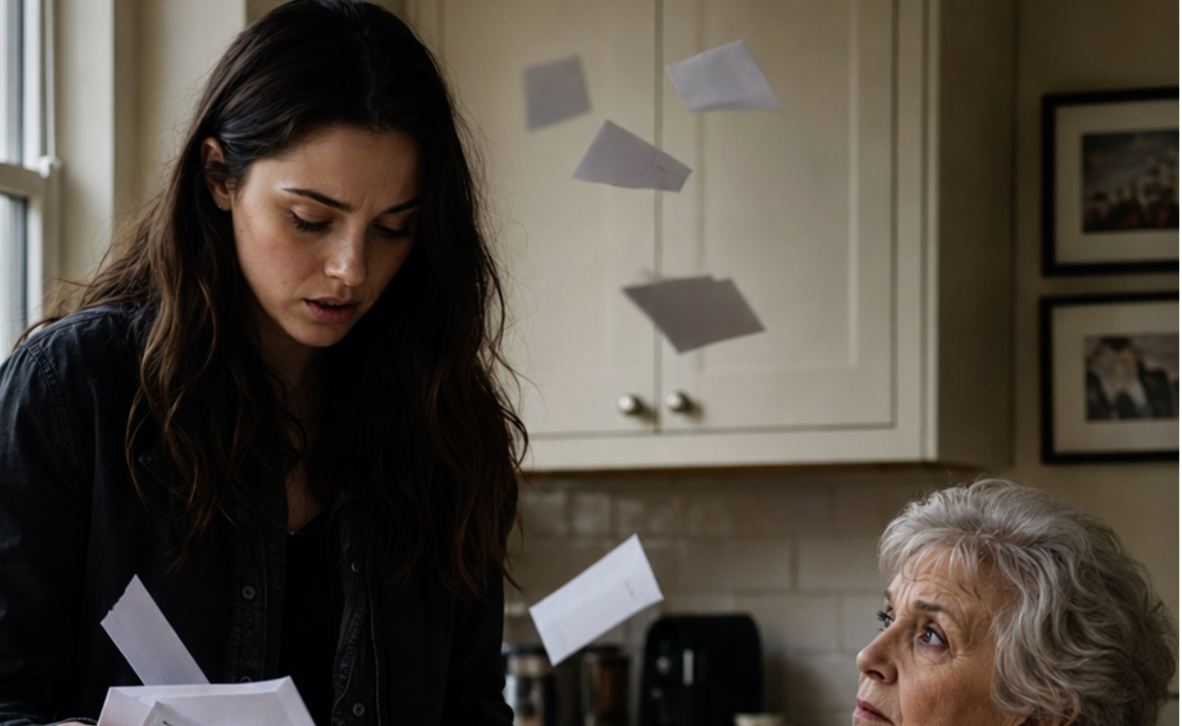
Galina Petrovna arrived with a folder and a smile. She said it was only a formality. But Rita read every single line, and her hands did what her voice could not.
Rita heard the doorbell and, for some reason, did not get up right away. She sat on a stool by the window, holding a mug of cold tea and watching pigeons shuffle along the windowsill of the neighboring building.
The doorbell rang again. Insistent. Twice in a row. Only Galina Petrovna rang like that.
Rita opened the door. Her mother-in-law stood on the threshold in a beige blouse tucked into a gray skirt. She held a brown cardboard folder in her hands and wore low-heeled shoes polished to a shine. Her lips were lightly colored. Her sweet, heavy perfume entered the hallway before she did.
“Ritochka, I’ll only be a minute.”
She always said that. Only a minute. Then she would sit for two hours, drink tea, move her spoon from one place to another, and explain the proper way to cook borscht, even though Rita had been making it for nine years and had never once asked for advice.
“Come in, Galina Petrovna.”
“Oh, I won’t take my shoes off. I won’t be long.”
But she was already removing them. Already heading toward the kitchen. Already inspecting the sink, the stove, the towel hanging from its hook.
Rita closed the door and followed her.
Galina Petrovna sat down at the table, placed the folder in front of her, and smoothed it with her palm. Her fingers were dry, her nails cut short and covered with clear polish. On her ring finger she still wore her wedding band, which she had never taken off even after her husband’s death.
“Would you like some tea?”
“I wouldn’t say no. But first, business.”
Rita switched on the kettle. The button clicked and the heating element began to hum. Familiar sounds she could hide behind.
“I brought a document. A lawyer prepared it, everything is perfectly legal. I just need your signature.”
She opened the folder. Inside lay a printed sheet of paper with a stamp at the bottom and an empty line for a signature. Rita did not pick it up. She looked at it from above while standing near the stove.
“What is it?”
“Consent to transfer ownership of the apartment. Nothing serious. Just a formality.”
The kettle boiled. Rita switched it off but did not pour the water. She stood with her back to her mother-in-law and felt something tighten between her shoulder blades like a pulled string.
“Which apartment?”
“This one, Ritochka. This one.”
The apartment had two rooms and was located on the fourth floor of a brick building. Thirty-eight square meters, according to the documents. A balcony overlooking poplar trees and a playground where Rita’s son, Lyoshka, stayed on the swings every evening until dark.
They had bought the apartment six years earlier. Rita and Vadim. The mortgage had been taken out in both their names, and they paid it equally. Rita worked as a receptionist at a dental clinic, while Vadim worked as an installer on construction sites. They put all their money into one envelope stored on the top shelf of the wardrobe behind a stack of towels.
Then Vadim left.
Not for another woman. Not because of an argument. One morning, he simply got up, packed a backpack, and said he needed some time alone. He said he was confused. That he would come back once he had figured things out.
That was a year and a half ago.
He had not returned. But he had not divorced her either. Once a month, he sent money for Lyoshka to her bank card without a message. He called his son on Sundays, spoke for three minutes, and asked about school.
He never called Rita.
And she paid the mortgage. Alone. Twenty-seven thousand rubles every month. And every month, the envelope on the top shelf became thinner.
Galina Petrovna folded her hands on the table, one on top of the other, as though she were attending a formal meeting.
“Vadim asked me to do this. He’s in Krasnodar now, working rotational shifts. He needs money for a new place to live. He wants the apartment transferred to me, and afterward I’ll decide what’s best.”
“What’s best for whom?”
“For everyone, Ritochka. For everyone.”
Rita finally poured the tea. Two mugs. A white one with a chipped edge for herself. One decorated with cherries for her mother-in-law. She placed them on the table and sat opposite her.
“Galina Petrovna, this apartment belongs to both me and Vadim. I’ve been paying the mortgage alone for a year and a half.”
“I know, sweetheart. But Vadim paid too. For the first four years. And as for the down payment, by the way, the late Boris Ilyich and I helped you.”
There it was.
Rita had been waiting for it.
The down payment.
Four hundred thousand rubles that her in-laws had contributed toward the purchase. Galina Petrovna brought up that number every time she wanted something. Like an ace hidden up her sleeve.
“You helped us. I remember. We’re grateful.”
“That’s exactly what I mean. We helped. Now you help us.”
She pushed the paper closer to Rita. It rustled across the plastic tablecloth.
Lyoshka came home from school at half past one. He slammed the door, dropped his backpack in the hallway, and shouted:
“Mom, I’m hungry!”
He was eight. Thin, with protruding ears and a scratch on his chin from falling off his bicycle the day before. His light-brown hair always stuck out in every direction, no matter how carefully it was combed.
He ran into the kitchen and stopped.
“Hi, Grandma Galya.”
“Hello, Lyoshenka. Look how much you’ve grown.”
She said it every time. Every visit. As though he grew in sudden leaps between each of her appearances.
“Mom, what’s for lunch?”
“There’s soup in the pot. Heat it up. I’ll come in a minute.”
He ran off. The sound of a plate clattering came from the room, followed by the microwave starting.
Rita watched him leave, then turned back to her mother-in-law.
“Galina Petrovna, I’m not signing this.”
Silence.
Her mother-in-law blinked. Once. Slowly.
Then she lifted her mug, took a sip, and placed it back down precisely inside the ring the mug had already left on the tablecloth.
“Ritochka, you haven’t understood.”
“I have.”
“No. You’re not giving up the apartment. It’s just a transfer. Temporary. Until Vadim gets back on his feet.”
“Vadim left a year and a half ago. He’s already on his feet. He’s in Krasnodar working. I’m here with our child, paying the mortgage.”
Galina Petrovna pressed her lips together. The corners of her mouth drooped, and the wrinkles beside her nose deepened.
Rita knew that expression.
It meant: You are ungrateful.
When Vadim had left, Galina Petrovna visited every week. She brought a pot of borscht, a bag of apples, and advice. The advice was always the same: wait, he’ll come back, men need time, don’t pressure him.
Rita did not pressure him.
Rita worked.
In the morning, she took Lyoshka to school, hurried to the clinic, and spent the entire day at the reception desk dealing with appointments, patient records, phone calls, and demanding patients. In the evening, she picked up her son, cooked dinner, checked his homework, did the laundry, and ironed clothes.
She went to bed at eleven.
She woke up at six.
Sometimes, lying awake in the darkness at night, she counted.
Not sheep.
Money.
Salary: forty-two thousand.
Mortgage: twenty-seven.
Utilities: five and a half.
What remained had to cover food, Lyoshka’s extracurricular activities, and the shoes he wore out every two months. She had to calculate everything down to the last ruble.
Vadim sent fifteen thousand.
Child support, unofficially, by mutual agreement rather than court order.
Once, Rita had asked him on the phone whether he could pay his share of the mortgage.
He said, “Not right now.”
And hung up.
Not right now.
For a year and a half.
“Ritochka, try to understand. I’m not your enemy.”
“I didn’t say you were.”
“Then why are you being so stubborn? Sign it and be done with it. Vadim will sell his share and yours will remain yours. Or we’ll buy it from you. As family.”
“As family?”
Rita stood up and paced across the kitchen. Three steps to the refrigerator, three steps back. The kitchen was tiny, barely five and a half square meters. There was hardly room to turn around.
“Galina Petrovna, acting like family would mean your son paying the mortgage together with me. Or at least calling me himself and telling me what he plans to do. Instead of sending his mother over with a piece of paper.”
Her mother-in-law straightened. Her back became rigid as a board.
“He couldn’t come himself. Talking to you is difficult for him.”
“Difficult for him?”
“Yes, Rita. It is. He’s suffering.”
“He’s suffering in Krasnodar. I’m suffering here with his son, his mortgage, and the unpaid utility bills he left behind when he walked out.”
Her voice did not rise.
Rita spoke evenly, as though reading a shopping list.
But the knuckles of the fingers gripping the back of the chair had turned white.
Lyoshka finished his soup and returned to the kitchen carrying his plate.
“Mom, can I go to the playground?”
“Have you finished your homework?”
“Almost. I still have math.”
“Math first.”
“Come on, Mo-o-om.”
“Lyosha.”
He sighed, took his plate, and left. Grumbling and the rustling of a textbook came from the room.
Galina Petrovna watched him go.
“Such a good boy. Exactly like his father.”
Rita said nothing.
She turned on the tap and rinsed Lyoshka’s plate. The water was cold. She did not wait for it to warm.
“Like his father, you say. I hope not entirely.”
Her mother-in-law pressed her lips together.
But she said nothing.
That was unusual.
Normally, she never stayed silent.
Rita returned to the table.
She picked up the document.
Finally, she took it into her hands.
The print was small and dense. The lawyer had done a thorough job. Rita began to read.
“I, Margarita Olegovna Zotova, hereby consent to the transfer of ownership of the residential property located at…”
Then came the address.
Their address.
Then the description of the apartment, cadastral number, and floor area.
“…in favor of Zotova Galina Petrovna.”
Not Vadim.
Galina Petrovna.
Rita reread the line.
Then she read it again.
The letters remained the same.
Zotova Galina Petrovna.
“Galina Petrovna.”
“Yes, sweetheart?”
“It says here that ownership is being transferred to you. Not Vadim.”
“Well, yes. I explained. First to me, and then…”
“And then what?”
“Then we’ll work it out. As family.”
That phrase again.
As family.
Like wrapping paper around a gift with nothing inside.
Rita placed the document on the table. She smoothed it with her palm, just as her mother-in-law had done five minutes earlier. Under her fingertips she felt the roughness of the paper, its sharp edge, the printer ink.
She remembered how six years ago they had stood in this same apartment when it was still empty, without furniture or curtains.
Vadim had wrapped an arm around her shoulders and said:
“Ours.”
And Rita had rested her cheek against his jacket, which smelled of cigarettes and construction dust, and believed him.
Ours.
Then came the sofa.
Then the kitchen.
Then the child’s bed.
Then Lyoshka.
Then the wallpaper in the hallway, which they had put up together while arguing about bubbles trapped underneath it.
Then the bathroom shelf Vadim had hung crookedly and had to redo twice.
And then came the backpack in the hallway and the word “confused.”
What had once been ours became hers.
Only the mortgage remained shared.
Galina Petrovna finished her tea. She placed the mug down and looked at Rita with the expression she apparently considered maternal.
Soft.
Rita knew that behind the softness was calculation.
Not evil.
Not predatory.
Simply habitual.
Galina Petrovna had solved problems this way her entire life: quietly, affectionately, over tea, calling people sweetheart.
“Ritochka, I understand that you’re hurt. But think about Lyosha. He needs a father. Once Vadim gets back on his feet, perhaps he’ll come home.”
“What does the apartment have to do with that?”
“If you meet him halfway, he’ll see you don’t hold a grudge. That you’re a wise woman. Men appreciate that.”
Rita felt something hot rise from her stomach into her throat.
Not anger.
Something older than anger.
Exhaustion.
It had been accumulating for a year and a half, layer after layer, like dust on the top shelf.
“Galina Petrovna. Vadim left. I didn’t throw him out. He got up and walked away. I don’t hold a grudge because I don’t have time for one. I work. I pay for the apartment. I raise a child. And now you’ve come here asking me to give away the apartment I live in so your son can buy himself a new home in Krasnodar.”
“Not give away. Transfer ownership.”
“To you. Not to me. Not to Lyosha. To you.”
A pause.
The refrigerator started humming. A dog barked behind the wall in the neighboring apartment and then fell silent.
Galina Petrovna lowered her eyes.
For the first time during the entire conversation.
Her fingers found the corner of a napkin and began crumpling it.
“Boris Ilyich left me with nothing but my pension. I sold my one-room apartment, you know that, to help Vadim with his business. The business that failed. Now I live with my sister, in a walk-through room, and every day she reminds me of it.”
Rita remained silent.
“I’m sixty-two, Rita. I have nowhere to go. If the apartment were in my name, even if only on paper, I could… I don’t know. Feel like I still had something.”
Her mother-in-law’s voice trembled.
Not much.
Only slightly on the final word, as though her vocal cords had caught on something.
Rita looked at her.
At the dry hands.
The wedding ring.
The beige blouse buttoned all the way up.
The colored lips, now trembling slightly.
And she felt something.
Not pity.
Something else.
Understanding.
Heavy as a stone in a pocket.
She understood.
She understood loneliness.
She understood the fear of being left with nothing.
She understood what it meant to lie awake at night and count, and count, and count.
But understanding did not change the facts.
“Galina Petrovna, I feel sorry for you. Truly. But this document wasn’t written to help you. It was written so that I would lose my rights to the apartment where I live with my child.”
“That isn’t true.”
“I read it. It says consent to transfer ownership. Full transfer. No conditions. No deadline. No provision for transferring it back. The lawyer who wrote this was not working in my interests.”
Her mother-in-law raised her head.
“What are you now, a lawyer?”
“No. I’m a dental clinic receptionist. But I know how to read.”
Galina Petrovna stood up. The chair scraped across the linoleum.
“Vadim will be disappointed.”
“Vadim can call me himself. I’ve been waiting for a year and a half.”
“He will call.”
“Maybe. Or maybe he’ll send you with another piece of paper.”
Her mother-in-law froze.
Rita saw the muscles in her jaw tighten. Small movements, barely noticeable beneath the thin skin.
“You’ve become hard, Ritochka.”
“I’m not hard. I’m tired. Those are two different things.”
Galina Petrovna went into the hallway. She put on her shoes and fastened the straps.
Rita stood by the door with one shoulder against the wall.
“You’re forgetting your folder.”
“Keep it. Maybe you’ll change your mind.”
“I won’t.”
Her mother-in-law looked at her.
For a long time.
So long that Rita could hear Lyoshka in the other room muttering multiplication problems:
“Seven times eight is fifty-six… seven times nine…”
“You’re abandoning my son.”
“Your son abandoned me, Galina Petrovna. A year and a half ago. With a backpack and the words ‘I’m confused.’”
The door closed.
A cloud of heavy perfume remained in the hallway.
Rita stood there breathing it in.
Then she opened the kitchen window.
The folder lay on the table.
Brown.
With the paper inside.
Rita sat down.
She picked up the sheet.
Read it again.
Slowly.
Line by line.
“I, Margarita Olegovna Zotova, hereby consent…”
Her fingers tightened around the paper.
At first gently.
Then harder.
She was not thinking.
She was not making a conscious decision.
Her hands simply did what her mind could not formulate in words.
The sound was quiet.
The sheet tore evenly in half.
Then again.
And again.
Four pieces fell onto the plastic tablecloth beside the mug, which had left a wet ring on the surface.
Lyoshka shouted from the other room:
“Mom! What’s seven times nine?”
“Sixty-three.”
“Exactly! That’s what I thought!”
She gathered the pieces, placed them in a neat stack, and put them into the empty folder.
Closed it.
Carried it into the hallway and placed it by the door.
Then she returned to the kitchen.
She poured herself tea.
Fresh tea.
Hot.
The sun was setting, and the room filled with orange light that fell across the tablecloth, the mug, and her hands.
Her hands were not trembling.
That evening, after Lyoshka had fallen asleep, Rita sat in the kitchen and thought.
Not about the paper.
Not about her mother-in-law.
About other things.
That she needed to pay the electricity bill in the morning.
That Lyoshka had a parents’ meeting on Thursday.
That his winter boots were already too small, even though winter was four months away, and she needed to search for a pair on sale.
That Vadim still had not called.
That she remembered the four hundred thousand rubles her in-laws had given them.
And she would always remember.
But four hundred thousand rubles were not equal to the two rooms where her child slept.
The phone rang.
An unknown number.
She answered.
“Rita, it’s Vadim.”
His voice was quiet.
Distant.
Not the voice that had said “ours” six years earlier.
“Mom said you didn’t sign.”
“I didn’t.”
“Why?”
“Because the apartment is mine too. And Lyosha’s.”
Silence.
She could hear footsteps at his end of the line, a door slamming, the muffled sound of a television.
Someone else’s life.
His life.
“Rita, I need money.”
“So do I.”
“I can’t keep doing this. The mortgage is crushing me.”
“You’re not paying the mortgage, Vadim. I am.”
Silence again.
Long silence.
Rita counted the seconds.
She reached fourteen.
“I want to sell my share.”
“Then sell it. Legally. With an appraisal, formal notice, and everything else required. I have the right of first refusal.”
“How do you know that?”
“I read.”
He gave a short laugh.
Not maliciously.
More in surprise.
“You’ve changed.”
“No. I just started reading things before I sign them.”
She ended the call.
The screen went dark.
For a second, her reflection appeared in the black glass: a thin face, dark circles under her eyes, hair pulled into a ponytail that had slipped to one side.
Thirty-one years old.
Eight years of marriage.
A year and a half of loneliness that was never called loneliness because Lyoshka was beside her.
She stood, went to the window, and closed it.
Cool air drifted in from outside. Autumn was approaching, although the calendar still said August. The poplars rustled in the courtyard, and the squeaking of the playground swings could be heard even though no one was sitting on them.
Only the wind.
Rita washed the mug.
Both mugs.
The white one with the chipped edge and the one decorated with cherries.
She placed them beside each other on the drying rack.
Then she moved them.
She left her own mug there and put the cherry mug away in the cupboard.
Farther back.
Behind a stack of plates.
Not intentionally.
Just because.
She wiped down the tablecloth.
The ring from the mug disappeared.
The table became clean and empty, as though no one had ever sat there.
The next morning, Rita took Lyoshka to school.
On the way, he told her how Dimka from the neighboring class had brought a hamster to school and it had escaped, and everyone had searched under the desks until the janitor finally found it in a bucket.
Rita listened and nodded.
She held his hand.
It was small and warm, with an ink stain on his index finger.
At the school entrance, she crouched down and adjusted his collar.
“Mom, what are you doing?”
“Nothing. Go on. Don’t forget your backpack.”
He ran off.
The backpack bounced against his back.
Rita watched him until he disappeared through the doors.
Then she went to work.
Her usual route: through the courtyard, past the pharmacy, toward the bus stop.
The bus arrived four minutes later.
She sat by the window and took out her phone.
Opened her notes.
There was a list she had been keeping for a month:
“Lawyer. Free consultation at the public services center.
Extract from the property registry.
Statement of outstanding mortgage balance.
File for official child support if he stops paying voluntarily.”
Four items.
Two had already been crossed out.
Rita crossed out the third.
She had collected the statement yesterday. It was in her handbag, folded into quarters in the side pocket.
One item remained.
The bus swayed around a corner.
Outside the window passed a billboard, trees, and someone’s balcony with laundry hanging from a clothesline.
Rita put away the phone and rested her forehead against the glass.
It was cold.
And that felt good.
It was a quiet morning at the clinic.
Two patients canceled their appointments, and another rescheduled.
Rita was sitting at the reception desk completing patient records when Natasha arrived, the second receptionist with whom she worked alternating shifts.
“Ritka, you look different today.”
“How?”
“I don’t know. Calm. Like you finally got some sleep.”
“I didn’t.”
“Then you’ve fallen in love?”
“Natasha.”
“All right, all right.”
Natasha was seven years older. Divorced, with two children, a mother to support, and a mortgage she paid with earnings from two jobs. On weekends, she also did manicures from home. Her hands always smelled of acetone.
“Yesterday I tore up a document my mother-in-law brought me to sign.”
“What kind of document?”
“Consent to transfer ownership of the apartment into her name.”
“Are you serious?”
“Completely.”
Natasha put down her bag, sat on a chair, and stared at her.
“And what did your mother-in-law do?”
“She left. Said, ‘Maybe you’ll change your mind.’”
“And you?”
“I won’t change my mind.”
Natasha was silent for five seconds.
Then she gave a small grunt.
Not like Vadim had on the phone.
Different.
With respect.
“Good for you, Zotova.”
“I didn’t do anything special. I just read what was written.”
Her mother called that afternoon.
Rita stood in the clinic corridor, holding the phone against her ear and listening.
“Rita, Galina Petrovna called me. She was crying. She said you refused her.”
“Mom.”
“I’m not taking her side. I just want to understand.”
“She brought a document that would give the apartment to her. Not Vadim. Her. No conditions and no time limit.”
“My God.”
“That’s exactly what I thought.”
“And Vadim?”
“Vadim called last night. He wants to sell his share.”
“And what did you say?”
“I told him to sell it legally. I have the right of first refusal.”
“How do you know all this?”
Rita smiled.
For the first time in two days.
“I read, Mom. I simply read.”
Her mother was quiet for a moment.
Then she said softly:
“Your father would have been proud of you.”
Rita said nothing.
She pressed the phone more tightly to her ear and closed her eyes.
Behind her eyelids it was dark, warm, and very quiet.
On Friday, she went to see a lawyer.
A free consultation at the public services center, by appointment.
The lawyer was a man of about forty-five, balding, wearing a wrinkled jacket that smelled of coffee and paper.
He read the documents Rita had laid out in front of him.
“You’re in a strong position. The apartment is jointly owned, and you are paying the mortgage. If your husband wants to sell his share, you do indeed have the right of first refusal.”
“What if I don’t have the money to buy it?”
“Then he can sell it to a third party. But only after formally notifying you in writing and allowing you one month to decline.”
“What if he tries to transfer it through his mother?”
“Without your notarized consent, it’s impossible. The document you were brought has no legal force without notarization. A signature at a kitchen table means nothing.”
“So even if I had signed it…”
“It would not have been legally binding. But it could have been a first step. After that document, they might have come with another one. This time to a notary.”
Rita nodded.
Her hands rested calmly in her lap.
“What should I do next?”
“File for division of marital property and an official divorce. Secure your legal share and document the fact that you are the one paying the mortgage. And file for child support through the courts if the voluntary payments aren’t sufficient.”
“They’re enough.”
“For now. The child is growing. Expenses grow too.”
He was right.
She knew it.
Boots.
Extracurricular activities.
School.