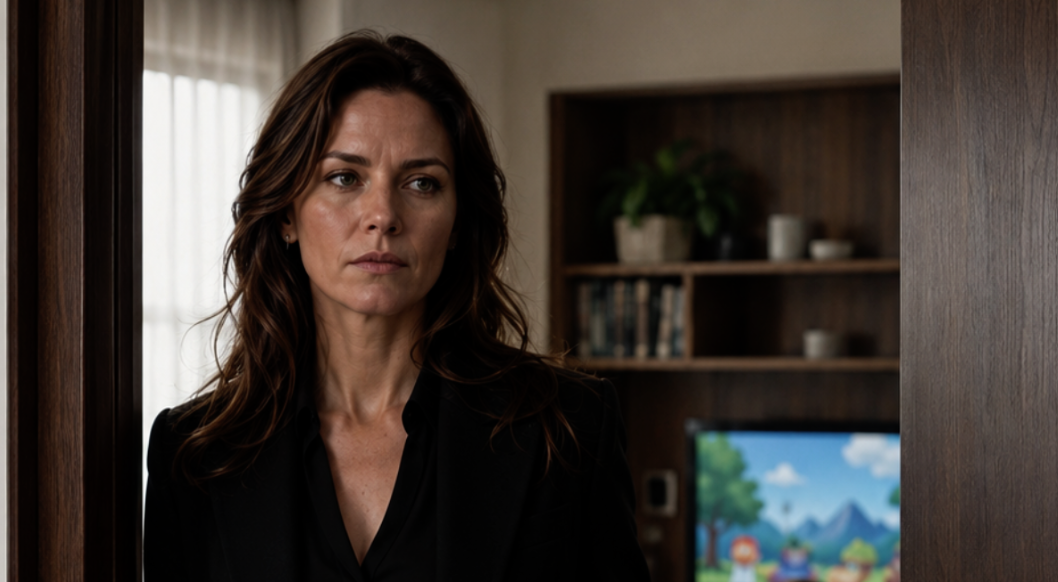
The doorbell rang at half past seven in the evening. I wiped my hands on a towel, looked through the peephole, and didn’t recognize the person standing outside.
There was a woman on the landing wearing a dark coat. High heels, a shoulder bag, a perfect manicure—she looked as though she had come to a business meeting. Except she had arranged this meeting all by herself.
“Larisa?” Her voice was confident and forceful. “I’m Kristina. We need to talk.”
I remained silent. Behind me, the sound of a cartoon drifted in from the other room—Matvey was watching it before bed. The apartment smelled of buckwheat and meat patties. It was an ordinary Thursday evening. And now, standing on my doorstep, was a woman I had previously seen only in photographs on someone else’s social-media profile.
“I’m with Arkady,” she added, as though that explained everything. “Please let me in. This isn’t something we should discuss in the hallway.”
I could have refused to open the door. I had every right to.
But something inside me said, Listen to what she has to say. It might be useful. Perhaps even today.
Arkady and I had divorced two years earlier. We had gone through the courts, as required—Matvey had been five at the time, and the judge had ordered Arkady to pay child support equal to twenty-five percent of his salary. Fifteen thousand four hundred rubles a month.
It wasn’t millions. It wasn’t an astronomical amount. It was an ordinary sum that covered Matvey’s after-school activities, clothes, and the part of his life Arkady had stopped noticing the moment he moved out.
During the first year, he paid. Not always on time, but he paid.
Then he began missing payments. One month, then two, then three in a row. I called him, and he replied, “I’ll transfer it soon.” I sent him messages, which he read without answering.
Once, I prepared a table listing every date, payment, and missed installment. I sent it to him through a messaging app.
He read it.
He didn’t reply with a single word.
Over two years, only eleven of the twenty-four required payments had arrived. Thirteen times, the money simply never came.
I had calculated everything. I knew how to calculate—that was my job. A procurement specialist was essentially someone who knew the value of every ruble and every document.
One hundred and eighty thousand rubles.
That was how much Arkady owed his own son.
A week earlier, Matvey had asked me about a new school backpack. He would be starting second grade in September, and he wanted a blue one with a rocket on it. He had seen one belonging to a classmate.
I opened the notes on my phone and started calculating.
School uniform—four thousand.
Textbooks—three and a half thousand.
Stationery—one and a half.
The backpack—five.
Indoor shoes, sports clothes, a separate bag for physical education.
Thirty-eight thousand rubles to prepare him for school.
That was when I understood that one hundred and eighty thousand wasn’t merely an abstract debt. It was almost five complete sets of school supplies. It was enough to prepare a child for school five times over.
And during that same period, Arkady had bought himself a new phone without once asking how his son was doing.
That evening, I took the court order out of my desk drawer, sat down, and wrote an application to the Federal Bailiff Service. I attached a bank statement showing every transfer and every missed payment.
They accepted my application on the sixth. Enforcement proceedings were opened within three days.
And now Kristina was standing on my doorstep.
I opened the door wider.
“Come into the kitchen.”
She entered. The heavy, sweet smell of her perfume immediately filled the hallway. Her heels clicked against the tiles.
From his room, Matvey called, “Mom, who is it?”
“Nobody, sweetheart. Keep watching your cartoon.”
I closed the door to his room and followed Kristina.
The kitchen light was on, and the pan of meat patties was cooling on the stove. The window was slightly open, letting in the evening chill and the smell of wet asphalt.
An ordinary evening.
The only unusual thing was my guest.
A document folder was lying on the kitchen table. I had placed it there that morning—a habit from work, where I always prepared documents in advance.
Kristina didn’t notice it.
She sat on a stool, placed her handbag on her knees, and looked around the kitchen as though she were inspecting the apartment before purchasing it.
I took my phone out of my pocket and placed it on the shelf above the worktop, with the screen facing Kristina. I leaned it against a jar of grain so that it wouldn’t fall.
Then I pressed Record.
I had the right to record whatever happened inside my own apartment. I knew that because I had checked the week before when I submitted the application.
My hands weren’t trembling.
At work, I conducted negotiations with suppliers who lied to my face about prices and delivery dates.
This was more or less the same thing.
“Tea?” I asked.
“No,” Kristina replied sharply. Her long burgundy nails tapped against the table. “I won’t be here long.”
She opened her handbag and took out a folded sheet of paper.
Kristina unfolded the sheet and placed it on the table in front of me. The paper was warm, probably because it had been lying in her handbag close to her body.
I leaned forward.
The heading read: “Statement Waiving the Collection of Child Support.”
It had been printed on an ordinary printer. The font was slightly uneven, and there was a blank line at the bottom for my signature.
She had downloaded it from the internet—from one of those websites full of templates, half of which had no legal validity whatsoever.
I understood that immediately. I dealt with contracts every day at work, both genuine and fraudulent.
This one was fraudulent.
But I didn’t say anything.
“Sign here.” Kristina pointed to the line at the bottom with one of her nails. “Then we won’t bother you again.”
I raised my head and looked at her.
She was around thirty-five. Confident and well groomed. She sat in my kitchen as though she had every right to be there.
As though I owed her something instead of the other way around.
“Why?” I asked.
“I’ll tell you why.” Kristina straightened her back. “Arkady and I are planning to start a family. We need a mortgage and a down payment. We’re four hundred thousand short. If you give up the child support, we’ll be able to save it in a year and a half. But as things stand, he gives you money every month, and our numbers don’t add up.”
Every month.
I almost laughed.
Over two years, he had made eleven out of twenty-four payments. Was that what she considered “every month”?
Had he told her he paid regularly? Had he lied to her about the amount too?
But I didn’t argue.
Not yet.
I folded my arms across my chest and listened.
“You have a job,” Kristina continued. She had switched to the informal form of “you” without hesitation, as though we were friends. “You’re managing on your own. The child has clothes and shoes. Why do you need the child support? It’s just a formality.”
A formality.
Fifteen thousand four hundred rubles was a formality.
Perhaps it was to her.
To me, it paid for the robotics club Matvey attended every Tuesday. It paid for the winter coat I had bought him in November. It paid for three appointments with the dentist, because baby teeth didn’t wait until you had spare money.
Kristina waited for my answer, tapping her sharp, perfectly shaped burgundy nails against the table.
It all seemed simple to her.
Sign the paper, and the problem would disappear.
“Does Arkady know you’re here?” I asked.
There was a pause.
A brief one, but I noticed it.
Kristina adjusted the handbag on her knees.
“It was a decision we made together,” she replied.
“Then, if it was a joint decision, he can come here himself. He can sit opposite me and say to my face, ‘I don’t need my son, and I don’t want to support him.’ Then we can talk.”
Kristina narrowed her eyes.
She hadn’t expected that.
She had come to see a quiet, exhausted ex-wife who was supposed to become frightened and sign whatever was placed in front of her.
But I wasn’t frightened.
And I didn’t sign.
“You don’t understand.” Kristina’s voice became harder. “He’s having a difficult time. He’s being torn between you. You keep taking money from him while he’s trying to build a new life.”
Taking money from him.
I tucked a loose strand of hair behind my ear and turned toward the stove. I switched on the kettle, not because I wanted tea, but because I needed to do something with my hands. I needed to turn away so that she couldn’t see my face.
The kettle hissed and boiled.
I poured water into a cup, added a mint tea bag, and waited for it to brew. Greenish steam rose toward the ceiling and mixed with the smell of Kristina’s perfume.
The tea tasted bitter because I had forgotten to add sugar.
But I drank it while standing beside the window, feeling her eyes on my back.
“I’m not taking money from him,” I said without turning around. “I’m receiving the amount ordered by the court. No more and no less.”
“The court, the court,” Kristina scoffed. “Everything has to go through the courts with people like you. Normal people reach agreements.”
I sat down opposite her. The cup stood between us, hot and steaming.
“I tried to reach an agreement,” I replied. “Twice this year. The first time, I sent him a detailed calculation showing how much he owed and for which months. He read it and didn’t respond. The second time, I suggested a repayment schedule—ten thousand a month in addition to the current payments. He agreed. And the following month, he didn’t pay a single ruble.”
Kristina remained silent.
Then she tugged nervously and sharply at the zipper of her handbag.
“Fine,” she said. “Since we can’t settle this nicely, I’ll call him. Right here, in front of you. He’ll tell you himself.”
She took out her phone and found his number.
I watched in silence.
I cast one quick glance at the shelf. My phone was still standing upright, the tiny red recording light barely visible.
Kristina made the call and switched on the speaker.
One ring.
Then another.
Arkady answered on the third.
“Kristin, what is it?”
His voice filled the kitchen—sharp and irritated.
I hadn’t heard it for more than six months. The last time had been when I called to remind him about Matvey’s birthday. He had said, “Fine,” and never called back.
“I’m at your ex-wife’s place,” Kristina said loudly, making a show of it. “She refuses to sign. Talk to her.”
There was a pause.
I could hear a television mumbling in the background on his end.
“Kristin, I told you to deal with it yourself. I’m sick of this women’s drama.”
Women’s drama.
His son, his child support, his debt—and he called it women’s drama.
I stood beside the window, holding the cup with both hands, saying nothing. The cup had already grown cold, but I didn’t put it down.
I needed something to hold on to.
“Arkady, she doesn’t understand,” Kristina said, raising her voice. “Explain it to her properly. Tell her you two already agreed.”
“Listen, she should just sign it. I’m sick of all this trouble. If she wants money, she can work for it. I’m tired.”
He didn’t say a single word about Matvey.
Not one.
He didn’t ask how his son was doing. He didn’t ask her to pass along his regards. He didn’t even say that he would support the child in some other way.
Just: “She should sign.”
As though his son were merely a clause in a contract that could be deleted.
Then I heard footsteps in the hallway.
Light, bare feet moving across the linoleum.
Matvey stood in the kitchen doorway. He was wearing pajamas covered in rockets. His hair was sticking up after lying on the pillow, and his eyes were sleepy.
He stared at Kristina’s phone, from which his father’s voice was coming.
“Mom, is that Dad calling?”
Kristina turned around and fell silent.
For a moment, something crossed her face. It wasn’t shame. No, it was more like confusion.
She hadn’t expected to see the child.
She had come to visit “the ex-wife,” not a mother.
I put down my cup, walked over to Matvey, and crouched beside him.
“That isn’t Dad, sweetheart. This lady came to discuss some business. Go back to your room. I’ll be there soon, all right?”
He looked at Kristina.
Then at her phone.
Then at me.
He nodded and walked away.
I heard the blanket rustle and the cartoon start playing again.
I closed the door to his room and remained in the hallway for a moment. I rested my forehead against the doorframe.
Then I exhaled and returned to the kitchen.
Everything inside me had tightened painfully.
My son had heard his father say that he was tired of “these women.”
He was seven years old.
He already understood everything.
Perhaps not the exact words, but certainly the tone.
Kristina placed her phone facedown on the table. Arkady had already ended the call, apparently having said everything he wanted to say.
The kitchen was quiet.
The clock ticked on the wall. The tap dripped faintly into the sink. Muffled music came from the apartment upstairs.
I stood near the door and wondered whether Kristina had finally realized that Arkady wasn’t going to help her.
Or whether she still believed he was being “torn between us.”
Then Kristina did something I hadn’t expected.
She changed her tone completely.
“Listen,” she said softly, almost sympathetically. “I can see that things aren’t easy for you. You’re raising a child alone, and you have a job. I understand. Let’s speak woman to woman. Why do you need all these courts, bailiffs, and stress? Sign it, and we’ll go our separate ways. Perhaps we’ll help with presents and clothes for the child. We’ll do it like human beings, without paperwork.”
I looked at her.
And for one second—just one second—I wondered whether she might be right.
Perhaps it would be easier.
I could sign the paper and stop calling, calculating, and waiting on the first of every month for a payment that would never come.
I could simply erase Arkady from our financial life, just as I had erased him from my personal life.
Perhaps it would be easier.
But Kristina couldn’t stop herself.
She had to add something more.
“Besides, you know,” she said, leaning toward me across the table as the smell of her perfume became almost suffocating, “Arkady could always quit his job. Officially, I mean. He could be paid cash under the table, and then you wouldn’t see anything at all. Not a single ruble. We would manage. But you and your child…”
She didn’t finish.
She didn’t need to.
This was no longer a request.
It was a threat.
A direct, specific threat, made inside my kitchen while the camera was recording.
I looked her in the eyes.
Calmly.
Without anger and without fear.
I tucked a strand of hair behind my ear and said:
“You just said, while being recorded, that your partner is prepared to leave his official job to avoid paying child support for his own child—and that both of you know about it. Thank you. This will be useful.”
Kristina froze.
Her hand, with its burgundy nails, stopped above the table.
“What recording?”
I nodded toward the shelf.
My phone was standing upright, its screen glowing.
Kristina turned her head.
She saw it.
And went pale.
I placed my hand on the folder of documents.
I opened the folder.
Slowly, the same way I opened documents at work when dealing with a supplier who was attempting to inflate a price.
Calmly and without haste.
Every page was in its proper place.
“Here.” I turned the first sheet toward Kristina. “This is the payment register. Twenty-four months. The payments I received are marked in green. The missed payments are marked in red. Do you see? Thirteen red lines. Thirteen months without money.”
Kristina stared at it.
Her nails had stopped tapping against the table. Her hands lay completely still.
“Next.” I turned the page. “This is the calculation of the outstanding debt. According to the court order, he owes fifteen thousand four hundred rubles a month—twenty-five percent of his salary. Thirteen missed payments, minus two separate transfers of ten thousand each for Matvey’s birthday and New Year. The total is one hundred and eighty thousand two hundred rubles.”
I said it calmly.
Without emphasis and without triumph.
They were simply numbers. Facts.
The thing I did best—putting everything in order.
Kristina looked up at me.
The confidence she had arrived with was gone. Something else had taken its place.
Confusion.
“How much?” she asked quietly. “He told me it was twenty thousand. Thirty at most.”
“One hundred and eighty thousand,” I repeated. “Here is the calculation. Every line includes the date and the amount. You can check it yourself.”
Kristina picked up the sheet.
Her hands were trembling slightly, nothing like the confident way she had taken her document out of her handbag earlier.
Her eyes moved across the lines.
January, February, March.
Red, red, green.
Red.
Red.
I watched as she began to understand.
Not immediately, but gradually.
She was putting it all together in her head.
Not twenty thousand, but one hundred and eighty.
Not “a small amount of unpaid support,” but the equivalent of six months of someone’s salary.
She was trying to save four hundred thousand for a mortgage, yet the one hundred and eighty thousand owed to his child was merely “a formality.”
I turned another page.
“And this is a copy of my application to the Federal Bailiff Service. Here is the reference number and the date—the sixth. One week ago. Enforcement proceedings have already been opened.”
“What does that mean?” Kristina’s voice had changed.
It was thinner and quieter.
What had happened to the woman whose heels had clicked confidently through my hallway forty minutes earlier?
“It means that within the next two or three weeks, the bailiffs will request information about his bank accounts. They will freeze all of them until the debt has been paid in full. Including the account where the two of you are saving your mortgage down payment.”
I wasn’t gloating.
I didn’t feel happy.
I felt quiet.
The way you feel after carrying a heavy bag for a long time and finally setting it down.
Kristina stood up. The stool scraped across the floor.
She grabbed her phone and called Arkady.
One ring, then another.
This time, he didn’t answer immediately.
A third ring.
A fourth.
He picked up on the fifth.
“You lied to me,” Kristina said quickly, swallowing her words. Her voice was trembling. “Twenty thousand, right? Twenty?! She has documents here showing one hundred and eighty! The bailiffs are involved! They’re going to freeze the account! What mortgage, Arkady? What mortgage can we possibly get when you’re six months behind on your debt?”
I heard him mumbling something in reply.
Quietly and indistinctly.
Making excuses.
Kristina didn’t let him finish.
She ended the call, threw the phone into her handbag, and tried to close the zipper. Her hands wouldn’t cooperate, and the zipper caught.
She tugged harder, stood up, and headed toward the door.
At the threshold, she stopped and turned around.
“Why did you show me all of this?”
I stood in the doorway, resting one shoulder against the frame. The folder was still lying open on the table.
“Because you came into my home, into my apartment where my child is sleeping, and demanded that I give up money that legally belongs to him,” I said. “Not to me. To him. To a seven-year-old boy who wants a backpack with a rocket on it. I don’t owe you anything. And I’m not signing anything.”
Kristina pulled the door open and left.
The door slammed behind her.
Then everything was quiet.
I remained standing in the hallway.
The smell of her perfume still hung in the air—sweet and foreign.
The smell of cold buckwheat drifted in from the kitchen.
There was no sound from Matvey’s room. He had fallen asleep.
I walked over to the shelf and picked up my phone.
The recording had lasted forty-seven minutes and fourteen seconds.
I pressed Stop.
I saved the file and emailed it to myself, just in case, so that I would have a second copy.
Then I sat on the stool where Kristina had been sitting. It was still warm.
Her sheet of paper—the “statement of waiver”—was lying on the table.
I picked it up with two fingers, folded it carefully, and placed it inside the folder.
That might be useful too.
At around ten o’clock that evening, a notification appeared on my phone.
A transfer of forty-five thousand rubles.
From Arkady.
There was no comment and no message.
For the first time in six months, he had transferred money without being called or reminded.
A month later, a bailiff contacted me through a messaging app.
Arkady’s account had been frozen, and one hundred and thirty-five thousand two hundred rubles had been withdrawn to settle the outstanding debt.
Remaining balance: zero.
The debt was paid in full.
Kristina disappeared.
I don’t know the details, and I don’t want to know.
Apparently, once she calculated the numbers properly, taking out a mortgage with a man whose accounts had been frozen no longer seemed like such a good idea.
After his account was frozen, Arkady stopped calling Matvey.
Before that, he had called once every two or three weeks—briefly, just so that he could say he had done it.
Now there was silence.
Matvey asked once, “Mom, is Dad going to call?”
“I don’t know, sweetheart,” I answered. “But I’m here.”
He nodded and went back to building something with his construction set.
Seven is the age when children already understand more than adults would like them to.
In August, I bought him the backpack.
The blue one with the rocket—the exact one he had wanted.
I stood in the store holding it in my hands and thought: this money wasn’t charity. It wasn’t a favor or an act of kindness.
It was something my son was entitled to simply because he had been born.
And for the first time in two years, I hadn’t been forced to humiliate myself to receive it.
That evening, I stood in the hallway.
The door was closed.
It was an ordinary white door with a simple lock.
A month earlier, I had opened it to a stranger who had come to take away something that belonged to my child.
Now it was simply a door.
The door to an apartment where Matvey and I were safe. Where the air smelled of buckwheat instead of someone else’s perfume.
And where a phone stood on the shelf, no longer recording.
Has anyone ever asked you to give up your rights for the sake of someone else’s comfort?