Oksana entered the apartment a little after eight, set a bag containing kefir, bread, and cottage cheese on the cabinet, and simply closed her eyes for a moment. The damp smell from the stairwell still clung to her. Her head throbbed dully, and her legs ached as though she had spent the night hauling sacks rather than visiting patients in their apartments. There had been thirteen calls during her shift.
A child with a temperature close to forty degrees. An elderly man who had suffered a stroke. A drunken altercation. An asthma patient on the fifth floor of a building without an elevator. An old woman with high blood pressure who had no one even to make her a cup of tea. By the end of the shift, Oksana’s fingers were trembling from exhaustion as she completed the paperwork.
She wanted only one thing: to take off her coat, make it to the shower, and fall asleep for at least four hours.
The low murmur of the television came from the living room. Igor was lying on the sofa in a T-shirt and sweatpants, awake but not yet out of bed, holding his phone. Hearing the key in the lock, he turned his head and, instead of saying hello, complained as though she had returned five minutes late from the store.
“What are we having for breakfast? Feed me first, and then you can rest, all right?”
Oksana did not immediately understand what he had said. The words seemed so incompatible with that morning, with her condition, and with the way one human being ought to look at another after a night shift. Slowly, she removed her scarf.
“I had a very difficult night. There were a lot of calls.”
“I’m not asking for a banquet,” Igor replied without even getting up. “At least make some scrambled eggs.”
Oksana was already taking off her shoes, having placed the grocery bag beside the wall. Out of habit, moving faster than she could think, she actually stepped toward the refrigerator. It was always like this: she came home, checked what they had, decided what needed to be bought and what needed to go on the stove. Her body was still upright only because it had not yet managed to switch out of its things must be done mode.
Not noticing anything, Igor delivered the final blow in the most ordinary tone imaginable.
“And my mother is coming over at one today. Make something decent for her.”
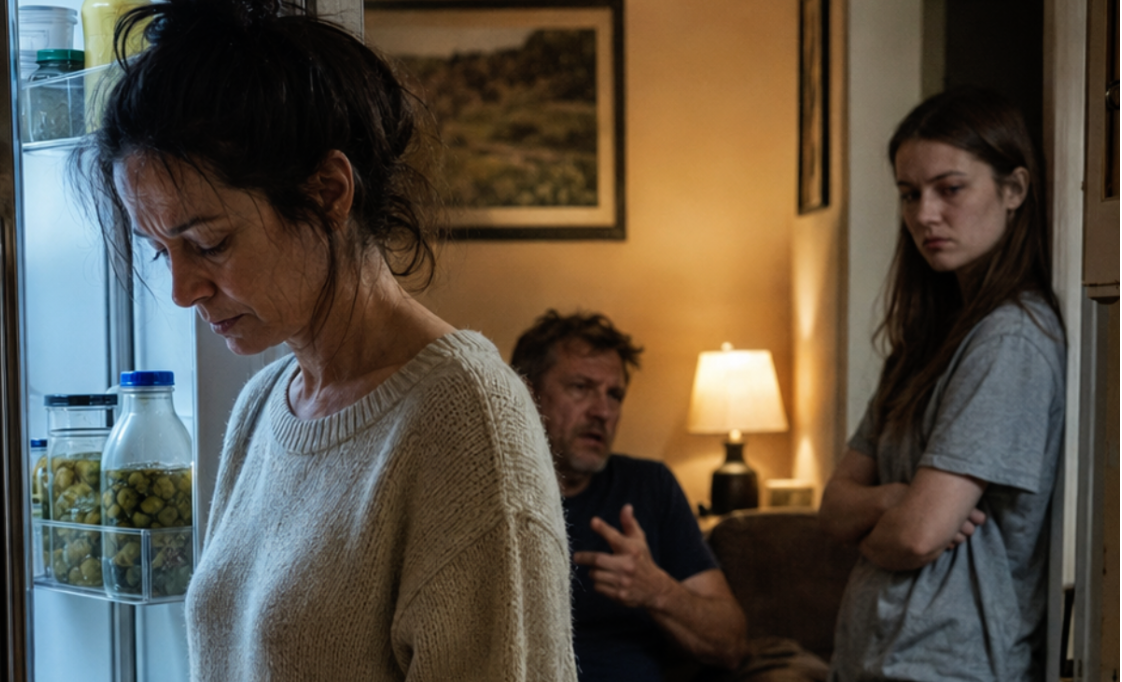
Oksana opened the refrigerator. On the shelf were half a jar of sour cream, a container of yesterday’s buckwheat, two eggs, a jar of pickles, and an old piece of cheese in a plastic bag. And at that moment, as she looked at the empty shelf, she suddenly saw not food but her entire life. It was as though everything had been forming the same pattern for years, but she had always been too tired to take a step back and look at it.
She took out the eggs. Her hand slipped against the refrigerator door, her fingers numb and weak.
Her niece Yana emerged from her room and entered the kitchen. She was sleepy, wearing an oversized T-shirt, her hair tied in a messy bun. She was nineteen, preparing for entrance examinations in an unfamiliar city. Yana was temporarily staying with them while she sorted out her courses and university application. Usually quiet and careful not to inconvenience anyone, she had only come to get some water and clearly had no intention of interfering in their family morning.
But then she heard Igor’s remark about his mother and stopped.
“Are you serious right now, Uncle Igor?” she asked.
Igor looked up at her.
“No one asked you!”
Yana looked at Oksana, at the eggs in her hands, and at the grocery bag by the door.
“Aunt Oksana has just come home from a night shift,” she said, now fully awake. “She can barely stand. Can’t you make your own scrambled eggs?”
Igor sat up straighter on the sofa, as though he had suddenly been unfairly attacked.
“I was only asking…”
As though there were genuinely nothing to argue about. Oksana was already home and had reached the kitchen, so naturally she could make him something to eat and prepare a meal for his mother’s arrival.
Oksana stood in front of the open refrigerator, holding the eggs, and suddenly saw the scene not through her own eyes but from the outside. A nineteen-year-old girl had understood in one month what Oksana herself had long ago grown accustomed to and stopped resisting. A woman had returned from a night shift with the ambulance service, with gray circles beneath her eyes and shoulders sagging from exhaustion, while her healthy adult husband lay on the sofa on his day off, discussing what he would be having for breakfast.
She felt ashamed not only of him but of herself as well. Ashamed that she had almost begun making that damned breakfast.
Oksana returned the eggs to the refrigerator and closed the door.
“If your mother is coming at one, you’ve seen what’s in the refrigerator,” she said calmly. “You can work it out yourselves. I’m going to sleep.”
Igor was taken aback.
“So that’s it? I’m the villain first thing in the morning now?”
But Oksana was already walking toward the bathroom. If she started explaining, arguing, or fighting, she would once again be left without sleep, and somehow the frying pan would still end up in her hands.
Behind her, no longer trying to stay out of it, Yana said:
“Did you honestly think she was going to start baking a pie for Grandma’s visit?”
Igor snapped something in reply, but Oksana did not hear him. The sound of the shower was already drowning him out.
She stood beneath the water almost without moving, resting her forehead against the cold tiles. Water ran down her back, while that level, dissatisfied voice continued to echo in her mind: Feed me first, and then you can rest.
It had been such an ordinary domestic command. Had he shouted, she might later have told herself that he had simply lost his temper. But he had not shouted. He had merely said exactly what he believed.
She dried herself, put on an old T-shirt, and lay down in bed. Almost immediately, she heard the clatter of a frying pan from the kitchen, followed by the refrigerator door slamming. Then Igor called someone. A little later, the front door shut. Apparently, he had gone to the store.
Those sounds were unfamiliar because Igor usually helped only when he was specifically told what needed to be done. But doing everything himself, from scratch, on his day off, after her shift, and before his mother’s visit—that almost never happened.
She fell asleep in fits and starts.
She woke every hour, perhaps even more often. Once, the sound of dishes clinking behind the wall woke her. Another time, it was Yana’s voice explaining something, probably where the salad bowl was kept. In her dreams, she saw flashing ambulance lights, an apartment landing, someone’s child wrapped in a blanket, and, for some reason, their empty refrigerator.
When Oksana finally opened her eyes properly, gray daylight filled the room. Her phone showed ten minutes to three. Her mouth was dry, and her body felt heavy, as though she were recovering from an illness. She sat up and listened. The apartment held that particular kind of silence in which everything had already happened, yet nothing was truly over.
As soon as she entered the kitchen, she smelled store-bought rotisserie chicken. Sliced cucumbers and tomatoes stood on the table beside a bowl of salad, bread, and a cake in a plastic container. The tablecloth had been laid upside down, the knife rested dangerously close to the edge, no one had cleared away the crumbs, a frying pan remained on the stove, and two dirty plates sat in the sink.
Nadezhda Pavlovna was sitting at the table in her brown cardigan, her back straight and her lips pursed. Igor sat beside her, tapping at his phone with the expression of a man who had been forced to create “comfort” himself and had not yet decided exactly whom he resented for it.
“You’re awake?” he asked in an excessively neutral voice.
Nadezhda Pavlovna looked Oksana up and down.
“Hello, Oksana. Did you get enough sleep? I thought you would be up by the time I arrived.”
Oksana walked toward the kettle.
“I worked a night shift.”
“Igor already told me. But of course, you could have put the house in order beforehand.”
She did not even say it maliciously. She spoke as though she were merely stating a fact. That familiarity made it particularly hurtful. It was as though Oksana was being judged not by the fact that she had spent the night saving people’s lives, but by whether the cabinets shone and the table had been properly set.
Oksana poured herself a glass of water, drank it slowly, and returned the glass to its place.
“If you were able to spend your whole life waving a cleaning cloth around the house whenever you pleased, that was your choice,” she suddenly said. “I was on my feet all night. And believe me, our home is no worse than most people’s.”
Nadezhda Pavlovna froze, clearly not expecting such a tone. In the past, Oksana had either remained silent or tried to smooth things over. At worst, she had gone into another room to avoid an argument. This time, she did not retreat.
“I didn’t say anything wrong!” her mother-in-law protested, pursing her lips even more tightly.
“No, you spoke the way you’re accustomed to speaking,” Oksana replied. “But from now on, let’s agree that you will come to our home as a guest, not as an inspector.”
Igor immediately stirred.
“Oksana, why did you have to—”
“Why did you have to start this morning?” she interrupted.
Silence descended over the kitchen. Even Yana, who had been sitting in her room and apparently pretending not to exist, peered into the hallway.
Nadezhda Pavlovna was the first to rise.
“I think I’ll leave. I can see I came at a bad time.”
She spoke with the dignity of someone whose finest feelings had been wounded. Nevertheless, she began gathering her handbag with quick, nervous movements. Igor jumped up and accompanied her to the door, muttering things such as “Don’t pay any attention” and “She’s just tired.”
Oksana did not go into the hallway. She had no desire either to apologize or to persuade her mother-in-law to stay.
When the door closed behind Nadezhda Pavlovna, the apartment became truly quiet for the first time that day—the kind of quiet that comes after all the necessary words have been spoken and can no longer be taken back.
Igor returned to the kitchen, looking gloomy.
“You could have been gentler!”
Oksana rested her palms against the countertop. Even after sleeping, exhaustion remained lodged heavily and dully in her body. At least now it was no longer disguising itself as obedience.
“You really crossed the line today, Igor.”
“For God’s sake, I wasn’t tormenting you. I just…”
“You just asked?” Oksana finished for him. “Yes. I’ve already heard that.”
He looked away.
“What was so terrible about it? I woke up and I was hungry. I didn’t think.”
“Exactly. You didn’t think. Not this morning, not when you invited your mother over for one o’clock, and not when you saw the condition I was in.”
It was obvious that her husband wanted to defend himself in his usual way: I’m not a tyrant. I don’t shout. I went to the store myself afterward.
But even he seemed to understand how that would sound after Yana’s intervention, after his mother’s remarks, and after the absurdly arranged table with its store-bought chicken.
“Even Yana told you it wasn’t normal,” Oksana said quietly.
That struck him harder than her own words. He was a grown man who had needed to be corrected by a nineteen-year-old girl.
“I really didn’t think,” he repeated more quietly.
This time, it did not sound like a convenient excuse. It sounded more like an admission of his own stupidity—something that had suddenly become embarrassing even to him.
Oksana looked at him and felt neither victorious nor especially angry. She felt only exhaustion and a belated resentment toward the habit that had shaped their lives. He was not a monster. He did not drink, cheat, smash dishes, withhold money, or abandon his children. And that was precisely why everything had appeared “normal” for so many years.
He had simply become accustomed to her doing everything around the house—cleaning, washing clothes, and cooking—after a shift, while ill, on Saturdays, and at any other time. She, in turn, had become accustomed to the idea that doing it herself was easier than explaining why she could not.
“I suppose I got used to you doing everything yourself,” he said, using almost the same words he apparently had never intended to say aloud.
“Yes,” Oksana replied. “Exactly, Igor. You got used to it.”
She added nothing more. She did not lecture him or list how many times she had fried potatoes for him after a twenty-four-hour shift, how many times she had spent her only day off accompanying his mother to medical appointments, or how many times she had slept in fragments between making soup, doing laundry, and preparing for work.
All those things were already standing between them like pieces of furniture they had previously failed to notice but could now no longer walk around.
The day was not over. It had only cracked open.
Toward evening, Yana peered out of her room.
“Aunt Oksana… may I ask you something?”
Oksana nodded. Yana hesitated by the doorframe and then finally entered the kitchen.
“Does this happen often?”
It was an awkward and intrusive question, yet at the same time remarkably precise. She was not asking only about that morning’s breakfast, of course. She meant their life in general.
Oksana automatically reached for her mug, even though the tea inside had long since gone cold.
“What do you mean by ‘this’?”
“Well… you come home from work, and everyone immediately needs something from you. You don’t even get angry at first. You just go and start doing everything.”
Igor, who had been sitting silently and staring at the table, flinched as though he had once again been criticized in front of an outsider. But he said nothing.
Oksana gave a brief laugh that held almost no amusement.
“It just built up by itself somehow.”
Yana looked at her with a directness unusual for someone her age.
“My mother lived the same way,” she said. “Until she got sick. Then everyone suddenly discovered where we kept the rice and how to turn on the washing machine.”
The kitchen became silent again.
Igor raised his head.
“For the record, I know how to use the washing machine.”
“I wasn’t talking about the washing machine,” Yana replied. She immediately became embarrassed, as though remembering that she was neither their daughter nor the mistress of the house. “All right. I’m sorry.”
She returned to her room and partially closed the door.
After that, Oksana no longer felt like speaking loudly. Something inside her seemed to have settled and solidified. She picked up a cloth and silently wiped the table because the crumbs irritated her.
That simple action revealed how narrow the difference was between I’m doing this because it is convenient for everyone and I’m doing this because it is easier for me at this particular moment.
Previously, that distinction had barely existed for her.
Igor watched her clean the table and then suddenly said:
“I’ll visit Mom by myself tomorrow.”
Oksana did not immediately understand.
“Why?”
“Well… she’s probably offended.”
“That’s between the two of you,” Oksana said with a shrug. “Go if you want.”
“You aren’t coming?”
She placed the cloth in the sink.
“No. I’ll be catching up on sleep after my shift. And in general, Igor, I no longer want visits to your mother to feel like an additional job. When something needs to be done, you can go yourself. Or we can discuss it beforehand instead of you presenting me with a decision at eight in the morning.”
He nodded too quickly, as though eager to show that he understood. But Oksana already sensed that understanding something in words was not the same as changing one’s behavior.
That evening, she had a video call with her daughter. The girl was studying in another city and usually called around nine, after finishing her classes. Oksana had not intended to tell her anything, but her daughter heard something in her voice immediately.
“Mom, why do you sound so exhausted?”
“It was a difficult night.”
“Only the night?” her daughter persisted. “You look the same as you did that time you stayed silent for two days after Grandma gave you all that ‘advice.’”
Oksana could not help smiling slightly.
“You’re far away, yet you still notice everything.”
“What happened?”
Oksana briefly described the morning without complaining, giving only the facts: she had come home, been asked to make breakfast, then been told to prepare food for her mother-in-law’s visit, and finally been criticized because she had not woken up before her mother-in-law arrived.
There was a pause on the other end of the call.
“Mom, why do you put up with this at all?” her daughter asked.
The words at all made Oksana feel almost as uncomfortable as Yana’s remarks had that morning. Children and young people always cut straight to the point because they have not yet developed the thick layer of domestic habit that adults use to cover the most unpleasant parts of their lives.
“I don’t know,” she answered honestly.
“Dad can certainly be… sometimes…” Her daughter did not finish the sentence and exhaled instead. “All right. Just don’t let this go. Otherwise, you’ll smooth everything over again and everyone will pretend nothing happened. Okay?”
Oksana did not answer immediately because that was precisely what she had done throughout her entire life—smoothed things over. Even when she had no strength left. Even when she wanted to lie down on the hallway floor and never move again.
The next morning, Igor got up earlier and, to her surprise, did not try to start a conversation. He got ready quietly, made his own coffee, and spent far too long searching for a clean shirt on two separate occasions, but he did not call her for help. Before leaving, he looked into the bedroom.
“I’ll visit Mom after work. And… I’ll buy groceries.”
Oksana lay in bed, staring at the ceiling.
“Buy them.”
He remained in the doorway, clearly waiting for something else. Perhaps gratitude, perhaps a softening of her attitude. He received neither and eventually left.
Yana came into the kitchen after he had gone.
“He made his own coffee,” she said almost in a whisper, like someone reporting a rare natural phenomenon.
Oksana could not help snorting.
“I saw.”
“Listen, perhaps I’m interfering in something that isn’t my business…”
“You are,” Oksana said tiredly but without anger.
“Yes,” Yana agreed. “But your face looks different today.”
“Different how?”
Yana shrugged.
“As though you at least don’t agree anymore.”
It sounded so simple that there was no point arguing.
The day passed quietly but tensely. Igor really did return that evening carrying bags of groceries. He put everything in the refrigerator himself. Admittedly, he placed the yogurt on the wrong shelf and failed to close the bread properly, but Oksana did not rush after him to correct everything. She stood in the kitchen doorway and watched silently.
He noticed, and his movements became even more uncertain.
Two days later, Nadezhda Pavlovna called Oksana herself.
Oksana was sitting in the kitchen with a bowl of soup, preparing to leave for a daytime shift.
“Oksana, it’s me,” said the same slightly dry voice over the phone. “I wanted to say… perhaps our conversation the other day did not go very well.”
It could not exactly be called an apology. But neither was it her usual excuse that she had “only said it without meaning anything.”
“Perhaps,” Oksana answered.
“Igor came to see me. He went on and on about how tired you are.”
Oksana almost smiled, as though this were startling new information.
“I really am tired.”
“I understand,” her mother-in-law said after a pause.
That was perhaps the most unexpected statement of the entire conversation.
“It simply wasn’t customary in our time to… say these things aloud.”
Oksana stirred her soup with a spoon.
“That was a mistake.”
Nadezhda Pavlovna sighed loudly.
“All right. That isn’t why I called. Igor bought me a blood-pressure monitor. Thank you.”
“You should thank him. I’ll tell him.”
“Tell him,” her mother-in-law said dryly before ending the call.
The conversation had lasted less than two minutes, but afterward Oksana sat over her soup for a long time without eating, lost in thought.
The most uncomfortable conversation took place a week later. Oksana returned home in the afternoon after an ordinary shift rather than a night shift. Igor was home because he had taken the day off. A bag of medicine for his mother stood in the kitchen.
“I’m going to visit her again tomorrow,” he said.
“All right.”
“She asked whether you might come too. She needs someone to look at the curtains, and she wants you to make a pot roast, and…”
He stopped himself because he had heard how his own words sounded.
Oksana did not respond immediately. She merely looked at him.
“Do you see?” she asked quietly. “It comes out of your mouth automatically.”
“That isn’t what I meant.”
“What did you mean? Once again, you’re reciting a list of things I’m expected to take care of because I’m better at them. At least now you can hear yourself doing it.”
He rubbed the back of his neck.
“I really am trying.”
“I can see that. But trying doesn’t mean waiting for me to return to my old role, only asking me a little more politely.”
Igor remained silent and then unexpectedly sat down opposite her.
“What do you want?” he asked. “Tell me directly, without hints.”
Oksana sat down as well. It was unusual to hear such a straightforward question from him.
“I want you to notice when I’m at my limit. Not after an outsider points it out to you, but on your own.”
“That’s difficult to judge simply by looking at someone.”
“That isn’t true,” Oksana said, shaking her head. “You simply don’t look as long as ignoring it is convenient for you.”
He lowered his eyes.
“Perhaps.”
“And one more thing,” she added. “I don’t want your mother coming here to inspect my cleaning anymore. If she comes as a guest, that’s one thing. If she comes to see why I’m not waiting with a freshly baked pie after a twenty-four-hour shift, then no.”
“I understand.”
“You’ll understand when you stop inviting her to lunch after my night shifts.”
He did not enjoy hearing it, but he did not argue. That, too, was new.
Nothing magically transformed overnight. Igor did not become the perfect husband in three evenings. He still occasionally asked, “What are we having for dinner?” in that particular tone that immediately made Oksana tense. He could still forget that a day off following a twenty-four-hour shift was not truly a day off.
But Oksana also stopped automatically taking care of everything. Sometimes she responded sharply. Sometimes she merely paused, and the silence itself made Igor uncomfortable.
One afternoon, she returned home after being on duty, and out of habit he called from the living room:
“Oksana, did you buy milk?”
She was standing in the hallway, removing her coat.
“No.”
“Why not?”
“Because I was returning from an emergency call, not from the supermarket.”
He came into the hallway and opened his mouth to say something, but then merely nodded.
“I understand. I’ll go and get it.”
It was through such small moments that the change became visible. The old path on which she silently handled everything was no longer smooth and effortless.
Yana left two weeks later. She packed her bag, said goodbye, hugged Oksana in the hallway, and suddenly whispered:
“What you did that day was really great.”
“When?”
“When you went to sleep!”
Oksana laughed.
“What a heroic achievement.”
“No,” Yana said seriously. “It truly was exactly what you needed to do.”
A month later, Oksana returned from another night shift. Once again, she was exhausted, her legs numb, the smell of the street clinging to her coat, and her stomach empty.
The hallway was quiet. A small lamp above the kitchen table was glowing. A pot of already-cooked oatmeal stood on the stove, and beside it lay a note written on a page torn from a notebook:
“Yana would say this isn’t an act of heroism—it’s the bare minimum. But the oatmeal is ready. Eat something and get some rest.”
The handwriting was Igor’s—crooked and hurried.
Oksana looked at the note cautiously for a long time, the way one looks at something one has stopped expecting and no longer knows whether it is safe to become accustomed to.
Then she ate the warm, freshly cooked oatmeal and went into the bedroom.
She lay down, pulled the blanket up to her chin, and, for the first time in a very long while, fell asleep before the list of everything she still needed to do could begin running through her mind.