“My mother-in-law ‘gave’ me a public meltdown for the holiday, and after that I never gave her another penny
There is a special kind of exhaustion—not from work, not from lack of sleep, but from people. When every conversation with a certain person leaves something sticky behind, something clinging, as if you had walked through a swamp and come out the other side, but the mud was still there. That was exactly the kind of exhaustion I had been accumulating for years, and its name was Valentina Stepanovna, my mother-in-law.
I married Ilya when I was twenty-eight. He seemed reliable to me—calm, sensible, one of those men who know how to listen and do not jump in with advice unless asked. In the first years, that was exactly how it was. We rented an apartment, then bought one—small, but our own. I worked at a marketing agency and worked my way up to department head. Ilya was in logistics and earned decent money. We lived steadily, without any extra luxury, but without hardship either.
And then he was laid off.
It happened suddenly—the company was restructuring, and his position was eliminated. I did not panic. I told him, it is fine, you will find something else, the market is big. He nodded, sent out résumés—at first. Then somehow the résumés went out less and less often, the rejections hurt more and more, and about six months later it was as if Ilya had exhaled and stopped hurrying. Not completely—he took occasional jobs, helped acquaintances from his old work—but he had no steady income. I did. And the money coming into the family came from me.
I would have handled it more easily if not for Valentina Stepanovna.
My mother-in-law lived alone on the other side of the city—her husband had died long ago, her pension was modest, and she was used to her son helping her. Before, he had helped. Now, when he was not working, I helped. The requests came regularly, like utility bills. One time she needed extra money for a stay at a sanatorium—her back was bad, and that was not a whim but a necessity, as she explained. Another time her friends had invited her to a café to celebrate someone’s anniversary, and it would be awkward to sit at the table without a gift. Then there was a sale at the jewelry store, and the earrings were so lovely, and she had been through so much in life—did she really not deserve a small joy?
I transferred the money. Silently, without extra words. Ilya looked at me with such a mixture of gratitude and embarrassment that I could not refuse—it felt to me that by refusing, I would be betraying not only his mother, but him as well. And that feeling was skillfully exploited.
Valentina Stepanovna was a woman with a strong character. To put it mildly. She never forgot to point out that my soup was too thin, that the curtains in the living room had been chosen badly, that I worked too much and did not devote enough time to Ilya, that my hairstyle made me look older, that I should be stricter with my colleagues—she had worked in accounting her whole life and knew how these things worked. Every piece of advice came wrapped in concern, but when unwrapped it was always the same: you are doing everything wrong. I learned to answer briefly and neutrally. “Perhaps you are right,” and then go into the kitchen to wash the dishes. That was my survival strategy.
Valentina Stepanovna’s birthday fell at the end of November. That year, she called Ilya in early October—in advance, so we would have time to prepare. Ilya retold the conversation that evening while we were having dinner.
“She wants us to host the celebration here at our place. Invite her friends. Set the table. You know.”
I put down my fork. Looked at him.
“She wants me to set the table for her friends in our home, for her birthday.”
“Oksan, she is alone. She has no way to organize it herself.”
“Ilya, she has a son.”
He looked down at his plate.
That was the whole point. He knew how to look at his plate in such a way that I would feel cruel. I sat across from him, tired after a workday, and thought about how once again I would become the organizer of someone else’s celebration. I would buy the groceries, cook the food, set the table, smile at unfamiliar women who would look at me with the same appraising squint as their friend.
“Please just bear with it,” Ilya said. “She does not need much. Just for it to be decent.”
“Being decent means taking into account what I want too.”
“Oksan.”
I stood up and carried my plate away. Then I came back and said that I would do it. One time. And that he should remember it.
The following weeks I lived in a state of double workload. Work, home, and alongside that, planning someone else’s celebration. Valentina Stepanovna called to clarify things: four friends would be coming, one did not eat fish, another was on a diet, a third adored cream cakes. She did not suggest the menu—she dictated it. I wrote it down and did not argue.
On the Friday before the celebration, I took the day off and spent it in the kitchen. I cooked from morning until evening. Salads, a hot main course, appetizers, and I ordered the cake from a pastry shop—a good one, beautiful. Ilya helped set the table, arrange the chairs, and buy flowers. He was careful and attentive in that way—in small things, in details, in things that did not require sustained effort.
The guests arrived at one in the afternoon. Valentina Stepanovna showed up before everyone else—half an hour early, in a new dress, with her hair done. She inspected the table, walked around the room.
“The tablecloth is a bit crooked,” she said to me instead of greeting me. “And why did you put out these glasses? We have beautiful crystal ones.”
“The crystal ones are on the top shelf, way in the back, Valentina Stepanovna. They were very awkward to get out.”
“What is awkward is when everything looks cheap. Get them.”
I got out the crystal glasses.
Her friends arrived almost at once—noisy, in dressy blouses, with gifts and boxes of chocolates. I took their coats, offered tea before the meal, introduced myself. The women were actually quite pleasant, and I even felt a little lighter—maybe everything would go fine.
The first hour went well. They ate, praised the food, Valentina Stepanovna flushed with attention and wine, laughed, told stories from her youth. One of her friends—Tamara Ivanovna, plump and good-natured—turned to me and said:
“Oksanochka, you are such a clever girl. You cook wonderfully, and you work too, Valya told us. How do you manage everything?”
I smiled, was about to answer something ordinary—thank you, I do my best—but I did not get the chance.
“She manages because I taught her everything,” Valentina Stepanovna said. Her tone was light, almost joking, but there was something sharp in it.
“Well, probably not everything,” Tamara Ivanovna laughed.
“Everything. When she came into our family, she had no idea how to run a home. She could hardly cook. I taught her, taught her. And how to please a husband too. They are still together, after all—how many of your children have been married that many years?”
I felt as if I had been dunked in mud. I kept smiling, because there were strangers sitting at the table and it was not my celebration.
“Oksana is wonderful,” another friend, Lyudmila, said. “What a table she has laid out.”
“She tries,” Valentina Stepanovna agreed with an expression as though she were doing me a favor. “Though not without shortcomings. The tablecloth is crooked, for one thing.”
Tamara Ivanovna laughed again—she was clearly taking it as harmless joking. I picked up my glass and took a sip. Then Lyudmila asked me about my work, and I began to talk—about a project we had recently completed, about how we had managed to bring in new clients. I spoke simply, without bragging, but it was pleasant for me—this was my territory, where I felt confident. Tamara Ivanovna listened with genuine interest, asked questions. Lyudmila said her niece also wanted to go into marketing, could she ask my advice sometime. I said of course, with pleasure.
And this was where something changed in Valentina Stepanovna.
I did not notice it right away. She poured herself more wine—more than usual. Then she became a little quieter. Then she began correcting things on the table—rearranging plates, moving the candy bowl.
“Valya, why did you go so quiet?” the third friend, Natalya, asked.
“Nothing,” my mother-in-law said. But her voice was different.
The conversation came back to me—Lyudmila was asking something else about the agency, Tamara Ivanovna said I was “such a good girl, so independent.” And then Valentina Stepanovna set her glass down sharply enough to make the wine slosh.
“Independent,” she repeated. And there was so much in that one word that everyone at the table fell silent.
“Mom,” Ilya said cautiously.
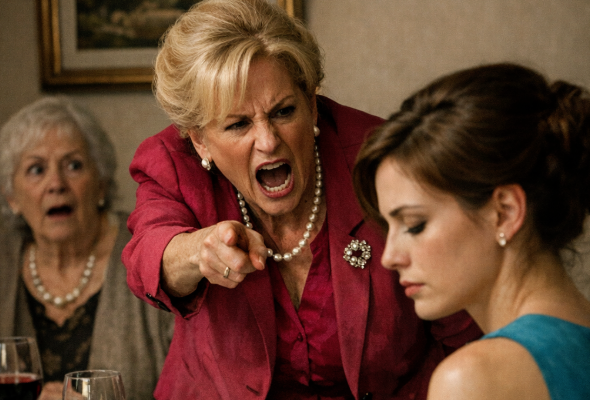
“No, let me speak.” Her voice rose. “I sit here, I listen—everyone admires her. Oksana this, Oksana that. But ask yourselves—where did all of it come from? Who taught her everything? Who advised her how to carry herself, how to speak, how to look? I invested in her for years, explained things, spent my time and energy on her! And she sits here accepting compliments and will not even say thank you. As if I do not exist!”
The table fell very quiet. Tamara Ivanovna looked down at her plate. Lyudmila picked up her napkin. Natalya stared out the window.
“Valentina Stepanovna,” I began evenly.
“No, be quiet! All her achievements are my doing. I raised her! If not for me—what would she even be? She came from who-knows-where, and now she is the mistress of the house!”
Ilya put a hand on her shoulder.
“Mom, stop.”
“Do not touch me! Let them know the truth!”
I sat and looked at her. At her red face, at her trembling hands, at her friends, who were mortified. I thought about Friday in the kitchen. About the cake from the pastry shop. About the crystal glasses I had taken down from the top shelf. About the sanatoriums, the earrings, the café get-togethers. About years of bank transfers without a word of gratitude.
I waited until she finished speaking.
Then I said—calmly, without shouting, looking her in the eyes:
“If all my achievements are the result of your advice and lessons, then it would probably be only fair if you started paying for your own wishes too. Sanatoriums, jewelry, celebrations with friends. If all of this is your заслуга”—your doing—“then the money for it should be yours as well…
There is a special kind of exhaustion—not from work, not from lack of sleep, but from people. When every conversation with a certain person leaves something sticky and dragging behind, as if you had walked through a swamp and come out, but the mud stayed on you. That was exactly the kind of exhaustion I had been accumulating for years, and its name was Valentina Stepanovna, my mother-in-law.
I married Ilya when I was twenty-eight. He seemed dependable to me—calm, sensible, one of those men who know how to listen and do not rush in with advice when no one asks for it. In the first years, that was exactly how things were. We rented an apartment, then bought one—small, but our own. I worked at a marketing agency and worked my way up to department head. Ilya was in logistics and earned a decent living. We lived steadily, without unnecessary luxury, but without hardship.
Then he was laid off.
It happened suddenly—the company was restructuring, and his position was eliminated. I did not panic. I told him, it is fine, you will find something else, the market is big. He nodded, sent out résumés—at first. Then somehow, little by little, the résumés went out less often, each rejection hurt more deeply, and after about six months, it was as if Ilya had exhaled and stopped hurrying. Not completely—he took occasional freelance jobs, helped former coworkers he still knew—but he had no steady income. I did. And the money coming into the family came from me.
I could have handled it more easily if it had not been for Valentina Stepanovna.
My mother-in-law lived alone on the other side of the city—her husband had died long ago, her pension was modest, and she was used to her son helping her. Before, he helped. Now that he was not working, I did. The requests came regularly, like utility bills. One time she needed extra money for a sanatorium stay—her back was bad, and that was not a whim but a necessity, as she explained. Another time her friends had invited her to a café to celebrate someone’s anniversary, and it would be awkward to sit at the table without a gift. Then there was a sale at the jewelry store, and the earrings were so lovely, and she had been through so much in life—did she not deserve a little joy?
I transferred the money. Silently, without unnecessary words. Ilya looked at me with such a mixture of gratitude and embarrassment that I could not refuse—it felt to me as though by refusing, I would be betraying not only his mother, but him as well. And that feeling was skillfully exploited.
Valentina Stepanovna was a woman with character. To put it mildly. She never missed a chance to point out that my soup was too watery, that the curtains in the living room were badly chosen, that I worked too much and did not devote enough time to Ilya, that my hairstyle made me look older, that I should be stricter with my coworkers—she had worked in accounting all her life and knew how these things worked. Every piece of advice came wrapped in concern, but once unwrapped it always meant the same thing: you are doing everything wrong.
I learned to answer briefly and neutrally. “Perhaps you’re right,” and then go to the kitchen to wash dishes. That was my survival strategy.
Valentina Stepanovna’s birthday fell at the end of November. That year, she called Ilya in early October—well in advance, so we would have time to prepare. Ilya told me about the conversation that evening while we were having dinner.
“She wants us to host the celebration here. Invite her friends. Set the table. You know.”
I put down my fork. Looked at him.
“She wants me to set a table for her friends in our home, for her birthday.”
“Oksan, she’s alone. She has no way of organizing it herself.”
“Ilya, she has a son.”
He looked down at his plate.
That was exactly it. He knew how to look at his plate in such a way that I felt cruel. I sat across from him, tired after a workday, thinking that once again I would become the organizer of someone else’s celebration. I would buy groceries, cook the food, set the table, smile at unfamiliar women who would look at me with the same appraising squint as their friend.
“Just bear with it,” Ilya said. “She doesn’t need much. Just for it to be decent and proper.”
“Proper is when what I want is taken into account too.”
“Oksan.”
I stood up and carried my plate away. Then I came back and said that I would do it. One time. And that he should remember it.
The next few weeks, I lived in double-load mode. Work, home, and alongside that—planning someone else’s celebration. Valentina Stepanovna called to уточнить things: four friends would be coming, one did not eat fish, another was on a diet, a third adored cream cakes. She did not suggest the menu—she dictated it. I wrote it down and did not argue.
On the Friday before the party, I took a day off and spent it in the kitchen. I cooked from morning till evening. Salads, hot dishes, appetizers, and I ordered the cake from a pastry shop—good, beautiful. Ilya helped set the table, arrange the chairs, bought flowers. In that, he was careful and attentive—in small things, in details, in things that did not require sustained effort.
The guests arrived at one in the afternoon. Valentina Stepanovna showed up before everyone else—half an hour early, in a new dress, with her hair done. She inspected the table, walked around the room.
“The tablecloth is lying crooked,” she said to me instead of greeting me. “And why did you put out these glasses? We have beautiful crystal ones.”
“The crystal glasses are on the top shelf, all the way in the back, Valentina Stepanovna. They were very hard to reach.”
“Hard is when everything looks cheap. Get them.”
I got the crystal glasses.
Her friends arrived almost at the same time—noisy, in dressy blouses, carrying gifts and boxes of chocolate. I took their coats, offered them tea before we sat down, introduced myself. The women were actually quite pleasant, and I even felt a little lighter—maybe everything would go fine.
The first hour went well. They ate, praised the food, Valentina Stepanovna flushed from the attention and wine, laughed, told stories from her youth. One of her friends—Tamara Ivanovna, plump and good-natured—turned to me and said:
“Oksanochka, you are such a clever girl. You cook wonderfully, and you work too, Valya told us. How do you manage it all?”
I smiled, was about to answer something ordinary—thank you, I try—but I did not have time.
“She manages because I taught her everything,” Valentina Stepanovna said. Her tone was light, almost joking, but there was something sharp in it.
“Well, not everything, probably,” Tamara Ivanovna laughed.
“Everything. When she came into our family, she had no idea how to run a household. She could barely cook. I taught her, taught her. Even how to please her husband. And look, they are still together—how many of your children have been married this many years?”
I felt as though I had been dunked in mud. I kept smiling, because there were strangers sitting at the table and it was not my celebration.
“Oksana is wonderful,” another friend, Lyudmila, said. “She set such a table.”
“She tries,” Valentina Stepanovna agreed with the air of someone doing me a favor. “Though not without flaws. She laid the tablecloth crooked, for one.”
Tamara Ivanovna laughed again—she was clearly taking it as harmless teasing. I picked up my glass and took a sip.
Then Lyudmila asked me about work, and I started talking—about a project we had recently completed, about how we had managed to bring in new clients. I talked simply, without boasting, but it pleased me—this was my territory, where I felt confident. Tamara Ivanovna listened with genuine interest and asked questions. Lyudmila said her niece also wanted to go into marketing, and could she ask my advice. I said of course, I would be happy to. And that was when something in Valentina Stepanovna changed.
I did not notice it at once. She poured herself more wine—more than usual. Then she grew a little quieter. Then she began correcting things on the table—moving plates, shifting a little dish of candy.
“Valya, why have you gone so quiet?” the third friend, Natalia, asked.
“Nothing,” my mother-in-law said. But her voice was different.
The conversation turned back to me—Lyudmila was clarifying something about the agency, Tamara Ivanovna said I was “such a good girl, so independent.” And then Valentina Stepanovna set her glass down sharply on the table, so sharply that the wine sloshed.
“Independent,” she repeated. And there was so much packed into that word that everyone at the table fell silent.
“Mom,” Ilya said cautiously.
“No, I will say it.” Her voice rose. “I sit here listening—everyone admires her. Oksana this, Oksana that. But ask yourselves—where did all that come from? Who taught her everything? Who advised her how to carry herself, how to speak, how to look? I spent years investing in her, explaining things, wasting my time and energy on her! And she sits here accepting compliments and cannot even say thank you. As if I do not exist!”
The table went very quiet. Tamara Ivanovna looked at her plate. Lyudmila picked up a napkin. Natalia stared out the window.
“Valentina Stepanovna,” I began evenly.
“No, be quiet! All her achievements are my doing. I raised her! If it were not for me, what would she even be? She came from who-knows-where, and now she is the mistress of the house!”
Ilya put a hand on her shoulder.
“Mom, stop.”
“Don’t touch me! Let them know the truth!”
I sat there looking at her. At her red face, her trembling hands, at her friends who were excruciatingly embarrassed. I thought about Friday in the kitchen. About the cake from the pastry shop. About the crystal glasses I had taken down from the top shelf. About the sanatoriums, the earrings, the café get-togethers. About years of bank transfers without a single word of thanks.
I waited until she finished.
Then I said—calmly, without shouting, looking her in the eye:
“If all my achievements are the result of your advice and lessons, then I suppose it would only be fair if you paid for your own wishes as well. The sanatoriums, the jewelry, the parties with your friends. If all of it is your merit—then the money for it should be yours too.”
Valentina Stepanovna opened her mouth.
“Oksana,” Ilya said. There was a warning in his voice.
“No,” I said. “That’s enough.”
I stood up. Took my bag from the chair in the hallway. Put on my coat. Her friends were silent—no one tried to stop me, and I was grateful to them for that.
“Where are you going?” Valentina Stepanovna found her voice. “It’s my celebration!”
“Wonderful celebration,” I said, and walked out.
Outside it was cold—late November, the first snow, not yet sure whether it wanted to stay or melt away. I walked toward the metro and thought about how I was not afraid. Not one bit afraid. It was a strange, almost unfamiliar feeling—as if something heavy had finally been lifted from my shoulders, and it turned out I knew how to stand up straight.
Ilya called two hours later. I was already home, in the quiet, with a cup of tea.
“The guests have left,” he said.
“Good.”
“Mom is very upset.”
“I know.”
“Oksana. Couldn’t you just have kept quiet?”
I thought for a moment. Then answered:
“No.”
He was silent for a long time. Then he said he would be home soon. I said all right.
When he returned, we sat in the kitchen for a long time. I spoke calmly—about everything that had been building up. About how tired I was of being a financial source for someone who had never once said thank you to me. About how each of her little digs fit into one bigger picture, one where there was no place for me except as the payer and the guilty one.
Ilya listened. Said nothing. Then he said:
“I didn’t realize how far this had gone.”
“I know,” I said. “You were looking at your plate.”
It was true, and he did not argue.
Valentina Stepanovna called three days later. Her voice was different—not angry, not offended, but somehow lost, perhaps. She said that maybe at the celebration she had spoken without restraint. That she had not wanted to hurt me. That it was nerves. That Lyudmila had told her afterward that she had been wrong.
I listened. Then said:
“All right, Valentina Stepanovna.”
And after that, not another word was said about money. She did not ask. I did not offer.
Maybe she understood that she had gone too far. Maybe Lyudmila said something important to her. Maybe she was simply afraid of losing the last thing she had—her son and daughter-in-law, who had a home where people still sometimes gathered for holidays.
I do not know.
What I do know is this: on that November evening, walking through the first snow, I did not lose a family. I found myself. And that turned out to matter more than all the crystal glasses, all the celebrations, and all the conciliatory phone calls put together.
Sometimes the most valuable gift you can give yourself is simply to stand up and leave. Exactly when it is necessary. Exactly when it is frightening. Exactly when everyone at the table is watching and waiting to see how you will swallow this, too.
I did not swallow it.
And ever since then, it has been easier to breathe.