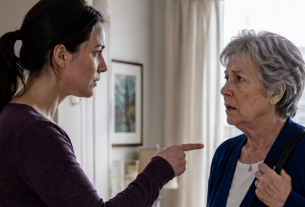
“Vera… I got hit on the road,” Gleb suddenly told his wife over the phone.
She had only just cleared the breakfast dishes from the table and was about to start preparing lunch. Gleb had asked her to make his favorite salad, but it turned out they were missing the main ingredient. He had to go to the store for some nuts.
Now, hearing her husband’s voice on the phone, Vera regretted sending him shopping. An image immediately flashed through her mind: a motorcycle or a car speeding toward her husband, leaving him barely alive, calling his wife with the last of his strength.
“My God, Gleb! Are you alive? Are you okay? Don’t hang up, I’m going to… I’m going to call an ambulance right now. Tell me where you are!” Trembling all over, she abandoned the vegetables she had prepared for the salad on the stove and rushed to the window.
As it turned out, her husband hadn’t gone far. Gleb was sitting on the edge of a flower bed, clutching his leg.
“Thank God, he’s alive,” flashed through Vera’s mind.
She ran out of the apartment and hurried toward him.
“Did you manage to remember the car’s license plate? How are you? Are you badly hurt? Where does it hurt?” she bombarded her pale husband with questions.
“What car? It hurts here. My whole leg…” he muttered.
“The one that hit you! If necessary, we can check the security cameras. Or was it a motorcycle?”
“No. I was run over by a scooter.”
Vera stared at her husband. She imagined some delivery courier with an enormous backpack, or perhaps a grown man speeding recklessly and crashing into him.
“Yes, they race around like crazy. I’ve seen it on television,” his wife said sympathetically. “He could have seriously injured you… So he knocked you down and drove away? He didn’t even ask if you needed help?”
“Where would he go? There.” Gleb nodded to the right.
Vera peered in that direction.
“I don’t see anyone. Where?”
“Are you blind, woman? There he is!” Gleb hissed through clenched teeth, pointing at a boy who looked about five years old. “I might have a fracture. Or a crack in the bone.”
Vera stared at the little scooter with its bell and then at the culprit behind the “accident.” The boy’s helmet had slipped sideways, and he stood there looking confused and frightened.
“Gleb, you were ‘hit’ by a child?!” Vera asked again.
“Not a child—a spawn of hell! He ran the wheel right over my bone! We need to go to the emergency clinic. Immediately!”
Hearing this, the boy burst into tears. His mother rushed over and began apologizing. Vera tried to calm the situation.
“It’s his first day riding a scooter. He’s still learning. He didn’t mean to do it. Please forgive us…”
“Gleb, he really didn’t do it on purpose…”
“You didn’t hear the crack! It could have been another child or an old lady!” Gleb snapped. “I might be disabled now, and they’re standing here apologizing while you’re taking the side of these useless parents. Wonderful!”
“I’m not taking their side! I’m always on your side! Come on, let’s go to the emergency clinic.”
“My husband could have driven you, but he’s away…” the boy’s mother lamented.
“I have a car, don’t worry,” Vera replied, taking Gleb by the arm and helping him stand.
“Why did you refuse?” Gleb grumbled. “They could have paid for a taxi! Or at least the gas!”
Vera silently changed her clothes, gathered all the necessary documents, drove her husband to the clinic, and handled everything at reception.
While waiting for the “verdict,” Gleb sat on a chair and gave an elderly woman he had never met a detailed account of how a scooter rider had crippled him.
“Oh yes, I know how reckless those people are!” the woman said. “They’re always showing scooter accidents on television!”
“And now I’ll probably have to walk around in a cast…”
“Sinitsyn? Your X-ray is ready,” a nurse called from the examination room. “Your leg is fine. Everything is normal.”
“Are you sure?!” Gleb stared at the nurse in surprise, then looked at his wife.
“Thank God nothing serious happened. Let’s go!” Vera breathed with relief.
Still, Gleb spent the entire evening limping dramatically around the apartment, complaining that not everything could be seen on an X-ray.
Vera eventually made the salad he had wanted, but somehow it did nothing to improve his mood.
The next day he said:
“We need to go talk to that boy’s parents. They should know what kind of person their son is growing up to be.”
“Gleb, maybe we shouldn’t? They already apologized…” Vera tried to object.
“That’s not enough! They should compensate us for raising such a reckless driver. How much did we spend on the X-ray yesterday?”
“Nothing. It was free…”
“What about gasoline? And how many nerve cells did we lose? No. I’m going. And you’re coming with me to support me!”
Vera took off her apron and shook her head. She didn’t dare let her husband go alone, so she went with him.
The boy’s mother met them in the hallway. Vera stood there with an awkward smile while Gleb forcefully lectured the woman about emotional damages and the possibility that he could have become disabled.
The woman’s face grew red, and the little boy hid behind her.
“All right, that’s enough. What exactly do you want?” the boy’s father finally demanded as he came out of another room.
Vera saw an enormous man nearly two meters tall and immediately realized that the balance of power was not in Gleb’s favor.
“Nothing. Gleb, let’s go. My husband only wanted to say that your son should be more careful,” Vera quickly explained.
“We understand. I hope that’s the end of it.”
The man slammed the door in front of Gleb and Vera.
“Why did you interfere?” Gleb asked Vera irritably. “I could have dealt with him myself.”
“And you would have walked out of there with a real fracture,” Vera thought, remembering the boy’s father.
Vera slept badly that night.
She dreamed about scooters, the nurse’s expression at the clinic, her husband’s dramatic sighs, and the way the boy’s father had stood up for his family.
She woke up in a cold sweat.
Fortunately, by morning everything had returned to normal.
Her husband went to work, while Vera began tutoring students. It was summer, and she was on vacation from her regular job.
“So? How was your day?” she asked her husband that evening while serving dinner. “Are you getting used to the new job?”
“You have no idea. It’s hell. They hate people there. The boss is a narcissist. My coworkers are always trying to set me up. I’m not working there—I’m surviving. I have to fight for every penny.”
“What happened?”
“I asked for an advance, and they told me I hadn’t earned it yet!”
“But you’ve already worked half a month,” Vera said, her eyes widening. Their family had been counting on that money.
“Exactly! They told me their rules say salaries are paid only once a month.”
“Well… we’ll have to tighten our belts,” Vera said. “I’ll take on more students. You just hang in there…”
“I did hang in there. But I quit. I can’t work with those rats,” Gleb announced.
“You quit? Well… okay…”
As always, Vera supported him. She nodded, told him, “You did the right thing,” and even offered to help him look for another vacancy.
The next day, however, her mother came to visit and asked:
“Vera, haven’t you ever considered that your husband simply doesn’t want to work?”
Vera immediately became defensive.
“Mom, how can you say that? He has a difficult personality. Besides, he’s sensitive. It’s just that people around him are cruel and greedy. Every boss promises one thing and then does another. It happens at every job!”
“Exactly, Vera! At every job. And around every corner. Maybe the problem isn’t everyone else. Maybe Gleb is just like that. He needs to start looking for the reasons in himself instead of blaming other people.”
“Mom! Let’s not talk about this. I don’t want to discuss him. He’s my husband.”
Her mother stopped talking, but the next day, while washing the dishes, Vera suddenly wondered: how many of those “terrible” workplaces had there already been?
Five?
Six?
And every single time, someone else had been to blame.
The saddest part was that her mother’s words made some sense.
The real turning point came on Saturday.
They were getting ready to visit Gleb’s mother, and Gleb went outside first to take out the trash.
His route passed by the ill-fated playground. Unfortunately—or perhaps fortunately—the same little boy happened to be playing there.
He had a small white dog with a bow around its neck. The boy was throwing a ball for the dog, while the little animal barked happily and raced around the courtyard.
During one of those throws, the ball rolled directly under Gleb’s feet.
Gleb froze.
His face twisted in anger.
“Gleb, are we going?” Vera asked. By then, she had also come outside.
“Going?! You’re just going to let this happen?!”
“Let what happen?” Vera asked, confused.
“They got my white trousers dirty!”
He bent down and kicked the ball away.
The dog assumed Gleb was playing and rushed toward him, barking excitedly.
“That dog is definitely rabid. Can’t you see how it’s growling at me? It’s about to attack me! Get that dog away from me! Immediately!” Gleb began shouting.
He stepped toward the dog as if to shove it away.
Vera hurried from the car and stood between them.
“Move, Vera. I’ll deal with this mutt…”
“Don’t touch it. It’s only barking. It’s tiny. It isn’t dangerous!”
The boy’s mother and the dog’s owner were already hurrying toward them, concern written across their faces.
“Are you ever going to train your offspring?” Gleb shouted—although the word he actually used was far less polite. His nostrils flared. “If you can’t control them, they belong in cages!”
“Mister, you’re the one who belongs in a cage! Stop shouting!”
“You…”
“Gleb, let’s go,” Vera tried again.
But he turned on his wife.
“What? Now you’re taking their side too? The side of these brainless little mutts?”
“Gleb!” Vera raised her voice.
“Ma’am, are you going to take him away? Or should I call my husband?” the boy’s mother asked.
Vera didn’t answer.
She had decided she was no longer going to participate in any of this.
She simply turned around and walked away.
And suddenly… Gleb stopped shouting, stunned by his wife’s behavior.
He quickly turned around and hurried after her.
They walked home in silence.
And Vera could feel something changing inside her.
Something strange and irreversible.
That evening, she remembered the way Gleb talked about his coworkers: “rotten.” About the neighbors: “idiots.” About shop assistants: “cheaters.” About his mother-in-law: “quarrelsome and biased.” About drivers: “morons.”
Everyone around him was terrible.
Everyone except Gleb himself.
And suddenly Vera realized that it was a pattern.
He was always right.
He was always at the center of some tragedy.
And he always expected her to stand beside him, hold his hand, defend him, pity him, and justify his behavior.
“Why did you leave?”
“Because that was your personal problem. I have nothing against dogs.”
“And what about the neighbors’ stupidity?”
“So far, there’s only one stupid neighbor I can think of.”
Gleb didn’t understand whom she meant.
And if he had understood, he probably would have been offended.
Her husband didn’t change.
He learned no lessons either.
But when Vera stopped pitying and supporting him, Gleb noticed.
At first, he was surprised.
Then he began reproaching her.
“You’ve changed. You don’t support me anymore. What happened to you?”
She didn’t make excuses.
Because the truth was that she had changed.
She no longer wanted to be his protective wall.
She didn’t want to fight the entire world over someone else’s hurt feelings, ambitions, and bad temper.
Vera wanted to be married.
But it seemed that all this time, she hadn’t been the one with a spouse who supported her.
Gleb never understood the reason for her behavior. He decided it was simply because she had become cold.
“Our family means nothing to you, Vera. I guess you’re just like everyone else… Materialistic and heartless.”
“Yes. Maybe I am,” she said, pointing toward the door.
Gleb left.
He went to someone who “understood him and felt sorry for him.”
Another woman became his “support and hope.”
Coincidentally, her name was Nadya—short for Nadezhda, which means “Hope.”
Vera learned about it later.
But she didn’t regret anything.
She didn’t even regret the ten years of marriage.
“Well, well… First Vera, now Nadezhda,” her mother muttered when her daughter told her the news about her former son-in-law. “What’s next?”
“No, Mom. Not Lyubov.”
The name Lyubov means “Love.”
“He’s always had love in his life. Only it was love for himself, not for anyone else.”
They looked at each other and laughed.
Strangely enough, after her husband left, Vera found life easier.
It was as though a heavy weight that had been dragging her to the bottom had finally fallen away.
“Good riddance,” she said, looking at photographs of her former husband on social media.
Apparently, he was planning to get married again.
Let him.
Vera would find her own happiness.
Just not with him.