Alyona was tightening the last screw on the joint when her phone vibrated on the workbench. The veterinary orthopedics workshop hummed steadily with the sound of machinery, and she hated being interrupted in the middle of an assembly. The prosthetic leg for a German shepherd named Bublik was almost finished; all that remained was to adjust the support angle. She wiped her hands on her apron and picked up the phone.
“Yes, Ruslan.”
“Listen, my mother’s coming over tonight. She said she wants to talk.”
“What kind of talk?” Alyona pushed the lamp aside. “Eva’s had a fever for three days. I don’t have time for talks.”
“How should I know? She sounded… like she was asking for a favor.”
“That’s exactly what I don’t like,” Alyona said. “Your mother never asks for anything just because. She asks with interest attached.”
“Here we go,” Ruslan sighed. “Could you at least hear someone out once before passing sentence?”
“I’ll hear her out. Then I’ll pass sentence.”
She hung up and stared at the prosthesis, but her hands were already working more harshly than necessary. The screw went in crooked, and she had to take it back out. Alyona hated that feeling—when the day wasn’t even over yet, but someone had already managed to ruin it in advance.
That evening, Galina Andreyevna arrived at exactly seven, as punctual as the tram depot where she had worked as a dispatcher for twenty-eight years. She took off her coat, hung it carefully, straightened the collar, sat in an armchair, and folded her hands on her knees as though she had come to sign an important document.
“Is Eva asleep?” she asked.
“Asleep. Finally,” Alyona replied. “Her temperature was 38.2 this morning.”
“You need to toughen a child up.”
“Galina Andreyevna, did you come here on business or to lecture me about parenting?”
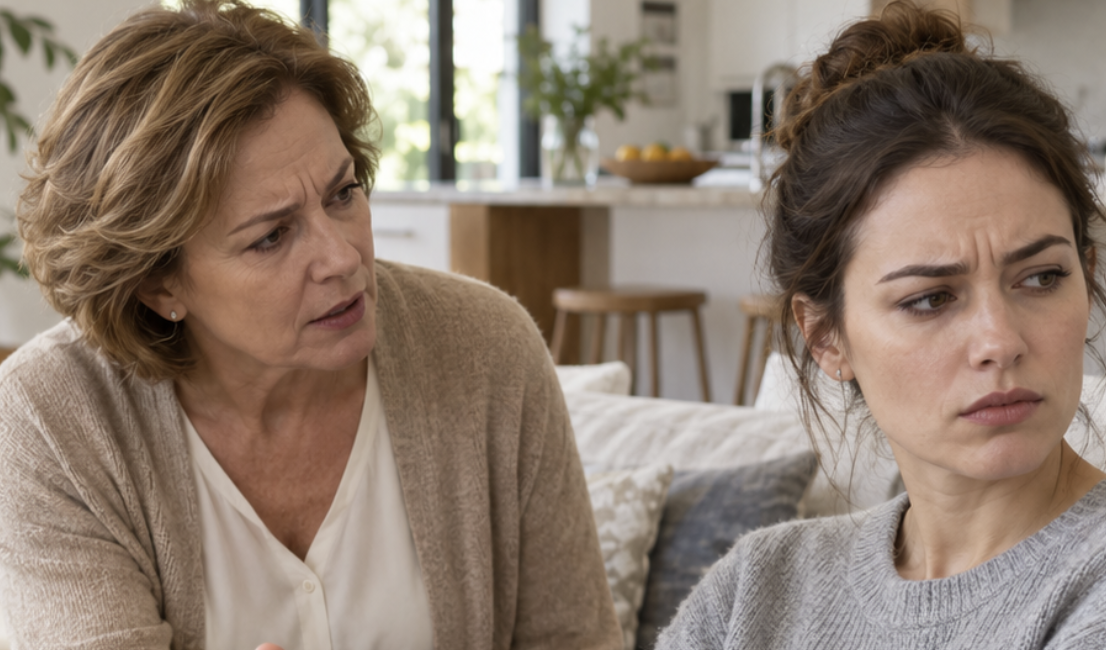
Her mother-in-law pursed her lips and looked at her son. Ruslan sat on the edge of the sofa as though he were a guest in his own home, turning the remote control over in his fingers.
“Zinaida Markovna is in trouble,” his mother began. “You remember Zinaida from the dacha? The one whose currants are as big as grapes?”
“I remember the currants. I don’t remember the trouble.”
“She has a daughter, Oksana. Her husband left her, walked out, doesn’t give her a single ruble. She’s been left alone with a little girl, the same age as our Eva. They keep renting rooms here and there, and every six months the landlords throw them out.”
“I’m sorry to hear that,” Alyona said. “But I’m not a charity fund or the social services department.”
“Let me finish!” her mother-in-law raised her voice. “They won’t take the girl into kindergarten. No registration means no place in the queue. No place in the queue means no kindergarten. Oksana can’t go back to work because there’s nobody to look after the child.”
“And?”
“So she needs to be registered here. For a month. Just formally. It’s only a piece of paper.”
Alyona slowly lowered herself onto the chair opposite her. Everything inside her tightened into one hard knot, and she already knew that before the evening was over she was going to have an argument with everyone in the apartment.
“Register her. In my apartment. A strange woman and her child.”
“She’s not a stranger! She’s my friend’s daughter.”
“Your friend,” Alyona enunciated. “Not mine. I saw this Oksana once at the dacha, and she told me my coat was tasteless.”
“Good Lord, how petty can you be?” her mother-in-law threw up her hands. “A person is drowning, and you’re talking about a coat.”
“She isn’t drowning. She wants to establish herself in somebody else’s apartment.”
Ruslan finally put the remote aside.
“Alyona, you really are going too far. Registration doesn’t give someone ownership rights. It’s just registration.”
“Oh, just registration,” she said with a smirk. “Wonderful. Then explain to me why this simple registration can’t be done at Galina Andreyevna’s place. You have a two-room apartment too, by the way. And you live alone.”
Her mother-in-law adjusted the neckline of her blouse, then the bracelet on her wrist, then her collar again.
“It can’t be done at my place,” she finally said.
“Why?”
“My apartment… it was arranged under a social tenancy agreement once, and I wouldn’t even be able to find the documents now. Besides, my bathroom and toilet are combined.”
“What does the bathroom have to do with anything?” Alyona leaned forward. “Do they inspect whether your bathroom is combined before allowing registration?”
“You’re making fun of an elderly woman.”
“I’m asking a question. For the second time. Why can’t it be done at your place?”
“Because my district police officer is nasty!” her mother-in-law blurted out. “He goes around checking who lives where. I don’t need scandals.”
“So I do, apparently. And what does the district officer have to do with this?”
“You’re a young family. Things are easier for you. You’re not afraid of anything.”
“We’re not afraid because we’re idiots,” Alyona said. “Is that what you mean?”
Ruslan grimaced, stood up, walked to the wall and back.
“Why do you have to talk to her like that?”
“How should I talk?” Alyona stood up too. “She came here and immediately started talking about the apartment which, by the way, I bought before we got married. With money from selling my grandmother’s room and a loan that I spent five years paying off with my own hands while making animal prosthetics at night.”
“There it is!” her mother-in-law pressed a hand to her chest. “There’s the truth! ‘My apartment.’ You should say that to Ruslan more often. He loves hearing it.”
“I’m saying it in response to a request to register outsiders in it. And I’ll say it as many times as necessary.”
“A couple of months, Alyona. A couple. Of. Months.”
“You said one month.”
“One month, a month and a half, what difference does it make?” her mother-in-law waved dismissively. “You count days like a loan shark.”
“I’m counting because you’ve already changed the time frame in the second minute of this conversation,” Alyona said. “That says a lot.”
Galina Andreyevna got to her feet, pulled down her blouse, and grabbed her coat as though she were being chased out of a burning building.
“I understand everything. I won’t bother you anymore. Live your lives.”
“Oh, where are you going?” Ruslan said weakly.
“I’m leaving. My place in this family has been made perfectly clear.”
The door closed. Ruslan stood in the hallway for a moment, then returned and looked down at his wife.
“You could have just said, ‘I’ll think about it.’”
“I don’t think about things I’ve already decided.”
“She’s offended.”
“She came here intending to be offended. It was item number three on her agenda,” Alyona gathered the cups from the table. “Right between ‘combined bathroom’ and ‘nasty district police officer.’”
“Stop it.”
“I won’t,” she said. “And get this into your head: no outsiders will ever be registered in my apartment. Ever.”
Eva’s weak voice came from the children’s room. Alyona went to her, anger sloshing inside her like water in an overfilled bucket.
A day later, her mother-in-law appeared again—with a cake in a box tied with a gold ribbon, a bouquet of spray roses, and an enormous pink rabbit wrapped in cellophane. Eva squealed with delight and dragged the toy into her room. Alyona looked at it all and understood: the offensive had begun according to every rule in the book.
“The cake is from that bakery on Zarechnaya Street,” Galina Andreyevna said sweetly. “You like those.”
“I don’t. Ruslan does.”
“Then I mixed it up. I’m getting old,” her mother-in-law sat down and spread out a napkin. “Alyonochka, forgive me for yesterday. I got carried away.”
“It happens.”
“You’re such a clever girl. Ruslan doesn’t understand what a treasure he got. Such a homemaker, such a craftswoman, golden hands. Who else could make a dog a leg so it can run again?”
“Galina Andreyevna, get to the point. I have an urgent order.”
Her mother-in-law fell silent, then put on an expression that suggested she was suffering on behalf of all mankind.
“Oksana cried half the night yesterday. Zinaida called me; her heart was acting up.”
“Did she call an ambulance?”
“What?”
“If her heart was acting up, she should call an ambulance,” Alyona said. “If she didn’t, then apparently it was only acting up moderately.”
“You’re so hard,” her mother-in-law shook her head. “So young, and you already have a stone inside you.”
“What I have inside me is a sense of self-preservation. Very useful thing.”
“A child!” her mother-in-law slapped her palm against the table. “A child has no kindergarten, do you understand? A girl the same age as your Eva. Yours goes to her group and sings songs while that little girl sits in somebody else’s rented room staring at the ceiling. Aren’t you ashamed?”
“No, I’m not ashamed,” Alyona replied. “Shame is for when I’ve done something wrong. I haven’t harmed anyone.”
“You’re harming her right now. By refusing.”
“No. I’m simply refusing to give a stranger a legal address in my apartment.”
“Legal address,” her mother-in-law mocked. “Listen to the fancy words you’ve learned. Can’t you just behave like a human being?”
“Like a human being? Fine. Let her own mother register her. Zinaida Markovna has a house in Olkhovka. I heard you talking about it myself. They rebuilt the stove there the year before last.”
Her mother-in-law blinked. The silence that followed was long and uncomfortable, like wearing somebody else’s coat.
“The house is far away.”
“Forty kilometers. Not Kamchatka.”
“The kindergarten there is bad.”
“There is a kindergarten?”
“There is, but it’s bad,” her mother-in-law snapped. “The groups are small.”
“Wonderful. Small groups are an advantage, not a disadvantage,” Alyona laced her fingers together. “You’re contradicting yourself roughly every ten seconds right now, and you think I don’t notice.”
“I hear that you’re greedy,” her mother-in-law said quietly. “That’s what I hear. You can’t even spare a piece of paper. One line in a database.”
“What I can’t spare is six months of my life fighting this in court later.”
“Who is going to sue you? Oksana is a quiet girl.”
“The quiet ones sue for the longest.”
The lock clicked in the hallway and Ruslan entered. He immediately assessed the situation: roses in a vase, cake on the table, two women sitting opposite each other like boxers waiting for the bell.
“Oh. Are we celebrating something?”
“We’re having a sequel,” Alyona said.
Her mother-in-law immediately turned to her son and began speaking rapidly, pitifully, with little catches in her breath. About Zinaida, about her bad heart, about poor Oksana, about the little girl who didn’t even know what a kindergarten performance was. Ruslan listened, nodded, then looked at his wife.
“Listen, it’s only a month.”
“Are you serious?”
“Completely. What’s so terrible about it? We register her, she unregisters a month later, everyone is happy.”
“And if she doesn’t?”
“She will.”
“And if she doesn’t?” Alyona stood up. “Tell me as an engineer. You work with 3D printing, you make calculations. What do you do if a part comes out defective? Do you have a Plan B?”
“That’s different.”
“It’s exactly the same,” she said. “Only instead of a part, it’s our apartment and our daughter.”
“You’re paranoid,” Ruslan said irritably. “Seriously. Everything is a conspiracy to you. Someone needs help, and instead of helping, you sit there calculating possibilities like you work in a pawnshop.”
“Speaking of pawnshops,” Alyona turned to her mother-in-law. “Where does Oksana work?”
“As an appraiser. At a secondhand shop,” she answered reluctantly.
“Wonderful,” Alyona nodded briefly. “An appraiser. Professionally determines how much other people’s things are worth and how quickly they can be sold.”
“What does that have to do with anything?” her mother-in-law exploded. “Now you’re smearing dirt all over someone!”
“I’m stating a fact.”
“Alyona, enough!” Ruslan raised his voice. “You’re selfish. You really are selfish. I’ve never said it to you before, but I’m saying it now. It’s easier for you to refuse than to put yourself out even once.”
She looked at him for a long moment. There was no confidence in his eyes—the confidence of a man doing a good deed at someone else’s expense.
“Fine,” Alyona said. “Let it be that way. But on one condition: temporary registration. With a specific expiration date. Written in the application, black on white.”
“Of course!” her mother-in-law exclaimed happily. “Of course, Alyonochka! One month, two at most!”
“And one more thing. If she doesn’t unregister on time, I go to court. No discussions, no ‘let’s wait a little longer.’”
“It won’t come to that,” Ruslan waved her off.
“I didn’t ask whether it would. I’m warning you.”
Her mother-in-law began smiling and reached for the knife to cut the cake, but Alyona had already gone into her workshop and turned the machine up to full power. Its roar was the only sound she wanted to hear right then.
The multifunctional government services center was hot and cramped, and ticket numbers crawled out of the machine with an unpleasant beep. Oksana arrived carrying her daughter Milana—a fair-haired, neat-looking woman in a cream-colored coat. She smiled at everyone, including the security guard.
“Alyonochka, thank you so much,” she said as soon as she arrived. “You’re our angel.”
“I’m not an angel. I’m the property owner.”
“Oh, why put it like that?” Oksana set her daughter down. “Milana, say hello to the nice lady.”
The girl hid behind her mother’s leg. Eva, sitting in Ruslan’s arms, watched her solemnly like a customs officer.
The queue moved slowly. Her mother-in-law sat next to Oksana and spent the whole time stroking her hand and murmuring something about kindness always coming back to you. Alyona stood against the wall counting the minutes.
They were called to window five. The employee took their passports, tapped at the keyboard, and turned the monitor toward them.
“All right. Application for registration at the place of residence. Permanent registration. Two people: one adult and one minor.”
Alyona stepped forward so abruptly that Eva flinched.
“Stop. What do you mean permanent? We agreed on temporary registration.”
“The application I have says permanent,” the employee replied calmly. “Was it filled out beforehand?”
“Yes, it was filled out beforehand,” Oksana interrupted. “The kindergarten told me temporary registration wouldn’t get us a place. They require permanent registration.”
“Who told you?”
“The director.”
“What’s the director’s surname?”
“Alyona, why are you interrogating me?” Oksana frowned. “I don’t memorize everyone’s surnames.”
“Miss, you need to decide,” the employee said. “There are people waiting behind you.”
“Alyonochka, it’s a formality,” her mother-in-law moved close to her. “The word ‘permanent’ is just the name of the field. She can unregister any day.”
“The name of the field,” Alyona repeated. “Galina Andreyevna, do you even understand what you’re saying?”
“I understand that we’ve been standing here for an hour making fools of ourselves in front of the whole room!”
“The people who replaced the documents are the ones making fools of themselves.”
“Nobody replaced anything!” Oksana flared up. “I swear to you: the very day we get a kindergarten place, I’ll unregister. I’ll even write you a signed statement.”
“Write it.”
“What?”
“A statement. Right now.” Alyona pulled a notebook and pen from her bag. “Date, commitment, signature.”
Oksana looked uncertainly at her mother-in-law. Ruslan cleared his throat.
“Alyona, enough of this circus.”
“This isn’t a circus. It’s a document.”
“The statement wouldn’t have any legal force anyway,” the employee behind the glass said. “Removal from registration can only be done by application or by court order.”
“See!” her mother-in-law said happily. “Even this woman says you don’t need any paperwork.”
“She said the opposite,” Alyona replied. “She said that without Oksana’s consent, I can only remove her through court. You heard what you wanted to hear.”
Milana began whining. Oksana picked her up and rocked her, and her face became simultaneously beautiful and full of suffering—a practiced expression.
“The child is tired. We’ve been on our feet since seven in the morning.”
“Alyona, sign it,” Ruslan said quietly. “People are looking.”
“Let them.”
“Sign it. I said so.”
She turned toward him. He was standing there holding their daughter, and his eyes held the irritation of a man who had simply grown tired of standing in line.
“Don’t you dare say later that I didn’t warn you.”
“I won’t.”
Alyona took the pen. Her signature came out crooked, almost unfamiliar. The employee stamped the papers, handed over the receipt, and gave them the date when the documents would be ready.
Outside, her mother-in-law was beaming.
“There. See? What would it have cost you to do that from the beginning? Half an hour.”
“Thirty-five minutes,” Alyona said. “I timed it.”
“You’re terrible,” her mother-in-law laughed and wagged a finger at her. “Terrible, but I love you.”
Oksana came over and tried to hug her. Alyona stepped back.
“Don’t.”
“As you wish,” Oksana smiled. “Thank you anyway. You have no idea what you’ve done for us.”
“I’m beginning to,” Alyona replied.
The month passed quickly, the way all bad things do before the reckoning comes. Alyona had marked the date on the calendar, and on the very first day after it passed she dialed Oksana’s number. Oksana answered immediately.
“Oksana, hello. This is Alyona. The month is over. When are we going to apply to remove your registration?”
“Oh,” Oksana drawled. “We have a situation. There’s no kindergarten place.”
“What do you mean there’s no place?”
“There’s a waiting list. They said maybe by autumn. Maybe by winter. You know how these things work.”
“No, I don’t. My daughter got into her group through the normal waiting list, without any tricks.”
“You were lucky,” Oksana said coldly.
“So what happens now?”
“I stay registered until the issue is resolved.”
Alyona gripped the phone so hard that the plastic creaked.
“We agreed on one month.”
“We agreed I’d unregister when we got a place. And I will.”
“You said the same day.”
“I said a lot of things,” steel entered Oksana’s voice. “Listen, don’t get hysterical. I’m not bothering you. I don’t live in your apartment, you have meters installed. Why are you getting so worked up?”
“You’re permanently registered in my apartment. That isn’t just a line in a database. It gives you the right to use the property.”
“Don’t start lecturing me about rights,” Oksana scoffed. “I understand this better than you do. I happen to know a lawyer.”
“Wonderful. Then you’ll understand the lawsuit when you receive it.”
“A lawsuit?” Oksana actually laughed. “Are you serious? I have a minor child registered there. Do you know how courts treat children? Nobody is going to throw me out before winter. And if you start getting on my nerves, I’ll report you to child protection for preventing a child from getting a kindergarten place. Let them come and see how you live.”
“What exactly are you going to tell them?”
“You heard me,” Oksana snapped. “And by the way, you’ve got that cabinet in your hallway with tools in it. Sharp metal things. Child protection loves that kind of thing.”
Alyona lowered the phone and stared at the wall for several seconds. Then she called her mother-in-law.
“Galina Andreyevna. Your protégé refuses to unregister.”
“So what?” she replied calmly. “I told you it might take longer.”
“You said one month. Two at most.”
“Alyona, don’t be petty. The child still doesn’t have a kindergarten place.”
“She’s threatening me with child protection.”
“Well, you probably drove her to it,” her mother-in-law sighed. “You could drive anyone crazy. You don’t know how to talk to people like a normal human being. Everything has to be itemized.”
“You’re taking her side? Against me?”
“I’m on the side of truth.”
“The truth is that I was deceived right in front of you,” Alyona said. “With your approval. You were standing there telling me it was ‘just a formality.’”
“Listen,” her mother-in-law’s voice became dry and sharp. “You inherited an apartment from your grandmother, you sit in it like an owl guarding its nest, shaking over every square centimeter. People help each other. All you do is calculate. Heartless and greedy—that’s what you are.”
“Remember those words,” Alyona said. “One day I’ll return them to you. With interest.”
That evening, she placed a printout in front of Ruslan—the registration extract, her correspondence with Oksana, calculations of the additional utility charges. He read everything in silence, twice running a hand over the back of his head.
“She really said that? About child protection?”
“Word for word. And about the tool cabinet.”
“That’s vile.”
“That’s strategy,” Alyona sat opposite him. “Now let’s calculate. Two registered people means garbage collection fees, maintenance fees, everything charged according to the number of registered residents. At least twelve thousand rubles a year out of our pocket.”
“Forget the money.”
“No, not forget it. But that isn’t the main thing,” she agreed. “The main thing is that she has the right to move in. She can show up with her belongings, with her husband, with whoever she likes, and I won’t be able to refuse her entry. The police will say she’s registered, so she has the right.”
Ruslan pushed the papers away.
“I’ll talk to her.”
“Talk to her. But first tell me one thing.”
“What?”
“Which one of us is paranoid?”
He didn’t answer. He stood up, paced around, took his phone and went into the hallway. The conversation lasted four minutes. He returned looking like a man who had just been politely and expertly put in his place.
“Well?”
“She said she’ll only speak to the owner. And if I call her again, she’ll document it as harassment.”
“Document it,” Alyona repeated. “Good word. Straight out of our paranoid vocabulary.”
The lawyer, Artyom Vadimovich, received clients in a cramped office on the second floor above a bakery. He listened to the story and interrupted only once to ask again about the date of the application. Then he leaned back in his chair.
“The situation is ugly, but not hopeless. You’re the owner, and you acquired the apartment before marriage. She isn’t your relative, she isn’t a member of your family, you don’t run a joint household, and she never actually moved into the apartment.”
“She didn’t,” Alyona confirmed.
“That helps. Registration without actual residence is merely formal. That’s what we’ll emphasize.”
“And the child?”
“The child follows the mother. If we remove the mother, the daughter is removed as well. But the court will look at whether they have somewhere else to live. That’s where we need facts.”
“Her mother owns a house in Olkhovka. They rebuilt the stove, and the place has gas.”
“Excellent,” the lawyer wrote it down. “Property register extract, a certificate from the local administration confirming the house is habitable, and preferably information about the kindergarten in the village. If places are available, that’s a strong card.”
“She’s going to complain to child protection.”
“Let her,” he smirked. “They’ll come, see your daughter, see the group she attends, and leave. What do you do for a living, by the way?”
“I make prosthetics for animals. The workshop is right here in the apartment, in a separate room, fully equipped.”
“Are the tools locked up?”
“They are.”
“Then photograph the lock. A small detail, but it could be useful.”
They filed the lawsuit on Wednesday. On Thursday, Galina Andreyevna arrived—without cake, without roses, without the rabbit. She walked in without saying hello and stopped in the middle of the room.
“You filed a lawsuit.”
“I did.”
“Against a girl with a child.”
“Against a woman who deceived me.”
“You’re disgracing our family,” her mother-in-law spoke slowly. “Zinaida looked me in the eye and said, ‘Your daughter-in-law is a rat.’ I can’t even look her in the face anymore. I’ve lived on the same street as that woman for thirty years. Our dacha plots are next to each other.”
“Move to a different plot.”
“You—!” her mother-in-law gasped. “Ruslan! Ruslan, come here. Listen to me carefully. Choose: either her with her lawsuits, or me. I’m your own blood. She’s just some woman with a piece of paper saying she owns an apartment.”
Ruslan stood in the doorway. He was pale and very calm. Alyona knew that state well: it was how he looked when an entire production batch was coming out defective and he had one minute to make a decision.
“I’m on my wife’s side.”
His mother blinked.
“What?”
“I’m on my wife’s side,” he repeated louder. “And on my daughter’s side. I was the one who brought Oksana into our apartment, so I’m the one who’ll fix it. You asked me to do this. You told me ‘one month.’ You set me up.”
“I set you up? I gave birth to you!”
“You did. Thank you,” he didn’t look away. “And you raised me in such a way that for thirty-four years I haven’t been able to say no to you. I’m learning now.”
“So that’s how it is,” his mother grabbed her coat. “I don’t have a son anymore. And I don’t have a granddaughter.”
“You do have a granddaughter,” Alyona said. “She’s in her room playing. If you want, go say goodbye. Just explain to her why you decided to erase her from your life.”
Her mother-in-law yanked the door open and left. For a long time there were no footsteps on the stairs—she was standing outside, waiting for someone to run after her.
Nobody did.
The hearing was scheduled three months later. The courtroom was small, and the judge was a stern-looking woman with an even voice. Oksana appeared in the same cream-colored coat, carrying a folder of documents and wearing an expression of gentle suffering.
“Your Honor, my daughter and I have nowhere else to go,” she said. “I’m alone, my husband left me, I have no help. The plaintiff is asking to deprive a child of her only registration. That is contrary to the interests of a minor.”
“Did you live at the address where you were registered?” the judge asked.
“I… visited from time to time.”
“Did you stay overnight?”
“I stopped by.”
“Do you keep any belongings there?”
“No.”
“Do you have keys?”
A pause.
“No.”
Artyom Vadimovich stood.
“Your Honor, the defendant never moved into the property. The registration was purely formal, as is confirmed by her own testimony. At the same time, the defendant’s mother, Zinaida Markovna, owns a residential house in the village of Olkhovka that is suitable for year-round habitation. The house has gas and running water. A certificate from the local administration has been submitted.”
“That’s my mother’s house, not mine!” Oksana exclaimed.
“You’re her daughter,” the lawyer said calmly. “And you can register there with the owner’s consent. Furthermore, Olkhovka has an operating kindergarten with available places. The relevant certificate has also been submitted. I would also like to point out that during the past eleven months the defendant made no attempt whatsoever to join a waiting list anywhere else.”
“That’s not true!”
“Your Honor, the defendant has presented no documents proving otherwise.”
The representative from child protection, a young man, spoke briefly: the child’s rights were not being violated; the mother had the option of registering her daughter at the grandmother’s place of residence; the conditions there were suitable; an inspection had been carried out and the report was attached.
Oksana turned toward the courtroom. Galina Andreyevna was sitting upright in the third row, lips pressed together.
“Galina Andreyevna! Tell them! You were the one who asked me! You were the one who said—”
The judge tapped her pen.
“Sit down.”
The decision was read forty minutes later.
The claim was granted. Oksana was declared not to have acquired the right to use the residential property. Both mother and daughter were to be removed from the registration record.
In the corridor, Oksana walked quickly, her heels clicking, speaking into her phone as she went.
“It’s fine. There are other options.”
At the exit, her mother-in-law caught up with her.
“Oksanochka, wait, I…”
“Leave me alone,” Oksana threw over her shoulder. “You promised me everything and delivered nothing.”
Galina Andreyevna spun around and headed toward Alyona like a tram with no brakes.
“Happy now? You disgraced me. In front of the whole street, the whole dacha community. Zinaida doesn’t even speak to me anymore. Because of you. Because of your greed!”
“Because of your lies,” Alyona replied. “You gave someone else your word using my apartment. Not me.”
“I don’t want to see either of you ever again,” her mother-in-law grabbed her handbag. “Not you, not my son. You’re both dead to me.”
She left. Ruslan watched her go and said nothing the entire way to the car.
A month later, Alyona received the certificate confirming the removal from registration. A thin sheet of paper, two lines, a stamp.
She put it into her desk drawer, closed it, and realized she felt no joy—only a dry sense of satisfaction, like finally paying off a debt.
Something had stood between her and Ruslan ever since, something they didn’t talk about. He no longer argued with her, but he didn’t joke the way he used to either. She stopped telling him about her work orders. Making the right decisions can change people too—and not always for the better.
Then her mother-in-law’s neighbor called.
Galina Andreyevna had registered Oksana at her own apartment.
Temporarily.
For six months.
Out of principle—to prove that she was “a human being, not a rat.”
“She’s insane,” Ruslan said after hanging up. “Absolutely insane.”
“She’s proud,” Alyona corrected him. “That costs more.”
Eleven days later, Oksana arrived at Galina Andreyevna’s apartment with two suitcases, her daughter, and a man—the very husband who had supposedly abandoned her forever.
He was a sturdy man wearing a cap and carrying a toolbox, and the first thing he did was start measuring the hallway with a tape measure.
“Where do you think you’re going?” her mother-in-law screamed. “Where?!”
“Home,” Oksana replied. “I’m registered here. Forgotten?”
“He isn’t registered!”
“He’s my husband. He came to visit me. For a long time.”
Galina Andreyevna pushed them out onto the landing, slammed the door, and called a locksmith that very evening. The lock was replaced with a new one with three bolts.
The next morning, Oksana stood outside the door loudly announcing—loud enough for the entire building to hear—that an elderly woman was illegally preventing her from accessing her residence and that she was going to file a police report.
Her mother-in-law called her son at seven in the morning.
“Ruslan. Help me. They’re on the landing. They say I have to let them in.”
“Legally, you do,” he replied. “She’s registered there.”
“Then do something!”
“What am I supposed to do? It was your decision. You registered her yourself. File a lawsuit to evict her.”
“A lawsuit?” his mother gasped. “You’re telling me to go to court? After everything?”
“Precisely after everything,” Ruslan said. “Want a lawyer’s number? He’s good. Proven. We’ve already been through this with him. Though back then I was called selfish and my wife was called a rat.”
“You’re cruel.”
“I’m trained,” he replied and hung up.
Alyona had been listening from the doorway of her workshop, a prosthetic joint in her hand. Eva was sitting on the floor playing with the pink rabbit—the only thing that remained from the whole story.
“Are you going over there?” she asked.
“No,” Ruslan shook his head. “Let her deal with it herself. Otherwise she’ll never understand.”
“I feel like I should be happy,” Alyona said. “But for some reason I’m angry.”
“Me too.”
The scandal outside her mother-in-law’s door was now in its third day.
The neighbors had called the district police officer twice. Oksana and her husband had placed a folding chair on the landing and announced that they would sit there until they were allowed inside.
Galina Andreyevna opened the door to no one.