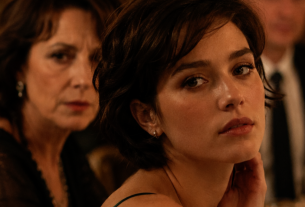
Serhiy didn’t recognize her right away. First, he heard the laughter—clear and ringing, with that slightly hoarse tone at the end, finished with the same funny little ‘oh’ that Viktoriya always used when she laughed until she cried.
He was walking through the park with a grocery bag from the market, carrying vareniki and kefir. It was mid-October, chestnut leaves rustled under his feet, and the air near the fountain kiosk smelled of roasted corn. And amid it all—that unmistakable laughter. Serhiy looked up.
She was strolling down the avenue wearing a terracotta scarf—he’d never seen her in such a bright color before. Her hair was cut short, her light jacket hung open. On her arm was a tall, gray-haired man in a pale trench coat. He gestured as he talked, keeping pace as they walked, and Viktoriya threw her head back in laughter. She hadn’t laughed like that in… Serhiy couldn’t even remember the last time.
He stepped behind the newspaper kiosk. Sixty-one years old, hair gray, with a granddaughter in second grade—and yet there he was, acting like a teenager sneaking a look at a classmate. He watched them walk away until her scarf disappeared around the corner.
The bag of vareniki tugged at his hand. Nobody was waiting for him at home. That had been his choice a year ago.
* * *
It all started with retirement. For thirty-eight years, Serhiy woke up at 5:40, took the first bus to the plant, and ran the workshop—he was sure not a single bolt turned there without him. Then came the farewell, a cake from the team, a wristwatch with an inscription—and suddenly, the mornings became very long.
He wandered through the apartment and started to notice things he’d never seen before. How Viktoriya added dill to everything—borsch, potatoes, even scrambled eggs. How she watched the same cooking show every night, where women baked multi-layered cakes, even though she hadn’t baked anything more complex than apple pie in ten years. How she talked on the phone with her sister so loudly that the whole building knew the price of potatoes at the market and which relatives forgot to wish someone a happy birthday.
“Vika, why so much dill?” he asked, pushing his plate away. “This isn’t soup—it’s a vegetable patch.”
“You ate it for thirty-six years and always praised it.”
“I was silent, not praising it. There’s a difference.”
She’d shrug and take away his plate without arguing. Sometimes, Serhiy thought it would be better if she actually got angry—at least then there’d be something for him to grab onto.
That evening, she was wiping down the kitchen table. The clock above the fridge—which was seven minutes slow and that no one had bothered to fix all these years—read half past eight.
“Vika, sit down. We need to talk.”
She sat, resting the rag on her knees.
“We’ve been strangers for a long time,” Serhiy said. He’d rehearsed those words for days, and now he said them steadily, almost businesslike. “You know it too. We live like neighbors. I want to live on my own. I need freedom.”
“Freedom from what, Serhiy?”
“From all of this.”
He waved his hand—at the curtains, the TV, the clock. At her.
Viktoriya looked at her husband for a long time. So long that he was the first to break eye contact. Then she got up, went to the bedroom, opened the closet, and took down two suitcases from the top shelf. The same blue ones they had bought years ago for a seaside trip that never happened—sometimes Serhiy had too much work at the plant, sometimes their daughter had exams, sometimes the apartment needed fixing. One of the bags still had the store tag attached.
She placed her suitcases in the middle of the room.
«If that’s your decision, I won’t hold you back.»
He expected tears. He thought she would scream, call the kids, grab his sleeve. But instead, she just went to finish washing the dishes. That silence hit him harder than any argument ever could.
* * *
Serhiy rented a one-room apartment on the other side of the city—fifth floor, balcony overlooking poplar trees. The landlady, a lively woman about seventy, handed over the keys, pointed out the meters, and reminded him that rent was due by the fifth of each month because she was, in her words, «a punctual person.»
The first months, he was almost happy. No one asked where he’d been or why he was late. No one requested he take out the trash, fix a shelf, or go fetch potatoes. He fished at the pond until dawn, blasted football matches at full volume, and had dumplings straight from the pot for dinner. Freedom tasted like store-bought dumplings, and for the first few weeks, he actually enjoyed it.
Then the washing machine in his rented apartment blinked an unfamiliar symbol and dyed three of his white shirts pink. December came, and the evenings grew so long he caught himself retelling the news out loud to the empty kitchen. The kids spent New Year’s with their mom. His daughter Maryana visited him on January second—she brought cabbage rolls in a container and a net bag of tangerines. She stayed for an hour, checking her watch, and then left.
He didn’t dare call Viktoriya. Pride is a stubborn thing—especially for a man who left home on his own terms.
* * *
For the first few weeks, Viktoriya cried at night. Quietly, so the neighbors couldn’t hear through the walls. By day, she kept it together: went to the market, cooked borscht—and every time, she found herself reaching for dill, then pausing with the bunch in her hand. Who needs it now?
Maryana called her every evening. Her son Andriy came over one Saturday, replaced the kitchen faucet, and as he wiped his hands, said:
«Mom, just don’t sit around these four walls. Dad made his choice. Now it’s your turn.»
She nodded but kept sitting. That is, until she ran into Nataliya at the bus stop.
They’d sat at the same desk from fifth to tenth grade, passed notes on blotting paper, then life took them to different neighborhoods, jobs, and families. Nataliya recognized Viktoriya first and hugged her right there at the bus stop—so tightly both of them dropped their bags.
«Vikusya! Why do you look so pale? What happened?»
Viktoriya told her. Briefly, dryly, eyes on the bus that was arriving. Nataliya listened and then decisively took her arm.
«Here’s the deal. This Thursday at six, there’s a dance class for those over fifty at the community center. I’ve been going for two years.»
«Nata, dancing? I’m fifty-eight.»
«And I’m fifty-nine, and I almost know how to tango. Hanna, our instructor, can turn anyone into a dancer. Even me.»
At the first lesson, Viktoriya stood by the wall for half an hour. At the second, she managed a few waltz steps and stepped on her partner’s foot. At the third, she laughed for the first time when the whole group got tangled up in a «square» and Hanna clapped her hands: «You’re just like first graders on their first day!»
In the spring, she went to the beauty salon and asked for a short haircut—the same style Serhiy once called «boyish,» which made her wear a ponytail for twenty years. She bought a terracotta scarf because the saleswoman told her it suited her. For the first time in a long while, Viktoria believed it might be true.
In July, Nataliya and her husband Petro convinced her to join them at the sea. It was just a regular bus tour, a guesthouse 200 meters from the beach, and a room with a fan that squeaked on the third speed. Viktoria woke up at seven and was the first to enter the water, while the beach was still empty.
She hadn’t seen the sea in twenty-two years. She brought back a flat pebble with a hole in it and hung it on a string in her kitchen window. When the sun shone through it, a small spot of light appeared on the windowsill.
* * *
The day after the park, Serhiy stood in a flower shop for twenty minutes. The saleswoman asked three times how she could help, and three times he answered, «I’m still thinking.» He tried to remember which flowers Viktoria liked—and he couldn’t. Thirty-six years. He bought white chrysanthemums because they were the largest.
She opened the door, wearing a soft gray sweater. The scent of apples and cinnamon drifted in from the kitchen.
«Serhiy?» She looked at the flowers, then at him. She paused. «Come in. The kettle just came to a boil.»
The kitchen was the same and yet different. New curtains, light and checkered. A radio instead of a TV. The pebble on the window. And the clock above the fridge—now it kept perfect time.
«Stopped working?» Serhiy nodded at the clock.
«Andriy fixed it. He said living all these years seven minutes in the past is just too much.»
She put a charlotte cake on the table and poured some tea. At first, they spoke carefully, almost like strangers. About the weather, about her granddaughter who now refuses to let grandma walk her to school because «I’m grown up now.» And then, somehow, about other things.
«Do you remember how we met?» Serhiy suddenly asked. «At the party in college. I stepped on your feet all night.»
«You did,» she smiled. «And then you walked me home across the whole city because you didn’t have enough money for a tram, but you were too shy to say so.»
«You knew?»
«I knew everything, Serhiy.»
They remembered the dorm, where twelve rooms had to share one stove. The winter when Maryana was born, the pipes in their apartment froze, and he heated water with pots for three nights in a row. New Year’s, when three-year-old Andriy secretly ate half a bowl of Olivier salad while the adults listened to greetings. They laughed, and for a moment Serhiy felt as if nothing had happened—no suitcases, no rented apartment, no year like this.
He set his cup down.
«Vika… I saw you yesterday. In the park. With him.»
She didn’t answer, just adjusted the napkin.
«Do our thirty-six years together mean nothing to you?»
Viktoria looked out the window for a long time, at the pebble with a hole.
«They mean a lot,» she said finally. «A great deal. But I don’t want to spend the rest of my life feeling like someone’s doing me a favor just by staying with me.»
«What favor? Vika, I never…»
«For the past few years, you’ve looked at me as if I was just in your way—how I cooked, what I watched, the way I spoke. I even stopped laughing around you, afraid I’d be too loud. You left to find your freedom, Serhiy. But I found mine when you walked out. Turns out, it was always right here, in this kitchen.»
Serhiy lowered his head.
«And him… Who is he to you?»
At that, Viktoria burst out laughing. The same laugh as in the park.
«Petro. He’s Natali’s husband. Remember Nata, the one I used to share a desk with? She was right behind us, grabbing coffee at the kiosk. Meanwhile, Petro and I were practicing our steps as we walked, because I always mess up the count on Thursdays. You just didn’t notice her.»
Serhiy opened his mouth but didn’t say a word.
«Do you know what Petro told me while teaching me the waltz?» Viktoria stopped smiling. «Six years ago, he packed his bags and told Nata he felt like he was suffocating, that he needed space. He lived on his own for half a year. Then, for a whole year after that, he’d show up like it was their first date every time—with flowers, with cinema tickets, with pastries from the bakery she loved as a girl. He even signed up for dance classes with her, though he said himself he had two left feet. Nata says now she finally has a husband she never had in the thirty years before. Because before, he was just there. But now—they’re really together.»
She fell silent.
«I don’t know, Serhiy, if you’re capable of that. And honestly, I don’t know if that’s what I want anymore.»
He sat in silence for a long while. Looking at the clock, now working properly, at the new curtains, at the woman across from him—with her short haircut, her terracotta scarf draped over her chair. And he realized he’d lived beside her for years, like having a wardrobe in the hallway—so used to it that you stop seeing it. He’d been searching for freedom where it never existed.
When he was already putting on his shoes in the hallway, Viktoria brought him a piece of charlotte cake wrapped in foil.
«There’s a dance class at the cultural center on Thursday at six,» she said, not meeting his eyes. «Hanna hates it when people are late. And she really hates when someone steps on her feet.»
Serhiy took the foil-wrapped cake and stood on the doorstep for a moment.
«Vika… The dill in your borscht—it was always delicious. I just never said so.»
She laughed—loudly, with that same funny little «oh» at the end. And this time, he didn’t wince. He just listened.
* * *
Does a woman over fifty-five have to hold on to a marriage that’s stifling her, or does she have the right to start over? Viktoria seems to have found her answer. You can start again—even with the same husband—if he’s willing to begin from scratch too. But now, every Thursday at six, she has somewhere to go. With him, or without him.