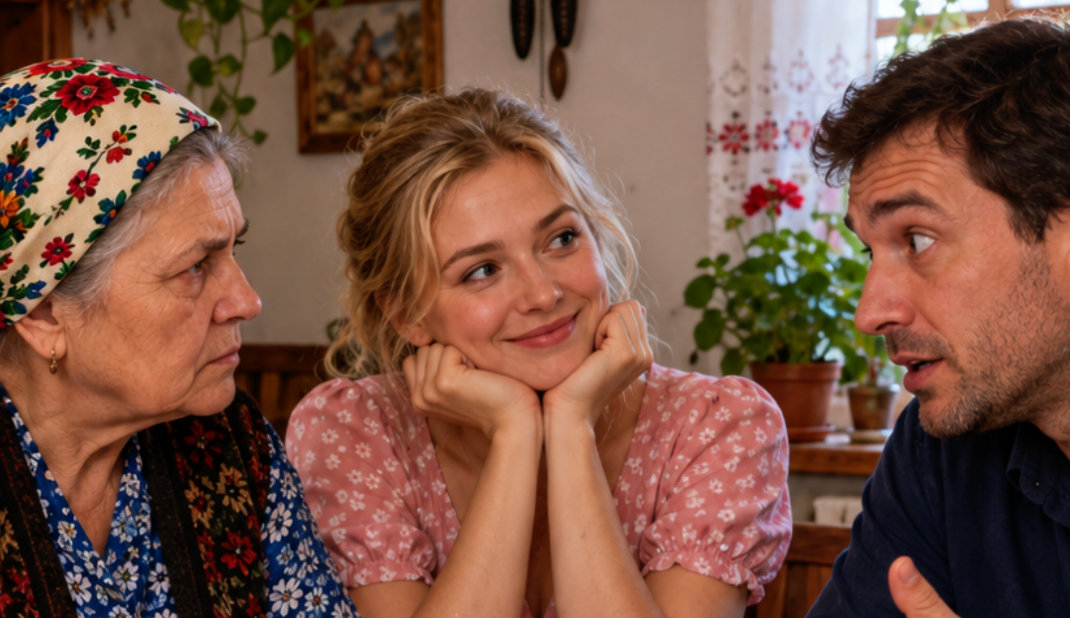
In Paraskeva Petrovna’s cabinet, behind the crystal salad bowl, there was a box that once held chocolates. The chocolates had been gone for twenty-four years. Inside was a wedding towel for matchmakers, embroidered back when granddaughter Oksana was still in kindergarten and pronounced the letter “r” only half the time.
Every spring, Grandma would take out that towel, hang it on a clothesline between the apple tree and the shed to air out, then fold it up again in the evening with a sigh that the whole street could hear.
“Thirty years,” she said that October morning, smoothing down the red roosters on the towel. “Thirty, Oksana! When I was your age, I was getting three kids ready for school.”
“And at my age, Grandma, I handed out a hundred and twenty parcels in a single day without mixing up a single one,” Oksana said as she pulled on her rubber boots by the doorstep. “Everyone has their own record.”
“Parcels won’t hug you.”
“At least they don’t snore.”
Paraskeva Petrovna waved the towel at her but smiled. Arguing with her granddaughter had been pointless ever since Oksana was four and explained to Grandpa why the chickens should sleep in the house and not the coop.
Oksana worked at the village post office, making her the most well-informed person within ten kilometers. She knew who’d received a new jacket from a son abroad, who’d ordered pumpkin seeds from three different shops, and whose daughter-in-law had sent her mother-in-law the book “How Not to Interfere in the Lives of Adult Children” yet again. She knew, but kept quiet. That’s why people trusted her.
Oksana also had a laugh that could make everyone waiting in line at the window start smiling too. She could fix a gate, stack firewood into a neat pile, and get Grandpa’s motor-cultivator running just as neighbor Hryts was about to call for help.
Grandma kept her own record of possible suitors. Vasyl the tractor driver was “too quiet, you can’t get a word out of him.” The agronomist from the next village had a mother who called him three times every hour. The PE teacher “wore sweatpants his whole life and would probably wear them to his own wedding.”
“Grandma, you’re not looking for a groom for me, you’re looking for someone without a single flaw,” Oksana would say. “Such people don’t exist. Even your borscht sometimes ends up too salty.”
“My borscht is never too salty!” Paraskeva Petrovna would protest. “It’s your tongue that’s wrong.”
* * *
That day, it had been raining since morning, and the post office smelled of damp jackets and apples that Grandma Lidiya had brought to sell right under the counter. Around noon, the door creaked and a tall young man in a light jacket stepped inside. Well, the jacket used to be light. After the village road, it matched the color of the autumn fields.
“Hello,” he said, glancing around as if he’d just entered a museum. “There should be a coffeemaker here for me.”
Oksana looked under the table. There had been a large box there for three days addressed to: 12 Sadova Street. Only that Sadova Street was in the regional center, not in their village. Someone had mixed up the postal code, and the coffeemaker had ended up taking a little vacation in the countryside.
“We do have one,” she nodded. “Show me your ID or the pick-up code from the message.”
“Do you realize I just traveled sixty kilometers and through puddles deep as ponds, all for coffee?”
“I get it. Our coffee is so good, people will walk here just for a cup,” Oksana said, placing the box on the counter. “But honestly, you’re the first person who has ever come in person for their parcel. Usually, people send such heartfelt letters, you’d want to frame them.”
The young man laughed. His laugh was genuine, not for show. He introduced himself as Maksym and shared that he sets up inventory systems for large warehouses. He hadn’t been to the village since he was a schoolboy, visiting his aunt for the summer holidays.
Oksana poured him tea from a thermos because the water was still dripping off his sleeve onto the floor. Grandma Lidiya sold him a kilo of apples and at the same time, asked if he was married. Maksym blushed but admitted he wasn’t. Grandma Lidiya nodded approvingly and looked at Oksana in such a way that Oksana almost dropped the stamp.
Before he left, Maksym asked for her phone number.
“Just to confirm how your postal codes work,” he explained with a serious face.
“Our postal codes work perfectly,” Oksana responded. “But go ahead and write down my number.”
* * *
Grandma found out about the ‘city boy’ calling Oksana for a month on the second day. In the village, news travels faster than cell service. And by the third week, Paraska Petrovna made her demands:
“Sunday. Lunch. Let him come— I want to have a look at him.”
“Grandma, you’re going to look at him like he’s a pig at the fair.”
“That’s how I look at everyone. That’s why I still have all my own teeth.”
On Sunday, Grandma got up at five in the morning. By lunchtime, the table was covered in stuffed cabbage, potato pancakes with sour cream, marinated mushrooms, salted pork with garlic, borscht with garlic rolls, and cabbage pies under a towel. Not the towel from the box. It was still too soon for that one.
Maksym arrived exactly at two, carrying yellow chrysanthemums and a bakery cake. Seeing Paraska Petrovna on the porch, he grinned widely and said:
“Good afternoon! You must be Oksana’s sister?”
“Sister, yes,” Grandma nodded. “Older. By about fifty years.”
She looked stern, but she moved the chrysanthemums twice before finding the perfect spot for them on the windowsill.
At lunch, Maksym ate with such enthusiasm that Paraska Petrovna’s face actually warmed. He praised the potato pancakes, asked for more stuffed cabbage, and honestly admitted he hadn’t tasted such good salted pork since his aunt moved to her daughter’s. Oksana was starting to think everything would pass peacefully.
Then Maksym leaned back in his chair and said, as if in passing:
“You know, I’m a simple guy. What I care about in a wife is that the house is warm, clean, dinner is hot, shirts are ironed. That she greets me when I come home. I work late, you know.”
Oksana was just about to answer, but Grandma spoke first.
“Son, are you looking for a wife or an all-inclusive hotel?”
Maksym laughed. He thought Paraska Petrovna was joking.
“Oh no, Paraska Petrovna. A woman is a homemaker—she brings coziness, warmth, keeps the home fires burning…”
“A homemaker, you say?” Grandma put her spoon down. “Alright then. So, who will you be in this house? The vacation guest?”
“Well, I’ll be the one earning money…”
“Oksana works too. And what will YOU leave in the house? Socks under the couch and a TV remote no one can ever find?”
The kitchen was so silent, you could hear the clock ticking on the wall. That same clock had been running seven minutes slow ever since Grandpa hung it up, and no one dared to fix it. Right then, as if on cue, the cuckoo bird popped out and called twice.
Oksana dropped her eyes to her plate, afraid she’d burst out laughing. Maksym blushed as red as the beets used for that very same borscht.
Grandma calmly poured him another bowl of borscht.
«Go on, eat, don’t be shy. My Oksana can cook exactly the same borscht, just as good—I taught her well. And in winter, when our tiller won’t start because it’s too cold, she gets it running on the second try. Our neighbor Hryts—he needs five tries, and that’s only after he tells everyone on the street his back hurts. So, son, do you know how to peel potatoes?»
«Well… in theory…»
«Oh, ‘in theory’!» — Paraska Petrivna was already getting up. — «Let’s see your theory in practice.»
A minute later, Maksym found himself in front of a bucket of potatoes, a bowl of water, and a knife with a wooden handle.
* * *
What happened next, Oksana would go on to tell her friends about for five years—and every time, someone would end up laughing until they cried.
Maksym peeled potatoes in a way that made it impossible not to laugh. The skins came off in thick strips, along with a good chunk of potato itself. In his hands, a potato as big as a fist was soon reduced to something the size of a walnut—and it always turned out perfectly cube-shaped.
«From a spud like that, I could have grated enough to make potato pancakes for three people,» Grandma commented. «But you turned it into a Rubik’s cube! Should I throw it in the soup, or give it to a child to play with?»
«I’m still practicing,» Maksym mumbled.
«Yeah, you’re practicing, all right. The chickens are going to have a feast—they’ll eat better than us today.»
After twenty minutes, Maksym had peeled five potatoes. Paraska Petrivna, sitting beside him and chatting about how her Mykola once came courting the same way, peeled fifteen. Her potato skins fell off in long, thin ribbons. Eventually, Maksym couldn’t help but ask:
«How do you do it?»
«With my hands, son. Same kind as yours. The only difference is, mine have always known what they’re for since I was a child.»
Maksym went home that evening. He said goodbye politely, thanked everyone for lunch, and even took the potatoes with him since Grandma said they were already no good for planting. But the chrysanthemums stayed behind on the windowsill.
* * *
«Grandma, why did you do that?» Oksana asked, scrubbing the dishes so loudly that the plates clattered more than necessary.
«Because I didn’t raise you to be a servant for anyone,» Paraska Petrivna replied, putting bread away in a linen bag. «If he gets offended and doesn’t come back—well, then that’s his path, and the towel will stay whole. But if he comes back, maybe he’s worth something after all.»
Maksym didn’t call on Sunday, or Monday, or Tuesday. All week, Oksana handed out packages with such a sour face that grandma Lidiya brought her a jar of honey ‘to cheer her up.’ Then on Thursday, a short message arrived:
«Tell Paraska Petrivna that I’m practicing.»
Oksana read the message aloud to her grandmother. She didn’t say a word—just grunted and went to fetch another jar of pickles from the cellar. Just in case.
On Saturday, Maksym was back by the gate. He was holding something large wrapped in a kitchen towel, and from his bag peeked a brand new checkered apron, tag still attached.
«A pie,» he announced ceremoniously. «Apple. Made it all by myself from start to finish. Mom only gave me tips over the phone.»
They put the pie on the table. Paraska Petrovna tapped it with her knuckles. The sound it made was like someone knocking on a door.
«Son, what did you make it from? Apples or bricks?»
«I think the dough sat a bit too long,» Maksym admitted honestly.
«A bit,» Grandma agreed. «You know what? My gate always swings open in the wind. A pie like this could keep it closed, even in a storm. A handy thing to have around the house.»
Everyone burst out laughing—Maksym louder than the rest. In the end, they did eat the pie, but in their own way: they cut off the crust and dug out the filling with spoons. The apples, to be fair, were perfectly done.
Over tea, Maksym shared that he told his mom everything he’d heard from Paraska Petrovna.
«She laughed for a good ten minutes. Then she said, ‘Finally, someone told you what I’ve been repeating for twenty years.'»
«You’ve got a smart mom,» Grandma nodded. «Bring her over sometime. Let’s get acquainted.»
* * *
That winter, Maksym came every Saturday. He learned to peel potatoes thinly—though not as quickly as Paraska Petrovna. He made dumplings—crooked, but sturdy ones. He chopped enough wood for two months and finally fixed the gate, so the pie was relieved of its honorary position. One frosty morning, he even started the motor-cultivator. On the seventh try, but even neighbor Hryts took off his hat.
Grandma stopped calling him «that city boy» and started saying «our Maksym.» At first, of course, only when he wasn’t around.
In the spring, when the cherry trees bloomed, the box from the chocolates finally opened. The towel with red roosters had its moment at last.
* * *
A year later, at the end of October, the kitchen was filled with the aroma of borscht again. Maksym stood by the stove in that same checkered apron, now well-washed. Right beside him, almost elbow to elbow, Paraska Petrovna was supervising the process.
«Beets separately. Separately, I said! And a spoon of sugar in there, plus a little vinegar so it keeps its color. You’re not making compote.»
«When do I add salt?»
«When I say so. You’re still on probation.»
Oksana was sitting in the next room, holding little Karina, listening to their conversation through the slightly open door. Their daughter was three weeks old and slept so sweetly—as though she, too, was following whether her dad was adding the beets correctly.
«See, Oksana,» Grandma called out from the stove without turning around, «you always said I’d scare him off back then. Well, I didn’t scare him off. I raised him right.»
«I can hear everything, Paraska Petrovna,» Maksym chimed in.
«Good—then keep stirring. Don’t just stand there.»
And in the china cabinet, behind the crystal salad bowl, the box from the chocolates was there again. Last night, Paraska Petrovna sat by the lamp with her embroidery hoop and started stitching a new towel. She said it’s better to start early—because nowadays, it takes a long time to finish raising these grooms.