An empty borscht pot had been sitting in the fridge for four days now. Inna deliberately left it unwashed. She was curious to see how many days it would take for her son to notice.
Sashko finally noticed on the fifth day. He opened the fridge, stared at the pot with dried beet stains clinging to its sides, closed the door, and said, facing somewhere toward the window:
“Mom, is there seriously nothing to eat?”
Inna was standing behind him, still wearing her coat and holding shopping bags. Drops from her hood dripped onto the linoleum—the third day of steady October rain, and it was already getting dark by six.
“There is,” she replied. “A pot. Wash it, and you’ll have something to cook in.”
Sashko laughed, thinking it was a joke, and headed to his room.
* * *
Inna was forty. Sashko was seventeen, in eleventh grade. He kept steady grades, never below a B, and every parent-teacher meeting his homeroom teacher would tell Inna, “You have a golden boy, Inna Serhiivna.” One time, the neighbor from the fifth floor stopped her by the mailboxes just to share how Sashko had carried a sack of potatoes to her elevator and wouldn’t even let her thank him.
Inna nodded, smiled, but her mind drifted elsewhere. She thought about the socks piling up under the couch like fallen leaves under a maple tree. About the cups with dried cocoa sitting on his windowsill. About the towel in the bathroom, lying exactly where it had fallen—as if it decided that was the most comfortable spot.
Her husband, Vitalii, had been working in another city for the second year now: two weeks away, one week at home. Whenever he returned, the apartment became quieter and tidier. He never said a word—just washed his own plate, hung his shirt in the closet, took out the trash as he passed by. And Sashko seemed to shape up when his father was around. But after Vitalii left, everything slipped right back to where it was—or rather, fell apart again.
Just a week ago, Inna was comparing dishwasher prices online. She sat with her laptop in the evening, scrolling through reviews, honestly believing the problem was the lack of proper equipment. Get a machine—and things will get easier.
* * *
That week, Ilona Markivna, Vitalii’s mother, came to visit. She brought a bucket of Antonovka apples from the village, a three-liter jar of honey, and her favorite apron—a little blue checkered one. Without her own apron, she always felt lost in other people’s kitchens.
On Thursday at work, Inna’s office was wrapping up the quarterly report. She’d known since the morning that she wouldn’t be home before eight.
“Sashko,” she said as she put on her shoes in the hallway. “I’ll be home late today. Cook something for dinner, okay? We have potatoes, and there’s ground meat in the freezer. Take it out as soon as you get home from school so it thaws.”
“Okay.”
“Sashko, are you listening to me?”
“Yes, Mom. I’ll cook.”
Inna didn’t think about it all day. But squeezed into a crowded minibus between someone’s wet umbrella and another person’s gym bag, she suddenly imagined: she opens the door, and the kitchen is filled with the smell of fried onions. Even if it’s just pasta with sausages. Even if it’s too salty. She’d eat it and give a compliment. The thought warmed her so much that she missed her stop.
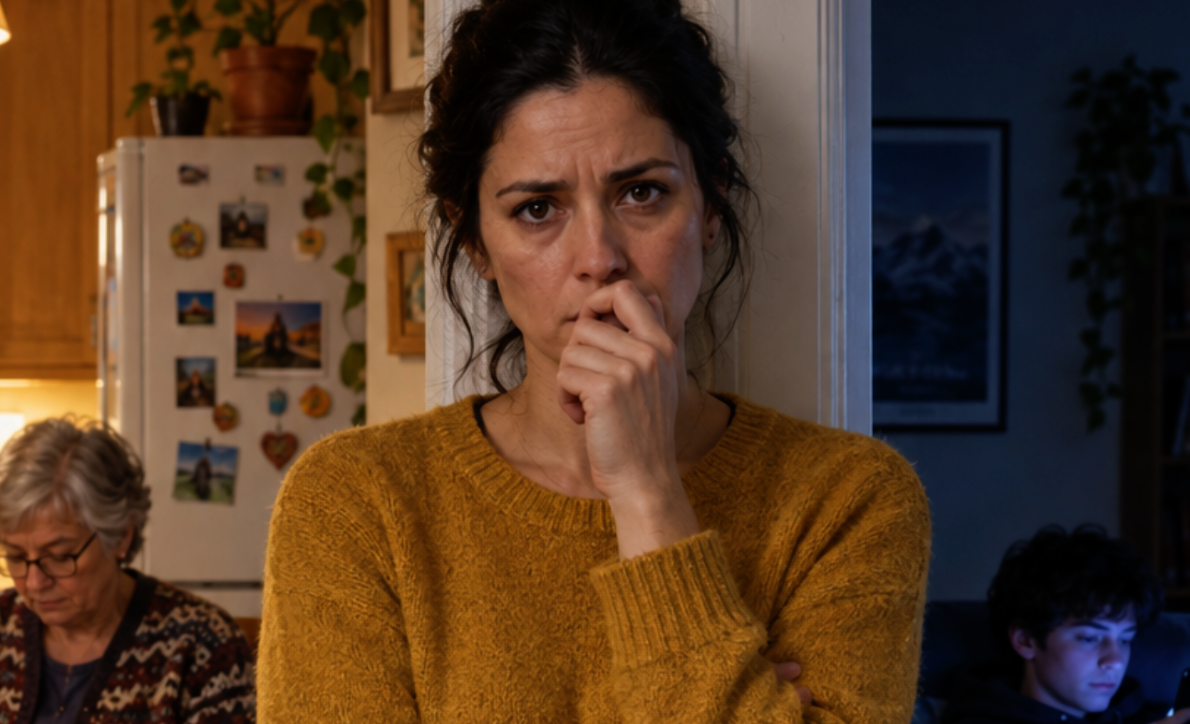
At home, around 8:30, the hallway was dark. It smelled like nothing. In the kitchen, Ilona Markivna sat under the lamp, knitting a pair of socks for her grandson—gray with a white stripe. Sashko was lying on the couch in the living room, his face lit by the blue glow of his phone.
«Oh, hi, Mom,» he said, even sitting up a bit. «So, what’s for dinner?»
«What did you make?»
He looked at her, honestly surprised. Not a hint of slyness or laziness in his voice—just genuinely confused, like someone asked him something strange.
«Mom, you cook better anyway. I’d just waste the groceries.»
The minced meat sat in the freezer like a brick. Inna silently took off her jacket, poured water into a pot, and set it on the stove. She peeled potatoes while standing, not bothering to sit—making thick peels, thicker than ever before.
When Sashko went to take a shower, Ilona Markivna put down her knitting needles.
«Don’t take it the wrong way, dear,» she said softly. «But you raised him this way yourself. I got Vitalik doing laundry and peeling potatoes since he was twelve. But you always pampered your son. Don’t be surprised if his wife won’t thank you for it later.»
Inna set the knife down on the cutting board.
«Thank you, Ilona Markivna. I’ll keep that in mind.»
She said it evenly, even politely. But her mother-in-law understood, picked up her knitting again, and for the rest of the evening, the only sounds in the kitchen were bubbling water and the clicking of needles.
* * *
That night, Inna couldn’t sleep. Rain drummed on the metal windowsill outside, and every drop seemed to echo, «your own doing, your own doing.»
At first, she was angry. Easy for you to say, when your husband was always around and not hundreds of kilometers away. Easy to lecture after showing up for four days with honey and an apron. Let her try juggling a nine-hour workday and then a second shift at home.
But then, around two in the morning, her anger faded, replaced by memories.
Sashko was five. Standing on a stool by the stove, reaching for the ladle: «Mom, let me stir!» And she’d say: «Go play, sweetheart, you’ll spill everything.»
Sashko was seven. He had washed the dishes all by himself after lunch, concentrating hard, tongue sticking out in effort. But at night, after he fell asleep, she quietly rewashed every plate—so he wouldn’t notice or feel bad. But the next day, he didn’t wash them anymore.
Sashko was ten. For her birthday, he made sandwiches—with thick slices of cheese, and ketchup in the shape of a heart. There were crumbs everywhere in the kitchen. She remembered sighing louder than she said thank you.
And so, year after year. “I’ll do it myself, it’s quicker.” “Don’t touch that, I’ll get to it.” “Just leave it, I’ll take care of it.”
Lying in the dark, Inna realized: no one turned her son into a slacker. She’d just spent a long time, patiently showing him that the kitchen wasn’t his place. And he believed it.
* * *
In the morning, the kitchen was already filled with the smell of Antonovka apple pancakes. Ilona Markivna, in her checkered apron, was flipping them on the skillet.
«Sit down, dear, while they’re hot,» she said without turning around. But then she did turn. «I was a bit harsh with you yesterday. Don’t be upset with me.»
«You spoke the truth,» Inna replied, picking up a pancake with her hands, just like when she was a child. «It just doesn’t make things any easier.»
Her mother-in-law smiled and sat down across from her.
“Want to hear how I taught Vitalik?” she began. “When he was twelve, he ironed his first shirt by himself. Burned it though—a big iron mark on the back. He cried his eyes out, swearing he’d never touch an iron again. But I just handed him another shirt. Didn’t say a word.” She paused for a moment. “But don’t think I was so wise. I worked on the farm from five in the morning; I just didn’t have time to clean up after him. Life taught both of us. You’ll have to figure it out on your own—without waiting until it really burns.”
“But how do I figure it out?” Inna put her pancake aside. “I ask. I ask every day. He says ‘yeah’—and does nothing.”
“Stop asking. When you say ‘help mom,’ he just hears it’s mom’s chore and he’s only a helper. But he lives here too, daughter. This is his home as well. Give him something that’s all his, totally his. And don’t redo it for him, no matter how badly it turns out. How many times have you rewashed his dishes?”
Inna looked up.
“How did you know?”
“Because I was a daughter-in-law once too,” Ilona Markivna laughed. “And I rewashed dishes after everyone as well. Here’s another thing: don’t nag every night. Say it once, calmly. Then just stick to your word. They don’t learn from yelling, they learn because you don’t back down.”
On Saturday, Inna saw her mother-in-law off at the bus. She hugged her tighter than usual farewell, and left her apron hanging by the stove: ‘No sense hauling it back and forth.’
* * *
On Sunday evening, Inna knocked on Sasha’s door and sat on the edge of his bed. He took off his headphones, instantly on alert—people only act like this when something serious has happened.
“I’m not going to lecture you,” she said. “I’m just tired, Sasha. I come home from work, and my second shift begins. I’m forty, and I don’t want to live like this until I’m fifty.”
He shrugged.
“Just tell me what to do, I’ll do it.”
“That’s exactly what I don’t want—to have to tell you. Let’s do it another way. Tuesday and Thursday are your dinner nights. They’re completely yours—you decide what to cook, what to buy, and clean up after. I won’t interfere. Wash your plate right after you eat. The bathroom once a week—that’s yours too.”
“What if I don’t know how?”
“You’ll learn. I didn’t know either, until I had to.”
“What if it turns out to be gross?”
“Then we’ll eat gross food.”
Sasha gave her a long look, like he was making sure she wasn’t joking, like with the pot last time. Then he said:
“Okay… Just promise you won’t hover over me.”
* * *
On the first Tuesday, the pasta stuck together in one big clump, and the sausages burst and twisted in the pan. Sasha stood red-faced by the stove, waiting to see what his mom would say.
Inna ate everything on her plate.
“It’s fine,” she said. “Next time use more water, and put in the pasta when it’s already boiling.”
One piece of advice. Not five. She learned this after that sleepless night.
He didn’t do a great job washing the pot—streaks stayed on the bottom. The hardest part for Inna was not saying anything, not rewashing it herself. Her hands were itching to do it. She went to the bathroom and washed her hands in cold water for a long time, just to keep herself from going back to the kitchen.
It wasn’t always smooth. One Thursday, Sasha stayed late at a friend’s, and by eight, there was nothing at home. Out of habit—after twenty years—Inna reached for the frying pan. Then she stopped. She made herself tea and a sandwich, just for herself, and went to read.
Sashko arrived at nine.
«Mom, what…»
«It’s Thursday today, sweetheart.»
He stood in the hallway for a moment, exhaled, and then went to the kitchen to fry eggs at half past nine in the evening. No shouting, no arguing, no slamming doors. Inna was actually surprised at how quietly it could all be done.
She also stopped picking up socks from under the couch. By Wednesday, Sashko had run out of clean ones, and came into the kitchen wearing the look of someone facing great injustice. Inna showed him once which buttons to press on the washing machine and where to put the detergent. She never had to show him again.
She somehow forgot about the dishwasher.
* * *
At the end of November, the first wet snow fell. Inna was coming home late from work, twenty minutes to nine, the minibus filled with the smell of damp clothes, and all she wanted was to lie down and not move.
As she walked up the stairs, she smelled fried onions. She thought it was coming from the neighbors.
But the smell was coming from her own apartment.
The kitchen light was on. The table was set—with napkins, the special ones Inna only took out for guests, maybe twice a year. Sashko was standing by the stove, wearing Grandma’s blue checkered apron, which looked hilariously short on him.
«Sit down, mom,» he said. «Just don’t say anything until you taste it.»
It was stewed potatoes with meat. And as soon as Inna brought a spoon to her mouth, her nose tingled: it was the taste of Ilona Markivna. That exact taste, with bay leaf and something else Inna had never guessed in eighteen years.
«How did you…» was all she managed to ask.
«I called Grandma,» Sashko grinned, impossibly pleased with himself, sitting down across from her. «She spent an hour on the phone telling me everything step by step. She said you never asked for her recipe.»
Inna laughed, and it came out a little teary.
Sashko twisted the fork in his hands. He was quiet for a moment.
«Mom… I didn’t used to think about you coming home at eight and then doing all this, too. I just thought it all… kind of happened by itself.»
She didn’t answer. She just reached across the table and ruffled his hair the way she did when he was five. He swatted her hand away, but not too hard.
The sink was empty. The pot he’d used to stew the potatoes was drying upside down on the towel—washed, even before Inna got home.
* * *
That same evening, she called her mother-in-law.
«Ilona Markivna, thank you.»
«For what, dear?»
«For the recipe. And for that evening in October.»
«Oh, I really gave you a talking-to then…»
«You said everything exactly right.» Inna paused. «I thought it was already too late. Seventeen years old, grown up, that’s it.»
There was a crackling sound on the phone—probably Ilona Markivna settling into her chair by the stove.
«Seventeen isn’t too late,» she said. «Too late is when there’s no one left to teach you.»
And then she added, and Inna could hear her smiling:
«He called me again yesterday. Asked how to make dumplings. Said he wants to cook them for his girlfriend, Daryna. So you watch out, dear. Maybe his future wife will even say something nice about me one day.»
Inna put down the phone and sat in the kitchen for a long time. She looked at the clean pot on the towel, at the checkered apron on the hook, at the wet snow outside the window. Nothing special. Just an ordinary evening in an ordinary kitchen.
For the first time in many years, no one had left her any dirty dishes.