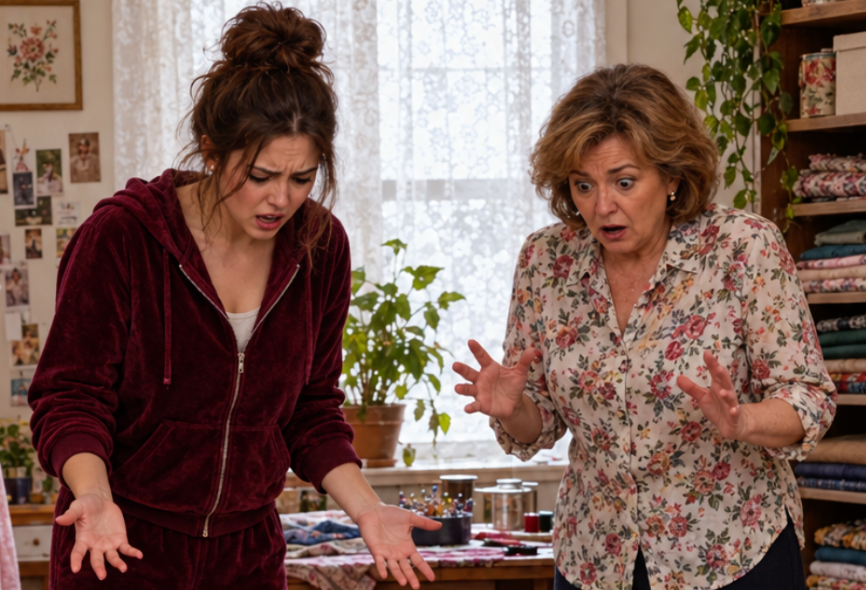
When I spotted the sewing machine on the floor, I didn’t look at it first—I glanced straight at my mother-in-law. Tamara Pavlovna stood by the window, holding a box of threads and spoke up a little too quickly:
«Natasha, please don’t make a scene. I didn’t do anything wrong.»
The pedal was lying on the floor, the cord was hanging off the edge of the table, and the plastic shuttle cover had flown all the way over to the radiator. I had just four days left to finish my biggest order of the year.
I put my bag on a chair and asked:
«So what exactly happened?»
My mother-in-law just shrugged.
«I hit it with my elbow, that’s all. It fell. No big deal, it’s just equipment.»
When she said, «No big deal,» for the first time I started to wonder if this wasn’t just an accident. But back then, I had no idea Tamara Pavlovna had already decided she could treat my work the same way she did my money.
As long as the money was coming in, no one cared about my «rags.»
I’ve been sewing since I was twenty. First I worked in a factory, then at a small studio, and three years ago I started freelancing. The reason was simple: the commute took almost two hours a day, my schedule was constantly shifting, and private orders kept increasing.
Andrey and I did the math. He worked as a technician for a service company, and I earned about the same from home as I did at the studio. We set aside one room in our two-bedroom apartment just for my work: table, shelves, sewing machine, overlock. For any complicated projects, I sometimes went to Sveta, a former colleague with a small workshop near the market.
The first year, Andrey was thrilled about my work, especially when his own money was starting to run out.
Six months before I left the studio, he took out a consumer loan to renovate his mother’s apartment. Tamara Pavlovna lived in an old two-bedroom space—she needed new windows, kitchen wiring, and some plumbing repairs. It was her idea: Andrey should get the loan since he could get it on decent terms, and she would pay him part of the payment each month.
I didn’t argue. That was their arrangement.
For the first few months, my mother-in-law paid on time, but then she started mentioning her own expenses more and more. After a while, Andrey just stopped asking her at all.
The payment was about twenty thousand. If Andrey was short at the end of the month, I’d chip in the difference—sometimes seven thousand, sometimes ten, sometimes almost the whole amount.
One day, he showed me his bank app:
«I’m nine thousand short for the payment. I’ll pay you back after I get paid.»
I transferred the money. After payday, he spent his salary on the car and groceries, and we never brought it up again. This went on for almost a year.
During all this, Tamara Pavlovna still thought of me as someone who just «sits at home.»
«It’s easy for you. Put the kettle on whenever you want, take a break whenever you want.»
Meanwhile, my desk would be cluttered with half-finished clothes, and my phone would be buzzing with messages from clients. At first, I just joked about it—eventually, I stopped.
That’s when she started treating my work as just another household chore.
Our first serious conversation happened because of a good pair of tailor’s scissors.
On Saturday, I couldn’t find the scissors. Andrey said he hadn’t taken them. Two days later, Tamara Pavlovna returned them, along with a container of homemade cutlets.
«Thanks, they came in handy.»
At first, I didn’t even get it.
«You borrowed them?»
— I just needed to trim the sheer curtains. I put them back.
I opened the scissors, looked at the blades, and set them down on the table.
— Please, from now on, don’t take anything from my workspace.
She pressed her lips together.
— You could have just said you didn’t want to share.
— It’s a work tool.
That evening, Andrey asked me not to turn the scissor situation into a ‘family tragedy.’
A couple of weeks later, my mother-in-law showed up while I was out buying fabric. She’s had a spare key for years.
When I came home, I saw jars of homemade preserves on my work desk.
— Mom dropped by, — Andrey explained. — Her fridge was defrosting.
— Why here?
— You’re not sewing right now.
I moved the jars to the kitchen, and after that, I started closing the door to my room whenever I worked.
Tamara Pavlovna noticed this almost immediately.
— Who are you locking yourself away from?
— I’m not locking myself away. I just don’t want anyone coming in when I have fabric laid out.
She smirked.
— Sounds like some secret production.
But the strangest thing was this: the moment Andrey needed more money, my so-called ‘secret production’ suddenly became part of the family finances.
For some reason, she didn’t like the big order I got.
At the end of November, a client I’d made a dress for in the summer messaged me. She ran a children’s dance group and wanted to know if I could make twelve stage costumes for their December show.
The deadline was tight, but she offered a fair payment and immediately sent an advance for the materials. Sveta and I planned out the work: I’d do part at home, and the complex steps at her place.
Andrey was pleased.
— Now that’s a good order.
At the time, I didn’t even notice the emphasis on ‘now.’
A few days later, Tamara Pavlovna came over. She was sitting in the kitchen while I was noting how many sets I still had to finish on my phone.
— How much will you get paid for this? — she asked.
I named the amount.
My mother-in-law raised her eyebrows.
— For three weeks?
— About that.
— And what if the next order is only two months later?
I shrugged.
— I don’t have just one client.
She pushed the sugar bowl closer to the wall and addressed Andrey instead.
— This is why I always say: you need a proper salary. The same amount every month, no surprises.
Andrey opened the fridge, took out the dinner container, and unexpectedly backed her up:
— Stability is definitely easier.
I looked at him.
— Especially when my unstable money is covering your loan.
He froze by the fridge.
— Here we go again.
— Nothing’s happening. I’m just reminding you.
Tamara Pavlovna jumped in right away:
— You’re family. What do you mean ‘your loan’?
— The one Andrey took to renovate your apartment.
The kitchen went quiet. My mother-in-law adjusted her sweater sleeve and said:
— I’m his mother. Today he helps me, tomorrow I’ll help him.
I didn’t bother to ask when exactly ‘tomorrow’ would come.
After that conversation, Andrey twice told me I shouldn’t have jabbed at his mom about the money. I said I was just tired of hearing that my work isn’t ‘real’ enough.
A week later, my mother-in-law dropped by again in the afternoon. I was just finishing one of the costumes.
She stood in the doorway for a moment, taking in the sewing machine.
— Do you sew at night, too?
— Sometimes.
— You’ll ruin your eyesight, and what’s the point of that?
I asked her to close the door because I needed to focus.
She closed it. At that moment, I thought that was the end of it.
Four days later, the sewing machine was on the floor.
That day, I went out to buy zippers and trims. I planned to get back in the evening, but I found everything quickly at the store and came home almost two hours earlier than expected.
The apartment door was slightly ajar. Tamara Pavlovna’s shoes were in the hallway.
I heard noises coming from the workroom, then a short thud.
When I walked in, the sewing machine was already on the floor.
My mother-in-law was standing by the table, holding a box of threads.
I didn’t yell.
«How did it fall?»
«I bumped it with my elbow.»
The sewing machine was always at the far end of the table. To hit it with an elbow, you’d have to reach clear across.
«Why did you touch it at all?»
«I wanted to look at the threads. Why are you interrogating me?»
I didn’t turn the machine on before Andrey got home. I called a technician, explained that it fell off the table; he told me to bring it in for an inspection.
Tamara Pavlovna sat in the kitchen the whole time.
When Andrey came in, she was the first to greet him.
«Tell your wife I’m not a criminal. I knocked over her sewing machine by accident, and she looks at me like I did it on purpose.»
Andrey walked into the room, crouched by the sewing machine, and examined the crack in the body.
«Natasha, this is upsetting, of course. But if it was an accident…»
I looked at him.
«Did you see where it always stands?»
He said nothing.
From the kitchen, I heard:
«Maybe it’s for the best. At least she won’t be sitting with it all day for a few days.»
I walked out to my mother-in-law.
«What do you mean, ‘for the best’?»
Tamara Pavlovna looked away at first, then put her cup down on the table.
«I mean what I said. You’ve worn yourself out with all these orders. A normal job ends in the evening.»
«And my job isn’t normal?»
«Natasha, don’t twist my words. I’ve said for a while now—you should go back to the atelier, you’d have a steady paycheck. And Andrey would feel better about it, too.»
«What does Andrey have to do with this?»
She looked at her son.
«Because he has obligations. And with you, one day you have an order, the next you don’t.»
I stepped closer.
«Is that why the sewing machine ended up on the floor?»
Andrey sharply turned to his mother:
«Mom, did you really not drop it on accident?»
Tamara Pavlovna was silent for a few seconds, then waved her hand.
«Fine, I moved it! I just wanted Natasha to have a few days without her orders so she could think things through. I wasn’t trying to smash it to bits. It just slipped—what’s the big deal?»
Andrey slowly straightened up.
«You pushed the sewing machine off the table?»
«Don’t make me out to be a monster. So she’d miss a couple orders and go back to the atelier—things would be better for everyone.»
Now, everything had finally been said.
I asked her to leave. Andrey tried to say that it was a long trip across town for his mother, but I took down her coat from the hook and handed it to her.
Tamara Pavlovna got dressed, slipped her feet into her shoes, and as she stood in the doorway, she said:
«You’re going to ruin everything over one sewing machine.»
I closed the door.
I finished the order anyway.
The next day, the repairman kept the sewing machine for repairs: the body was damaged and the mechanism had shifted. I told my client about the breakdown, but didn’t change the delivery date and went over to see Sveta.
Sveta glanced at the calendar:
“After six, come work for me. Come by Saturday morning. I’ll be there to open up myself.”
We agreed on that.
For four days, I came there after lunch and stayed until evening. One day, Andrey brought over some food and tried to talk to me about his mom.
“She’s upset too.”
I didn’t look up from my work.
“Let her be upset at her own house.”
“Natasha, she didn’t mean you any harm.”
I switched off the machine and looked at him.
“Then let her pay for the repairs.”
Andrey didn’t say anything.
I finished the order on time. The group leader checked the costumes, asked me to adjust one clasp, and transferred the final payment to me that evening.
At home, Andrey asked if I’d completed everything and even smiled. Two days later, it was the day he usually made his loan payment.
“You know the payment is due tomorrow.”
That message came through to me on messenger around four in the afternoon.
“Can you transfer twenty today?”
Before, I would have transferred it right away. Sometimes less, sometimes the whole amount—depending on how much he needed.
This time I replied:
“No.”
My phone rang almost immediately.
“Natasha, my payment is due tomorrow.”
I was at Sveta’s workshop, picking out a bad seam on a skirt.
“I remember.”
“Then why ‘no’?”
“Because it’s your loan.”
He was silent.
“This isn’t how we agreed to do things.”
“We never actually agreed that I would pay it. I started helping because you were short on money.”
“And I’m still short now.”
“Then talk to the person whose apartment you spent that money on.”
Andrey started speaking more quietly:
“Are you bringing my mom into this on purpose now?”
“No. She brought my job into things a long time ago.”
I set the seam ripper down on the table.
“You saw all of this and every time asked me not to make a fuss. Fine. I won’t make a fuss anymore. I’m just done paying for things that don’t concern me.”
He asked:
“And does family concern you?”
“Shared expenses, yes. Your loan for your mom’s renovation, no.”
That’s where we ended the conversation.
That night, he came home angry, sat at the table with his phone, and spent a long time figuring out the finances. Then he said he’d try picking up extra shifts.
“That’s your choice,” I replied.
Tamara Pavlovna called the next day.
“So, you’re leaving my son without money?”
I was standing by the window at Sveta’s workshop, waiting for the big table to be free.
“I’m not leaving him without money. I just stopped paying his loan.”
“You two are husband and wife.”
“Yes.”
“That means everything’s shared.”
“Then why is the loan for your apartment only considered shared for us?”
She was quiet for a while, then said I’d always been petty.
I ended the call.
After that, a lot of things at home became easier
For the first time in a while, Andrey and I set out our expenses clearly. Utilities, groceries, household items—shared. His loan is his. My supplies are mine. I paid for the sewing machine repair myself; I wasn’t about to go chasing his mom for weeks for the money.
Andrey picked up a few extra shifts. One time he asked to borrow five thousand until payday, and on payday returned it himself.
He discussed things with his mom separately. I wasn’t there for it and didn’t ask for details. I only knew he took back the spare key to our apartment from her.
Two and a half weeks later, the repairman called to let us know the sewing machine was ready for pickup.
We went to collect it together. Back home, Andrey set the machine up on my work desk. I plugged in the pedal, threaded the needle, and stitched a piece of fabric. The machine worked smoothly.
The next day, Andrey replaced the handle on my workroom door with one that could be locked with a key. I kept one key, and put the other in the drawer with my important documents.
Tamara Pavlovna didn’t show up for a whole month. She didn’t step into the workroom. At the table, she just asked me about my orders.
‘There are enough,’ I replied.
She seemed about to say something more, but Andrey asked her to pass the salad, and the conversation ended.
In the spring, the leader of the dance troupe messaged me again—this time requesting eight costumes. I checked my schedule and agreed.
That evening, Andrey noticed the new fabrics on my desk, asked if the order was a large one, and quietly closed the door to my workspace. The next morning, I turned the key myself and got to work.