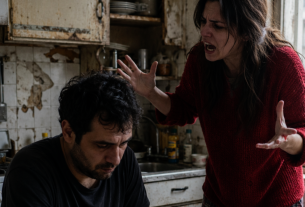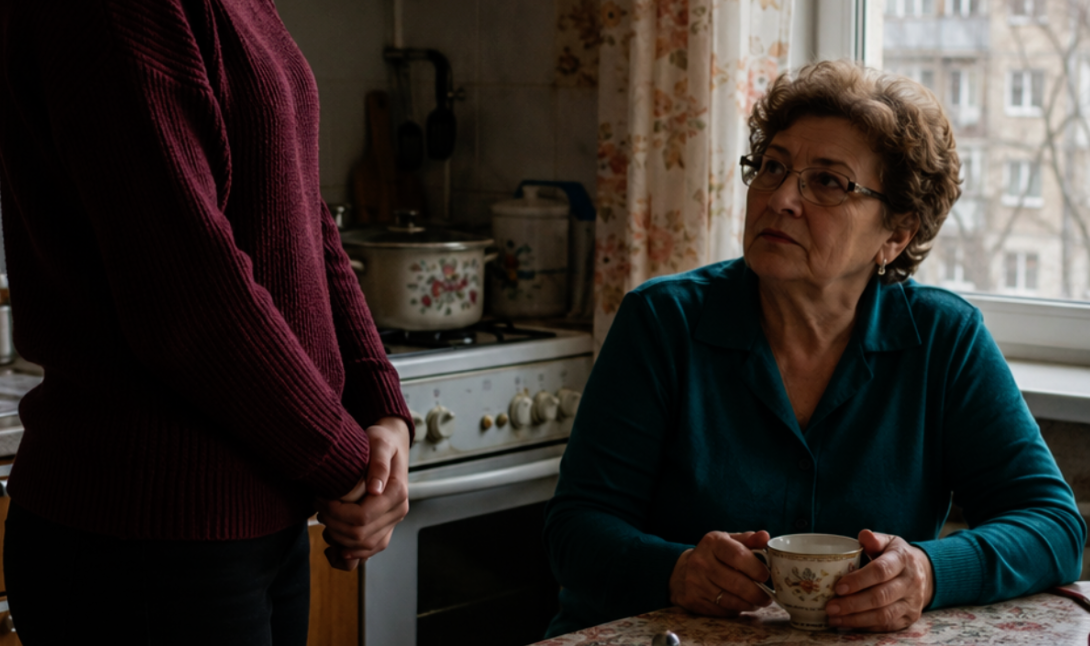
Galina Petrovna rang the doorbell three times. Short, demanding rings, the way someone knocks on the door of a boss’s office.
Zoya wiped her hands on a towel, took off her apron, and went to open the door. She knew that ring. In four years of marriage, she had learned to distinguish it from any other.
“Zoyenka, is Seryozha home?”
Galina stood on the threshold with two bags. In one, jars could be made out; in the other, something soft wrapped in newspaper. She was wearing a burgundy coat with large buttons and a scarf tied as if she were going to a reception, not to visit her son in Biryulyovo.
“Seryozha is at work, Galina Petrovna. He’ll be back by seven.”
“Well, never mind. I’ll wait. I’m not going to stand out on the landing.”
She was already stepping over the threshold without waiting for an invitation. That was how it always was.
Zoya had met Galina six months before the wedding. Seryozha had brought her to Tula then, to a two-room apartment on Metallurgov Street, where it smelled of cherry jam and something slightly sour, the way old bookshelves smell.
Galina met her at the door and looked her up and down. Zoya was five foot three, thin, with delicate wrists and a habit of hiding her hands in her sleeves. Her hair was light brown, always tied back in a ponytail. Her face was the kind you did not remember the first time, but remembered the second.
“Seryozhenka, is she ill or something? She’s so pale.”
Seryozha laughed. Zoya smiled. She knew how to smile in such a way that no one understood what was going on inside her.
At dinner, Galina talked about her neighbor Valentina, who had raised two sons and found brides for both of them. Good brides. Hardworking ones. With hips.
“I’m not talking about you, Zoyenka, don’t be offended. I’m just telling a story.”
Zoya was not offended. She ate borscht and counted the tiles on the floor. Twenty-four. Then she counted again. Still twenty-four.
On the way back, Seryozha said:
“Mom is just worried. She’s a good person.”
“I know,” Zoya answered.
And both of them stayed silent the whole way to Moscow.
They had the wedding in May. Galina arrived a week before the celebration and stayed for ten days afterward. She rearranged the dishes in the kitchen cabinets because “it’s more convenient this way.” She rehung the curtains in the bedroom because “these are too thin, you can see everything through them.” She threw out Zoya’s cactus from the windowsill because “thorns in a home lead to quarrels.”
Zoya stayed silent.
Seryozha would say:
“Mom, why did you do that?”
“What’s wrong with it? I’m trying for your sake. Zoya, tell him, it’s better this way, isn’t it?”
“Yes, Galina Petrovna.”
Zoya bought the cactus again a week later. She placed it on another windowsill, in a room where her mother-in-law never went.
The visits became regular. Galina came once a month, sometimes twice, always without warning. She liked that effect: the door opening, and behind it Zoya in her home clothes, with no hairstyle, no preparation. As if Galina were catching her at something.
Every visit began the same way. Galina would go into the kitchen, open the refrigerator, and shake her head.
“Zoya, what does Seryozha even eat here? It’s empty.”
The refrigerator was not empty. But it did not contain what Galina considered food: three-liter jars of compote, pickles, a pot of borscht for three days.
“I cook every day, Galina Petrovna. Fresh food.”
“Every day? And when do you work?”
“I work from home.”
“Oh, well, that doesn’t count.”
Zoya would close the refrigerator. Pour her mother-in-law tea. Take cookies from the cupboard, the ones she bought especially for such occasions: shortbread, crumbly, in a yellow box.
Galina would eat the cookies and talk.
She talked about Seryozha’s classmate Vitya, who had married Nadya, and Nadya, by the way, made cabbage soup from fresh cabbage, not from packets. About the neighbor Valentina, whose daughter-in-law washed the floors every day. About her friend Tamara, whose daughter-in-law called her every morning.
“Every morning, Zoya. On her own. Without being reminded.”
Zoya nodded. Cleared the table. Washed the cup.
Sometimes Galina went into the room where Zoya worked at her laptop. She touched the books on the shelf, adjusted the pillows on the sofa, moved a photo frame.
“And what kind of photograph is this? Seryozha looks ugly here. Why did you put it out?”
“I like it.”
“Well, it’s your business.”
And Galina would put the frame back, but at a slightly different angle. So it would be clear she had touched it.
Seryozha loved his mother. You could see it in the way he changed around her: he became quieter, younger, somehow invisible. Next to Galina, he turned into a ten-year-old boy afraid to say he did not want to finish his porridge.
Tall, six foot one, broad-shouldered, with the large hands of an installer, he sat at the table and listened as his mother explained to Zoya that towels should be folded in half, not in quarters.
“Mom, stop it.”
“Seryozhenka, I’m not scolding her. I’m teaching her.”
“No one asked you to teach.”
“Do I need to be asked? I’m a mother. I can see.”
At such moments, Zoya would leave the kitchen. She would go to the bathroom, turn on the water, and stand there looking at her reflection in the mirror above the sink. Her face was calm. Her hands too. But her fingers would find the edge of a towel and knead it until the fabric grew hot from the friction.
One day Galina found one of Seryozha’s shirts in the wardrobe with a stain on the cuff.
“Zoya, what is this?”
“Coffee. It wouldn’t wash out.”
“It wouldn’t wash out? Did you soak it?”
“Yes.”
“In what?”
“In Vanish.”
“My God. You need baking soda. Baking soda and laundry soap. My mother did laundry for seven people, and not a single stain. Not one.”
Galina carried the shirt to the kitchen, soaked it in the sink, and left it there for two hours. The stain came out. She brought the shirt back, holding it with both hands like a trophy.
“There. See? Nothing complicated.”
“Thank you, Galina Petrovna.”
“You’re welcome. Learn while I’m still alive.”
That evening Seryozha said:
“I’m sorry. I’ll talk to her.”
“Don’t.”
“Why?”
“Because nothing will change. She doesn’t hear words. She only hears what confirms the picture in her head.”
He looked at Zoya. She was sitting on the bed, her legs pulled up to her chest, her chin resting on her knees. In that pose, she looked like a little girl who had been given a problem too difficult for her age.
“Then what should we do?”
“I’ll handle it.”
He did not ask how. Maybe he was afraid. Maybe he was just tired.
Galina came three weeks later. Saturday, eleven in the morning. Three rings at the door.
Zoya opened it. She was wearing a clean white shirt tucked into jeans. Her hair was loose. On her feet were house shoes, not slippers. A small detail, but Galina noticed.
“Oh, you’re dressed up today. Guests?”
“No. Just because.”
“And Seryozha?”
“At work.”
“On a Saturday?”
“He’s doing extra work.”
“I see. Apparently there isn’t enough money.”
Zoya did not answer. She took Galina’s bags, carried them to the kitchen, and put the kettle on.
Galina walked through the apartment. Touched the pillows. Looked into the bedroom. Opened the refrigerator.
“And your milk is strange. What is this, oat milk? Does Seryozha drink this?”
“It’s mine. Seryozha’s regular milk is on the second shelf.”
“Oh, well, fine.”
She sat down at the table. Zoya placed a cup, a sugar bowl, and cookies in the yellow box in front of her. Galina stirred sugar into her tea and took a bite of a cookie.
“Zoya, I’ll tell you honestly. Tamara told me that her son’s daughter-in-law invites her mother-in-law to lunch every weekend. Every weekend. And you have never invited me once.”
“You come on your own, Galina Petrovna.”
“Well, what, should I wait for an invitation? I’m his mother.”
“You are Seryozha’s mother. That is true.”
Galina lifted her eyes from her cup. Something in Zoya’s voice was different. Not louder. Not sharper. But denser. As if the words had become heavier.
“What is that supposed to mean?”
“Nothing. I’m just clarifying.”
Galina was silent for a moment. She finished the cookie. Shook the crumbs off her fingers.
“Well then, show me what you’ve cooked here.”
Zoya placed on the table what she had been preparing since morning. And it was unexpected.
On the table stood a pot of borscht. Real borscht, with beets, with a marrow bone, with a smell that made Galina’s nostrils flare. Beside it stood a plate of pirozhki: small, even, neatly pinched, as if they had been made not by Zoya, but by someone who had done it a thousand times.
Salad in a crystal bowl. Pickles in a rimmed dish. Sliced bread on a wooden board.
“You made this?” Galina asked.
“Yes.”
“Borscht with beets?”
“With beets. And with a beef bone.”
Galina reached for the pot and lifted the lid slightly. Steam rose and settled on her face. She closed her eyes for a second, and it was clear the smell had reached somewhere deep inside her, somewhere she kept her own kitchens, her own pots, her own Saturday mornings from thirty years ago.
“Give me a taste.”
Zoya poured her a bowl. Put down a spoon. Set sour cream beside it.
Galina ate in silence. That was rare. In four years, Zoya had never seen her mother-in-law eat silently. Usually, she commented on every bite: this was too salty, that was undercooked, the onion was too coarse.
But the borscht was good. And Galina knew it. She finished the bowl, wiped her lips with a napkin, and looked at Zoya.
“Who taught you?”
“My mother.”
“Hm. And why didn’t you cook like this before?”
“I did. You didn’t try it. You brought your own.”
Galina blinked. It was true, and she knew it. Every time, she came with jars, containers, pots wrapped in towels. She brought food like proof: without me, you’ll perish.
“Well, I wanted to help.”
“I know,” Zoya said. And added nothing more.
After lunch, Zoya cleared the table, washed the dishes, and offered Galina tea.
“With lemon?”
“With lemon.”
They sat in the kitchen, and outside the window a fine rain was falling, the kind you cannot see but can hear on the windowsill. The drops tapped unevenly, as if someone were sorting through small pebbles.
Zoya took an envelope from the table drawer. An ordinary white envelope, without a stamp, without an address. She placed it in front of Galina.
“What is this?”
“Open it.”
Galina took the envelope and turned it in her hands. She caught the edge with her fingernail and opened it. Inside lay a sheet of paper folded in half.
She unfolded it.
It was a list. Written by hand, in Zoya’s neat handwriting, small, with rounded letters.
At the top it said: “What you have done in four years.”
Galina put on her glasses. She began to read.
“Rearranged the dishes in the cabinets. Three times.”
“Threw out my cactus.”
“Rehung the curtains in the bedroom.”
“Said I was pale and probably sick.”
“Said my remote work doesn’t count.”
“Took Seryozha’s shirt from the wardrobe to show that I don’t know how to do laundry.”
“Moved the photo frame twelve times.”
“Said oat milk is strange.”
“Came without warning nineteen times.”
“Never once said thank you for the tea.”
The list filled the whole page. In small handwriting, line after line. Galina read, and her face changed. Not immediately. First her eyebrows drew together; she was not used to being confronted. Then her lips pressed tightly together. Then something trembled in her chin, as if she wanted to say something and changed her mind.
She read to the end. The last line was this:
“Never once asked how I was doing.”
Galina placed the sheet on the table. Took off her glasses. Wiped them with the edge of her scarf, though they were clean.
“Why did you write this?”
Zoya sat beside her. Her hands lay on the table, one over the other. Her back was straight. Her voice was even.
“Because you don’t hear words, Galina Petrovna. You proved that yourself. Seryozha asked you a hundred times. I asked you. You only hear what can be seen and touched. So I wrote it down.”
“Is this an accusation?”
“No. It’s a list. Just facts. Without judgments.”
Galina looked at the sheet. Then at Zoya. Then back at the sheet.
“You counted how many times I moved the frame?”
“Yes.”
“Why?”
“Because every time you touch it, you tell me this is not my home. That I’m temporary here. That you can come in and rearrange anything you want because you are the mother, and I am nobody.”
Zoya spoke evenly. She did not raise her voice, did not speed up. Every word landed on the table like an object. Galina could have gathered them up, counted them, the way Zoya had counted her visits.
“I never said you were nobody.”
“You didn’t say it. You did it. Every time you rearranged my things, threw out my flowers, and brought your own food because mine didn’t count. You did it.”
Galina fell silent.
The rain outside grew stronger. The drops became larger, and the tapping on the windowsill grew faster, more insistent.
A minute passed. Maybe two. Galina sat looking into her cup. The tea was cooling, and a thin film had appeared on the surface.
“I wanted to help,” she said. Her voice was quieter than usual. Without pressure. Without “I’m a mother, I can see.”
“I know,” Zoya answered. “But help that isn’t asked for and cannot be stopped isn’t help.”
“Then what is it?”
Zoya was silent for a moment. She took a sip of tea.
“Control.”
Galina flinched. The word was short, and it hit precisely. As if Zoya knew where to strike. Though she was not striking. She was simply telling the truth, and the truth found its own place.
“I don’t control. I care.”
“Care is when you ask whether it’s needed. You have never once asked.”
Galina opened her mouth. Closed it. Her fingers found the edge of a napkin and began to knead it. Exactly the way Zoya kneaded the towel in the bathroom. The gesture repeated itself like a mirror image, and Zoya noticed it.
“Galina Petrovna. I don’t want to quarrel. For four years, I didn’t want to quarrel. I stayed silent, smiled, bought your cookies, poured you tea. But silence does not mean agreement. Silence means I am collecting things. And now I’ve collected them.”
She nodded toward the sheet.
“This list could go on. But I don’t want it to go on. I want you to see what is written here and understand one thing.”
“What?”
“This is our home. Mine and Seryozha’s. I’m not asking you not to come. I’m asking you to call before you come. Not to touch my things. Not to bring food unless I ask you to. And if you want to help, first ask whether help is needed.”
Zoya spoke and looked straight at Galina. She did not look away, did not lower her eyes. Her back stayed straight. Her hands rested on the table.
Galina looked at her, and something moved in her face. Not anger. Not resentment. Something else, unfamiliar, something she perhaps had not had for many years. Confusion.
She was used to her daughter-in-law being silent. Silent and smiling. And silence meant: I agree, you are right, do as you wish. For four years, she had read that silence as permission.
But it had been a pause before this conversation.
Galina stood up. She went to the window. Outside, the rain was already ending, and between the drops something gray-blue was showing through — not sunlight yet, but no longer cloud.
“My husband, may he rest in peace, used to say I stuck my nose where it didn’t belong. I thought he was joking.”
“He wasn’t joking.”
“Yes, probably not.”
She turned to Zoya. Her eyes were red, but dry. Galina was not crying. She simply stood there and breathed a little faster than usual.
“You could have said all this earlier.”
“I could have. But you wouldn’t have heard it. You needed to read it.”
“Why?”
“Because when someone speaks, you can interrupt. But when it’s written down, there’s no one to interrupt. You can only read.”
Galina looked at the sheet lying on the table. Small handwriting. Rounded letters. Twenty-three lines. Each one like a little door she had opened without asking whether she could come in.
“I didn’t think it looked like that.”
“I know.”
“Were you hurt?”
“No, Galina Petrovna. I’m tired. Hurt passes. Tiredness accumulates.”
They sat for another half hour. In silence. Galina finished her cold tea and did not ask for a new one. Zoya did not offer.
Then Galina got up, put on her coat, and tied her scarf.
“Your pirozhki are good,” she said at the door. “The dough is right.”
Zoya nodded.
“Thank you.”
Galina hesitated. As if she wanted to add something familiar: “but my mother made them differently,” or “there’s just a bit too little filling.” But she did not add anything. She turned and walked toward the elevator.
The door closed.
Zoya stood in the hallway for a while. She listened as the elevator cabin went down. Then she returned to the kitchen, put the envelope back into the table drawer, and washed Galina’s cup. She placed it in the drying rack upside down.
The cookies in the yellow box remained on the table. She closed the lid and put them in the cupboard. She did not throw them away. She simply put them away.
Seryozha came home at seven. He took off his shoes, hung up his jacket, and went into the kitchen. He saw the pot of borscht and stopped.
“You made borscht?”
“Yes.”
“With a bone?”
“With a bone.”
He looked at her. Then at the pot. Then back at her.
“Mom came?”
“She did.”
“And?”
Zoya poured him a bowl. Added sour cream. Put down bread.
“Eat. I’ll tell you afterward.”
He ate in silence. Twice he asked for seconds. After the third bowl, he leaned back in his chair and looked at her the way people look when they feel something has happened but cannot understand whether it is bad or good.
“What did you say to her?”
“I showed her.”
“What did you show her?”
“A list.”
“What list?”
Zoya took the envelope from the drawer and placed it in front of him. Seryozha read it. Slowly, running his finger along the lines as if each line were heavy.
He finished reading. Looked at Zoya.
“Twelve times? The frame?”
“Twelve.”
“You counted?”
“I counted everything, Seryozha. I counted for four years.”
He placed the sheet on the table. Rubbed the bridge of his nose. He had a habit of doing that when he did not know what to say: rubbing the bridge of his nose with his index finger, slowly, as if he wanted to erase something invisible.
“Was she offended?”
“I don’t know. Maybe.”
“Do you regret it?”
“No.”
He stood up, came over to her, and hugged her. Not tightly. He just placed his hands on her shoulders and stood like that.
“I should have done this,” he said quietly.
“Yes. But you didn’t. And I don’t blame you. You love her. That’s normal.”
“I love you too.”
“I know.”
She placed her palm on his hand. His fingers were warm. Her nails were cut short, without polish. The hand of a woman used to doing everything herself and not asking.
Galina called five days later. Not at the door. On the phone.
Zoya saw her name on the screen and did not pick up right away. Two rings. Three. On the fourth, she answered.
“Hello.”
“Zoya, it’s Galina Petrovna.”
“Hello.”
“I wanted to ask. May I come on Saturday? I made quince jam. I wanted to bring some.”
A pause.
“You may, Galina Petrovna. Come.”
“Will Seryozha be there?”
“He will.”
“Good. Then at twelve. Or would one be better?”
“One would be more convenient.”
“One it is, then.”
She was silent for a moment. Zoya could hear breathing on the line and some background noise, maybe the television, maybe the radio.
“Zoya.”
“Yes?”
“This time the jam isn’t in a jar. It’s in a container. You’ll return the container.”
And she hung up.
Zoya stood with the phone in her hand. Outside the window it was sunny. On the windowsill, in the room where Galina never went, stood the cactus. Small, in a clay pot, with one thorn sticking out to the side like an index finger.
She put the phone on the table.
Her smile was small. Barely noticeable. Not the smile behind which she had hidden everything else for four years. A different one.
On Saturday, Galina arrived exactly at one. She rang the bell once. Briefly.
Zoya opened the door. Galina stood on the threshold with a container of jam and no bags.
“Hello, Zoyenka.”
“Hello.”
She entered. Took off her coat. Carefully hung it on a hook — not the one she would have chosen herself, but an empty one.
She went into the kitchen. She saw the table set for three: three plates, three cups, three spoons. The forks lay to the left of the plates. The napkins stood in a glass.
Galina looked at the table, then at Zoya.
“Beautiful.”
“Thank you.”
Seryozha came out of the room and hugged his mother. She patted his back three times, quickly.
They sat down at the table. Zoya took a cottage cheese and raisin casserole out of the oven. Put the kettle on.
Galina ate. She did not comment. Once, she raised her eyes from her plate and looked at Zoya, as if she wanted to say something. But she kept silent.
After lunch, she helped clear the table. She handed plates to Zoya, and Zoya washed them. They worked in silence, in a rhythm that did not need to be built. It appeared on its own.
Before leaving, Galina stopped in the hallway.
“Zoya.”
“Yes?”
“How are you doing?”
Four words. Zoya looked at her. Galina stood there, already in her coat, already with her scarf tied, and waited for an answer. Truly waited.
“I’m doing well, Galina Petrovna. Thank you for asking.”
“Well, all right then. I’ll go.”
“I’ll see you out.”
“No need. I know the way.”
She turned and walked toward the elevator. Then she stopped.
“Return the container. It’s a good one.”
“I will.”
The elevator door closed.
Zoya stood in the hallway and listened as the cabin went down. Floor by floor. Then silence.
She returned to the kitchen. On the table stood the container of jam. Quince, amber-colored, with a smell that for some reason made her nose sting.
Zoya opened the lid. Took a spoonful. Tasted it.
The jam was good. And she knew it.
On the windowsill in the room stood the cactus. Its thorn still stuck out to the side.
No one had touched it.