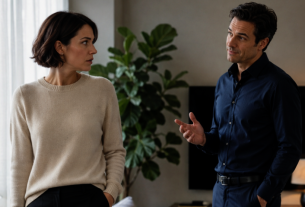
Friday. Six in the evening. I was at the stove, listening to the sizzling sound of cutlets—those classic ones from kindergarten menus that my Andrey loved. My hands moved on autopilot: straightening the napkin holder, checking the salt shaker, placing the store-bought tulips exactly in the center of the table. Everything had to be perfect. Just like always when his parents came to visit.
The doorbell rang—like an alarm going off. I took a deep breath, brushed a strand of hair from my forehead, and went to open the door.
«Hello, Tamara Stepanovna, Viktor Petrovich,» I smiled, stepping aside to let them in.
My mother-in-law, still in her astrakhan coat, walked into the hallway and eyed the shoe rack and my slippers. Her usually stern face softened for a brief moment.
«Olya, you really could’ve bought fresh flowers and not these… wilted ones,» she sighed, taking off her coat and hanging it up carefully—as if my humble coat rack was the wardrobe of a fancy restaurant.
«Hi, Mom, Dad,» Andrey came out of his study, already changed into his home clothes. He kissed his mother on the cheek and patted his father on the shoulder. Something inside me skipped a beat. His «hi» sounded so much warmer than my forced «hello.»
We sat down at the table. The first ten minutes were a sacred ritual: questions about the journey, about their health, about the weather. Then Tamara Stepanovna, after tasting a cutlet, put her fork down.
«It’s tasty, Olya, of course. But my Andrey likes it when it’s made with heart. With sautéed onions and creamy sauce. You remember that, don’t you?» Her voice was as sweet as syrup.
«I remember,» I nodded, feeling the warmth from the wine spread across my cheeks. «But he’s watching his diet now, training. These are diet-friendly.»
«Ah, yes, his career,» Viktor Petrovich perked up, pouring himself some cognac. «Well, tell us, son, how’s it going at the work front? We heard they’re considering you for a promotion.»
Andrey lowered his eyes modestly, but I knew that look—the look of someone triumphant, trying to appear humble.
«It’s nothing special, Dad. They trusted me with a new project, the budget’s big. I have a team of about twenty people reporting to me.»
«Wow, look at that!» my mother-in-law exclaimed, then her gaze, almost casual, slid over to me. «Our provider. Some sons-in-law are just average, but ours is pure gold. Olya, do you appreciate what a husband you have?»
I choked on my water. Under the table, Andrey touched my knee—a sign to calm down, don’t react. I pulled myself together.
«I do appreciate him, Tamara Stepanovna. Very much.»
«That’s right,» she said, cutting a piece of bread and spreading butter on it slowly. «I see some wives—they just sit at home, playing on social media, while their husbands work like crazy. That’s not an equal exchange. At least you have a side job… what is it you do again? Draw pictures for websites?»
«I’m a designer,» I corrected her quietly but firmly. «Yes, I work freelance. I have my own circle of clients.»
«Freelancer,» she said the word as if tasting something bitter. «That’s all so unstable. Today there’s work, tomorrow there’s not. It’s not like a steady paycheck at a big company, like our Andrey has. He’s shouldering the mortgage by himself, right?»
The air in the room grew thick. Andrey froze, his fork suspended mid-air. He glanced at me, and in his eyes I saw a silent plea: “Please, just don’t say anything. For God’s sake, don’t.”
I looked at his father. Viktor Petrovich was studying the label on his bottle very intently, pretending not to hear anything. Then I glanced at his mother. Her eyes glowed with triumphant, righteous certainty. She was utterly convinced of her own words.
And in that moment, something inside me flipped. It wasn’t anger. It wasn’t rage. It was emptiness. The very emptiness that had been building up over seven years of our marriage, every time he looked away, every time I heard that “our provider, our son.”
«Yes,» I said, and my voice sounded distant, even to myself. «He provides. Of course. Ever since we started living here.»
Andrey let out a breath. He moved his foot away from mine under the table. He thought the storm had passed. He didn’t realize it was just the calm before the worst storm ever. Tamara Stepanovna, feeling satisfied, nodded and shifted the conversation to her friend’s new fur coat. I sat there, smiling. I thought about how strange it was: the walls of this apartment, which were supposed to be our fortress, felt alien. As if I was still just a guest here. Temporary, and not especially wanted.
The conversation at the dinner table dragged on slowly, thick as molasses. We went over all the relatives, discussed gas prices, and complained about how tasteless TV shows are these days. I mindlessly cleared the plates, feeling my mother-in-law’s heavy, evaluative gaze on me. She watched my every move, as if checking a checklist—was I washing the dishes correctly, was I putting the cups in the cupboard the right way.
Andrey and his father moved to the living room to discuss the news. Fragments of their muffled conversation drifted in. I was left alone in the kitchen with my mother-in-law. She sat upright on a stool, sipping her tea in small, measured sips.
«So, Olenka,» she began, placing her cup down with a quiet but distinct clink against the saucer. «Let’s be honest. What are your plans?»
«For the weekend?» I asked, though I knew perfectly well what she meant.
«Oh, come on. I mean for the future. You’re already thirty. It’s a big apartment, a nice place. But it’s so quiet here… too quiet. Like a museum. When will we finally get some grandchildren? I’m not getting any younger. I look at my friends—they all have two grandkids already, and here I am just showing pictures on my phone of how my son decorated his new office.»
This wasn’t the first time she’d said this. But today, after all the talk of being a «provider» and «unequal exchanges,» her words landed on soil already saturated with the bitter water of old grievances. Each word was another drop, overflowing the cup.
«Tamara Stepanovna,» my voice was calm, though inside I was trembling. «Children aren’t interior decorations. They’re not here just to fill the silence.»
«Oh, enough with the clever remarks!» she dismissed it with a wave. «We all know what’s really going on. You’re just clinging to your so-called career. Sitting in your headphones, clicking away at your computer, when a mother’s duty can’t wait. Andrey’s tired—he wants to come home to children’s laughter, a home-cooked meal, not… not this.»
With a sweeping gesture, she took in my perfectly spotless, quiet kitchen. The look was so full of contempt, so dismissive of everything I had built here—maybe unwillingly, maybe with effort, but built nonetheless—that something inside me just snapped.
The silence she so despised suddenly exploded in my ears with a deafening roar. I heard the television in the living room go quiet. They heard us.
“Maybe,” I said, my calm so icy and dangerous that it even scared me, “I don’t want my children to grow up in an atmosphere where the most important thing is how much their father earns or what his new car looks like. Where their grandmother judges them, the way she judges my cutlets. Where the house is not a fortress, but a showroom for someone else’s ambitions.”
Dead silence fell. Andrei stepped out of the living room, pale, his eyes wide with terror. Behind him was Viktor Petrovich, awkwardly adjusting his glasses.
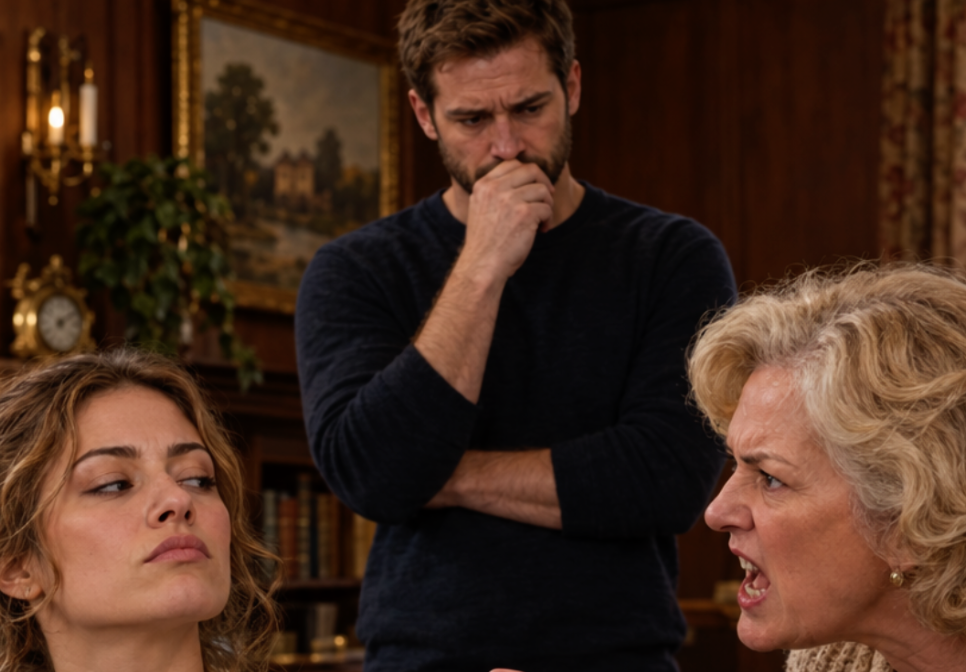
“What… what are you saying?” Tamara Stepanovna whispered. Her face changed, flushed a deep red. “How dare you?! I’ve spent my whole life for you…”
“Mom, Olya, please calm down,” Andrei said weakly, taking a step forward—but not toward anyone in particular. He stood frozen in the middle of the room like a mannequin.
“No, son, just wait!” my mother-in-law jumped up, her cup clattering as it rolled across the floor—but she didn’t even notice. She pointed accusingly at me. “Did you hear that? Did you hear what she said? About my grandchildren! About my son! In her own home!”
And there it was. That very phrase, the one that had hung in the air for all these years. It burst out at last, poisonous and completely natural for her.
“She’s gone soft with luxury! Living off you, in your house, and still has the nerve to say things like that! Get rid of her!—” she was no longer yelling at me but at Andrei, demanding he take action, demanding her authority be acknowledged. “Get her out of this house, I don’t want to see her here again! I’ve had enough of your ingratitude!”
I turned my gaze from her to Andrei. My husband. The man who was supposed to be my rock. I looked at him, waited. For a word, a sign, even just a single step in my direction.
He opened his mouth, swallowed hard. His eyes darted from my icy mask to his mother’s flushed face, then to his confused father. And I saw the same thing in his eyes I’d always seen at times like this: fear. Childish, panicked fear of his mother’s anger. And shame. Shame for me, for the scene, for having dragged this lie out into the open.
He looked away. Down. At the shards of the teacup lying on the floor.
That was the last straw. Not her hysteria. His silence. His cowardly, betraying avoidance of my gaze.
The air, seconds before thick with her screams, suddenly felt crystal clear and cold. I couldn’t hear her anymore. I couldn’t see her hands, shaking with fury. I straightened and spoke—my voice was quiet, steady, slicing through the hysteria like a blade through silk.
“Tamara Stepanovna.”
She fell silent, choking on her own rage, stunned by my tone.
“You’ve forgotten one thing. Just a tiny one. A purely formal detail.”
Slowly, I looked around the kitchen, the living room—this ‘her’ house.
«This house isn’t yours. And it’s not even…» I paused for a split second, locking eyes with Andrey, who jerked his head up. «It’s not even your son’s. My parents gave it to me as a gift. Every penny from selling their old apartment went right here, into these walls. Back then, your ‘breadwinner’ couldn’t even cover the down payment. The money ran out just after he bought himself a new suit for the job interview.»
I could see Andrey turn to stone. His father slowly, as if in a nightmare, sank into the sofa. But my eyes were fixed on her—on Tamara Stepanovna.
«The documents are in the safe. The same place as the statements from the first two years. From my accounts, Tamara Stepanovna. While your son was ‘getting on his feet,’ I was the one paying for this house. Want to see them?»
The silence that followed was absolute—ringing, terrifying. The only sound was Tamara Stepanovna’s ragged, hoarse gasp as she stared at me with shocked, faded eyes. She searched for her son’s gaze, desperate for him to deny everything. But all she found were his lips, pale with fear, and his empty, haunted eyes fixed on nothing. He didn’t even try to deny it.
The shock lasted just a few seconds, but it felt like an eternity. And then, cleaving that thick, sticky silence, came not a voice, but a sound—a desperate, primal scream that burst out of Tamara Stepanovna’s chest.
«Nooo!» she wailed—not words, just one long, piercing shriek made of denial and panic. She clutched her head, as if trying to hold together her shattering reality. «It can’t be! You’re lying! Son!» She lunged at Andrey, grabbing his pajama sleeve and shaking him. «Tell her! Tell her she’s making this up! That it’s nonsense! Say it!»
Andrey stood like a statue. He stared off somewhere above my head, his face gray and waxy. The arm his mother was shaking dangled lifelessly.
«Mom…» he rasped out. That wasn’t a denial. It was a groan.
«What do you mean, ‘Mom’?!» her cry grew louder, becoming hysterical. «Why are you silent?! Olya, have you lost your mind? Why are you saying such nonsense? Out of jealousy? Envy? Are you trying to destroy my family?!»
At that moment, the front door lock snapped loudly, and Olga burst into the apartment without even taking off her coat. Her hair was a mess, her face showing a mix of curiosity and irritation.
«What’s going on in here?» she almost shouted. «You guys are yelling across two floors! I can’t get the kid to sleep! Mom, what’s wrong with you?»
Seeing her daughter, Tamara Stepanovna found someone new to unleash her horror upon.
«Olenka! It’s her! She claims the apartment is hers! That her parents gave it to her! That our Andryusha didn’t even pay the down payment! She’s crazy!»
Olga froze at the kitchen doorway. Her quick, sharp gaze swept over me—cold, assessing—then moved to her brother, who still couldn’t utter a word, and finally landed on her father. Viktor Petrovich sat hunched over, face buried in his hands.
«Dad?» Olga asked quietly.
He just shook his head, never looking up. And that was all she needed.
It all happened in a split second. The shock on Olga’s face quickly turned to rage—but not the noble fury of a woman defending her family’s honor. It was something much more basic, panicked, and mean.
«You witch!» she hissed, taking a step toward me. «You calculative snake! All these years you pretended to be a quiet little mouse! All the while plotting behind our backs? You waited for my brother to get back on his feet, for everything to settle, and now you want to throw us out on the street? Are you trying to give Mom a heart attack?!»
Her words hit like spits in my face. But behind them, I didn’t hear defense of her mother, I heard something else—a deeper, scarier fear. Fear for herself. Fear that her carefully constructed world, where her brother was successful and therefore obligated to help, was about to collapse.
«No one is kicking anyone out, Olga,» I said, my voice icy calm—which seemed to enrage them even more. «I’m just stating the facts. Which, as I see, your brother has preferred to keep secret from everyone.»
«What facts?!» she screeched. «You’re just jealous! Your parents are poor teachers, and ours…»
«Olga, that’s enough,» Andrei’s voice finally came out, but it was dull, without any strength. It was all weariness and despair.
«No, it is not enough!» She no longer paid attention to him. «Where are these supposed ‘facts’ of yours, huh? Show me! I’ll sue you for slander!»
My calmness was a stone wall. I silently turned and walked to the bedroom. My heart was pounding, but my hands were steady. I opened the small safe built into the wardrobe and took out a blue cardboard folder—the one that had been sitting there all these years, like a silent reproach, a reminder of everything left unsaid.
I came back to the living room and placed the folder on the dining table, right on top of the bread crumbs and the wet circles from the cups. All five of us—me, Andrei, his mother, father, and sister—stared at that blue rectangle like it was a defused bomb.
«Here,» I said simply. «Deed of gift. Signed by my parents and me. Notarized. The date—five years and three months ago. And the amount—the full value of the apartment at the time.»
I opened the folder and pulled out the first sheet, offering it to Tamara Stepanovna. She wouldn’t take it. She looked at the paper as if it were a venomous snake. Viktor Petrovich took it instead, silently, his hands shaking. He put on his glasses and began to read, moving his lips. His face turned ashen.
«And this,» I said, pulling out a stack of papers bound together, «are bank statements from my personal account. For the first two years. See, marked in yellow—monthly mortgage payments. The second mortgage was smaller, but it existed. All while Andrei was earning his so-called ‘stable salary at a big company,’ which pretty much went into his business suits, restaurant lunches, and gas for the new car. That same car you all loved taking pictures with.»
I looked at Olga.
«You asked about the ‘poor teachers.’ Yes, they didn’t save up for a caracul fur coat. They saved up for their daughter’s future. And they gave everything they had. Not in exchange for anything. Just because they believed in our happiness. That kind of belief—well, it isn’t kept in a bank vault.»
Olga stayed silent. The rage that had just consumed her faded, replaced by confusion and that primal fear. She stared at her brother.
«Andrei… is it… true?»
He closed his eyes and nodded. Just once. It was as if his head weighed a ton.
«Why?..» she whispered, sounding more hurt like a child than accusing now. «Why didn’t you tell me?»
And suddenly, Andrei exploded. But not at me. At them. At everyone.
«What was I supposed to say?!» he yelled, his voice cracking with all the bitterness of seven years spent in humiliating silence. «That I couldn’t do it? That I couldn’t pull it off? That her parents, two modest teachers, turned out to be wealthier than all of us put together? That you, Mom, would look at me with the same disappointment you look at Dad? That you, Olga, would stop asking me for money for every little whim because ‘you’re so successful’? It was easier for me, you know? Easier!»
He was breathing heavily, his arms limp, propped on the table. Silence fell again, but now it was a different kind – heavy, dense, like a funeral march.
I looked at them: at my father-in-law, who still hadn’t lifted his eyes from the documents; at my mother-in-law, whose arrogance had shattered completely; at my sister-in-law, whose self-serving comfort had suddenly cracked; at my husband, whose lies had finally come to light.
«You know,» I began quietly, but each word dropped like a nail, «all these years you thought I was part of your company. The ‘Family & Co.’ company, where the main asset is your successful son, and I’m the silent junior manager whose job is to keep things cozy and never ask questions. You never even tried to get to know me. You needed an image. A convenient image. But I’m not an asset. And I’m definitely not free of charge.»
I closed the folder with the documents. The snap echoed through the room.
«You’re not a family. You’re a firm dedicated to laundering your conscience and propping up your status. And me… I was just someone else’s capital, which you mistakenly thought was yours. And now it’s audit time.»
They left without saying goodbye. Almost like it was on cue. Olga went first, mumbling something about her child, avoiding my gaze – her hurried exit looked more like an escape. Then Viktor Petrovich, rising cautiously from the couch, quietly placed the paper back in the folder, nodded into the space, and walked out without looking at his son or me. He looked twice as old as he had an hour ago.
Tamara Stepanovna was the last to leave. She didn’t shout anymore. Slowly, as if every joint in her body protested, she put on her old astrakhan coat and grabbed her handbag. At the door, she turned back. Her eyes, usually so sharp, were empty and scorched. She looked at Andrei, standing by the window with his back to the room.
«We believed in you,» she said softly. And she left, closing the door gently, not slamming it.
The click of the lock was deafening. We were left alone in the apartment. The air still felt thick from the scandal, from broken illusions, from the poison that had finally been released.
Andrei didn’t move. I stood by the table, hands pressed on the smooth blue folder. The kitchen clock ticked on. Somewhere outside, a car honked. Life on the other side of these walls carried on. Ours had just come to a stop.
He finally turned around. His face was ashen, his eyes bloodshot—not from tears, but from sheer tension.
«Are you happy now?» His voice was hoarse, barely above a whisper. «You destroyed everything. Down to the ground. Mom is half passed out, Dad… I don’t even know what’s going on with him now. My sister… Did you get what you wanted?»
I looked at him, and that strange sense of calm still wouldn’t let me go.
«I didn’t want this scandal, Andrey. I wanted the truth. At least between us. At least within these walls. You knew. All these years, you knew. And you stayed silent. You let her say those things. ‘Provider.’ ‘His house.’ You heard it every time. And you… you just looked away. Just like you did today.»
He suddenly strode to the table and pressed his fists against it.
«What was I supposed to do, Olya? Yell at my mother? Start a scene? Expose all this… all this financial dirt to them? They’re old-school! To them, a man is the breadwinner! I tried to be that! I worked myself ragged at my job to prove I was worth something! To live up to their expectations… and yours too!»
«My expectations?» I laughed softly, the sound bitter. «My expectations weren’t about you ‘proving’ anything. I wanted us to be together. To be a team. But you… you turned me into your secret. Your shameful secret. You didn’t protect me. You let me stand under their contemptuous stares as long as it kept your ‘successful son’ image intact. You knew this was my home, but you made me feel like a guest. Isn’t that just cowardice?»
«It’s not cowardice!» He straightened, fire flaring in his eyes—true, raw anger. «I was trying to keep the peace! Yes, I was ashamed! Ashamed that your parents did what mine couldn’t! Ashamed that, at the crucial moment, I ended up… amounting to nothing. And yes, I hoped it would stop mattering over time. That my own success would make up for everything. That I could finally contribute enough for this to be my home too. But you—» he shook his head, «you never forgot. You kept score. Every little jab, every remark. You carried it around like a dagger, waiting for the moment to stab me. And today you did it. Brilliantly. You didn’t want the truth. You wanted revenge.»
His words hit unexpectedly hard. Because there was some truth in them. Yes, I kept score. But not like a dagger. More like a heavy stone on my soul. A weight that suffocated our love.
«How else was I supposed to hold on to myself?» My voice trembled for the first time all evening. «All day, I could listen to them, smile, make those damn cutlets. And at night, when you fell asleep, I lay there staring at the ceiling. Thinking: he knows. He knows this is a lie. Why does he let it go on? Does that mean he agrees with them? Does he also see my job as ‘just clicking on a computer,’ and my parents’ help as something we have to hide, like it’s a disease? You thought your success would ‘compensate’? It only highlighted the gulf between us. You were building your tower on the sand of their approval, and I was expected to pretend it was granite.»
I turned away, staring into the dark window, where our distorted, separated reflection stared back at me.
“Greed, Andrei, isn’t just about money. There’s greed for someone else’s patience. For someone else’s silence. All of you—my mother, my father, my sister, and even you—you all greedily consumed my patience, acting like it was an endless resource. But love… love shouldn’t have a price tag. You can’t trade it. ‘I give you comfort, you endure my lies.’ That’s not a deal. That’s just prostituting feelings.”
Dead silence filled the space behind me. Then I heard him sink heavily into a chair.
“What do we do now?” His voice sounded, and there was no anger or accusation. Only endless fatigue and emptiness.
I closed my eyes. But instead of this evening, what came to mind was a day over five years ago. We stood with my parents in an empty apartment that smelled of fresh paint and hope. My mom, small, gray-haired, little wrinkles by her eyes, hugged me.
«This is your start, Olechka. Solid, dependable. Love should be built on something real, not a fear of tomorrow,» she said. My dad, reserved and a bit stiff, shook Andrei’s hand. «Take care of her. And this home. A home isn’t just walls. It’s what’s inside them.”
Back then, Andrei nodded eagerly, his eyes shining. “Thank you. We will. We’ll create something beautiful here.”
We created a crypt. A crypt for unspoken grievances and convenient lies.
I turned to him.
“I don’t know what we’re supposed to do, Andrei. All I know is I can’t live in these lies anymore. I can’t breathe this air—every breath just reminds me I’m supposed to be grateful you tolerate me in ‘your’ home. I’m tired of being your silent accomplice.” I paused. “Tomorrow, I’ll go stay with my parents. We both need…time. To understand if there’s anything left worth saving. Or if we buried it all seven years ago, the day you chose to stay loyal to your mother instead of standing up for me.”
Continued in the comments.
He didn’t answer. He just sat, hunched over, staring at the pattern on the tablecloth. His silence said more than words ever could. It held our whole story. A story not of drama, but of the quiet, slow dying of something vital. A death from indifference and a comfort that worked for everyone but me—comfortable lies.
Morning came quietly, with clear rays of light stretching across the parquet floor. I opened my eyes and, for a few seconds, didn’t know where I was. Then memory returned, falling into the sunlight like a heavy, cold stone. The fight. The documents. His leaving.
Andrei left for a hotel late at night. He didn’t argue, didn’t beg me to stay. He just gathered a small sports bag, put in his laptop, some chargers. At the door, he paused.
“I… I don’t know what to say,” he mumbled, not looking at me.
“Then don’t say anything,” I replied.
He nodded and left. And again, that quiet, careful click of the lock.
I lay on our bed, on my side, staring at his empty half. The pillow was untouched, the blanket smooth. It was as if he’d never really been there at all. Maybe he never was.
Struggling to my feet, I made my way into the kitchen. The blue folder was still on the table, right next to the pieces of a cup I hadn’t cleaned up from yesterday. Carefully, I swept them into a dustpan and threw them away. I put the kettle on. Those simple, mechanical actions helped me feel calmer.
I sat at the table and reached for the folder. Without opening it, I ran my hand over its smooth surface. For years, these papers had sat there as a silent reproach—a secret weapon I was afraid to use. But the truth was, they weren’t a weapon at all. They were something else… a testament. A testament to my parents’ faith. Their naive, unconditional faith in our future. They didn’t just give us money. They gave away their safety, their modest lifetime savings, fully believing they were planting them into good soil.
And Andrey and I took that gift and buried it in the ground of silence. We buried it so deep it started to suffocate and rot, poisoning everything around it.
The kettle switched off with a quiet click. I didn’t make tea. I needed to hear their voices. Not to complain. For something else.
I picked up my phone, found the contact ‘Mom and Dad’, and dialed. My heart started pounding in a strange way—not from nerves, but from shame. Shame for what we had turned their gift into.
«Olechka?» Mom’s cheerful voice, with a slight rasp, answered after the second ring. «Why so early, sweetheart? Is everything okay?»
I closed my eyes, letting the sound of her voice wash over me—so normal, so far away from yesterday’s nightmare.
«Everything’s fine, Mom. I just… missed you.» My voice didn’t betray me, it sounded steady.
«We’re just having breakfast,» I heard some clattering in the background and then Dad’s voice: «Who is it? Olya? Give me the phone.» «Hold on, your father wants to talk.»
«Hi, Olya,» Dad said. «How are you? How’s Andrey?»
That question—so simple, yet so terrifying. I couldn’t lie. But I also couldn’t tell the whole truth.
«We’re… going through a tough time, Dad. But we’ll figure it out. I… I just wanted to say thank you. For everything. For believing in us. For giving us that start.»
There was a brief pause on the other end. My parents had always been sensitive.
«Olya, are you sure everything’s okay?» Mom asked, now with a hint of worry. «Do you want us to come over?»
«No, no, that’s not necessary,» I said quickly. «Really. I just needed to say this. That I remember. That I appreciate it. That your gift… it didn’t just give me these walls. It gave me something to lean on. So now, even as things are tough, I have something holding me up. Your love was in that gift. And it’s still here, in these walls. It’s real.»
As I spoke, I realized my words were becoming more than just gratitude. I was finally voicing a truth I’d been hiding from myself—not the truth about money, but about love. Their love for me, which was unconditional. Unlike everything else around me.
«Sweetheart…» Mom seemed to understand. Maybe not all the details, but she felt the heart of it. «We’re always with you. You know that. Home is wherever you feel at home. Remember that.»
We chatted for another five minutes about little things—about the dacha, Dad’s back pain, a new movie they watched. Just regular life. The way things were before all these ‘breadwinners’ and ‘statuses.’ Maybe that’s what real life actually is.
After hanging up, I sat there holding my cup of hot tea. A sunbeam moved and landed on the windowsill, right where my ficus plant in its ceramic pot stood. Mom gave it to me when we moved in. «So it can clean the air and bring some greenery to your life,» she said back then.
I looked around my kitchen. The very same one that Tamara Stepanovna had once scorned for being too quiet. But now, that silence felt different. It wasn’t suffocating—it was spacious. There was finally room for me. Just for me. Suddenly, I realized I’d spent the last seven years barely breathing, always shrinking myself, trying to be smaller, quieter, more convenient. Just so I wouldn’t disturb the fragile, stinking illusion everyone had built together.
They always saw me as an outsider in their world—built on appearances, cardboard values, admiration for other people’s successes. When that illusion finally collapsed, I realized—they ended up being the strangers in my house. The house that smelled of my morning coffee and the plant Mom had given me. Where papers on the table were no longer weapons or secrets. Now they were just facts. My facts. My history.
I walked over to the window. Down below, life was buzzing: people heading to work, moms pushing strollers, old folks with grocery carts. Everyone with their own home. Their own skeletons in the closet. Their own silent deals and noisy arguments.
And it hit me—the worst thing that had eaten us from the inside wasn’t greed for money, or Andrey’s obsession with his career, or his mother’s hypocrisy. No, it was indifference. That cold, deep indifference to another person’s truth—to my truth. Andrey was indifferent to my feelings, always choosing the easier lie. His parents saw only the role—a wife for their son, not me as a person. Olga cared about nothing but her own benefit. And me… I’d been indifferent to myself for far too long, letting it all happen.
In this silence, now filled not by fear but by a bitter clarity, one simple, terrifying, and freeing question kept echoing: What do I do next? With this house. With this marriage. With myself.
What do you think? Is it possible to repair what years of indifference have destroyed? Or are some boundaries, once finally set, impossible to cross back over? Continued in the comments.