“Keep the Keys”: The Daughter-in-Law’s Bold Reply That Cooled Her Brazen Mother-in-Law’s Ardor
It was exactly the kind of St. Petersburg evening when the sky, the color of stale oatmeal, had decided to merge completely with the asphalt. Marina stood by the window of her new kitchen, pressing her palms around a cup of cooling tea. The apartment smelled of fresh renovation, parquet wax, and… an approaching catastrophe.
A duplicate set of keys lay on the table. Three small steel petals on a cheap plastic ring. They looked harmless, but to Marina, they were a detonator.
“Mom said it’s just ‘in case,’ Marina. What if a pipe bursts, or we lose our keys?” Artem’s voice from the living room sounded painfully apologetic.
Marina closed her eyes. She had seen this scenario hundreds of times with her friends. First it was “just in case,” then “I brought you some pies at eleven at night,” and in the finale, the mother-in-law was inspecting the cleanliness of the baseboards in the bedroom while the owners were at work.
“Your pipe is your responsibility, Artem. And our keys are the boundaries of our family,” she answered quietly but firmly.
But Antonina Igorevna was not a woman who recognized boundaries. She recognized only surrender.
Antonina Igorevna appeared on the doorstep on Saturday, exactly at nine in the morning. Without ringing. She had her own key, and she used it with the grace of a repeat burglar.
Marina, in a short silk robe and with a face mask on, froze in the hallway when she came face-to-face with “Mom.”
“Oh,” Antonina Igorevna threw up her hands theatrically, casually tossing her bag onto the console table Marina had spent so much effort choosing in a vintage shop. “Are you still sleeping? At this hour? I was passing by and thought I’d bring Temochka some homemade cabbage rolls. He’s become so thin with you, nothing but skin and bones.”
“Good morning, Antonina Igorevna. Artem is in the shower. And we were planning to sleep in,” Marina tried to keep her voice even, though everything inside her was vibrating with righteous anger.
“We’ll sleep in the grave, dear. While you’re young, you need to get things done. You’ve let the apartment go! Look at that mirror, it’s covered in streaks!” Her mother-in-law had already armed herself with a rag, which she had somehow produced from her bottomless bag.
The entire day passed under the motto “Marina does everything wrong.” The salt was in the wrong jar, the curtains hung too low, and Artem didn’t need rare meat but pureed soup, because he had gastritis in the third grade.
Artem, like a typical “good son,” smiled guiltily and tried to smooth things over.
“Marina, she only means well. Be patient, she’ll leave soon.”
But Marina knew: “soon” would never come unless the umbilical cord was cut right now.
Over the course of a month, the invasions became regular. Antonina Igorevna came when they were not home. Marina began noticing strange things: pots moved around, underwear rearranged in the dresser — the most humiliating part — and the constant scent of “Red Moscow” perfume hanging in the air like a poisonous fog.
The point of no return came on a Thursday evening. Marina returned from the office squeezed dry like a lemon after a difficult tender. She dreamed of a bath and a glass of wine.
When she opened the door, she heard laughter. In her living room, on her favorite sofa, sat Antonina Igorevna with her friend Tamara. They were drinking the collectible wine Artem had given Marina for their anniversary and discussing… Marina.
“…not a homemaker at all, Tomochka. Nothing in the fridge but yogurts and some kind of grass. My poor son eats like a rabbit. And that character of hers — hard as stone, you’ll never get a kind word from her.”
Marina stood in the doorway without taking off her shoes. The anger inside her cooled, turning into transparent ice, sharp as a razor.
“I’m glad you liked the wine,” she said coldly. “It costs three hundred euros a bottle. I hope you appreciated the notes of blackberry and my personal space.”
Her mother-in-law flinched, but quickly pulled herself together.
“Marina, why are you so prickly? We just sat down to rest. I opened the door with the keys. We weren’t going to wait outside until you decided to come home.”
Marina understood: conversations would not help. Artem was afraid of offending his mother, considering it his “filial duty.” And Antonina Igorevna mistook politeness for weakness.
On Friday, Marina took the day off. She visited a locksmith’s workshop, then made one important phone call.
That evening, when Artem came home, he found a strange scene. Marina was sitting at the table. In front of her lay an envelope and a sealed box.
“Is Mom coming tomorrow?” she asked casually.
“Yes, she wanted to bring some seedlings for the balcony… Marina, please don’t shout, I’ll talk to her.”
“No need, Tyoma. I’ve already decided everything.”
Saturday. 9:15. The sound of a key in the lock. A turn. Another. A scrape.
Antonina Igorevna frowned. The key would not turn. She tugged the handle — locked. Then she pressed the doorbell, long and insistently.
Marina opened the door. She was fully dressed: an elegant suit, flawless makeup, and a cold smile on her lips. Behind her stood a confused Artem.
“What happened to the lock?” her mother-in-law shouted from the doorway. “I was fiddling with it for five minutes! Did you change the lock?”
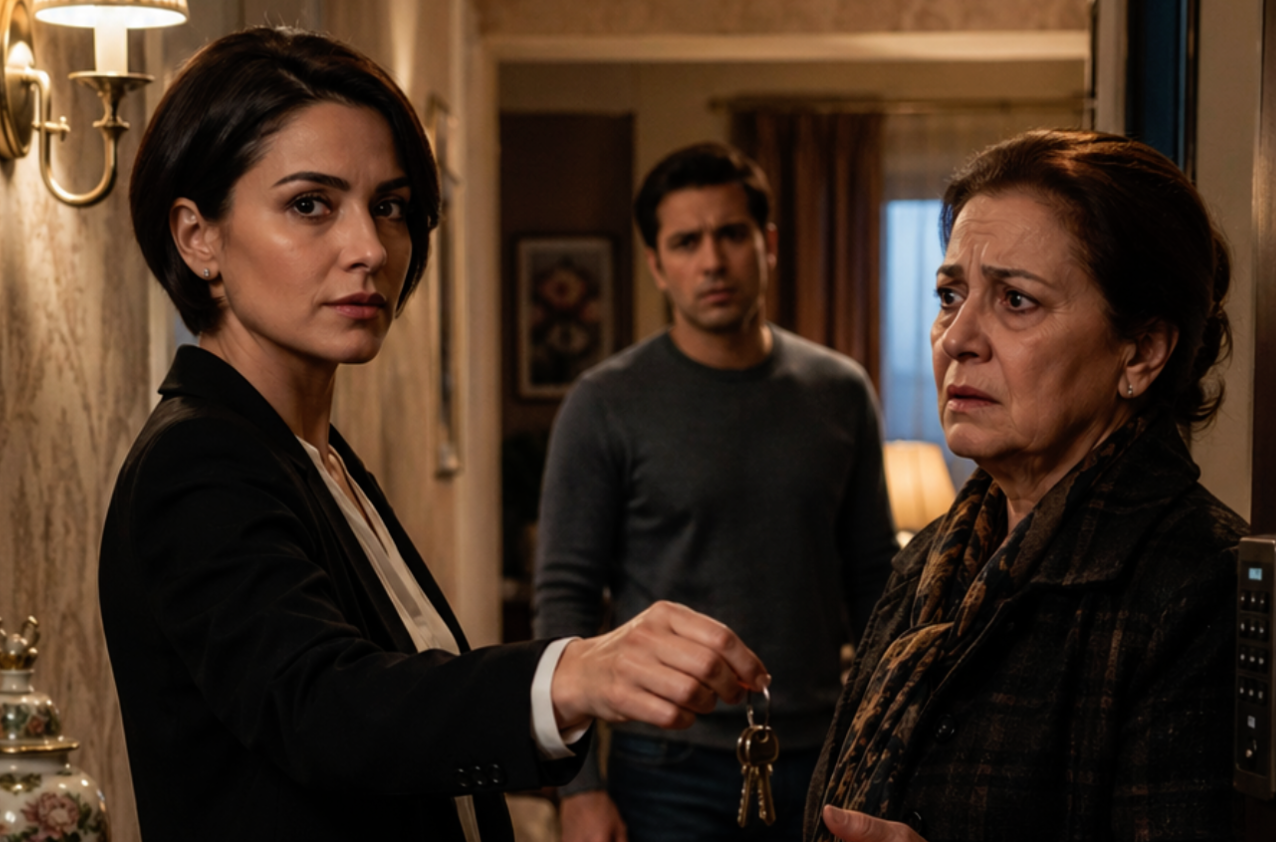
“Exactly, Antonina Igorevna,” Marina said, holding out her hand. “Give me your old set.”
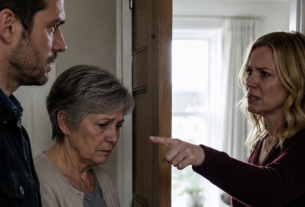
“This is outrageous!” Her mother-in-law began turning red. “Artem, do you see what she’s doing? She’s throwing your mother out into the street! In my son’s own home, I’m nobody now?”
Artem tried to speak: “Mom, we talked about boundaries…”
But Marina stepped forward. She carefully took the old keyring from the stunned woman’s hands.
“You won’t need these pieces of metal anymore. And now — your gift.”
Marina handed her the sealed box. Antonina Igorevna tore off the wrapping with trembling hands. Inside lay… a modern digital lock with a fingerprint reader.
“What kind of toy is this?” she hissed.
“It isn’t a toy. It is your new format for visiting. From now on, to enter, you’ll need to enter a code. But the code will work only on one day — Sunday, from noon to four. When we are both home and ready to receive guests.”
“You… you’re setting conditions for me?! Artem!” her mother-in-law shrieked.
“Mom, keep the keys,” Artem suddenly said clearly and loudly, looking his mother straight in the eyes. Marina felt pride for her husband spread through her body in a warm wave. “Keep them as a souvenir. There are different rules in this house now. We love you, but we are the ones who will live here. By our rules.”
Antonina Igorevna opened her mouth to launch into a tirade about ingratitude, heart drops, and “I raised you,” but then she met Marina’s gaze. There was no anger in it. Only the absolute, reinforced-concrete calm of a woman who had defended her territory.
“Keep the keys,” Marina repeated more softly. “They fit the doors of the past, where you could run our lives. But into the future, we invite you only after a call.”
Her mother-in-law left, loudly slamming the entrance door of the building. But a week later, she called. She did not open the door with her key — she called.
“Marina? I… found a recipe for duck with oranges. Could we… come by on Sunday at two?”
Marina smiled, looking at Artem, who was hanging their vacation photo on the wall — the one where it was just the two of them.
“Of course, Antonina Igorevna. We’ll be waiting for you.”
The battle was won. Not with shouting, not with tears, but with a lock changed at the right time and a phrase that put everything in its place.
During the first months after the wedding, Marina lived under the illusion that she had been lucky. Antonina Igorevna, a stately woman with a high hairstyle cemented with “Prelest” hairspray and the gaze of a head teacher with thirty years of experience, initially kept her distance. She only occasionally sent Artem messages: “Son, you haven’t forgotten that you have a weak liver, have you? Don’t overdo it with fried food.”
Marina, a successful marketer used to calculating risks, wrote it off as ordinary maternal anxiety. Until the “Curtain Incident” happened.
It was six months after the housewarming. Marina bought heavy drapes for the bedroom in the color of deep indigo. They created an atmosphere of coziness, intimacy, and exactly the kind of privacy that is so important for newlyweds.
When she came home from work on Tuesday, Marina froze on the threshold of the bedroom. On the windows hung… peach tulle with ruffles. Thin, cheap polyester, reminiscent of the outfit of a provincial prom girl from the 1990s. The indigo curtains lay neatly folded on the armchair, weighed down by a note:
“Marinochka, the bedroom should be bright and joyful, not like a crypt. Dust shows more on blue. No need to thank me. Mom.”
That evening, Marina shouted for the first time. Not at her mother-in-law — at Artem.
“She went into our bedroom!” she rushed around the room. “She touched our things! She decided what kind of light would fall on our bed! Artem, this is a physical invasion!”
Artem, huddled in the corner of the sofa, looked like a man trying to hide from artillery fire under a newspaper.
“Marina, they’re just curtains… She wanted to help. She was bored, went to the market, saw that peach color… She’s an old woman, she needs to feel needed.”
“She needs to feel in charge, Artem! There’s a difference.”
Marina put the curtains back that same evening. The tulle went into the trash bin. The next morning, Antonina Igorevna called Artem and cried for three hours, complaining of heart pain and the “black ingratitude of a daughter-in-law who threw away a gift bought with pension pennies.”
Artem felt like a criminal. Marina felt like a witch. Antonina Igorevna felt like a winner — because now everyone was talking about her.
Antonina Igorevna moved on to the tactic of “soft power.” She no longer changed the curtains. She began “taking care.”
Every visit of hers — in the owners’ absence, of course — was accompanied by tiny, almost imperceptible adjustments to reality. Marina would discover that her organic shampoo, worth 3,000 rubles, had been moved to the far corner of the shelf, while tar soap now stood in plain sight — “because that chemical stuff makes your hair fall out.”
In the kitchen cabinet, the spices Marina had sorted alphabetically were suddenly mixed into one heap, but the jars of grains were now labeled in her mother-in-law’s calligraphic handwriting: “RICE,” “BUCKWHEAT,” “POISON.” The last one, fortunately, turned out to be barley groats, but Marina still involuntarily shuddered.
“She’s marking her territory, do you understand?” Marina explained to her friend Katya in a café. “Like a cat. Only instead of… well, you understand, she uses cabbage rolls and rearranging jars of face cream. She’s pushing out my scent with hers.”
“Listen,” Katya said, taking a sip of latte, “why don’t you just take the keys back?”
“Because Artem gave them to her voluntarily. He thinks taking them back now would be a mortal insult. She plays on guilt masterfully. The second you bring up the keys, her blood pressure shoots up, her left arm goes numb, and an ambulance gets called.”
Marina realized that classic methods did not work in this war. You cannot confront a professional victim with aggression.
The climax came on Artem’s birthday. Marina had planned a surprise: dinner for two, candles, a rare vinyl record player, and a complete absence of the outside world. She warned her mother-in-law a week in advance: “We’re going out of town, don’t come, we won’t be home.”
It was a lie. Marina wanted to spend the evening at home, but in peace. She knew Antonina Igorevna would not be able to resist.
At seven in the evening, while risotto simmered on the stove and Artem opened champagne, the familiar scraping sounded in the lock. Artem turned pale.
“You said she wouldn’t come…”
“Shh,” Marina pressed a finger to her lips.
The door swung open. Antonina Igorevna barged into the hallway with a huge Napoleon cake and three bags from a delicatessen. Behind her shuffled her faithful companion — Aunt Lyusya.
“Come in, Lyusenka! See, nobody’s home, they left. And now we’ll prepare a surprise. Temochka will come back, and here Mommy has set the table, cleaned everything up… Otherwise Marina is probably feeding him army rations in a tent somewhere…”
Continuation just below in the first comment.
It was one of those St. Petersburg evenings when the sky, the color of stale oatmeal, seemed to have finally decided to merge with the asphalt. Marina stood by the window of her new kitchen, pressing her palms around a cup of cooling tea. The apartment smelled of fresh renovation, parquet wax, and… an approaching disaster.
On the table lay a duplicate set of keys. Three small steel petals on a cheap plastic ring. They looked harmless, but to Marina they were a detonator.
“Mom said it’s just ‘in case,’ Marin. You know, what if a pipe bursts, or we lose our keys?” Artem’s voice from the living room sounded painfully apologetic.
Marina closed her eyes. She had seen this scenario a hundred times with her friends. First it was “just in case,” then “I brought you some pastries at eleven at night,” and in the final stage, the mother-in-law was inspecting the cleanliness of the bedroom baseboards while the owners were at work.
“Your pipe is your responsibility, Artem. And our keys are the boundaries of our family,” she replied quietly but firmly.
But Antonina Igorevna was not a woman who recognized boundaries. She recognized only surrender.
Antonina Igorevna appeared on the doorstep on Saturday, exactly at nine in the morning. Without ringing. She had her own key, and she used it with the grace of a repeat burglar.
Marina, in a short silk robe and with a face mask on, froze in the hallway, coming face-to-face with “Mom.”
“Oh,” Antonina Igorevna threw up her hands with feigned surprise, casually dropping her bag onto the console table Marina had spent so much effort choosing in a vintage shop. “Are you still sleeping? At this hour? I was just passing by and thought I’d bring Temochka some homemade cabbage rolls. He’s become completely transparent with you, skin and bones.”
“Good morning, Antonina Igorevna. Artem is in the shower. And we had planned to sleep in,” Marina tried to keep her voice even, though inside everything was vibrating with righteous anger.
“We’ll sleep in the grave, sweetheart. While we’re young, we need to get things done. You’ve let the apartment go! Look at the mirror, there are streaks all over it!” Her mother-in-law had already armed herself with a rag, which she had somehow produced from her bottomless bag.
The entire day passed under the motto “Marina does everything wrong.” The salt was in the wrong jar, the curtains hung too low, and Artem did not need rare meat but pureed soup, because he had gastritis in third grade.
Artem, like a typical “good son,” smiled guiltily and tried to smooth things over.
“Marin, she just wants what’s best. Be patient, she’ll leave soon.”
But Marina knew: “soon” would never come unless the umbilical cord was cut right now.
Over the next month, the invasions became regular. Antonina Igorevna came when they were not home. Marina began noticing strange things: pots moved around, underwear rearranged in the dresser — the most humiliating part — and the eternal aura of Red Moscow perfume hanging in the air like poisonous fog.
The point of no return came on a Thursday evening. Marina came home from the office squeezed dry after a difficult tender. She dreamed of a bath and a glass of wine.
When she opened the door, she heard laughter. In her living room, on her favorite sofa, sat Antonina Igorevna with her friend Tamara. They were drinking a collectible wine Artem had given Marina for their anniversary and discussing… Marina.
“She’s no housewife at all, Tomochka. The fridge has nothing but yogurts and some kind of grass. My poor son eats like a rabbit. And her character is made of stone — you’ll never get a kind word from her.”
Marina stood in the doorway without taking off her shoes. The anger inside her cooled, turning into transparent ice, sharp as a razor.
“I’m glad you enjoyed the wine,” she said coldly. “It costs three hundred euros a bottle. I hope you appreciated the notes of blackberry and my personal space.”
Her mother-in-law flinched but quickly pulled herself together.
“Marin, why are you so prickly? We just sat down to rest. I opened the door with the keys. Should we have waited outside until you deigned to come home?”
Marina understood: conversations would not help. Artem was afraid of offending his mother, considering it his “filial duty.” And Antonina Igorevna mistook politeness for weakness.
On Friday, Marina took a day off. She visited a locksmith’s workshop and then made one important phone call.
That evening, when Artem came home, he found a strange scene. Marina was sitting at the table, an envelope and a sealed little box lying in front of her.
“Is Mom coming tomorrow?” she asked casually.
“Yes, she wanted to bring some seedlings for the balcony… Marin, just don’t yell. I’ll talk to her.”
“No need, Tema. I’ve already decided everything.”
Saturday. 9:15 a.m. The sound of a key in the lock. A turn. Another. A scrape.
Antonina Igorevna frowned. The key would not turn. She pulled the handle — locked. She pressed the doorbell, long and demanding.
Marina opened the door. She was fully dressed: an elegant suit, flawless makeup, and a cold smile on her lips. Behind her stood a confused Artem.
“What happened to the lock?” her mother-in-law shouted from the threshold. “I was fiddling with it for five minutes! Did you change the lock?”
“Exactly, Antonina Igorevna,” Marina said, holding out her hand. “Give me your old set.”
“This is outrageous!” Her mother-in-law began to redden. “Artem, do you see what she’s doing? She’s throwing your mother out onto the street! In my son’s own home, am I nobody now?”
Artem tried to get a word in.
“Mom, we talked about boundaries…”
But Marina stepped forward. She carefully took the bunch of old keys from the stunned woman’s hands.
“You won’t need these pieces of metal anymore. And now — your gift.”
Marina handed her the sealed box. Antonina Igorevna tore off the wrapping with trembling hands. Inside lay… a modern digital lock with a fingerprint reader.
“What kind of toy is this?” she hissed.
“It’s not a toy. It is your new visiting format. Now, to enter, you need to type in a code. But the code will work only on one day: Sunday, from twelve to four. When we are both home and ready to receive guests.”
“You… you’re setting conditions for me?! Artem!” her mother-in-law shrieked.
“Mom, keep the keys,” Artem suddenly said clearly and loudly, looking his mother straight in the eyes. Marina felt pride for her husband spread through her body like a warm wave. “Keep them as a souvenir. There are different rules in this house now. We love you, but we are the ones who will live here. By our rules.”
Antonina Igorevna opened her mouth to launch into a tirade about ingratitude, heart drops, and “I raised you,” but she met Marina’s gaze. There was no anger in that gaze. Only the absolute, reinforced-concrete calm of a woman who had defended her territory.
“Keep the keys,” Marina repeated more softly. “They fit the doors of the past, where you could control our lives. But into the future, we invite you only after you ring the bell.”
Her mother-in-law left, loudly slamming the entrance door downstairs. But a week later, she called. She did not open the door with her key. She actually called.
“Marina? I… found a recipe for duck with oranges. Could we… come by on Sunday at two?”
Marina smiled, looking at Artem, who was hanging their vacation photo on the wall — the one where there were only the two of them.
“Of course, Antonina Igorevna. We’ll be waiting for you.”
The battle had been won. Not with shouting, not with tears, but with a lock changed at the right time and a phrase that put everything in its place.
During the first months after the wedding, Marina lived under the illusion that she was lucky. Antonina Igorevna, a stately woman with a high hairstyle cemented with Prelest hairspray and the gaze of a head teacher with thirty years of experience, initially kept her distance. She only occasionally sent Artem messages: “Son, you haven’t forgotten that your liver is weak, have you? Don’t overdo the fried food.”
Marina, a successful marketer accustomed to calculating risks, dismissed it as ordinary maternal anxiety. Until the “Curtain Incident” happened.
It was six months after the housewarming. Marina bought heavy curtains for the bedroom in a deep indigo color. They created an atmosphere of coziness, intimacy, and that very sense of privacy so important for newlyweds.
When she came home from work on Tuesday, Marina froze on the threshold of the bedroom. On the windows hung… peach-colored tulle with ruffles. Thin, cheap polyester, resembling the outfit of a provincial prom girl from the 1990s. The indigo curtains lay neatly folded on an armchair, weighed down by a note:
“Marinochka, a bedroom should be bright and cheerful, not like a crypt. Dust is more visible on blue. No need to thank me. Mom.”
That evening, Marina screamed for the first time. Not at her mother-in-law — at Artem.
“She went into our bedroom!” she paced around the room. “She touched our things! She decided what kind of light would fall on our bed! Artem, this is a physical invasion!”
Artem, curled into the corner of the sofa, looked like a man trying to hide from artillery fire under a newspaper.
“Marin, they’re just curtains… She wanted to help. She was bored, went to the market, saw that peach color… She’s an older woman. She needs to feel needed.”
“She needs to feel in charge, Artem! There’s a difference.”
Marina put the curtains back that very evening. The tulle went into the trash bin. The next morning, Antonina Igorevna called Artem and cried for three hours, complaining of heart pain and “the black ingratitude of a daughter-in-law who threw away a gift bought with pension pennies.” Artem felt like a criminal. Marina felt like a witch. Antonina Igorevna felt like the winner — because now everyone was talking about her.
Antonina Igorevna switched to a “soft power” strategy. She no longer changed the curtains. She began to “care.”
Every one of her visits — in the owners’ absence, of course — was accompanied by small, almost unnoticeable corrections of reality. Marina would discover that her organic shampoo, worth 3,000 rubles, had been moved to the far corner of the shelf, while tar soap stood in plain sight “because your chemicals will make your hair fall out.”
In the kitchen cabinet, the spices Marina had arranged alphabetically would suddenly be mixed into a pile, while the jars of grains were now labeled in her mother-in-law’s calligraphic handwriting: “RICE,” “BUCKWHEAT,” “POISON.” The last one, fortunately, turned out to be barley groats, but Marina still involuntarily shuddered.
“She’s marking territory, do you understand?” Marina explained to her friend Katya in a café. “Like a cat. Only instead of… well, you get it, she uses cabbage rolls and rearranged cream jars. She’s pushing out my scent with hers.”
“Listen,” Katya said, sipping her latte, “why don’t you just take the keys back?”
“Because Artem gave them to her voluntarily. He thinks taking them back now would be a mortal insult. She’s a master at playing on guilt. The second anyone mentions the keys, her blood pressure instantly jumps, her left arm goes numb, and an ambulance is called.”
Marina realized that classic methods did not work in this war. You cannot fight a professional victim with aggression.
The climax came on Artem’s birthday. Marina had planned a surprise: dinner for two, candles, a rare vinyl record player, and a complete absence of the outside world. She had warned her mother-in-law a week in advance: “We’re going out of town. Don’t come. We won’t be home.”
It was a lie. Marina wanted to spend the evening at home, but in silence. She knew Antonina Igorevna would not be able to resist.
At seven in the evening, while risotto was simmering on the stove and Artem was opening champagne, the familiar scraping sound came from the lock. Artem turned pale.
“You said she wouldn’t come…”
“Shh,” Marina pressed a finger to her lips.
The door flew open. Antonina Igorevna burst into the hallway with a huge Napoleon cake and three bags from a deli. Behind her shuffled her faithful companion, Aunt Lyusya.
“Come in, Lyusenka! See, no one’s home, they’ve gone away. We’ll prepare a surprise now. Temochka will come back, and Mommy will have set the table, cleaned everything up… Otherwise Marina is probably feeding him dry rations in a tent somewhere.”
They walked into the kitchen. And froze.
Marina and Artem were sitting at the table. In complete silence. By candlelight.
“Oh…” Aunt Lyusya squeaked.
Antonina Igorevna was confused for a second, but immediately went on the attack.
“Artem! You deceived your mother? You said you were leaving, and here you are… hiding? From whom? From your own mother?”
“From people who do not understand the word ‘no,’ Antonina Igorevna,” Marina stood up, and in the dim candlelight her figure seemed frighteningly majestic. “You entered someone else’s apartment without an invitation. With an outsider. On a day when you were asked not to come.”
“This is my son’s apartment!” her mother-in-law screamed. “I gave birth to him in agony, I raised him and put him on his feet while you were swinging your tail around your offices! Artem, say something to her!”
Artem remained silent. He looked at the Napoleon cake beginning to melt in his mother’s hands, and something in his eyes finally went out. The “good boy” inside him had just seen his “saintly mother” unceremoniously trample his right to a private life.
“Leave,” Artem said quietly.
“What?!” Antonina Igorevna dropped the bag of cutlets.
“Leave. And put the keys on the little cabinet.”
His mother-in-law performed the classic routine: she clutched her heart, sank onto the bench, and began gulping air convulsively. Aunt Lyusya wailed, “A doctor! An ambulance! You’ve killed the woman!”
Marina calmly walked to the cabinet, took out a blood pressure monitor — purchased especially for occasions like this — and fastened the cuff around her mother-in-law’s arm.
“120 over 80, Antonina Igorevna. Pulse like an astronaut. Stop the circus. Aunt Lyusya, escort your friend to the exit before I call the police for unlawful entry. There is a camera on my door, and it’s recording.”
That was the first round in which her mother-in-law retreated. She did not leave the keys, of course — she “forgot in the commotion.” But Marina already knew what to do.
The following week, Marina spent studying security forums. She did not need just a lock. She needed a tool of re-education.
She chose a smart home system with biometric access. She paid for the installation herself and set up the scenarios herself.
That Saturday, as she stood behind the closed door listening to her mother-in-law break her nails against the keyhole, Marina felt a strange peace. It was not revenge. It was surgery. The amputation of toxic influence.
When the door finally opened and Antonina Igorevna began her tirade about being “thrown onto the street,” Marina did not argue. She simply showed her the phone.
“Look here, Mom. This is the app. See this icon? This is your ‘access window.’”
“What window? Am I some kind of vent to you?” her mother-in-law snapped.
“Almost. Now your old key is just a piece of metal. And my phone decides when the door lets you in. On Sunday, when Artem is ready to communicate with you, the lock will recognize your finger. On all other days, you are a stranger to it.”
“Artem! Do you hear this?! She has locked me inside a computer program!”
Artem stepped forward. He looked ten years older, but his posture no longer had that guilty stoop.
“Mom, Marina is right. You didn’t hear words. Maybe you’ll hear the lock. Keep the keys — as a memory of the time when you thought this was your home too. Now it is only our home.”
He gently but firmly took his mother by the shoulders and turned her toward the exit.
“Come on Sunday at two. We’ll order pizza. But only if you promise not to touch the curtains.”
A month passed.
For the first week, Antonina Igorevna did not call. She was “dying” in silence in her apartment, waiting for her son to crawl to her on his knees, begging forgiveness and homemade cutlets. He did not crawl.
The second week, she bombarded Artem with links to articles about how “evil wives destroy families.” Artem replied with short phrases: “Understood,” “Okay,” “See you Sunday.”
In the third week, she came. On Sunday. At 1:55 p.m.
She stood for a long time in front of the door, looking at the glowing panel of the lock. Then she carefully placed her finger on it. A soft melodic sound rang out, and the lock opened with a quiet click.
She entered the apartment slowly, as if entering a museum. The hallway did not smell of Red Moscow perfume but of sandalwood incense sticks — Marina’s choice.
“Hi, Mom,” Artem came out to meet her, dressed casually, relaxed and smiling. “Come in. We’ve just made tea. The one with bergamot, the kind you like.”
Marina came out of the kitchen, wiping her hands with a towel.
“Good afternoon, Antonina Igorevna. Come in, sit down. As you can see, the curtains are still in place.”
Her mother-in-law pursed her lips, clearly fighting the urge to comment on the dust on the shoe shelf, but… she held back. She understood the main truth of this new life: here she was a guest. An honored, loved guest, but a guest. And her right to be here now depended not on her whims, but on her ability to respect someone else’s territory.
The evening went surprisingly peacefully. They talked about the weather, vacation plans, old movies. No one taught Marina how to cook soup. No one checked whether the bed linen was fresh.
When, at four o’clock, the lock automatically “closed the access window” for outsiders — announcing it with a soft signal — Antonina Igorevna began gathering her things on her own.
“Well, it’s time for me to go,” she said, adjusting her hairstyle in front of the mirror. “I have things to do, you know. My friends are calling me to the philharmonic.”
At the threshold, she turned and looked at Marina. There was no longer that poisonous malice in her eyes. Rather, there was the bitter respect of one strong player for another.
“And the lock… it’s nice,” she muttered. “Modern.”
“Thank you, Mom,” Marina smiled. “Until next Sunday?”
“Until Sunday.”
When the door closed, the apartment was filled with that special silence that exists only in a truly safe place.
Marina walked up to her husband and rested her head on his shoulder.
“How are you?”
“You know… for the first time in a long time, I don’t feel like running away from my own home,” Artem admitted. “Thank you. For being firm when I was… well, you know.”
“We’re a team, Tema. Sometimes one of us has to be the lock so the other can remain the key.”
Marina looked at the console table in the hallway. There, in a small crystal vase, lay those very old keys. Antonina Igorevna had left them after all. But now they were just metal. A beautiful, meaningless artifact of a past era.
She picked them up and hid them in the farthest drawer of the desk. Not because she was afraid, but simply so they would not take up space in their new, clear, clean life.
The evening in St. Petersburg continued, but now the sky no longer seemed gray. It was the color of hope — that very indigo that suited their new curtains so perfectly.