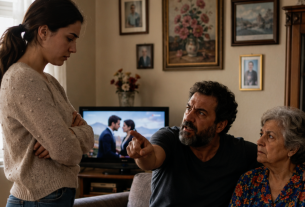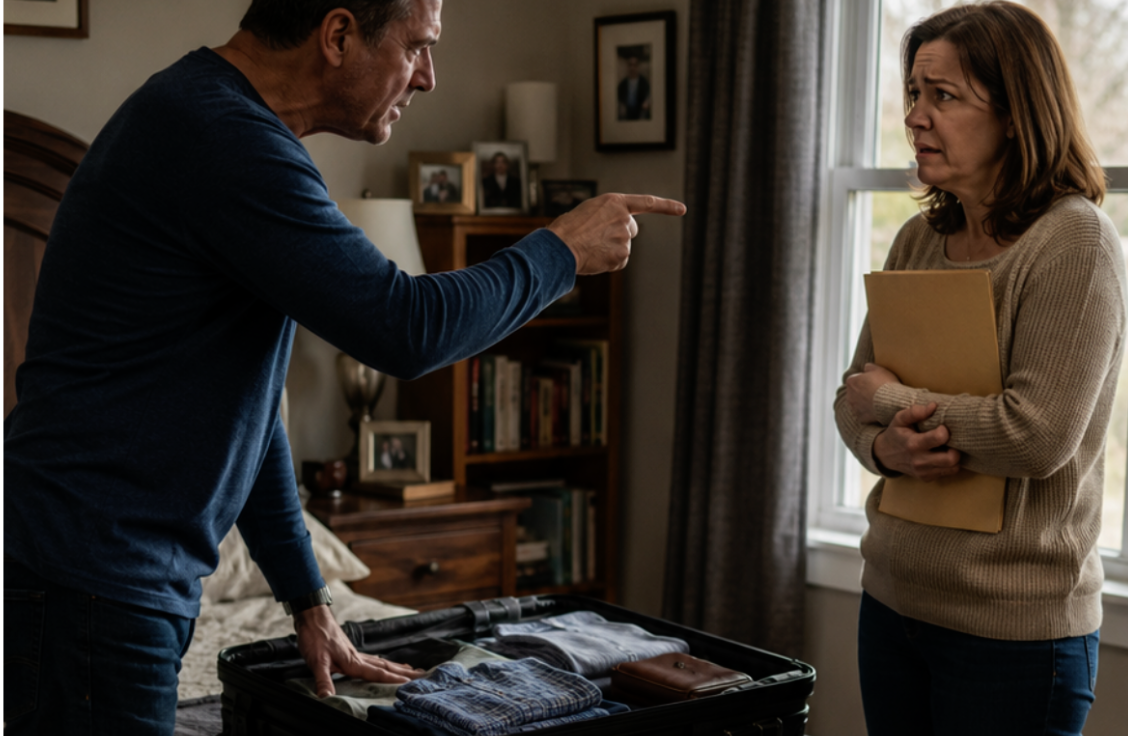
Gennady was fastening the suitcase when she entered the bedroom. The shirts lay in a neat stack, as if he had folded them slowly, with pleasure.
Marina leaned against the doorframe. The kitchen clock showed a quarter to ten, and its steady ticking carried through the half-open door. Alisa was already asleep in her room, hugging a plush rabbit with one torn ear. Behind the wall, the neighbors’ television was on; muffled laughter seeped through the concrete.
On the shelf above the bed stood his mug. Blue, with a chipped edge. He had drunk from it every morning for twelve years.
“Where are you going?”
He did not turn around. He took a winter jacket from the wardrobe, folded it, and placed it on top of the shirts.
“Gena.”
“Listen, let’s not make a scene. I’m leaving.”
He said it as if he were talking about a business trip. Calmly. Efficiently. The room smelled of his cologne, the woody one she had given him for his last birthday. Today the scent was stronger, as if he had sprayed it twice.
Marina gripped the edge of her apron. Her fingers found the seam on their own and began worrying at it.
“To whom?”
“That doesn’t matter.”
“It does.”
Gennady turned around. The lamp on the nightstand lit his face from below, throwing sharp shadows across it: the square jaw, the early gray at his temples, the deep crease between his brows. She used to smooth that crease with her finger when he was falling asleep. Now it looked unfamiliar.
“Her name is Polina. We’ve been seeing each other for six months.”
Six months.
Marina tried to remember what had happened six months ago. September. Their daughter had started second grade. They had still been buying her a backpack together at the shopping center on Michurinsky Avenue: he had carried the bags, she had held their daughter’s hand.
And even then, he already had her.
Her knees went weak. She did not sit down, but she leaned her shoulder against the wall. The wall was cold even through the fabric of her sweater.
“And Alisa?”
“I’ll see my daughter. Child support, everything as it should be.”
He spoke about the child in the same tone he had used for the jacket. The word “child support” sounded, coming from him, like a line in a business plan. Just another expense item, nothing more.
Then he said the main thing.
Not right away. First, he closed the suitcase, checked the pockets of his jacket, put his charger into his backpack. Only when he straightened did he look directly at her. His eyes were calm, like those of a man who had calculated everything long ago.
“The apartment is registered in my mother’s name. You know that.”
Marina blinked.
“What do you mean, in your mother’s name?”
“I transferred it. Six months ago.”
Again, six months.
He had begun a new life and, at the same time, taken the old one apart brick by brick. Dryly. Without emotion. The same way he had built his business.
“The business is in my mother’s name too,” he said matter-of-factly, zipping up his backpack. “Listen, don’t make this complicated. In the divorce, you’ll be left with nothing. That’s a fact. I have a lawyer. A good one. He checked everything.”
He had a lawyer.
A good one.
He had checked everything.
Marina stood there and listened to the collapse of everything she had invested twelve years into. Not some abstract “marriage.” Concrete things: the renovation they had done themselves, the wallpaper she had hung while seven months pregnant, their daughter’s room painted yellow because the girl had wanted it “like the sun.”
“Gena, this is my home. Our daughter lives here.”
“You’ll find a rental. Your mother will help.”
“My mother died two years ago.”
He looked away.
Not out of shame. Out of inconvenience. That was how people looked away when the other person had said something that disrupted a convenient plan.
“Well, you’ll figure it out. You’re a grown woman.”
The suitcase lock clicked. He lifted it with one hand, slung the backpack over his shoulder, and went to the door. In the hallway, he stopped beside the child’s room. Stood there for a second.
He did not go in.
The door closed quietly, without a slam.
Marina stood in the bedroom and looked at the empty half of the wardrobe. The hangers swayed, giving off a barely audible ringing sound, thin and metallic, as if someone had plucked a string and let it go.
She did not sleep the first night. She sat in the kitchen, warming her hands around a mug of tea, staring at the table where his plate had still been that morning. A stain from egg yolk remained on the oilcloth. She did not wipe it away.
On the mezzanine shelf stood a box with her mother’s things. Marina lifted her head and looked at it: a cardboard banana box with the word “Ecuador” printed on the side. She had not touched it in two years.
She really should sort through it.
Later.
Not now.
In the morning, Alisa came in wearing dinosaur pajamas, rubbing her eyes with her fist.
“Mom, did Dad go to work?”
“Yes, sunshine. To work.”
The girl nodded, climbed onto a chair, and began swinging her legs. Her thin braids had come loose overnight, and her freckles stood out more clearly in the morning light. She asked if there would be pancakes.
Marina got up and began taking out the flour. Her hands performed the familiar motions: sift, crack the egg, stir. But in her head one thought kept spinning.
Six months.
He had been planning for six months. Transferring things. Hiding things. And not once had he given himself away.
Or had he?
She remembered October. He had started staying late on Wednesdays. In November, he had changed the password on his phone when she had asked to check the weather forecast. In December, he had given her earrings with small sapphires. Beautiful. Expensive. She had even been surprised then: why all of a sudden? It was not an anniversary, not a holiday.
Just because, he had said.
Now “just because” looked different.
He had been buying her off. Or perhaps practicing the role of a generous man for someone else.
The pancakes were burning. Alisa shouted, “Mom, it smells!” and Marina quickly flipped the pan. The first pancake went into the trash. The second turned out all right. She spread butter on it and placed it on her daughter’s plate.
“They’re tasty, Mom.”
“Eat, eat.”
Marina sat down beside her and wrapped her palms around her cup. The tea had already gone cold, but she did not reheat it. She drank it cold and did not notice.
She called Zinaida two days later.
Not because she was ready.
Because there was no one else.
Her friend arrived forty minutes later, as if she had been waiting for that call. She came in, took off her boots, and dropped her bag on the hallway cabinet. She looked at Marina through her thick brown-framed glasses: broad cheekbones, large hands, a bob haircut she trimmed herself with paper scissors.
“Woman, your face is gray. When did you last eat properly?”
“Yesterday. I think.”
“Clear. Sit down. I’ll cut something.”
Zinaida opened the refrigerator and shook her head. She took out cheese, sausage, and a cucumber. Found bread in a bag and cut sandwiches right on the cutting board, without a plate. She pushed them toward Marina.
“Eat. Then talk.”
Marina took a bite. The bread was dry, but she chewed it. Then she told her everything. Quietly, as though retelling someone else’s story: Gennady, the suitcase, Polina, the apartment in his mother-in-law’s name. “You’ll be left with nothing.”
Zinaida chewed her sandwich and listened without interrupting. She adjusted her glasses. When Marina fell silent, her friend raised an eyebrow.
“So, apparently, in six months he shifted everything over to his mommy, and you didn’t notice?”
“I wasn’t checking. Why would I check my husband?”
“Because men do this, Marin. Not all of them. But ones like yours absolutely do.”
Something tightened in her chest. Not from tears. From anger, which arrived late, as if it had taken the last bus and almost missed its stop.
“He said he has a lawyer. Everything is clean.”
“A lawyer. Well, well. Have you been to one yourself?”
“No.”
Zinaida finished her tea in one gulp. She set the mug down so hard it knocked against the table.
“You’re going. Tomorrow. I’ll send you the address.”
Then she gathered the dishes, washed the mugs, and wiped the table. Marina sat and watched her friend moving about someone else’s kitchen. Zinaida did it without fussing, without being intrusive. She simply did it.
“Zin.”
“What?”
“Thank you.”
“No need. You’d do the same for me.”
And because that simple truth was so clear, it became a little easier to breathe.
The lawyer received clients in a small office on the second floor of a business center near the metro. The walls were covered with wood-effect panels, folders were stacked on the desk, and a water cooler hummed in the corner. It smelled of paper and the leather of an old chair.
The lawyer turned out to be young, about thirty, wearing glasses, with a pen he kept clicking against the edge of the desk.
Marina laid out everything she had found at home: the marriage certificate, their daughter’s birth certificate, a fresh extract from the Unified State Register of Real Estate. The extract showed the owner: Tamara Pavlovna Stolyarova. Registration date: September 2025.
“When was the apartment purchased?”
“In 2016. It was registered to both of us.”
“Did you sign anything related to the transfer of ownership?”
Marina closed her eyes.
Three years earlier, Gennady had asked her to sign “one paper, a formality, for refinancing the mortgage.” She had signed it. Without reading. Because she trusted him. Because he had said, “Come on, you trust me, don’t you?”
“I think I signed something. Three years ago. He said it was for the mortgage.”
“Most likely, it was consent to transfer your share into his ownership. Or a deed of gift. I can’t say for sure without the document. But if the apartment was already fully in his name, and then he gifted it to his mother…”
The leather chair creaked as Marina clasped her hands on her knees.
“What should I do?”
“It can be challenged. But you need grounds: that you did not understand the nature of what you signed, or that the transaction was aimed at removing property from division before divorce. It will be long, expensive, and the result is not guaranteed.”
He paused. Clicked the pen.
“On what terms was the apartment purchased? Mortgage? Savings?”
“My parents gave us the money. My mother sold the dacha, my father added his savings.”
“Are there documents confirming that?”
Marina tried to remember. Her mother had kept something. But what exactly and where, she did not know.
“My mother died two years ago. I’m not sure.”
“I see,” the lawyer said, writing something in his notebook. “If you could prove that the funds were your personal property, received from your parents, it would significantly change the situation. But without documentary evidence, the court will not accept oral claims.”
Marina poured water from the cooler. Tasteless, slightly warm. She took a sip. A wet ring from the plastic cup remained on the folder of documents.
“Child support,” the lawyer said. “For your minor daughter. Twenty-five percent of his income. That’s the law.”
Twenty-five percent of what? If the business was in his mother’s name, Gennady’s official salary could be pennies.
She stood up and gathered the papers. Thanked him. The lawyer saw her to the door, and his pen clicked one last time.
Outside, it was three degrees above freezing. The March air smelled of meltwater and exhaust. Her boots squelched through puddles. She walked to the bus stop and counted: four stops by bus, then on foot through the courtyard. The road had seemed short before. Today it stretched out as if the entire city had stretched with her.
Gennady came for the rest of his things on Saturday, while Alisa was at a friend’s birthday party. He let himself in with his key, went into the room, and gathered his laptop, winter shoes, and documents from the safe.
Marina sat in the kitchen and listened to his steps. He moved through the apartment without hesitation, quickly, like a person who knew where every object was but no longer considered the place his home.
Before leaving, he looked into the kitchen.
“Marin, think about it seriously. A settlement. You get child support, I get the apartment. Everyone wins.”
“Wins?”
“No nerves. No courts.”
He stood in the doorway: tall, broad-shouldered, wearing a leather jacket she had not bought with him. A new jacket. A new life.
And she was supposed to agree and leave.
“I’ll think about it.”
“Listen, don’t drag it out. Polina is waiting for an answer. We need to plan.”
“Polina is waiting for an answer.”
Marina imagined a silhouette, an outline into which her husband had packed all his expectations. Younger, easier, without twelve years of shared quarrels and renovations.
“Leave, Gena.”
He shrugged slightly and went out. The door lock clicked.
The apartment became more spacious.
And colder at the same time.
Her mother-in-law called on Wednesday evening. Tamara Pavlovna began in a sweet voice, the kind you do not trust before the first sentence is even over.
“Marinochka, I understand this is not easy for you. But Gena has made his decision. My son has a right to personal happiness.”
“And me?”
“You’re young, beautiful. You’ll arrange your life. Don’t cling to the apartment. I bought it myself, you know that.”
Tamara Pavlovna had not bought the apartment. Ten years earlier, she had lived in a one-room Khrushchev-era flat on the outskirts and borrowed money before her pension arrived. The apartment had been bought with Marina’s parents’ money: her mother sold the dacha in Kaluga, her father added his savings. Four million two hundred thousand. Her mother had repeated the figure like a spell:
“Four two hundred, Marin. Everything we earned.”
“Tamara Pavlovna, the apartment was bought with my parents’ money.”
There was a pause on the line. Brief, but noticeable. The gold chain on the other end stopped clinking.
“Well, that was a long time ago. Besides, the money was a wedding gift. Gifts are not divided.”
“Goodbye, Tamara Pavlovna.”
Beeps.
Marina placed the phone face down. She sat for a while, staring at the wall. In the bathroom, the faucet was dripping. It had been dripping for three months; Gennady kept promising to call a plumber. Now there was no one to promise.
She got up, took an adjustable wrench from the drawer, and went to fix it herself. She fussed with it for twenty minutes and scraped the skin off the knuckle of her index finger. The faucet stopped dripping. She covered her finger with a bandage and went to cook porridge for her daughter’s breakfast.
Alisa asked about her father a week later. They were having dinner: buckwheat with cutlets, cucumber sliced into rounds. Her daughter poked at the buckwheat with her fork, moving it from one side of the plate to the other.
“Mom, when is Dad coming back?”
“Dad is living somewhere else now, sunshine. But he loves you and will come to see you.”
Alisa raised her eyes. She looked the way children do when they understand more than adults are ready to explain.
“Are we going to stay here?”
“Of course.”
She answered too quickly.
Because six rental listings were open on her phone: one-room apartments starting at thirty-two thousand. On a kindergarten teacher’s salary, that was barely possible, if one did not count food, clothes, after-school care, and the drawing class her daughter attended every Tuesday.
The girl nodded. Stayed silent. Then asked quietly:
“Did Dad take the rabbit?”
“No. The rabbit is here. He’s yours.”
“Dad sewed his ear back on. Remember?”
Marina looked at the rabbit lying on the chair beside them. The right ear really had been sewn on with large male stitches, black thread against gray fabric. Gennady had sewn it two years earlier, when Alisa had burst into tears because the rabbit had “broken.” He had sat right down on the hallway floor, taken a needle from Marina’s sewing box, and stitched it back on. Crookedly, but firmly.
Marina stood up and turned toward the sink. She turned on the water.
“Mom, are you crying?”
“No, sunshine. There was onion left on the cutting board.”
There was no onion on the board.
But her daughter did not check.
Zinaida called on Friday.
“Well? Did you go to the lawyer?”
“I did.”
“And?”
“Chances are low. Everything has been transferred. Cleanly.”
Her friend was silent for a moment. Then she sighed hoarsely.
“Woman, someone I know got divorced. Spent three years in court and got nothing. Her lawyer advised her not to dig in. She took child support and left. Two years later she married a decent man.”
“Zin, I have nowhere to go.”
“You’ll move in with me. There isn’t much room, but there’s a sofa.”
Marina imagined it: she and her daughter on a sofa in a two-room apartment where Zinaida, her mother, and Barsik the cat lived. Barsik was ginger and occupied half an armchair by himself. Cramped. Temporary, but the kind of temporary that would surely drag on.
“Thank you, Zin. I’ll think about it.”
“Marin, sometimes it’s better to retreat. Agree to the settlement. Child support and freedom. He’s already registered the apartment. You won’t get it back.”
Marina hung up. She opened the app. A one-room place on Butyrskaya, thirty-five thousand, “no pets, preferably no children.” An apartment in Biryulyovo, twenty-eight thousand, the metro half an hour away. Another near the Third Ring Road for forty.
Salary: forty-one thousand.
The arithmetic did not work in any direction.
She closed the app. Got up. Outside, it was getting dark; the March sky was heavy, low, without a single break in the clouds. The water from the kitchen tap came out barely warm: the boiler was acting up, and there was no one to call a repairman.
And then her gaze fell again on the mezzanine shelf.
On the banana box.
“Always keep papers, Marin. Money leaves. People leave. Papers remain.”
Her mother had said that ten years ago. Marina had waved it off then. Why keep scraps of paper? They were family.
She brought a stool and placed it under the mezzanine. Climbed up. The box was dusty, heavier than she remembered. She took it down and placed it on the kitchen table. Opened it.
The smell hit her first.
Paper. Old perfume. Something sweetish and intangibly familiar. Her mother’s smell. The very smell that had refused to come back to memory for two years, slipping away as if on purpose. But it was here, in this cardboard box, and it took Marina’s breath away so sharply that she had to brace her palms on the table and stand still for a while.
Her hands moved slowly.
Photographs: her mother young, in a dress with daisies, on the porch of the dacha. Her father beside her, tanned, with a mustache, in a white shirt. Her parents’ marriage certificate, worn at the corners. Cards from International Women’s Day. Her mother’s apple charlotte recipe written on the back of an envelope: “Slice the apples thin. Don’t spare the sugar.” Receipts for the dacha. The sale contract for the dacha.
And beneath all of it, at the very bottom, a sheet of paper.
Folded in half. Yellowed. With a blue notary stamp in the left corner.
Marina unfolded it. Read it. Read it again. Her fingers turned white along the creases.
A receipt.
Written in Gennady’s hand. His handwriting, confident, with the distinctive flourish on the letter “d.” She would have recognized it among a thousand.
“I, Gennady Vadimovich Stolyarov, confirm receipt from Lyudmila Alekseyevna Kuznetsova and Pavel Ivanovich Kuznetsov of funds in the amount of 4,200,000 rubles — four million two hundred thousand rubles — for the purchase of an apartment at the address…”
The address.
Date: March 14, 2016.
Signature.
A notary stamp with a number.
Her mother had forced him to write it. Now Marina remembered it in fragments, like a film being rewound. The kitchen in her parents’ apartment, the sunflower-patterned oilcloth, tea in faceted glasses. Her mother standing by the stove, turning and saying in an even, steely voice:
“Gena, you will write a receipt. It is a large sum of money. Everything must be on paper.”
Gennady had laughed and called it nonsense. Her father had silently pushed a blank sheet of paper and a pen toward him.
Lyudmila Alekseyevna had been a short woman with a quiet voice. But when it came to money, her voice became such that no one wanted to argue. Gennady wrote it. So his mother-in-law would leave him alone. Then he finished his tea, stood up, and forgot about the paper ten minutes later.
Her mother had taken the receipt to a notary. Had it certified. Put it in the box. And said that very phrase.
“Papers remain.”
Marina sat in the kitchen, holding the receipt with both hands, and for the first time in three weeks, something inside her shifted.
Not joy.
Not gloating.
Something deeper.
Like a foundation that had stopped sinking and settled back into place.
The wall clock showed eleven. She photographed the document on her phone, carefully put the receipt back in the box, and hid the box on the mezzanine. Then she called her friend.
“Zin, are you asleep?”
“Woman, I go to bed at one. You know that.”
“I need that lawyer. Again.”
“Did you find something?”
“I did.”
Silence.
“What did you find?”
“A receipt. Notarized. With Gena’s signature.”
A longer pause.
Then an exhale.
Then a quiet, hoarse laugh.
“Woman. Your mother was a genius.”
The lawyer turned the receipt over in his hands, and Marina could see his expression changing. He took off his glasses, wiped the lenses with the edge of his shirt, and put them back on. Clicked his pen four times in a row.
“Notarized. The date matches the date of purchase. The amount corresponds to the market value at the time. The defendant’s signature.”
“What does that change?”
“Everything.”
He looked at her.
“Your husband confirmed in writing, before a notary, that the apartment was purchased with funds from your parents. Money from parents, transferred specifically for the purchase of housing, may be regarded by the court as your personal property. And the apartment bought with those funds may be recognized not as joint property, but as yours.”
Marina exhaled. She had not noticed she had been holding her breath.
“And the fact that he transferred it?”
“The gift transaction can be challenged. He disposed of property that was, in essence, purchased with your funds. The court may declare the transaction invalid, especially considering this document and the circumstances: he began transferring property at the same time he began a relationship on the side.”
“He said he had a good lawyer. That everything had been checked.”
The young lawyer allowed himself a brief smile. A professional one.
“A good lawyer did not know about the receipt. Your husband, apparently, forgot too.”
Forgot.
Ten years ago, he had signed a little paper just to get his mother-in-law off his back.
A trifle. A formality. A meaningless sheet no one would ever pull from an old box.
The sheet had been pulled out.
“What do we do next?”
“We file a claim. Challenge the gift. At the same time, file for divorce and property division. I will additionally request the sale contract for your parents’ dacha to confirm the origin of the money. The dates and amounts need to match.”
“And then?”
“Then your position is very strong.”
Marina placed the receipt in the folder. Zipped it shut. Ran her finger along the clasp.
Her hands were steady.
“We file.”
The court hearing was scheduled for mid-April. Marina prepared quietly. She did not call Gennady. Did not hint. Did not threaten.
He came once a week to pick up their daughter, returned her exactly at six, and each time looked at Marina with an expression she had now learned to read. Not pity. Not guilt. Condescension. The look of a man who was certain he had won.
Once, while handing the child over at the door, he asked:
“Well? Have you thought about it?”
“About what?”
“Don’t complicate things, Marin. The settlement. Sign it. You have no leverage.”
She said nothing. He shrugged slightly, crouched in front of their daughter, adjusted her hat, and kissed her forehead. Alisa turned back at the door and waved.
Marina waved back and smiled.
She closed the door. Pressed her back against it and counted to twenty. Her fingers were icy; she clenched them into fists and released them. Then she called the lawyer and confirmed the hearing date.
Everything was ready.
All that remained was to wait.
In the evenings, she sat in the kitchen and went through the photographs from her mother’s box. Not the receipt — the photographs. Her mother and father at the dacha. Her mother with little Marina under the apple tree. Her father on the porch with a newspaper. The dacha they had sold so their daughter and son-in-law could live in their own apartment.
Three million eight hundred thousand for the dacha. And another four hundred thousand from savings. Everything they had earned in their lives, they had given to her.
And she had signed some paper without reading it, because her husband had said, “You trust me, don’t you?”
Marina put the photographs back in the box. Closed the lid. Went to bed.
The courtroom was small, with cracked linoleum and blinds on the windows that did not close all the way. It smelled of dust and something institutional: paper no one had sorted through in years. Fluorescent lamps hummed overhead.
Gennady arrived in a suit. Dark blue, fitted, with a white shirt and no tie. Beside him stood his lawyer: a plump man with a brown leather briefcase and slight shortness of breath. They spoke quietly to each other and looked calm.
Winners who had come for a final formality.
Marina sat down nearby. The folder lay on her lap. Her lawyer sat beside her, young and composed, not clicking his pen. Marina’s palms were damp, but she did not allow herself to wipe them in front of her husband. She simply placed her hands firmly on the folder.
He looked at her and slowly shook his head, as if to say: Why did you come? Everything has already been decided.
The judge entered. Everyone stood. She was a woman of about fifty, with short hair, wearing a robe. Her face was tired and attentive. She opened the case file and flipped through the pages.
“The plaintiff seeks to invalidate the gift transaction concerning the residential premises and to divide the property. Defendant?”
Gennady’s lawyer stood. He spoke smoothly, without hesitation. The apartment had been voluntarily gifted to the defendant’s mother. The plaintiff had previously given notarized consent for the transfer of her share. At the time of the gift, the apartment was the sole property of the defendant. There were no grounds for challenging the transaction.
Gennady sat back in his chair, listening with the expression of a man who already knew how the film would end. He nodded at each argument.
“Representative of the plaintiff?”
Marina’s lawyer stood. Cleared his throat. Placed a copy of the receipt on the table.
“Your Honor, I request that a notarized document dated March 14, 2016, be added to the case file. In it, the defendant confirms in his own handwriting that he received from the plaintiff’s parents funds in the amount of four million two hundred thousand rubles for the purchase of the disputed apartment. The original is available for examination.”
Silence.
The lamps hummed. Somewhere in the corridor, a door slammed.
Gennady straightened. Slowly, as if the chair beneath him had shifted. Marina saw his fingers dig into the armrest, his knuckles whitening. The crease between his brows became a deep furrow.
His lawyer turned to him. Quickly. Irritated. Whispering.
Gennady did not answer. He looked at the receipt, which the judge had already taken in her hands, and Marina understood: he remembered. His mother-in-law’s kitchen, the sunflower oilcloth, the pen in his hand, and the feeling that he was writing nonsense that meant nothing.
The nonsense had turned out to be a document.
The judge read it. Raised her eyes.
“Defendant, do you confirm the authenticity of your signature on this document?”
Three seconds of silence.
Five.
Seven.
“Yes. The signature is mine. But that was…”
“Thank you. The court accepts the document for consideration.”
He opened his mouth and closed it again. His lawyer leaned closer. Marina caught a fragment:
“Why didn’t you tell me about this? This changes the whole picture.”
Gennady was silent. His face became motionless; only the muscles in his jaw moved beneath the skin.
Marina sat with her hands resting on the folder and looked at her fingers. On her ring finger, a pale mark from her wedding band remained. She had taken the ring off two weeks earlier. Put it in the box.
That same box.
The second hearing took place two weeks later. Tamara Pavlovna came: leopard-print dress, gold chain over a turtleneck, permed hair, painted lips. She spoke loudly, confused the dates, and insisted that the money had come from “my son, he achieved everything himself.” When the judge asked where her son had obtained such a sum at the age of twenty-nine, she fell silent and turned toward Gennady.
He said nothing. He stared straight ahead.
Marina’s lawyer additionally submitted the sale contract for her parents’ dacha, dated January 2016, for the amount of three million eight hundred thousand. The dates and sums formed a chain impossible to break. Sale of the dacha in January. Purchase of the apartment in March. Receipt on the very same day. Everything matched.
At the third hearing, Gennady asked to speak. He stood. Straightened his jacket. Began speaking in the same confident voice he was used to using when closing deals.
“Your Honor, the receipt was written ten years ago in an informal setting. The money from my wife’s parents was a wedding gift, not a targeted investment.”
The judge looked at him over her glasses.
“The wedding took place in 2014, and the apartment was purchased in 2016. A difference of two years. Are you claiming that a wedding gift was given two years after the wedding?”
He could not find an answer.
His lawyer with the expensive leather briefcase looked down at the table.
The court issued its decision: to recognize the gift transaction of the apartment to Tamara Pavlovna Stolyarova as invalid. To return the apartment to the spouses’ joint ownership. Considering the documented investment of the plaintiff’s personal funds, to determine the shares as follows: seventy percent to the plaintiff, thirty percent to the defendant. The minor daughter would remain with the mother. Child support: twenty-five percent of income.
Gennady left first. He did not look back. His lawyer followed, saying something about an appeal. Tamara Pavlovna shuffled after them, repeating, “Gena, I told you, we should have done it differently, I told you…”
Marina stepped outside.
April. Four in the afternoon. The sun was breaking through the clouds, and the puddles shone so brightly she had to squint. The asphalt had dried, except in the shadow of the fence, where a thin strip of ice remained.
The last one.
She stepped on it. The ice crunched beneath her boot.
She took out her phone.
“Zin.”
“Well?!”
“Seventy percent.”
Silence.
An exhale.
“Woman. I’m going to cry. No. Wait. I already am. You did it. Your mother did it.”
Marina nodded. Her friend could not see it. But she nodded anyway.
That evening, she picked her daughter up from after-school care. On the way home, the girl told her everything: who had drawn the best cat, why the teacher had been in a bad mood today, what soup they had served for lunch and whether it had been good — it had not. Marina listened, nodded, and held her hand. Her daughter’s palm was warm and slightly sticky from apple juice.
At home, Alisa threw her backpack in the hallway and ran off to change. Marina went into the kitchen.
Everything was the same: the table, the stove, the window overlooking the courtyard. The wall clock was still five minutes slow, and she still had not changed the battery. The oilcloth where, a month earlier, there had been an egg yolk stain. The stain had long since been scrubbed away. The table was clean.
On the shelf above the stove, his blue mug with the chipped edge used to stand. Now the shelf was empty. Marina took her own cup from the cupboard — white, with a thin handle — and placed it exactly where his had stood.
She turned on the kettle. The water began to hum.
Alisa came running from her room, already in sweatpants and a T-shirt. The rabbit was tucked under her arm, its ear sewn on crookedly.
“Mom, are we going to stay here?”
The same question as a month ago.
But now the answer was different.
Not hurried.
Not forced.
“Yes, sunshine. We’re going to stay here.”
Alisa smiled. Widely, openly, so that her freckles gathered together in a little cluster. Then she ran back to her room. Through the wall came the sound of construction blocks clattering on the floor, then quiet muttering: she was explaining the rules of a new game to the rabbit, inventing them as she went.
Marina brewed tea. She dropped in a sprig of mint from the pot on the windowsill: a crooked plastic pot she had brought from her mother’s apartment after the funeral. Her mother had grown mint exactly the same way, in the kitchen, by the window.
Beyond the glass, the courtyard was filled with evening light. Pinkish, April light, from the time of year when the days were already long but not yet hot. Someone was walking a dog. The neighbor boys sat on a bench by the entrance. A child’s bicycle leaned against the pipe by the wall.
Marina brought the cup to her lips.
Hot tea with a taste of mint.
She drank and thought of nothing.
She simply drank tea.
She was simply home.