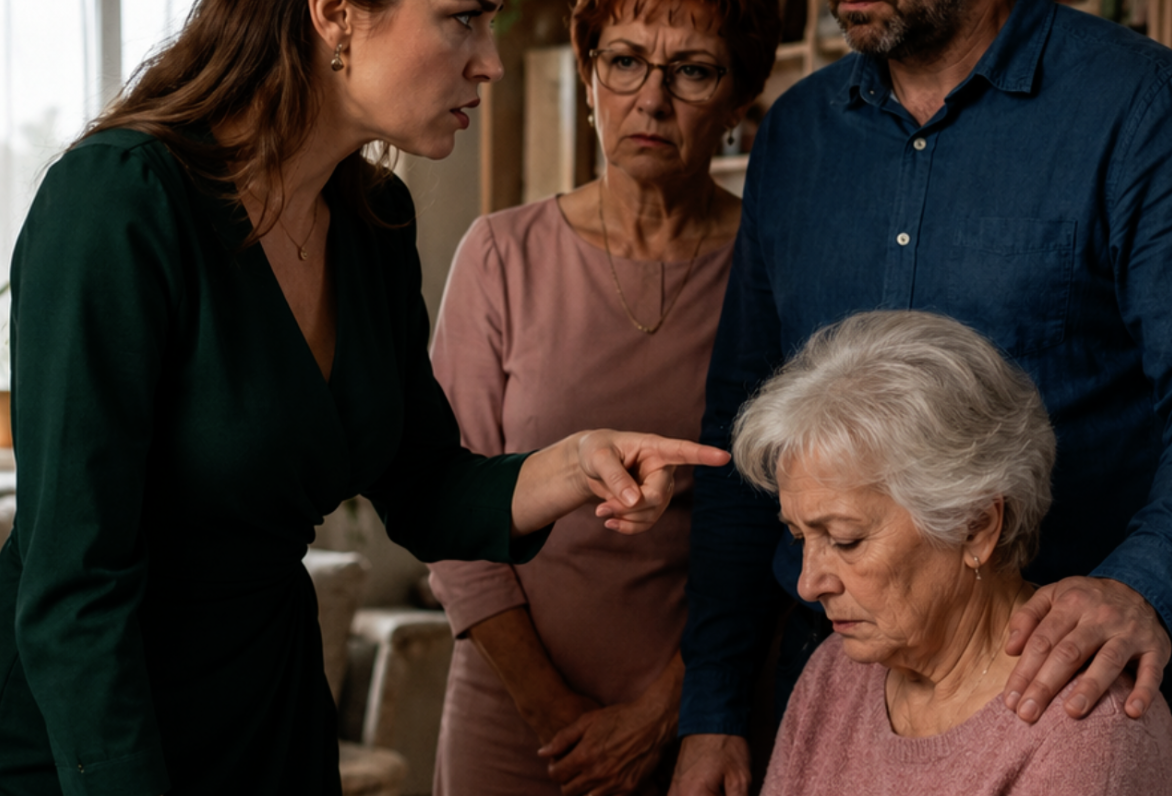
“You’re twisting everything again!” Ilya’s voice rang so sharply that Masha flinched, though she tried to remain calm. “I don’t understand why you’re making a mountain out of a molehill when we’re talking about a perfectly normal decision.”
“Normal?” She set her cup down on the table so abruptly that tea spilled over the rim. “Ilya, are you serious? You call it normal that you’re suggesting we sell my apartment? Before the wedding? And just like that, out of nowhere?”
“Not ‘out of nowhere’!” he exhaled, as if explaining an obvious truth to a child. “We’re adults. We need a spacious apartment. Not this… one-room place. We’re going to live together, build a family.”
“Build a family at the cost of me being left without my own home? Is that how you understand ‘family’?”
Ilya irritably ran a hand through his hair and stepped toward the window, looking down at the courtyard with cars soaked in February slush. The day was gray, wet, sticky — exactly the kind of Moscow February that makes everyone angry by default.
“Masha, why are you starting again?” He did not even turn around. “It’s logical. You sell yours, I add my savings, we take out a mortgage, and we buy a two-room apartment. In a new complex, a proper one. So we can live like normal people, not on these fifteen square meters.”
“Fifteen square meters?” Masha smirked. “It’s thirty-six, just so you know.”
“Oh, damn it, what difference does it make?” He waved his hand. “The whole point is that you’re just clinging to what’s yours. As if I’m trying to cheat you.”
She said nothing.
Because that was exactly how it sounded.
And the most disgusting thing was that this thought had already come to her more than once.
“Wait,” Ilya finally turned around. “Do you seriously think that I would…” He faltered, looking at her with wide, offended eyes. “…that I could use you?”
“I think you are far too comfortable making decisions about something that doesn’t belong to you,” Masha said slowly, feeling the heat rising in her chest again.
“Oh, sure, sure.” He raised his hands. “Here we go. ‘It’s mine, I bought it myself, it’s the result of my hard work.’ I know all that. You repeat it like a mantra. Except we’re planning to live together. Or maybe we aren’t?”
Masha wanted to answer sharply, precisely, to the point, but suddenly she felt a strange exhaustion. As if those ten minutes of conversation had burned half the energy out of her.
She sank into a chair.
“Ilya, why is it so important to you that I sell it? What do you get out of it? You have savings too. A stable job, your parents nearby. We can rent a place for now, or live here, and then decide later. Why is it so urgent?”
Ilya twitched, as if she had hit a sore spot.
“Because it’s the right thing to do!” he snapped. “That’s what Mom said. And Dad agrees. They’re not stupid people. They understand what’s best.”
Masha slowly raised her head.
“Ah. So here we are. Your parents again.”
Ilya tensed.
“Don’t start with that.”
“What do you mean, ‘that’?” Masha couldn’t hold back. “You just said they think it’s right. And you? Do you think with your own head at all?”
“I trust their experience!” he flared up. “They worked their whole lives to live decently. Not like some people…”
He stopped himself, but it was too late.
“‘Some people’ — was that aimed at me?” Masha stood up. Her voice turned cold. “I worked my ass off for eight years to buy this apartment. Without ‘Mom said,’ without ‘Dad gave,’ without any of that. Alone.”
“I know!” Ilya barked, but nervousness was already seeping into his voice. “I know you’re proud. It’s just… it’s just possible to think more broadly than your own square meters!”
Masha stepped closer.
“And can you stop repeating other people’s thoughts?”
He looked away.
Silence hung between them, heavy and sticky.
Masha already understood: the conversation had gone somewhere from which there would be no easy way out. But they had to say it out loud, otherwise everything would sink into a swamp.
“Fine,” she exhaled. “Let’s go point by point. No emotions. I sell the apartment, yes? We buy another one, yes? It will be shared, with a mortgage. For another twenty years. Correct?”
“Well, yes,” Ilya shrugged awkwardly. “So what? It’s a normal setup. Everyone does it.”
“Except with everyone,” Masha raised a finger, “both people invest equally. Or at least proportionally. But I’m giving everything. Everything I have. And you’re adding a part. Do you feel the difference?”
Ilya exhaled heavily, as if she were torturing him.
“Masha, here we go again… Your bookkeeping!” He rolled his eyes. “There are no percentages in a relationship! There’s trust!”
“Stop.” Masha raised her palm. “You just said it. Trust. So here it is: trust is not asking someone to throw their security out the window for someone else’s comfort. Trust is when no one pressures anyone. When no one gives ultimatums.”
“No one is giving ultimatums!” he flared up. “I just want a normal future! Mom said that—”
“Enough.” Masha closed her eyes. “If you say ‘Mom said’ one more time, I’m leaving and this conversation is over.”
He shut his mouth.
But his eyes made it clear: he himself no longer understood where his own thought ended and where Tamara Petrovna’s implanted one began — a woman Masha had spoken to only twice, yet around whom she felt as if she were being examined by a prosecutor.
A sharp phone call broke the silence.
Ilya glanced at the screen and exhaled sharply.
“Mom.”
Masha looked at him in such a way that he grew embarrassed, silenced the call, and shoved the phone into his pocket.
She spoke more softly.
“Ilya… do you hear me at all? Even a little? I don’t want to sell the apartment. That is a full stop. Not a comma. A full stop.”
He turned pale.
“So… that’s final? You’re not ready to make a… well… sacrifice for us?”
The word “sacrifice” sounded so loud it seemed to strike the room.
“Sacrifice?” Masha gave a short, dry laugh. “Wonderful. Now my own apartment, bought honestly, is a ‘sacrifice.’ Excellent. Then let’s do this: your car is also an asset. Shall we sell it? Into one common pot, right?”
Ilya visibly twitched.
“Masha… that’s different.”
“Of course it is.” She nodded. “Because what’s yours is sacred. And what’s mine is just a tool.”
He wanted to object, but stopped himself.
For two minutes, they stood in silence.
Finally, Ilya forced out:
“Fine. I… I need to think. I don’t want to fight right now. You don’t understand me, I don’t understand you. Give me time.”
Masha nodded, feeling something tighten into a hard knot in her chest.
“Fine. Think.”
He took his jacket, stood in the doorway as if he wanted to say something, then changed his mind.
“I’ll be back tonight,” he said curtly.
But Masha already knew: he would not come back that night.
And he really did not.
Not that evening, not at night.
The next morning — silence.
Then another full day.
Masha did not call.
She walked around the apartment as if through a museum of her own decisions. She tried working remotely, sorted through reports, answered emails. Everything mechanically, with pauses, with an emptiness inside.
Meanwhile, the weather had turned into one endless gray mess: snow, water, puddles, dirty boots in the stairwell, an eternally wet umbrella. February crawled slowly onward, leaving behind the sensation of endless heaviness.
On the third day, Ilya wrote.
“Hi. I’m sorry I disappeared. I want to talk. Can you tonight?”
Masha sat at her laptop, staring at the message for five minutes.
So he wanted to talk. So he had returned to the idea that “Mom said.” Or, perhaps, he had decided to step back?
She typed:
“Come at eight.”
He came.
With flowers. With a crooked attempt at a smile. With a guilty look.
“Masha, I…” He sat down without taking off his jacket. “I was wrong. I understand I went too far. I…” He faltered. “Mom was pressuring me, yes. And I picked it up. I should have thought everything through myself. Without her. Without emotions.”
Masha was silent. She listened, but did not believe him.
Until she saw behavior, words meant nothing.
Ilya continued:
“I thought… Maybe we just need to communicate better, all of us together. So you can get to know Mom, and she can get to know you. She’s good, really. Just strict. Let’s go to their dacha this weekend. It’ll be calm there, without all this…” He waved his hand. “You’ll talk. She’ll understand. You’ll understand. And we’ll sort everything out normally.”
Masha wanted to refuse.
With all her heart.
But she knew: if she refused, the conflict would flare up again, and this time for good. And she was not yet ready to put a full stop.
“Fine,” she said quietly. “We’ll go.”
Ilya exhaled with relief.
And Masha knew: ahead of her was not a dacha visit. Ahead of her was an interrogation. An interview. A trial.
“Well, are you ready?” Ilya looked out from around the car when Masha came out of the entrance. His voice was cheerful, but his eyes betrayed tension. The February wind struck their faces with tiny icy grains; the asphalt was covered in gray slush that made you want to curse out loud.
“Ready,” Masha answered shortly, getting into the passenger seat.
They barely spoke on the way. The radio played some pop song, and Ilya changed the station every two minutes, as if he could not find a place for himself. Masha looked out the window, watching the city gradually give way to the outskirts, then sparse trees, then cottage settlements with fences that all looked alike.
The closer they got to the dacha, the stronger the feeling grew inside her that she was not going “to visit,” but to some kind of trial. An internal hearing where she was the accused, Tamara Petrovna was the judge, and everyone already knew what the verdict would be.
Her future mother-in-law herself stood at the gate — tall, in a down jacket the color of wet snow, with a perfect hairstyle that seemed capable of surviving even a hurricane. On her face was a benevolent smile, but Masha knew: it was not warmth. It was control.
“Oh, you’re here!” she said in a tone that implied, “Finally.” “Come in, dears, I’ve been waiting and waiting.”
Ilya’s father, Viktor Sergeevich, appeared briefly in the doorway and immediately disappeared, as if he were afraid to be near his wife’s too-turbulent emotions. Masha suddenly thought that this was how he always lived: quietly, off to the side, not interfering, not arguing. She decided everything. Always.
Inside, it smelled of coffee and fried meat. The kitchen table was laid so thoroughly that it seemed not two guests had arrived, but six. Masha noted it to herself: demonstrative generosity.
“Mashenka, take off your jacket,” Tamara Petrovna said with gentle command. “How was the drive? The roads are terrible right now, of course.”
“Fine,” Masha answered. “We drove calmly.”
“And that’s right. We need calm,” her mother-in-law smiled. “Young people these days boil over, argue, run around. You and Ilyusha, I hear, have also been… nervous. That’s no good.”
Masha felt something crack inside her.
“I hear” meant Ilya had already complained. They didn’t even need to talk properly. She already knew everything.
Ilya grew embarrassed, looked away, but said nothing.
They sat down at the table. For a few minutes, everyone pretended to be occupied with food. Then his mother, carefully pushing a plate of vegetables toward Masha, began to speak.
“Mashenka, I’m very glad you came. We needed to talk woman to woman. Like adults. You understand?”
Masha nodded, though she wanted to answer differently.
“You girls are smart nowadays, independent,” Tamara Petrovna continued in a honeyed voice. “That’s good. But sometimes… sometimes you lose sight of what matters. Family is not a competition over who owns more property. It’s shared goals.”
Ilya listened attentively, as if catching every word his mother said.
“Ilya told us that you’re worried about the apartment,” his mother continued. “But, dear child, why are you clinging so tightly to these walls? They’re just square meters. Things. And family is people. It’s trust. Do you understand?”
“I do,” Masha set her fork aside. “But trust in a family has to be mutual. Not where I give everything I have, and in return I receive the opportunity to ‘trust.’”
Tamara Petrovna tilted her head to one side, like a teacher listening to a student who thought too highly of herself.
“Masha, what are you saying now?” she gently scolded. “No one is suggesting you ‘give everything away.’ Simply… sensibly combine resources. You have a long life ahead of you. A child will appear someday. Or two. Two people need space. And space requires money. You’re a smart girl, you calculate everything.”
“I do calculate,” Masha nodded. “And that is exactly why I understand that my apartment is my security. I don’t want to lose it.”
A pause hung in the air.
Viktor Sergeevich glanced at his wife. She barely moved her shoulder.
It was a sign: “Now I will continue.”
“Security…” Tamara Petrovna sighed. “Dear girl, you’re not marrying a bandit. Ilyusha loves you. You should value that. And your apartment… well… that is the past. You should look forward.”
“I am looking forward.” Masha met her gaze. “And when I look forward, I see that I am the only one risking everything.”
Her mother-in-law’s jaw twitched slightly. The sweet tone disappeared.
“Masha… you are saying dangerous things now. If you don’t trust the man you are planning to build a family with from the very beginning… perhaps you should consider whether you need that family at all.”
Ilya raised his head.
“Mom!” But there was no confidence in his voice.
She continued without looking at him.
“We don’t know you well, Masha. But we already see that you are too… independent. Excessively so. A man beside you should feel like a man. Not an accountant being audited.”
Masha felt the blood pounding in her temples. She wanted to stand up and slam the door. But she did not let herself break.
“I thought you wanted to talk,” she said quietly. “But you want to re-educate me.”
“Re-educate?” her mother-in-law widened her eyes. “What are you saying! I simply want my son to have a normal wife. A reliable one. One who won’t keep secrets from him or separate accounts, as some women like to do nowadays.”
“What secrets?” Masha narrowed her eyes.
Tamara smiled slightly.
“Well… Ilyusha said you didn’t immediately tell him how much you earn. And that you don’t want to show your contribution toward the future. That is strange. Very strange.”
Masha sharply turned to Ilya.
“You complained to her? That I don’t show you my salary statement?”
“I just…” He hesitated, frightened by her tone. “Mom asked… So I told her…”
“Right,” Masha nodded. “As always. She asked — you told. There is no such thing as ‘mine’ with you.”
Tamara Petrovna intervened instantly, like a hawk.
“Why are you attacking him? He is honest. He is open. He has no secrets from you. But you…” She waved her hand vaguely, which made Masha feel like some suspicious person. “You are closed off. Suspicious. That’s not good.”
“But convenient,” Masha smirked. “For you.”
The words hung in the air.
The pause was thick and heavy, like the air before a storm.
Her mother-in-law lost patience.
“Mashenka, I’ll say it plainly. You must decide: either you are part of our family, or you are on your own. And if you choose ‘on your own,’ then say so. We’re not holding you back.”
Ilya sat with his eyes lowered, like a schoolboy who felt ashamed but did not know why.
Masha understood: this was the moment of truth.
And there was no need for grand speeches. No need for explosions.
Only a clear, honest position.
She pushed her plate away.
Placed her hands on the table.
Inhaled.
“Fine. I’ll say it.” Her voice was even. “I am on my own.”
The silence struck harder than a scream.
Ilya raised his eyes, stunned.
“Masha… What are you saying? You’re…”
“No,” she interrupted. “I’m not ‘saying nonsense.’ You have all said it right now. You. You are demanding that I dissolve into your rules. That I have no voice of my own. That I live in whatever way is convenient for you. But it is not convenient for me.”
Both he and his mother looked at her as if she had torn a mask off some secret.
Tamara Petrovna hissed:
“So you put your property above our son?”
Masha stood.
“No. I put my life above your schemes.”
She took her jacket and went to the exit.
Ilya rushed after her.
“Wait, where are you going? Masha, stop! We’ve only just talked! I don’t want it like this! I… let’s do it differently, let’s start over, let’s…”
Masha turned around.
She looked at him as honestly as she could.
“Ilya. You are a good man. Maybe. But as long as you live by your mother’s words, you are not a man. You are a son. And you will always be a son. And none of your decisions are yours. Living with a man whom I have to coordinate through his mother… I’m sorry, but that is not my life.”
It was as if he had been struck.
He stood there blinking, lost, small, unfamiliar.
She stepped out into the cold, damp air.
And behind her, she heard only Tamara Petrovna’s muffled voice:
“Leave her. This is right. We don’t need someone like her.”
The trip back was by taxi.
She sat, looking at streams of wet lights, at the gray haze behind the glass. The car bounced softly over potholes, and Masha felt a strange calm inside.
Not joy.
Not relief.
Clarity.
She entered her apartment late in the evening. Took off her boots. Walked into the kitchen. Everything was in its place. Quiet. Peaceful.
She poured herself tea.
Sat down.
There was no loneliness in that silence.
There was freedom.
Yes, it hurt. It was bitter. It was insulting. But beneath all that pain, for the first time in a long while, she felt a firm, reliable support — herself.
Her apartment.
Her will.
Her decision.
She had not lost.
She had chosen.
Her phone vibrated. Ilya had written a long message. Then a second. Then a third — apologetic, confused, desperate.
She did not read them. She turned off the sound, placed the phone face down, and said aloud, almost in a whisper:
“That’s it. Enough.”
And for the first time in a long while, it became easy for her to breathe.