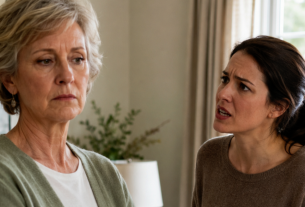
With all due respect to Oksana and her family, this apartment is my personal inheritance. My grandfather left it specifically to me. I am not planning to sell it, and certainly not to divide it into pieces.
Through the cloudy glass washed by a long autumn rain, Anna looked out at the empty playground. In her palm, warmed by the heat of her cup, lay a heavy bunch of keys with a worn keychain shaped like a small silver anchor. To her, that anchor was not just a trinket. It was a symbol of the stability her grandfather Ilya had left behind for her.
He had passed away three months earlier, and along with quiet sadness, an inheritance entered Anna’s life: an old but solid three-room apartment in the historic center of the city, with high ceilings and decorative molding that her grandfather had lovingly restored over many years.
Anna and Artyom had been married for five years. Their relationship had always seemed exemplary to Anna: mutual respect, shared interests, and a cozy rented two-room apartment that they had gradually turned into a real home. Artyom worked as an engineer, and Anna was an editor at a large publishing house.
They had enough money for a modest but decent life, for small trips once a year, and for dreams of owning their own home. And now that home had appeared. But along with it came a test for which Anna was completely unprepared.
Galina Petrovna, Artyom’s mother, was an energetic woman, deeply convinced that a family was a single, solid structure in which nothing could be personal, especially when it came to material assets. She often repeated, “We are one blood, one root. If one person gains something, then the whole family becomes richer.” For a while, these reflections seemed to Anna like harmless philosophizing, until the matter touched her grandfather’s inheritance.
It all began on a Saturday, when Galina Petrovna dropped by “just for a visit” with a homemade pie and a firm intention to discuss “pressing matters.”
“Anya, sweetheart, I keep thinking about your new apartment,” she began, pouring tea and confidently pulling the sugar bowl closer to herself. “It’s such a gift from fate! The city center, an old building… Have you already estimated how much it would be worth if you put it up for sale?”
Anna froze with the cup in her hands.
“Sell it? Galina Petrovna, I haven’t even thought about that. I was planning for us to move there. There’s so much light there. Grandfather loved those rooms so much. I want to preserve everything there as it was, only freshen up the renovation.”
Her mother-in-law nodded understandingly, but a steely glint flashed in her eyes, one Anna had only noticed briefly before.
“Moving there is romantic, of course. But it’s irrational, Anya. Look at the situation more broadly. The apartment is huge, the taxes are high, the maintenance is expensive. But if you sell it, there will be enough money for three excellent apartments in a new district!”
“Why do we need three apartments?” Artyom asked in surprise, looking up from his laptop.
“What do you mean, why?” Galina Petrovna threw up her hands. “Artyomushka, think about your sister! Poor Oksanochka, with her husband and two children, is suffering in a cramped one-room apartment. This way, one apartment would be for you and Anya, the second for Oksana, and with what’s left, I could get the little house in the suburbs I’ve dreamed of all my life. We are family, so we divide everything equally, fairly! One for all, as they say.”
A heavy, ringing silence settled over the room. Anna felt blood rush to her face. “Equally.” The word echoed in her head. Grandfather Ilya had saved all his life, protected that home, denied himself many things so that his only granddaughter would always have a reliable foundation. He had not known Oksana. He had barely known Galina Petrovna. This was his personal message to Anna, his care transformed into square meters.
“Galina Petrovna,” Anna said quietly but firmly. “With all due respect to Oksana and her family, this apartment is my personal inheritance. Grandfather left it specifically to me. I am not planning to sell it, and certainly not to divide it into pieces.”
Her mother-in-law slowly placed her cup on the table. Her face instantly lost its mask of good nature.
“Personal, you say?” Her voice became insinuating and cold. “And what about ‘for better or worse’? What about family support? So Artyom is your husband when you need a faucet fixed or groceries brought home, but when it comes to capital, you immediately retreat into your own little house? That isn’t human, Anya. It isn’t family-like. Artyom, do you hear what your wife is saying? She doesn’t consider us family. Walls are more important to her than the well-being of her loved ones.”
Artyom looked confused. He shifted his gaze from his mother to his wife, clearly not knowing whose side to take. On one hand, he was used to respecting his mother. On the other, he understood that the claims to Anna’s apartment looked, to put it mildly, strange.
“Mom, maybe you’re rushing things?” he said uncertainly. “Anya is right. It’s a gift from her grandfather. We haven’t decided anything yet…”
“We have decided!” Galina Petrovna snapped. “If you are a man, you should understand: family means everything goes into one common pot. And if Anya wants to live like a lone owner, then what kind of family is that? That’s just calculated cohabitation.”
The entire evening passed in tension. Galina Petrovna left without demonstratively saying goodbye to Anna, leaving behind a bitter aftertaste and a half-eaten pie that now seemed flavorless.
Over the next week, the pressure on Anna intensified. Galina Petrovna called Artyom several times a day, cried into the phone, complained about her heart and the “injustice of fate.” Oksana joined the process too, suddenly calling Anna with stories about how hard it was to live as four people in thirty square meters and how the children dreamed of having their own room.
Anna felt as though she were slowly being pulled into a swamp. She began to doubt herself. Maybe she really was too selfish? Maybe that was what family meant: sacrificing your own interests for the common good? But every time she remembered her grandfather, his work-worn hands and his quiet voice saying, “Take care of the home, Anyechka. It is your root,” her doubts disappeared.
The turning point came the following Sunday. Galina Petrovna appeared again, this time with some printouts from a real estate agency. She spread them out on the table with the air of a commander preparing for a decisive battle.
“Here, I found everything out. Your apartment in the center is valued very highly. If we sell it now, we can buy Oksana an excellent two-room apartment with a mortgage and a huge down payment, a wonderful new-build apartment for you, and there will be enough left for my little house. I’ve even found a notary I know. He’ll advise us on how best to arrange a renunciation of the inheritance in favor of the family so there will be fewer taxes. Artyom, sign it. Don’t drag this out.”
Artyom took the sheet and scanned the numbers. He remained silent for too long.
“Anya,” he finally said, not looking her in the eyes. “Maybe Mom is right about something? The two of us really don’t need such a huge apartment. And Oksana is truly having a hard time. If we help, things will become easier for all of us. Mom will be calm, my sister will be settled… We’re family.”
At that moment, Anna understood that a quiet conversation would no longer help. They needed facts that could not be ignored. She stood up, went into the bedroom, and returned with a folder of documents.
“Galina Petrovna, Artyom, listen to me carefully,” Anna said, placing not only the will on the table, but also another document she had arranged with a lawyer a few days earlier. “An inheritance is not a lottery ticket that can be cashed out and used to pay off debts. It is a responsibility. And Grandfather Ilya foresaw this much better than you think.”
She opened the will and pointed to a special clause she had not discussed earlier.
“Grandfather left the apartment to me with a lifelong encumbrance in favor of his own sister, my great-aunt Maria, who is currently living in a nursing home because there is no one to care for her. Under the terms of the will, I do not have the right to sell this apartment while Aunt Maria is alive. More than that, I am obligated to move her there and provide her with decent care. That was his will. He knew that the apartment was not just money. It was an obligation to the family line.”
Galina Petrovna’s face changed. Her “plan” was collapsing before her eyes.
“What old woman?” she protested. “Where did she come from? Why didn’t we know about this?”
“Because these are my family’s affairs,” Anna answered calmly. “And that is not all. I have drawn up a deed of gift for this apartment in the name of my future child. That means that even if I want to sell it in ten years, I will not be able to do so without the consent of the guardianship authorities, and only on the condition that housing of no smaller size is purchased in the child’s name. This apartment will never be divided into pieces. It will remain in my family—the one I will create and the one I came from.”
Galina Petrovna jumped up from her chair. Her lips trembled with indignation.
“So that’s how it is! You prepared in advance! You were scheming! So there will be no help for relatives? No ‘equal share’? Artyom, do you see? She considers you nobody. She has already dragged in unborn children just so she won’t give your mother a penny!”
Artyom looked at the documents, and something in his gaze began to change. He suddenly saw clearly the difference between Grandfather Ilya’s quiet, thoughtful care and his mother’s aggressive, consumer-like approach. He saw Anna not as a source of income, but as a woman defending her right to memory and to a future.
“Mom, enough,” Artyom said unexpectedly firmly. “Anya is right. This is her inheritance and her responsibility. Aunt Maria is a member of her family, and caring for her is an honor, not a burden. We will not sell the apartment. We will move there as soon as we prepare a room for Aunt Maria. And Oksana will have to solve her own problems herself, just as we all have done.”
Galina Petrovna gasped with outrage. She grabbed her bag, cast a look full of hatred at Anna, and flew out of the apartment. This time, no phone calls or tearful messages followed. She understood that she had encountered a force that could not be broken through manipulation.
A year passed. Anna and Artyom really did move into her grandfather’s apartment. They preserved the old molding and restored the parquet floor that Ilya Ivanovich had loved so much. In the sunniest room now lived Aunt Maria, a quiet, radiant old woman who could spend hours telling stories from the youth of their family line.
Galina Petrovna never forgave Anna. She occasionally called her son, pointedly and dryly asking about his health, but she never entered their home again. Oksana, having lost hope of easy money, suddenly found a job and, together with her husband, began saving to expand their housing. It turned out that when there was no opportunity to count on someone else’s inheritance, one’s own strength appeared much faster.
Anna sat on the wide windowsill, looking at the lights of the evening city. In the next room, Artyom was reading a book aloud to Aunt Maria. Anna’s soul felt calm and clear. She understood that real family was not about “dividing everything equally” when it was convenient. Real family was about respecting other people’s boundaries, keeping one’s word, and being able to protect what was truly dear to you.
Her inheritance really had been divided—not in the way her mother-in-law had imagined. It was divided into respect, care for the elderly, a secure future for children, and quiet pride in the fact that she had managed to remain true to herself and to the memory of her grandfather. And that division brought her far more happiness than any millions obtained at the cost of betraying her principles ever could have.
The house smelled of old books. The silver anchor on the keychain lying on the dresser glimmered dimly in the lamplight. Anna knew: her ship had reached the right shore, and no storm would ever be able to knock it off course again. Because when you have a strong foundation and a clear conscience, you can build any world you want—your own, without prying eyes or other people’s orders.