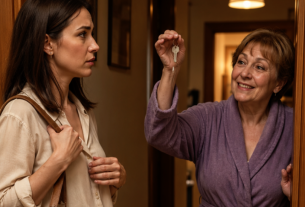
Zinaida Ivanovna, hello. Could you please explain to us what is going on here? Where is Grandma’s house? And why is there a potato field on our plot?!”
Marina always remembered her grandmother Elena Petrovna’s dacha with a special, bright sadness. In childhood, the place had seemed to her like a real fairy-tale kingdom. The plot was large—ten hundred square meters—and it was located incredibly well: only forty minutes by car from the edge of the city, surrounded by dense pine forest, ringing silence, and a small but clean river with a gentle sandy bank.
Once, life had been in full swing on that plot. Elena Petrovna grew amazing strawberries and tomatoes, cooked cherry jam in a copper basin right outside, and in the evenings she and little Marina drank tea on the veranda of the old wooden house. But time passed. Her grandmother became seriously ill, was bedridden, and did not visit the dacha during the last four years of her life.
Marina’s parents lived in their own private house in the suburbs. They had their own vegetable garden, their own chores, work, and the care of the sick Elena Petrovna. They had neither the time nor the physical ability to look after a dacha plot located in a completely different direction. Gradually, nature began to take over: the plot became overgrown with tall grass, the raspberry bushes went wild, and the old wooden house, battered by rain, snow, and neglect, leaned to one side, settled, and began to look more like a ramshackle shed than a place to live.
After Elena Petrovna passed away, the family council made a unanimous decision: the dacha would be given to Marina. The young woman had married Vadim just the year before, and her parents reasoned that a piece of land outside the city would be just what the young couple needed.
Vadim accepted the idea with incredible enthusiasm. He was generally a man of action—calm, sensible, and very handy. The prospect of becoming the true owner of his own ten hundred square meters awakened unprecedented energy in him.
“Marina, just imagine,” he would say on long winter evenings, sitting with his laptop in the kitchen of their city apartment. “The place is gorgeous. The forest, the river. We’ll tear down that old little shed and clear the territory. I’ve already spoken with Lyokha—he’s an architect, after all. He’ll design a small but very cozy brick house for us. With panoramic windows and a barbecue terrace. We’ll go there for entire weekends, away from the city bustle.”
Marina listened to her husband, looked at the beautiful 3D models of the future house on the screen, and smiled happily. She could already see them drinking morning coffee on their new terrace while listening to birdsong. All spring, Vadim worked on the paperwork, consulted builders, calculated the budget, and saved money to buy the first construction materials.
The trip to the dacha was planned for the first weekend of June. The weather was wonderful: the bright sun was shining, and there was not a single cloud in the sky. Vadim loaded a grass trimmer, shovels, a small axe for cutting down bushes, and a basket of food for a picnic into the trunk of the car. They drove there anticipating hard work and no less happiness from realizing that they were about to step onto their own land.
The road flew by unnoticed. The familiar turn, the dirt road winding between tall pines, the crunch of gravel under the wheels. Marina lowered the window, breathing in the intoxicating pine scent.
“Well, here we are, almost there,” Vadim announced joyfully, turning onto the right street of the dacha community. “Now we’ll park, inspect the scope of work, decide where to begin dismantling the old house…”
The car smoothly stopped beside the right plot. Marina opened the door, stepped onto the roadside, raised her eyes, and froze as if struck by thunder. The smile slowly slid from her face.
She rubbed her eyes, then looked at the sign on the neighboring house. Lesnaya Street, plot 42. Everything was correct. This was her grandmother’s dacha. But what appeared before their eyes was completely impossible to comprehend.
The old, crooked wooden house they had planned to demolish was simply gone. In its place was an empty, cleared space. But the most shocking thing was something else. Their entire huge plot, all ten hundred square meters, from the front boundary all the way to the forest, had been perfectly plowed, marked with even furrows, and densely planted with potatoes. Green, strong potato bushes flourished under the summer sun, occupying every free meter of someone else’s land.
“Vadim…” Marina whispered in a hoarse voice, unable to tear her eyes away from this agricultural splendor. “Vadim, I don’t understand anything. Did we get lost?”
Vadim got out of the car, took off his sunglasses, and frowned. He checked the plot number in the documents lying in the glove compartment against the settlement plan on his phone.
“No, Marina. We didn’t get lost. This is our plot. Only someone decided it belonged to them.”
Before Marina and Vadim had time to recover from the initial shock, footsteps sounded from the neighboring plot, which was separated by a low chain-link fence. A woman of about sixty, wearing a faded Panama hat and holding a hoe, walked up to the fence with a swaggering gait. Behind her appeared a stocky man in rubber boots and a checked shirt.
Marina recognized them. They were Elena Petrovna’s neighbors—Zinaida and Nikolai. Even in childhood, Marina remembered that her grandmother had disliked them for their quarrelsome nature and their habit of constantly peering over other people’s fences.
“Well, look who’s here!” Zinaida drawled with feigned surprise, leaning on the fence. “So you finally showed up. And we thought you’d disappeared for good.”
Marina, feeling a wave of righteous anger boiling inside her, took a step forward.
“Zinaida Ivanovna, hello. Could you please explain to us what is going on here? Where is Grandma’s house? And where did this potato field on our plot come from?!”
The neighbor was not embarrassed in the slightest. On the contrary, she proudly puffed out her chest and looked at Marina with undisguised superiority.
“What’s there to explain? Your Petrovna died long ago. The plot stood abandoned, overgrown with grass up to the waist. It was disgusting to look at! A fire hazard, by the way! We waited and waited—no one came. So Kolya and I decided: why should the land sit there uselessly? We took it and cultivated it.”
“Cultivated it?!” Marina could not believe her ears, and her voice broke into a shout. “You illegally seized someone else’s private property! Where is the house?!”
Nikolai joined the conversation, waving the hand that held a cigarette.
“What house, girl? It was only called a house. A rotten shed. It would have collapsed on its own in a year. We hired a tractor, demolished everything, and hauled away the trash. Spent a pile of money, by the way. So you should be thanking us for putting things in order here. And the potatoes are ours. We’ll dig them up in autumn, and then you can do whatever you want here. Until then, don’t interfere. We put labor into this soil!”
Marina gasped with outrage. These people’s insolence had no limits. They had not merely occupied their land without permission. They had demolished a structure that was part of the inheritance, and now they were seriously dictating their conditions to them, considering themselves the absolute masters of the situation.
“Are you out of your minds?!” Marina shouted, tears of helplessness and hurt appearing in her eyes. “This is our land! My husband ordered a house design! We are going to start building right now, not in autumn! Remove your potatoes immediately, or I’ll call the police!”
Zinaida Ivanovna smirked venomously.
“Call whoever you want, hysteric. The land was abandoned. First come, first served. I’m not digging up the potatoes; they aren’t ripe yet. And if you step into the field, I’ll have you charged for damaging someone else’s property!”
Marina was ready to climb over the fence and claw at the neighbor’s brazen face, but at that moment Vadim gently yet firmly took his wife by the shoulders and moved her back.
“Marina, calm down,” he said quietly, but loud enough for the neighbors to hear. Then he turned to Zinaida and Nikolai. Vadim’s face was completely calm, without a single emotion, but his gaze was as cold as ice.
“Here is how it will be, dear people,” Vadim said, pronouncing every word sharply. “I will not allow you to speak to my wife in that tone. What you have done is the unauthorized occupation of a land plot. And the demolition of someone else’s building is the intentional destruction of someone else’s property. We are leaving, but we will return very soon. And there will be no compromises.”
He took his phone out of his pocket, methodically photographed the plot from every side, capturing the neighbors in the frame as well. Then he took Marina by the hand, seated her in the car, and they drove away.
Marina cried the entire way back to the city. She was hurt for her grandmother’s memory, for the destroyed house, old though it had been, and for their ruined plans for the summer.
“Vadim, what are we going to do?” she sobbed. “They’re insane! They demolished the house with a tractor! What if they start ruining our construction later? Maybe we should sell this plot and be done with it?”
“No panic,” her husband answered firmly, keeping his eyes on the road. “We are not selling anything. It is ours by right. And we will fight for that right. They thought that if the old people died and the young ones were inexperienced, they could do whatever lawlessness they wanted. They were deeply mistaken. Tomorrow we start taking action.”
The next day, Vadim took a day off from work. First, they gathered all the documents. Fortunately, Marina’s parents were responsible people: the plot was registered in the cadastral system, the boundaries were clearly defined and fixed, and they had the certificate of inheritance and an extract from the Unified State Register of Real Estate on hand. The old house was also listed in the documents as a real estate object.
With that folder of papers, Vadim and Marina went to the administration of the rural settlement to which the dacha community belonged. The head of the administration, a tired man in glasses, listened to their story and looked at the photographs, then only sighed heavily.
“I know your Zinaida and Nikolai. They’ve quarreled with the whole street. One time they move a fence half a meter, another time they throw trash by someone else’s gate. But this time, of course, they have outdone themselves. Folks, we can send out a commission and draw up a report on the unauthorized occupation. But the administration has no right to uproot their potatoes. Your direct path is to court. And file a police report about the illegal demolition of the building.”
Vadim did exactly that. He hired a good lawyer specializing in land disputes. A proper statement of claim was prepared. In addition, they demanded compensation for material damage for the demolished house, assessing it according to its cadastral value.
When the neighbors received the court summons, at first they put on a brave face. They walked around the dacha settlement, complaining to everyone about the “shameless young people” who did not respect their elders and wanted to destroy the harvest they had “grown with blood and sweat.”
But at the court hearing, their arrogance quickly evaporated. The judge, a strict middle-aged woman, would not even listen to Zinaida’s emotional shouting that “the land had been abandoned.”
“Citizen, the concept of ‘abandoned land’ has clear criteria in law, and you are not authorized to determine them,” the judge interrupted her. “The plot has a lawful owner. You entered someone else’s territory without permission, destroyed someone else’s property, and used the land for personal purposes. The plaintiff’s documents are in full order.”
The court’s decision was clear and unconditional: the defendants were obliged, within ten days from the date the decision entered into legal force, to vacate the illegally occupied land plot, restore it to its original condition—that is, remove all their plantings—and also pay Marina and Vadim compensation for the demolished old house, plus cover all court costs and lawyer’s fees.
When Zinaida heard the amount she would have to pay, she turned pale and sank heavily onto the bench. The potatoes had turned out to be truly “golden.”
The enforcement of the court decision was a spectacle that drew half the dacha community to their fences.
In the presence of bailiffs, Vadim, and Marina, Zinaida and Nikolai, red with anger and humiliation, were forced to take shovels and pitchforks. It was the end of July. The potatoes were not yet ripe: the tubers were the size of walnuts, watery, and completely unsuitable for storage.
Under the scorching sun, drenched in sweat, the neighbors dug up bush after bush of their failed profit, putting the green tops and tiny potatoes into sacks so they could remove all of it from someone else’s plot. Zinaida tried to mutter something angrily under her breath, but whenever she met the stern gaze of the bailiff, she fell silent.
Marina stood beside Vadim with her arms crossed over her chest. She did not feel gloating, only deep satisfaction that justice had prevailed. During the entire humiliating process for the neighbors, Marina did not utter a single word. She decided for herself once and for all: these people no longer existed for her.
A year and a half had passed since then. Marina kept her inner promise—she never greeted Zinaida or Nikolai, even when she came face to face with them on the narrow village road. The neighbors, taught by bitter and very expensive experience, became quiet. They built a two-meter solid corrugated metal fence between the plots and never again tried to peer onto someone else’s territory.
And real life began on her grandmother’s plot. On the site of the demolished shed and the former potato furrows, Vadim and a crew of workers poured a solid concrete foundation. By autumn, even brick walls of the future house had risen on the plot, and in spring they put on the roof.
Marina planted thuja trees along the new fence, made a flower bed with hydrangeas in memory of Elena Petrovna, and hung a hammock on the terrace of the unfinished house. Lying in it and looking at the tops of the pines, she often thought that any problem was merely a test of strength. She and Vadim had passed that test, defended their boundaries and their right to happiness. And now, on their land, it was not other people’s weeds that were growing, but their own dreams.