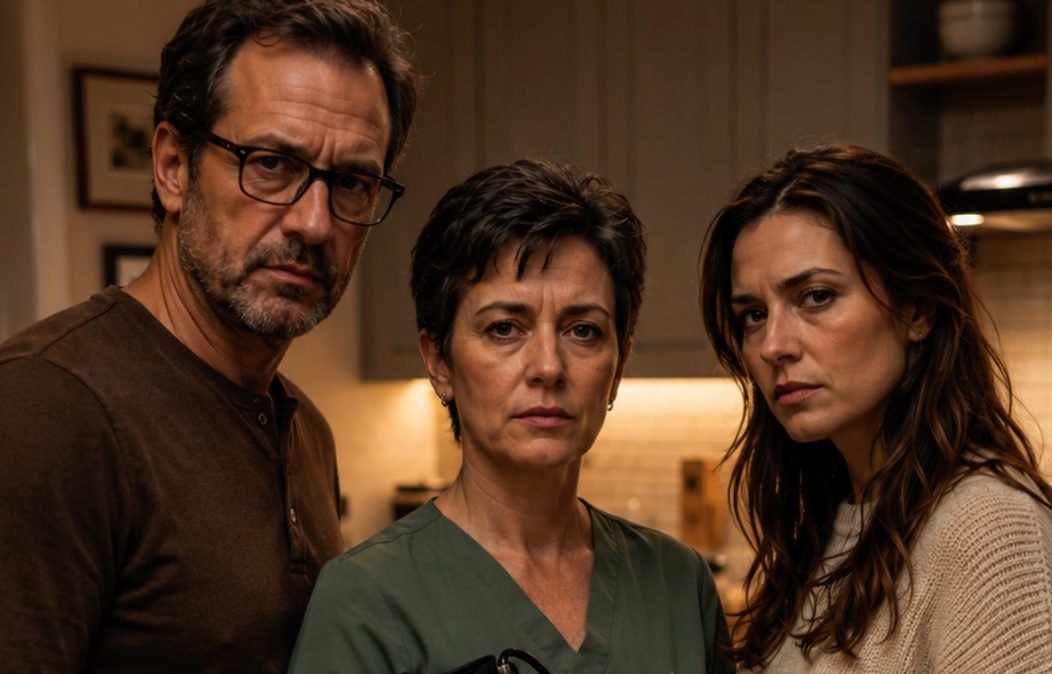
The gate latch stuck the way it always did. Elena stepped into the yard, her shoulder aching from the heavy medical bag. Her shift with the special response team had been difficult.
She froze halfway to the house.
In her favorite wicker chair, where she liked to rest after work, a woman was sitting. She was about thirty-five, with patchy, uneven hair. She wore a silk robe the color of dusty rose — the very robe Elena had bought a month ago with her first bonus in two years, but had not yet worn even once.
The woman lazily gnawed on an apple while staring at her phone. Beside her, on the porch boards, lay children’s sandals with dirty Velcro straps.
Elena did not start yelling. She simply set her bag down on the gravel, took out her phone, and dialed 102.
“Police? Write down the address: 12 Lesnaya Street. Strangers have broken into my house. I’m standing at the entrance. I’m afraid to go inside — they may be armed.”
“Woman, what are you doing?” the red-haired woman on the porch jumped up, her robe falling open and revealing stretched-out shorts. “What kind of squad? Dima! Dima, come out here, quick!”
The door flew open.
Dmitry rushed onto the porch, his glasses sliding down his nose, a kitchen towel crumpled in his hands. When he saw his wife, he froze. Then his face took on that expression of “enlightened humanism” Elena had once mistaken for kindness.
“Lena, are you serious?” Dmitry did not come down; he stayed on the top step. “Cancel the call. This is Roza, my sister. I told you about her. She’s had trouble in the region. Where is she supposed to go with three children?”
Elena glanced at her watch. 5:42 p.m.
“The dispatcher accepted the call,” she said, looking her husband in the eyes. “Roza is a stranger to me. I did not give her permission to be here.”
“Lenochka,” Dmitry stepped down, his voice softening. “Drop this drama. You’re just exhausted. Roza put on the robe because her things are still in bags. We’re good people. The room is empty anyway — why let space go to waste? We don’t have children, Len. And they’ll have plenty of room here.”
“We don’t have children” — he had used that phrase for ten years to shut down every attempt she made to defend her boundaries.
She opened her bag and took out a blood pressure monitor — reliable, with a tight black cuff. Slowly, she began winding the tube around the gauge.
“You got into my house while I was on a twenty-four-hour shift and brought four people here,” she said without raising her voice. “That robe cost twelve thousand.”
Dmitry threw up his hands, and the towel fell onto the dirty sandals.
“This is my family, Lena!”
“And this is the house I inherited. Your surname is not listed in my grandmother’s deed of gift.”
A boy of about six, with a grimy cheek, peered out from behind Roza. He looked at Lena with the same stupid stare as his mother.
“Dima, is she really going to throw us out?” Roza tossed the apple core into the currant bushes. “You said she was a normal woman.”
Dmitry adjusted his glasses. His fingers trembled slightly, and he hid them in his pockets.
“Lena is just wound up. That’s the kind of job she has: either you command, or you get commanded. Give her time. She’ll cool down.”
A siren wailed beyond the gate.
A blue-and-white UAZ braked sharply outside. Elena turned toward the gate.
“I won’t cool down, Dima. I’m seeing the guests out.”
Two police officers entered the yard. A young sergeant looked questioningly at Lena, then at Dmitry in his socks and at Oksana in the silk robe.
“Senior Sergeant Kolesnikov. What happened?”
“Strangers entered my house,” Lena said, handing him her passport. “There are people inside whom I did not invite.”
“What do you mean, did not invite them?” Dmitry stepped toward the sergeant. “I’m her husband. I’m registered here. I have the right to invite guests.”
The sergeant studied the documents.
“Citizen, registration allows you to live here, but it does not allow you to dispose of the property without the owner’s consent. And the owner,” he nodded toward Lena, “is demanding that the guests leave.”
“It’s nighttime!” Roza shrieked. “I have children! What are you, monsters?”
Elena walked up to the porch. She was half a head shorter than Roza, but Roza still stepped back. With visible disgust, Elena took the edge of her robe between two fingers and yanked it sharply.
“Take it off,” she whispered. “Right now.”
“What?” Roza gaped.
“Either you take it off now and walk out the gate, or you go to the station wearing it. Choose.”
Dmitry tried to grab Elena’s hand.
“Lena, stop. You’ll cry about this later yourself. We agreed, we wanted…”
“We wanted different things, Dima. You wanted comfort at someone else’s expense. I wanted not to be betrayed.”
Roza muttered curses, and the boy in the doorway started howling.
“Pack your things,” the sergeant ordered. “You have fifteen minutes.”
Dmitry leaned against the doorframe. He took out a handkerchief, slowly wiped his glasses, and looked at Elena.
“Fine,” he said. “Round one goes to you. Roza, take the children. We’re leaving.”
He turned to his wife and added almost tenderly:
“Just remember: tomorrow you’ll go back to work, and I’ll stay here. I have registration and keys. You can’t be on duty forever, can you?”
Elena said nothing. She neatly folded the robe and carried it to the laundry.
Inside the house, Roza hurriedly threw things into bags, and a child cried hysterically. Dmitry stood on the porch, wiping the lenses of his glasses.
When the UAZ disappeared around the bend, silence settled over the yard. Roza and the children sat on their suitcases by the gate. The youngest had gone quiet and was picking at a hole in the fence mesh.
Dmitry did not leave. From the window, he watched Elena wipe the railing with an alcohol swab.
“Finished disinfecting?” he asked through the glass. His voice sounded muffled.
Elena said nothing, entered the house, and turned on the kitchen faucet.
“Lena, let’s not make an emergency out of this,” Dmitry followed her inside. “I understood everything. I made a mistake. I thought you’d be more loyal to my family. Roza has no place here, since that’s what you decided.”
He pulled out a chair for her, but Lena remained standing, drying her hands with a towel.
“I booked them a room at the Sputnik,” Dmitry said, placing his smartphone with the reservation on the table. “The taxi is already coming. Tomorrow they’ll go to an aunt in the region. Lena, I’m asking you humanly: withdraw the statement. Why brand Roza like that? Child services, social services… you know how that machine works. Don’t ruin the children’s lives over your robe.”
Elena hesitated.
Two feelings fought inside her, but her unwillingness to be known among the neighbors as a monster won out. She still had to live here.
“Let them leave. I’ll withdraw the statement,” she answered.
“Thank you,” Dmitry smiled barely noticeably. “By the way, check my blood pressure. The back of my head is throbbing. The last thing we need is for you to come to me on a call tomorrow.”
It was his old trick: shifting attention to his own frailty. Elena automatically took out the blood pressure monitor. She rolled up his sleeve and tightened the cuff. Dmitry sat motionless while she pumped in air.
“One forty-five over ninety,” she stated. “A bit high for you.”
“Stress,” he sighed. “But everything will settle down now. Go rest. I’ll see them off myself and bring you some tea. You haven’t slept in two days.”
Her eyelids grew heavy. From the window came the sound of a car, slamming doors, and Roza’s swearing. Then everything went quiet. Elena reached the bedroom, collapsed onto the bed, and instantly fell into sleep.
She woke to bright light and noise. Children’s laughter and the clatter of dishes came from the kitchen. Elena jumped up: ten in the morning. She had slept for fourteen hours. On the nightstand lay a white note: “Tea is in the thermos. Don’t be angry. I fixed everything. We are one family.”
Elena ran into the hallway. The door to her office — the former nursery where she had set up her workspace — stood wide open. The furniture had been pushed against the walls, and three folding beds were crowded in the center. Crumbs were scattered on the floor, and someone had already spilled juice.
“Good morning!” Roza’s eldest son was twirling Elena’s stethoscope in his hands. “Dima said we’ll live here until winter.”
A chill ran down Elena’s spine. She rushed into the kitchen. Dmitry was stirring porridge, freshly shaved and looking bright. A folder lay on the table.
“Dima, what does this mean? Why are they here?”
“You’re awake,” he turned around, his glasses glinting. “Sit down. We’ll discuss the details.”
“Out of the house! All of you!”
Dmitry slowly put down the spoon.
“Don’t shout. You’ll scare the children. Yesterday, while you were asleep, I logged into your personal account. Very convenient that all the passwords are saved automatically.”
He handed her a printout.
“I registered Roza and the children here temporarily for six months. Last night, you withdrew the police statement, confirming that you did not object to their being here.”
“You had no right…”
“Formally, yes. But I acted as your representative while you were not yourself. You were deeply asleep, your blood pressure was jumping — I recorded the readings, remember? I simply took care of the people close to us.”
He smiled.
“And one more thing: I submitted an application for mortgage holidays in your name. We are now a large family. In a week it’ll be approved. We’ll save forty thousand a month. Great, isn’t it?”
Elena looked at him and saw not a husband, but a traitor.
“Now,” Dmitry stepped closer, “to deregister them, you’ll have to go to court. And that means six months of red tape. Plus child services: they won’t throw children out into the street during heating season.”
He carefully straightened her collar.
“You taught me yourself: first diagnosis, then treatment. We’re here for the long haul, accept it and make breakfast for everyone. Roza is still asleep.”
Dmitry turned back to the stove, humming something, certain of his victory. Elena silently walked out, locked herself in the bathroom, turned on the icy water, and began washing her face.
For three days, Elena lived like a shadow.
She did not argue over shelves in the refrigerator, did not wipe up sticky puddles on the parquet. She silently ate plain oatmeal while Roza fried cheap sausages, filling the house with the stench of burnt fat.
Dmitry settled in the living room among his papers. He wiped his glasses and calculated something in a notebook.
“Lena,” he called when she passed by with her bag. “I saw your bank statement: one hundred and twelve thousand. Transfer it to my account for safekeeping.”
Elena stopped.
“Sure, I’m running to transfer it right now,” she replied sarcastically.
Roza caught up with her by the gate. She was wearing Elena’s stretched-out sweater, her hair clumped together.
“Listen, medic,” Roza spat husks under her feet. “Don’t make Dima angry. He’s smart. He arranged everything legally. If you start acting up, I’ll get a certificate saying you attack children, got it?”
Elena looked at her like a smear under a microscope.
“Your pulse is fast, your face is swollen. Roza, cut down on salt. Your kidneys aren’t government property.”
And she left without looking back.
That evening the house smelled of Corvalol. Roza lay theatrically on the sofa, languishing, while Dmitry fanned her with a newspaper.
“Finally!” Dmitry jumped up. “Lena, the person is unwell. Roza fainted. Blood pressure, probably. Do something. You’re a doctor, you took an oath.”
“I’m a paramedic.”
Lena set down her bag. Roza moaned, rolling her eyes.
“Oh, I’m dying… My heart… Everything’s going dark…”
“Silence,” Elena cut her off. “Breathe evenly.”
She put on the cuff — almost under the armpit — and tightened it as hard as she could.
“We need to immobilize the arm,” she explained to her husband. “Dima, get magnesium sulfate and a syringe from the bag, quickly.”
Dmitry turned pale. Lena began pumping air. The gauge shot past two hundred.
“It hurts!” Roza squealed.
“Lie still!” Elena pressed her shoulder down with her knee. “During a crisis, convulsions can occur. Dima, hold her legs. The spasm is about to start!”
In a panic, Dmitry threw himself onto his sister, and the children began howling.
“Lena, maybe a pill?” her husband babbled, staring at Roza’s crimson face.
“What pill? This is cerebral edema!” Elena pinned Roza’s arm to the sofa like a vise. “Tell me: does your head hurt? Are you nauseous? Going numb?”
“Nothing hurts! Let me go!” Roza screamed. “Dima, get her off me! We just made it up… If I get sick, she won’t throw us out. He said so! By law, sick people can’t be evicted!”
Elena released her arm. She took her phone from the breast pocket of her uniform — it had been recording video the whole time.
“Repeat what he said,” she asked quietly.
“Go to hell!” Roza spat toward Elena, but hit Dima instead. “Let go of my arm, you bitch! Dima, do something!”
Dmitry froze, staring at the phone. The face of the “caring brother” changed into the expression of a thief caught red-handed.
“Lena, this was… just a test of your skills. A joke, to ease the tension.”
Elena stood up and let the air out of the cuff. Roza slid off the sofa, rubbing her numb wrist.
“The joke is recorded,” Elena nodded at the screen. “Faking an attack to avoid moving out. Assault on a medical worker. Dragging children into it.”
“So what?” Dmitry found his voice again. “That video won’t help you in court. The registration is valid.”
“Maybe not in court. But I didn’t call the police.”
A vehicle with an orange stripe stood outside the gate. A psychiatric emergency team.
“I told the dispatcher there was a woman in the house in acute psychosis, aggressive toward children. They trust my word at the department.”
“Have you lost your mind?” Dmitry took a step toward her.
“No. My colleagues are in the vehicle, and when I say someone is dangerous, they don’t ask for papers. They take restraints and come in.”
The door swung open, and two burly orderlies entered. A gray-haired, sharp-cheeked man nodded to Elena.
“Hello, Petrovna. Where’s the violent one?”
“Here she is,” Elena pointed at Roza. “And her accomplice.”
“You have no right! I’m a lawyer!” Dmitry shouted.
“Calm down, citizen,” the orderly pushed him aside with an iron grip. His glasses flew off his nose and crunched under someone’s foot. “We’ll sort it out. Ma’am, let’s go to the vehicle.”
Roza went into real hysterics. She clung to the furniture, to her brother, but the orderlies worked cleanly. Three minutes later, wrapped in a blanket, she was carried out. Dmitry stood in the middle of the wrecked room, the children pressed against the fireplace.
“You’ll be fired. You exceeded your authority.”
“File complaints,” Lena said, tearing the registration paper out of his folder and slowly ripping it apart. “But while you’re running around, the children will be taken to a reception center. Their mother is in a clinic, and you’re nobody to them. You never took guardianship. You were simply living here.”
She paused.
“And now the main thing. The orderlies documented unsanitary conditions and a threat to the children’s lives. As the owner, I’m signing a statement that their stay here is impossible.”
“This is unfair…”
“This is life, Dima.”
The morning of October sixth was clear and freezing. Neighbors shuffled by the fence and watched.
Dmitry stood frozen on the porch with his arms crossed. He tried to keep up appearances, but without his glasses, his gaze had gone cloudy.
“This is tyranny,” he hissed when Elena carried out his leather briefcase. “You are committing an official crime. Roza’s registration is still valid. You can’t throw children out onto the street.”
“No one is throwing them out, Dima. The children are at City Hospital Number Four, under supervision. It’s warm there, and they’re fed on schedule. And Roza is under reliable guard.”
“I’m going to the multifunctional center right now!”
“Sit down,” Elena ordered. “Let’s check your blood pressure before the road.”
“I don’t need—”
“Sit!”
Dmitry lowered himself onto the step. Elena tightened the cuff with practiced hands. He grimaced. She slowly pumped the bulb, looking at the neighbors by the gate.
“Do you know what your miscalculation was? You built everything on my consent. And I withdrew it.”
Dmitry jerked, but Elena pressed his arm down.
“Stay still. Yesterday morning, I filed a statement with the Ministry of Internal Affairs withdrawing my consent to the registration. The owner has the right to withdraw it at any moment, and they are required to annul it. Your sister was removed from the register by noon.”
“That’s not how it works,” he hissed.
“That is exactly how it works. And your pressure is one twenty over eighty.”
She opened the briefcase and dumped its contents onto the porch boards: a notebook, a voice recorder, and a pile of junk.
She found his passport.
“Witnesses!” she called. “Nikolai Sergeyevich, take a look. The citizen is registered here but has no share in the property. He set up a den, endangered children. You heard the screams?”
“I heard,” the neighbor muttered with contempt. “The children were howling, that woman was swearing. Elena is a respected medical worker, and you, Dimka, dragged some trash in here.”
“That’s it, Dima. Your things are by the gate. And the orderlies left you a gift.”
Dmitry looked down at his socked feet. Beside him stood huge rubber slippers stamped “Psychiatric Hospital No. 2.”
“I’ll sue you,” he whispered. “I’ll claw out a share as marital property.”
“Good luck with the lawyers, Dima. You’ll need money, and you don’t have any.”
She went into the house. Outside the window, the neighbors laughed. Dmitry, shuffling through the gravel in state-issued rubber slippers, dragged his things toward the road. After a while, a taxi door slammed.
Elena entered her house.