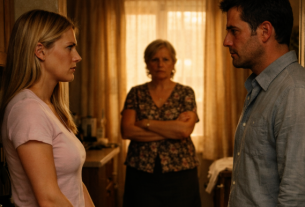
“What loans?” Olga tried to speak calmly, although everything inside her tightened from the shock. “What money are you talking about?”
She was standing in her kitchen, clutching her phone, looking out the window at the autumn rain tapping softly against the windowsill. She had only just come home from work and hadn’t even had time to take off her coat when this call came. Her mother-in-law’s voice sounded loud, full of hurt and confusion, as if Olga had just refused to do something completely obvious.
“What loans do you think?” Lyudmila Vasilyevna continued, and Olga heard papers rustling on the other end of the line. “The ones Sergei and I took out for the dacha renovations and the car! You promised to help when you married our Seryozha. We were counting on your salary, on those big bonuses of yours!”
Olga slowly sank onto the stool by the table. Her coat was still on, and rainwater was dripping from the umbrella standing in the corner. She remembered how five years earlier, at the wedding, her mother-in-law had hugged her tightly and whispered in her ear, “Now you’re ours, Olenka. We’re one family now. We’ll manage everything together.” Back then, those words had seemed warm, almost dear. Now they sounded completely different.
“I never promised anything,” Olga replied quietly. “Sergei and I can barely manage our mortgage as it is. We have our own expenses, our own plans.”
“Your own plans!” Lyudmila Vasilyevna snorted. “And what are we, strangers? Sergei is my son, your husband! When we took out the loan, he said you didn’t mind, that you would help. That’s what we were counting on!”
Olga felt her throat go dry. Sergei had said that? When? Why didn’t she know anything about it? She remembered how her husband sometimes avoided conversations about money, brushing her off with, “Mom knows better, she understands these things.” And Olga had been used to trusting him. She worked as a department head in a large company, her salary was good, her bonuses came regularly — and part of that money always went “to help the parents.” Sometimes for her father-in-law’s medicine, sometimes for utilities, sometimes for some urgent need. She never counted, never asked — she simply transferred the money, because that was what people did in a family, because Sergei asked.
“I’ll talk to Sergei,” Olga said, trying to keep her voice from trembling. “This needs to be discussed together.”
“Of course, discuss it,” her mother-in-law’s tone softened a little, though the confidence was still there. “Just don’t take too long. The interest is adding up, Olenka. We’re really counting on you.”
The call ended, but Olga sat motionless for a long time, staring at the phone. The rain outside grew heavier, the drops drumming against the glass as though trying to break in. She suddenly remembered how, a year earlier, Lyudmila Vasilyevna had called and asked to “borrow” a large sum for repairs at the dacha. Sergei had said then, “Mom is struggling, Dad is sick, let’s help.” Olga had transferred the money, even though she herself had been dreaming of saving for a vacation — her first in many years. The vacation never happened.
The door clicked — Sergei had come home from work. He entered the kitchen, shaking rain from his jacket, and immediately smiled his usual warm smile.
“Hi, darling. How was your day?”
Olga looked at him carefully. He was the same as always: a little tired, but kind, with a faint touch of gray at his temples. They had been together for seven years, five of them married. He never raised his voice, always gave in, always said, “You’re so smart, Olya.”
“Sergei,” she began directly, “your mother just called.”
He froze while hanging up his jacket.
“And?”
“She talked about loans. About the ones you and your father took out for the dacha and the car. And about how you were counting on my money to repay them.”
Sergei lowered his eyes and walked over to the table, sitting down across from her.
“Yes, we took them… We did. Mom had wanted to fix up the dacha for a long time, and the old car was completely falling apart.”
“Why didn’t you tell me?”
He sighed, rubbing his temples.
“I didn’t want to burden you. You already work so much. Mom said everything was under control, that we’d pay it off little by little.”
“Little by little — at my expense?” Olga felt her voice growing louder. “She said you promised her my help. That I didn’t mind.”
Sergei looked up at her. There was embarrassment in his eyes, but no repentance.
“Olya, we’re family. You’ve always helped. I thought you understood…”
“Understood what?” She leaned forward. “That my money is a common pot for all of your needs? That I’m supposed to pay for the dacha, the car, everything you decide to buy on credit?”
“It’s not like that,” he tried to take her hand, but she pulled away. “It’s just… Mom is used to us being together. When you came into our family, she accepted you right away. And I thought you also…”
“You thought I would support your parents?” Olga finished for him. “Without a discussion, without my consent?”
Sergei fell silent. Outside, the rain roared, and the kitchen was filled with silence, broken only by the ticking clock.
“I didn’t know you’d take it this way,” he finally said quietly. “For me, helping parents is normal. They raised me, they achieved everything on their own.”
Olga stood up and went to the window. City lights reflected in the puddles; everything looked blurred and unclear.
“Sergei, I help my parents too. But I ask you. We decide together. And here… here everything was decided without me.”
He got up, came up behind her, wanted to hug her, but stopped.
“I’m sorry. I didn’t think it would hurt you so much.”
“Hurt me?” She turned to him. “This isn’t just about being hurt. This is my money, earned by me. I’m not against helping — but I want to know what for and how much. And I want it to be my decision, not someone else’s expectation.”
Sergei nodded, but Olga saw doubt in his eyes. He was used to something else — Mom decides, Mom asks, and he passes it on. And everything keeps turning.
The evening passed quietly. They ate dinner almost in silence, watched some movie without following the plot. Before bed, Sergei tried to bring it up again.
“Mom wants to come tomorrow. To talk.”
Olga froze.
“Why?”
“Well… to discuss everything. She says the two of you alone won’t manage it properly.”
“The two of us?” Olga felt a chill inside. “And what do I have to do with that?”
“You’re part of the family, Olya. She wants us to decide together.”
Olga lay down, turning her back to the wall. Thoughts spun in her head, each more anxious than the last. What would happen tomorrow? What would Lyudmila Vasilyevna say? And most importantly — why had she suddenly begun to feel not like the mistress of this home, but like… some kind of sponsor?
In the morning, her mother-in-law arrived earlier than promised. Olga was still drinking coffee when the doorbell rang. Sergei went to open it, and she stayed in the kitchen, gathering herself inwardly.
Lyudmila Vasilyevna entered with a lively step, carrying a bag of fresh pies — as always, bringing a treat.
“Good morning, Olenka!” She hugged her daughter-in-law as though yesterday’s conversation had never happened. “How did you sleep?”
“Fine,” Olga replied, trying to smile.
They sat down at the table. Sergei poured tea for everyone. Lyudmila Vasilyevna immediately took the floor.
“Well then, children, let’s get down to business. The loans are hanging over us, the interest is running. We need to decide how to close them.”
Olga looked at her husband. He was silent, staring into his cup.
“Lyudmila Vasilyevna,” Olga began calmly, “I said it yesterday: Sergei and I can barely manage ourselves. We have a mortgage, our own expenses. I cannot take on your loans.”
Her mother-in-law looked at her with mild surprise.
“But Olenka, you earn well. Sergei said your bonuses are big. We aren’t asking forever — just help pay off part of it. Then we’ll manage ourselves.”
“Sergei said?” Olga turned to her husband. “When did he tell you that?”
Lyudmila Vasilyevna hesitated slightly.
“Well… back when you had just gotten married. He said you didn’t mind sharing, that everything was common between you.”
Olga felt blood rush to her face.
“Common means what we decide together. Not what someone decides for me.”
“Olenka, don’t be offended,” her mother-in-law placed a hand on her shoulder. “We aren’t strangers. I accept you like a daughter.”
But in those words, Olga suddenly heard something else — not warmth, but calculation. Like a daughter… who was supposed to help.
“I appreciate that,” she replied, removing the woman’s hand. “But I can’t. And I won’t.”
Lyudmila Vasilyevna looked at her son.
“Sergei, you tell her.”
He raised his eyes. They were full of confusion.
“Mom, Olya is right. We need to sort things out ourselves first.”
His mother sighed theatrically.
“Sort things out… Fine. I’ll wait. But I can’t wait long — the bank is already calling.”
She left an hour later, leaving the pies and a faint feeling of guilt in the air. Olga remained alone with Sergei.
“Why did you tell her about my bonuses?” she asked quietly.
“I… I was just proud of you,” he replied. “And Mom asked how we were living.”
“And you told her I would help with the loans?”
He said nothing.
“Sergei, answer me.”
“Not exactly like that,” he finally forced out. “But… yes, I hinted that you wouldn’t mind.”
Olga stood up and went to the window. The rain had stopped, but the sky remained gray.
“I don’t mind helping. But I do mind being treated like a wallet.”
He came over and hugged her from behind.
“I’m sorry. I didn’t mean to.”
But Olga heard uncertainty in his voice. And she understood: this conversation was not over. It was only beginning.
A few days later, Lyudmila Vasilyevna called again. This time her tone was softer, almost pleading.
“Olenka, may I stop by? I want to show you the loan papers. Maybe we can think together.”
Olga agreed — out of curiosity, out of a desire to understand. When her mother-in-law arrived, she spread the documents across the table. The amounts were not small.
“See,” Lyudmila Vasilyevna said, “if you help with part of it, we’ll close it quickly. And then I’ll pay you back, I give you my word.”
Olga looked at the papers and suddenly noticed something strange. The dates. The amounts. One loan had been taken out before their wedding. Another — a year after.
“Lyudmila Vasilyevna,” she asked, “this car loan… it was before our wedding, wasn’t it?”
Her mother-in-law hesitated.
“Well, yes… But we thought we’d manage it ourselves.”
“And this one for the dacha — a year later. When I had already started helping.”
Lyudmila Vasilyevna looked away.
“It just happened that way.”
Olga felt a chill. It just happened? Or had they been counting on her from the very beginning?
That evening she sat for a long time with the documents her mother-in-law had mistakenly left behind. And the more she looked, the clearer it became: part of the transfers she had made “to help” had gone directly toward these loans. Sergei knew. And he had kept silent.
When he came home, Olga placed the papers on the table.
“Explain.”
He looked at them — and turned pale.
“Olya…”
“Explain why my money was going toward loans I knew nothing about.”
He sat down, covering his face with his hands.
“Mom asked me not to tell you. She said you wouldn’t want to help if you found out everything at once.”
“And you agreed?”
“I… I didn’t know how to refuse.”
Olga felt something inside her snap. Not anger — exhaustion. Deep, heavy exhaustion.
“Sergei, I loved your family. I helped because I wanted to. But now I see: to your mother, I was not a daughter-in-law. I was… an opportunity.”
He looked up at her, tears in his eyes.
“Forgive me.”
But Olga already knew: forgiveness was not everything. She had to decide what to do next. And at that moment, she still had no idea just how deep it all went.
“Olenka, why are you being so formal?” Lyudmila Vasilyevna sat across from her, hands neatly folded on her lap, looking at her with the slight smile that always appeared when she felt the conversation was going her way. “We’re our own people. Let’s settle this nicely.”
Olga silently poured more tea for everyone. A week had passed since that conversation at the table with the documents. A week during which she had hardly slept, replaying transfers, dates, and sums in her head. Sergei had been quieter than water, trying to help around the house, making breakfast — but his eyes held the same confusion as before. He didn’t know whose side to take.
And now her mother-in-law was in their living room again. She had come “just to talk,” with a box of chocolates and a new plan.
“I understood everything,” Lyudmila Vasilyevna continued softly. “You are right, Olenka. We shouldn’t have dumped it on you like that. Sergei and I talked it over and decided to do it differently.”
Sergei, sitting beside his mother, nodded but did not look Olga in the eye.
“Differently how?” Olga asked, trying to keep her voice even.
“We’ll refinance the loans,” her mother-in-law said, pulling a folder of new documents from her bag. “At another bank, the interest rate is lower. And only a small initial payment is needed. If you help with that — well, three hundred or four hundred thousand — then the monthly payment will become something we can manage ourselves. And we’ll pay you back in a year or two, as soon as we start renting out the dacha in the summer.”
Olga looked at the papers. Everything appeared neat, professional. The bank was well-known, and the terms really were better. But everything inside her tightened.
“Lyudmila Vasilyevna,” she said quietly, “I already told you: I cannot. And I don’t want to.”
Her mother-in-law frowned slightly, but immediately smiled again.
“Olenka, why so categorical? You aren’t a stranger. Sergei is your husband, his parents are your parents. When we accepted you into the family, we thought we would be together.”
“Together is when everyone decides together,” Olga replied. “Not when one person takes out loans, another promises my money, and I find out afterward.”
Lyudmila Vasilyevna sighed and looked at her son.
“Sergei, you say something.”
He finally raised his eyes.
“Olya, Mom really is struggling. Dad is sick, their pension is small. If we don’t refinance now, the interest will eat up everything.”
“When you took out the first loans, were you thinking about the pension too?” Olga asked. “Or were you thinking I would help?”
Sergei fell silent. Lyudmila Vasilyevna placed a hand on his shoulder.
“No one thought it would turn out this way,” she said. “That’s life, Olenka. Everything is getting more expensive. We were counting on our own strength, and then… then you appeared in the family, with a good job. Sergei told us how clever you were, how you received bonuses. So we thought — it would be easier together.”
Olga felt a wave rising inside her. Not anger — something deeper. Disappointment.
“You thought I was the solution to your problems,” she said quietly. “From the very beginning.”
Lyudmila Vasilyevna looked away.
“Not so crudely, of course. But… yes, we hoped. You always helped yourself. We thought it wasn’t a burden for you.”
Olga stood and walked to the window. Winter had already taken over — snow lay outside, and rare flakes fell silently.
“It isn’t a burden for me to help,” she said without turning around. “It is a burden when I’m being used.”
Silence hung in the living room. Sergei coughed.
“Olya, no one is using you…”
“They are,” she turned around. “You said it yourself: Mom asked you not to tell me. Because she knew I would refuse if I learned the truth. That means you knew I didn’t agree. But you still took my money.”
Lyudmila Vasilyevna suddenly stood up.
“Fine,” she said, somewhat sharply. “If that’s how it is, we’ll manage ourselves. We don’t need anything.”
She gathered the papers and put them in her bag. Sergei jumped up.
“Mom, wait…”
“It’s all right, son,” his mother stroked his shoulder. “Apparently, not everyone is capable of being a real family.”
She kissed Sergei on the cheek, nodded to Olga — coldly, without a smile — and left. The door closed quietly, but the apartment suddenly felt empty.
Sergei sat down again, covering his face with his hands.
“Now she’s offended,” he said dully.
“And me?” Olga asked. “Don’t I have the right to be offended?”
He was silent.
That evening they barely spoke. Olga sat at the computer, checking her accounts. Transfers from the past few years — a neat list. Amounts, dates, purposes. Some really had gone to her father-in-law’s medicine, to utilities. But most were simply “for Mom’s needs.” And the dates matched the loan payments.
She suddenly remembered how, three years earlier, Lyudmila Vasilyevna had called crying into the phone: “Olenka, Dad is doing badly, the tests are expensive, help us.” Olga had transferred twenty thousand. And a month later, her mother-in-law was showing off a new kitchen at the dacha.
Or how Sergei had asked for money “for Mom’s birthday” — and a week later, photos from a holiday in Sochi appeared on their Instagram.
Small details that had once seemed random now formed a clear picture.
The next day, Olga went to a notary. Just for a consultation — about a marriage contract, about separate property. The notary, an older woman with kind eyes, listened and nodded.
“Many people do this now,” she said. “Especially when one spouse earns well. To protect themselves.”
Olga left her office feeling as if she had taken the first step. Small, but important.
At home, Sergei was waiting with dinner.
“Olya, let’s talk,” he said when they sat down at the table.
“Let’s.”
“I talked to Mom. She… she admits she lost her temper. She says she won’t ask anymore.”
Olga looked at him carefully.
“And do you believe her?”
He hesitated.
“I want to.”
“Sergei,” she put down her fork. “I want to believe too. But I can no longer live as if my money is a shared resource for everyone. I want clarity.”
“What do you mean?”
“I want a marriage contract. So my income remains mine. And yours remains yours.”
He froze.
“A marriage contract? Olya… that’s like saying we don’t trust each other.”
“That’s like saying we respect each other,” she replied. “And protect ourselves. I don’t want to find out ten years from now that another dacha or apartment for someone else was bought with my money.”
Sergei lowered his eyes.
“I… I need to think.”
“Think,” Olga nodded. “But I’ve already decided.”
That night they slept in separate rooms. For the first time in all their years together.
Two days later, Lyudmila Vasilyevna called again. This time her voice was completely different — quiet, almost tearful.
“Olenka, forgive me, old fool that I am. I understood everything. We don’t need anything. Your father and I will manage ourselves. Just don’t quarrel with Sergei because of me.”
Olga listened and felt that something was wrong. Too fast. Too easy.
“Thank you, Lyudmila Vasilyevna,” she replied. “I’m glad you understand.”
“I really do,” her mother-in-law sniffed. “Only… may I come over? I want to apologize in person. And I baked a pie, your favorite, cherry.”
Olga agreed. For some reason, she agreed.
When her mother-in-law arrived, she really did look older. Her eyes were red, her smile guilty.
“Olenka,” she began as soon as she sat down. “I didn’t sleep all night. I thought and thought. And I realized — I really was wrong. From the very beginning.”
Olga waited silently.
“When Sergei brought you to us, I saw you were smart, with a good job. And I thought… I thought, here it is, relief. Your father and I worked like dogs our whole lives, and our pension is pennies. And then there was you — with bonuses, with a career. And I… I began asking little by little. First a little, then more. And Sergei… he didn’t know how to refuse me.”
Sergei, sitting beside her, nodded.
“I thought it was normal,” Lyudmila Vasilyevna continued. “Family helps each other. But I didn’t think that for you it wasn’t help, but… an obligation.”
Olga felt something inside her begin to thaw.
“Thank you for saying that,” she replied quietly.
“And one more thing,” her mother-in-law pulled an envelope from her bag. “Here. This is part of what you transferred to us. Not all of it, of course, but as much as we could gather. We’ll return the rest gradually.”
There were one hundred and fifty thousand in the envelope. Not a small amount. Olga looked at her mother-in-law; the woman looked away.
“We mortgaged the dacha,” Lyudmila Vasilyevna admitted. “So we could repay at least part of it. I don’t want you to think we… used you.”
Sergei took Olga’s hand.
“Mom really has changed,” he said. “We talked all night.”
Olga was silent. Thoughts spun in her head. Had she changed? Really? Or was this a new plan — to regain trust, so that later…
But there was something real in her mother-in-law’s eyes. Fatigue. Shame.
“I don’t know if I can believe you right away,” Olga said honestly. “But… thank you for the money. And for your words.”
Lyudmila Vasilyevna nodded.
“I understand. It takes time. I won’t ask anymore. I promise.”
She left an hour later. Olga remained holding the envelope, with the feeling that everything was only beginning.
That evening, Sergei asked:
“Do you still want the marriage contract?”
Olga looked at him for a long time.
“Yes,” she replied. “But now… now I want it not to protect myself from you. I want it to protect us. From the past.”
He nodded.
“I’ll sign it.”
They embraced. For the first time in a week.
But a few days later, something happened that Olga had not expected at all. She received a letter from the bank. A notice that a loan had been opened in her name. For a large amount. And the first payment was already overdue.
She sat at the table, staring at the paper, unable to understand — how? When?
Then Lyudmila Vasilyevna called.
“Olenka, forgive me…” her voice trembled. “I didn’t want you to find out like this. But… we took out a loan in your name. Two years ago. Sergei signed the documents. We thought… we thought we would pay it off ourselves.”
Olga felt the world collapse around her.
This was not the end. This was the culmination of everything that had been building for years.
Olga sat at the kitchen table, clutching the letter from the bank. The paper felt heavy, though it weighed almost nothing. A loan in her name. Two hundred and fifty thousand. Taken out two years ago. Signed by Sergei under the power of attorney she had once arranged “just in case,” so he could handle mortgage matters without her.
The phone lay nearby, its screen still lit from Lyudmila Vasilyevna’s missed call. Olga did not call back. She couldn’t. One thought kept spinning in her head: how far had this gone?
Sergei came home late. She heard him quietly take off his shoes, put his bag down in the hallway. Then footsteps — uncertain, slow. He entered the kitchen and froze in the doorway when he saw the letter.
“Olya…” His voice shook.
She raised her eyes. Not angry — tired.
“Did you know?”
He nodded, lowering his head.
“Mom said it was temporary. That we’d close it quickly. I… I signed. I thought you wouldn’t notice.”
“Wouldn’t notice?” Olga laughed quietly, but there was no joy in the laugh. “Paying a loan I didn’t take out for two years — and not notice?”
Sergei came closer, wanted to sit down, but stopped.
“I didn’t know how to tell you. Mom asked me… she said it was for the family.”
“For what family, Sergei?” Olga asked. “For yours — yes. And who am I in it? A bank?”
He was silent. The kitchen was quiet, only the refrigerator humming faintly.
“I’ll go to the bank tomorrow,” he finally said. “I’ll transfer it to myself. I’ll pay it myself.”
“Too late,” Olga replied. “There’s already an overdue payment. It’s in my credit history. Now it’s my responsibility.”
Sergei sat down across from her, covering his face with his hands.
“I’m sorry. I didn’t think it would go this far.”
“What did you think?” She looked at him carefully. “That I would pay for your decisions all my life?”
He raised his eyes. They were full of tears.
“I love you, Olya. I really do.”
“I know,” she answered quietly. “But love is not enough when there is no respect.”
The next day Olga went to the bank herself. With her passport and all the documents. The manager, a young woman with tired eyes, listened and nodded.
“The loan was issued under a power of attorney. Legally. But if you did not give consent… you can file a police report. Fraud.”
Olga shook her head.
“No. I don’t want to.”
She stepped outside and breathed in the cold air. Winter was in full swing — the snow crunched underfoot, the sky was gray and low. She called Lyudmila Vasilyevna.
“Olenka,” her mother-in-law’s voice trembled. “I wanted to explain…”
“No need,” Olga said calmly. “I understood everything.”
“We didn’t want to set you up, truly. We just… thought we could manage it.”
“You didn’t think,” Olga replied. “You counted on me not finding out. Or on me forgiving you.”
Lyudmila Vasilyevna said nothing.
“I won’t file a report,” Olga continued. “But I will never help again. Never. Not one kopeck.”
“Olenka…”
“And one more thing. I’m moving all my accounts. Only into my name. Sergei and I will sign the marriage contract this week.”
Her mother-in-law sniffed.
“I understand. Forgive me.”
Olga hung up. Her chest felt heavy, but not painful. More empty. As though something important had ended.
At home, Sergei was waiting with the notary — he had arranged the appointment himself. The documents were ready. Separate property regime. Her income was hers. His was his. Shared property would only be what they bought together after the wedding.
He signed without a word. So did she.
“This isn’t a divorce,” he said quietly after the notary left.
“I know,” Olga replied. “It’s a boundary.”
They continued living. In the same apartment, but differently now. Sergei took on extra work and began paying that loan himself — he transferred it to his name, as promised. Lyudmila Vasilyevna called less often, only on holidays, and always carefully, as if afraid to say too much.
Olga opened a separate account. She began saving — for herself. For the vacation she had dreamed of. For the courses she wanted to take. For a future that now depended only on her.
A year passed. One evening Sergei came home from work early. He placed a bouquet of tulips on the table — her favorites.
“Olya,” he said, “I paid off the last loan. Myself.”
She looked at him. He had changed — there was a confidence in his eyes that had not been there before.
“Thank you for not leaving,” he added quietly.
“I didn’t leave because I love you,” she replied. “But now I’m here on my own terms.”
He nodded.
“I understand. I really do.”
Lyudmila Vasilyevna came to Olga’s birthday for the first time in a long while. She brought a pie, just like before. But not with apologies — simply with good wishes.
“You are strong, Olenka,” she said as she was leaving. “I didn’t see that before.”
Olga smiled.
“Now you do.”
They did not become close. But they became… peaceful. Without expectations. Without debts. Olga looked out the window at the spring city. The snow was melting, drops rang from the rooftops. She felt light — for the first time in many years. Independent.
And she understood: sometimes, in order to preserve a family, you must first protect yourself. And only then decide with whom, and how, to move forward.