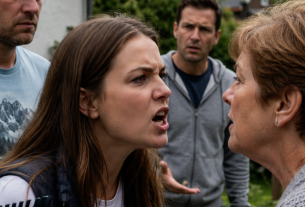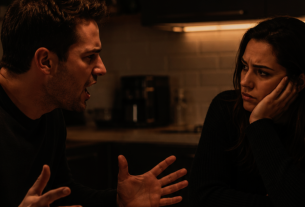
“Who do you think you are? You couldn’t even carry a child to term! If it weren’t for my son, you’d still be sitting in your little one-room apartment and keeping your mouth shut. So from now on, you’ll live by my rules, understood?”
Outside the window, a dull rain was drizzling, running down the cloudy glass in twisting streams, as if nature itself were crying with her. But Sveta could no longer cry. All her tears had been shed there, in the ultrasound room, when the doctor with an unreadable face had moved the probe over her rounded belly for a long time, then quietly, almost in a whisper, said the terrible words that split her life into “before” and “after.”
There was no heartbeat. A missed miscarriage. Seven months. The time when expectant mothers were already choosing strollers and ironing tiny baby shirts had turned into a nightmare for Sveta.
She lay on the narrow hospital bed, turned toward the wall, mentally returning to the recent past, which now seemed like someone else’s beautiful fairy tale.
She and Anatoly had married a little over a year ago. The wedding had been modest, youthful, almost student-like. They began living in a rented apartment, giving up the lion’s share of their small salaries for shabby walls on the outskirts of the city. Tolya was often irritated by the lack of money, grumbled that the landlady was threatening to raise the rent again, and constantly complained to his mother, Lyudmila Vladimirovna. His mother, a domineering and frugal woman, never missed a chance to needle her daughter-in-law, saying she could have found a more respectable job, since she had married a man without his own home.
Then suddenly, fate gave them an unbelievable, truly royal gift. The old district where Sveta’s mother Alla Petrovna’s private house stood was marked for demolition. In place of the aging houses with apple orchards, the city authorities had decided to build a modern residential complex. All registered residents were entitled to compensation in the form of new apartments.
Alla Petrovna, a wise and caring woman, decided that she and her younger son Sergey, who was just finishing tenth grade, would move into a two-room apartment. And Sveta, as an adult and a married woman, was legally entitled to a separate one-room apartment. That alone was incredible happiness — her own personal living space. No more renting, no more strangers coming by for inspections.
But the miracles did not end there. Just as the paperwork was in full swing, Sveta learned that she was pregnant. Their joy knew no bounds. Anatoly carried her in his arms, stroked her still-flat belly, and proudly told all his friends that he would soon become a father. Sveta’s pregnancy played a decisive role in the housing matter.
After submitting certificates from the prenatal clinic to the commission, the family managed to have the conditions reconsidered. By law, a family expecting a child was entitled to expanded living space. And instead of a modest one-room apartment, a bright, not very large but fully proper two-room apartment in a new building was registered in Sveta’s name.
At the time, Anatoly almost glowed with happiness.
“Sveta, can you imagine? A two-room apartment! Our own apartment!” he shouted joyfully, spinning her around the room of their rented place. “This is pure luck! We won’t have to squeeze into one room with the baby. We’ll have a bedroom and a separate nursery!”
True, Sveta noticed one strange thing. Her husband seemed less happy about his upcoming fatherhood than about the fact that they had received free square meters. Every evening he hung on the phone, reporting to his mother, Lyudmila Vladimirovna, in the tiniest detail how the developer’s renovation was progressing, what wallpaper there was, what the view from the window looked like. His mother-in-law, who until then had barely taken part in the young couple’s life, suddenly became extremely active, giving advice on where to place the furniture.
All the documents were successfully signed. The keys were received. They even managed to move some of their things. And then that black Tuesday came.
Sveta sensed something was wrong that very morning. The baby, who usually kicked actively beneath her ribs, had gone quiet. She drove away dark thoughts, blaming the weather, her fatigue, but her mother’s heart beat anxiously like a bird in a cage. Then came the ambulance, the white coats, the ultrasound, and the verdict that could not be appealed.
Sveta spent almost two weeks in the hospital. Her physical recovery went on as it had to, but her soul had turned into a scorched desert. She did not want to eat, drink, or speak. Anatoly came rarely. He claimed he was incredibly busy at work, that he needed to finish small repairs in their new apartment and assemble the furniture.
“Sveta, hang in there, get better. The doctors say everything will be fine. You’re still young. We’ll have another baby later,” he mumbled during his short visits, avoiding her eyes and bringing bags of fruit that Sveta never even opened. In his voice there was none of the deep, shared pain that Sveta so desperately needed. He seemed to have withdrawn, hidden inside some pragmatic shell of his own.
If only Sveta had known what her grieving husband was really busy with during those days while she stared at the ceiling of the hospital ward, trying to find an answer to the question: “Why?”
The day of her discharge came. The doctor spent a long time giving recommendations, wrote her a sick leave certificate for another two weeks of recovery at home, and strongly advised her to see a psychologist. Sveta nodded mechanically, packing her simple belongings into a travel bag.
She called Anatoly that morning.
“Tolya, they’re discharging me. Will you come?” Sveta’s voice was dull, stripped of all emotion.
“Oh, Sveta… Listen, we’ve got an unscheduled inventory at the warehouse, the boss is furious. I can’t get away at all, they’ll fire me to hell,” he said into the phone with an exaggeratedly heavy sigh. “Take a taxi, all right? You have money on your card, don’t you? Go straight to the new apartment. Everything’s ready there. Rest. I’ll see you in the evening.”
Sveta put the phone in her pocket. She had neither the strength nor the desire to argue. She called a taxi. The whole way to the new neighborhood, she looked out the window at the gray high-rises flashing by, and it seemed to her that she was not going home, but into some strange, unfamiliar life.
When she reached her floor, she turned the key in the lock. The door opened easily. Sveta stepped over the threshold and froze.
The hallway did not smell of paint and new laminate flooring, as a newly built apartment should have smelled. The air was thick with the unmistakable aroma of fried onions, borscht, and heavy, cloyingly sweet perfume — the very same perfume Lyudmila Vladimirovna had used for many years. Her mother-in-law’s familiar burgundy coat hung on the rack, and below it, her worn house slippers stood neatly in a row.
Sveta’s already exhausted heart skipped a beat. Slowly, as if in a dream, she walked down the corridor. From the kitchen came the cheerful muttering of the television. But her legs carried her to the second room — the very bright one with windows facing the sunny side, the one she and Tolya had planned to turn into a nursery.
The door was slightly open. Sveta pushed it with her hand and stood stunned.
There was no trace of the nursery left. By the window stood a massive bed covered with a flowery bedspread that Sveta remembered perfectly — it had always been in her mother-in-law’s apartment. Pots of geraniums crowded the windowsill, and an old polished wardrobe loomed in the corner. The room was fully and firmly occupied by another person.
“Oh, so you’ve shown up!” a sharp, creaking voice sounded behind her.
Sveta turned around. Lyudmila Vladimirovna stood in the doorway. She was wearing a house robe and wiping her hands on a kitchen towel. There was not a shadow of sympathy or awkwardness on her face — only the confidence of a woman who considered herself the mistress and a poorly hidden irritation.
“Lyudmila Vladimirovna?” Sveta whispered in confusion, feeling the floor slip away beneath her feet. “What are you doing here? And whose things are these in… in this room?”
“My things, whose else?” her mother-in-law snorted and walked into the room, adjusting the curtain like the owner. “Tolya gave me the keys. He and I talked it over and decided that I’ll live with you for now. The apartment is big, two rooms. The two of you don’t need that much space. And I’m lonely alone in my Khrushchev-era flat, besides, the pipes need replacing there. So my son suggested I move in. The room is empty anyway.”
Her mother-in-law’s words reached Sveta’s mind as if through a layer of cotton.
“Empty?” Sveta’s voice trembled, breaking into a hoarse whisper. “It’s empty because I lost my child. My child. Our child.”
“Oh, don’t start this drama,” her mother-in-law said, rolling her eyes, her entire appearance expressing unbearable boredom. “You lost it, so you lost it. Things happen. You’re not the first and you won’t be the last. But look what kind of apartment you managed to grab! You should be grateful they gave you an apartment at all. Tolya worked so hard, running around and knocking on doors. So now we’re the owners here. We’ll live together peacefully. I’ll cook and do the laundry for you.”
Sveta sank onto the edge of the sofa, unable to stand on her trembling legs. It felt like some elaborate, sadistic nightmare. Her husband, the person who should have been her support during the most terrible period of her life, had spent the time she lay in a hospital bed methodically moving his mother’s belongings into the room that was supposed to become their nursery. He had planned everything in advance. For him, the death of their unborn baby had simply become a convenient excuse to free up square meters for his dear mother.
But the worst was still ahead.
Lyudmila Vladimirovna, apparently deciding to finally establish her authority in the new home, went out into the corridor and returned a minute later with two enormous plastic bags.
She stood directly in front of Sveta, who was sitting on the sofa. Her face twisted into an evil, triumphant grimace.
“You know what, my dear?” her mother-in-law hissed. “Since we’re living together now, let’s make the situation clear right away. So you don’t start acting like some great martyr here.”
With those words, she abruptly turned the bags upside down.
Baby things spilled onto Sveta’s knees, onto the floor, onto the carpet. Tiny rompers with funny little bears, soft flannel swaddling cloths, tiny socks, knitted booties, bottles still in their packaging. Bright, light, smelling of factory-newness and unfulfilled hopes. They fell like silent accusations, like shards of a life smashed to pieces.
Sveta froze, unable even to move. Her breath caught.
“What, did I buy all this for nothing?” Lyudmila Vladimirovna shrieked, raising her voice and jabbing her finger at the pile of baby clothes. “I spent money from my pension, ran around the shops, chose everything! And you? You couldn’t even carry a child to term! All you know how to do is gape at a ready-made apartment! If it weren’t for my son, you’d still be sitting in your little one-room place and keeping your mouth shut. So from now on, you’ll live by my rules, understood?”
Dead silence hung in the room. Only the wind humming outside the window could be heard, and Sveta’s heart beating — heavy, hollow, throbbing painfully in her temples.
She looked at the tiny yellow booties lying at her feet. Then she slowly raised her eyes to her mother-in-law. And at that moment, something inside Sveta cracked. But instead of crumbling into dust, that crack exposed a steel core she had not even known existed. All her pain, all her despair, all the bitterness of her loss transformed in one second into pure, primal fury.
She slowly rose from the sofa. The baby things slipped to the floor. Sveta was a head taller than Lyudmila Vladimirovna, and now, in her pale, exhausted rage, she looked frightening.
“Get out,” Sveta said quietly, but in such a way that the glass seemed to ring.
“What? How dare you…” her mother-in-law began, but Sveta stepped right up to her.
“Get out of my apartment!” Sveta’s voice broke into a scream so powerful it seemed to shake the walls. “Pack your junk, your flowerpots, your wardrobe, and get out of here right now! If you’re still here in an hour, I’ll call the police and say that a strange woman broke into my apartment!”
“This is my son’s apartment! He has the same rights to it!” Lyudmila Vladimirovna screeched, backing toward the door, frightened by the wild gleam in her daughter-in-law’s eyes.
“This is my apartment! Registered in my name as compensation for the demolition of my mother’s house!” Sveta advanced, pronouncing every word sharply. “And your son is just as much a freeloader as you are! Pack your things!”
What happened next, Sveta remembered only vaguely. There was a call to Anatoly. Her husband rushed over from work, tried to shout, assert his rights, threaten with his fists, then switched to pathetic persuasion, demanding that she “calm down and stop acting like a hysterical woman after the hospital.” Sveta did not listen. She methodically threw her mother-in-law’s things into bags and placed them on the stairwell landing.
She threw them both out. Locked the door with every lock, and only then slid down the wall to the floor and began to howl — terribly, like a wounded animal — mourning not only her unborn baby, but also her destroyed, trampled family.
The divorce proceedings were long, filthy, and exhausting. Anatoly, encouraged by his mother, did not want to give up without a fight. He hired a lawyer and filed a lawsuit, demanding that he be recognized as having ownership rights to a share of the two-room apartment. His argument was based on the claim that their marriage and their joint preparation for the birth of the child had been the reason the state had allocated them a larger living space. He beat his chest, telling the judge how he had done repairs there with his own hands, how he had invested “jointly acquired funds.”
Sveta sat through the hearings, hiding her pale face, silently listening to the streams of lies. Her interests were represented by an experienced lawyer whom Alla Petrovna had helped her hire.
The court put everything in its place. Housing received as compensation for the demolition of property belonging to blood relatives — in this case, Sveta’s mother — is not legally considered jointly acquired marital property. The fact that the state commission had taken Svetlana’s pregnancy into account when determining the size of the apartment did not grant Anatoly any ownership rights. Pregnancy is a physiological condition of a woman, while the apartment was allocated in Svetlana’s name in exchange for her lost right of use in the demolished house. Anatoly could not provide receipts for repair work, because the repairs had been municipal, done by the developer.
The judge issued the decision: the claim was denied. The apartment remained fully and unconditionally Svetlana’s. Anatoly and Lyudmila Vladimirovna left the courtroom with nothing, throwing hateful glances at their former relative.
Sveta remained alone in her large, quiet apartment. She rearranged the furniture, threw away the sofa she had been sitting on that terrible day, and re-wallpapered the former “nursery,” turning it into a cozy study.
Time, as people say, does not heal. It merely teaches you to live with pain, turning a gaping wound into a dense scar that aches when the weather changes. Sveta returned to work, began seeing friends again, and started visiting her mother and brother more often. Outwardly, her life improved. She learned to smile sincerely again, not just out of politeness.
But for a very long time — for many years — she could not trust people. Any sign of care from men seemed suspicious to her, hiding selfish motives. Behind every affectionate word, she imagined cold calculation.
Because she had forever learned a cruel lesson: the closest people can betray you precisely when you are at your weakest, and someone else’s living space can matter far more to some people than a human life. And only after going through that hell did she understand the main truth — the only person she could truly rely on in this world was herself.