A Dress from Someone Else’s Shoulder
When Alina first said the word “wedding,” she meant a small dinner in a bright hall by the water, a dress without a corset, and about thirty guests. People who all knew each other, who wouldn’t confuse the bride with the host, and who wouldn’t ask the waiters where they were supposed to put the samovar.
Alina was the kind of woman who didn’t like unnecessary noise. She was short, with a dark bob, neat eyeliner, and a habit of writing everything down in the notes app on her phone. She worked as a manager in the commercial department of a construction company, so whenever she heard the words, “Well, we’ll figure it out somehow later,” her left eye began to twitch.
Her fiancé, Igor, was the complete opposite. Tall, gentle, with the eternal smile of a man who hoped all the adults would somehow come to an agreement on their own. He repaired people’s laptops, spoke to cats as equals, and believed any conflict could be extinguished with the phrase, “Come on, Mom.”
But his mother, Valentina Petrovna, did not extinguish conflicts. She decorated them with ribbons, placed them in the center of the table, and announced them as the main event of the evening.
Valentina Petrovna was a striking woman: tall, in a burgundy dress, with a gold brooch shaped like a twig and a hairstyle that held up in any weather, as if it had its own separate passport. She worked as the head of the district library, but spoke as though she ran the Ministry of Family Happiness.
That evening, Alina came to their place for tea. The kitchen smelled of cabbage pie, violets stood on the windowsill, and on the refrigerator there was an unexpected magnet from Gelendzhik with the inscription: “One must vacation beautifully.” Igor was slicing lemon. Valentina Petrovna was laying out napkins.
“Alinochka, I’ve sketched out a little something for the wedding,” she said in the kind of voice usually used to announce a victory in a district competition.
Alina smiled.
“Great. We were just planning to discuss everything.”
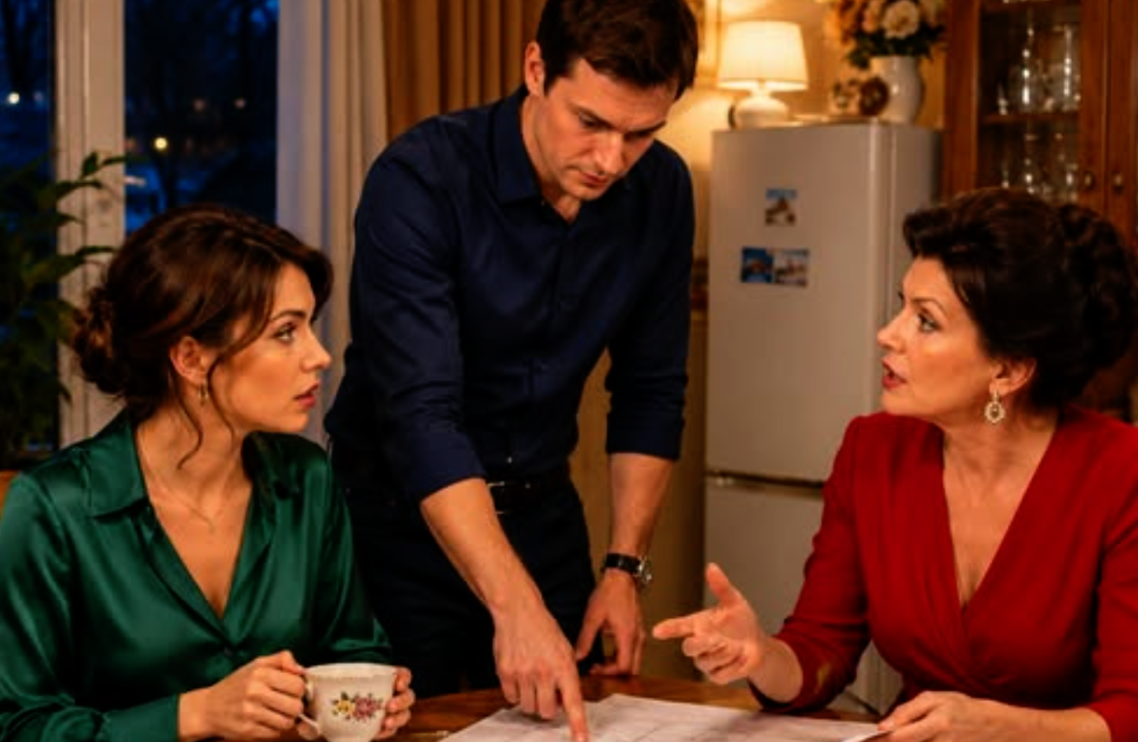
Valentina Petrovna pulled several sheets of paper out of a folder. Many sheets. Far too many for the phrase “a little something.”
“Here is the guest list. From my side, there are seventy-two people for now, but that’s without the Petrovs. They absolutely must be invited. They took Igor to the seaside when he was a child.”
Igor dropped a slice of lemon into the sugar bowl.
Alina blinked.
“Seventy-two?”
“Well, how else? A wedding doesn’t happen every day. People will be offended.”
“People — meaning who?”
“Relatives, colleagues, Aunt Zina from next door. She remembers Igor when he was little.”
“Aunt Zina remembers Igor when he was little, so she needs a steak at our expense?” Alina asked calmly.
Igor coughed. Valentina Petrovna looked at her as if someone had placed a mug on a rare edition in the library.
The Plan Was Already Ready
But the guests were only the beginning.
Valentina Petrovna turned over the sheet and pulled out a printout from a bridal salon. There was a dress in the photo. Enormous, white, with lace, puffy sleeves, pearls, and a skirt big enough to hide an entire elementary school class inside.
“And here is the dress. I knew at once: it’s yours.”
Alina looked at the dress, then at her future mother-in-law, then back at the dress.
“Valentina Petrovna, it weighs as much as a washing machine.”
“But it’s festive. A bride shouldn’t look like she’s going for a walk. She should look like a bride.”
“I wanted a simple dress.”
“A simple one can be for the second day,” Valentina Petrovna cut her off. “And your hair needs to be pinned up high. You have a nice face, but it needs to be opened up.”
Alina ran her fingers over her bob.
“My face asked me to tell you that it’s managing just fine on its own for now.”
Igor quietly snorted, but immediately hid behind the kettle.
Valentina Petrovna did not give up. She had already chosen the restaurant, a host with an accordion “for warmth,” a five-tier cake, and the song for the first dance. And it was the kind of song that made you want not to dance, but to apologize to everyone for being young.
“And I also thought there should be a bride ransom. With games. So it’ll be fun.”
“I don’t want a bride ransom,” Alina said.
“You simply don’t understand. It’s a tradition.”
“A tradition is when everyone agrees. When one person doesn’t want it, it becomes a survival quest.”
Igor finally sat down beside Alina and carefully placed a hand on her shoulder.
“Mom, maybe we really should decide this ourselves?”
Valentina Petrovna sighed heavily, with meaning. That is how people sigh when they have spent their whole lives saving the ungrateful.
“Of course, yourselves. I’m not interfering. I’m helping.”
Alina nodded. Slowly. With the very expression that, at the construction company, meant: someone is about to learn why a contract matters more than someone’s mood.
The Expense Spreadsheet
The next day, Alina opened her laptop. A cup of coffee stood on the kitchen table, a notebook lay beside it, and a spreadsheet glowed on the screen. The columns were honest and merciless: restaurant, dress, host, décor, photographer, transport, cake, percentage for unforeseen family pressure.
Igor sat opposite her, eating a sandwich and already looking guilty in advance.
“I’ll talk to Mom,” he said.
“You will. But first we’ll talk in numbers.”
That evening, they went to Valentina Petrovna’s place again. She greeted them in a pistachio-colored house suit and with the expression of a woman who had already mentally seated the guests at tables and sorted them by political views.
Alina placed the laptop on the kitchen table.
“Valentina Petrovna, I’ve calculated everything.”
“Oh, what is there to calculate? A wedding is an expensive affair.”
“Exactly.”
She turned the screen around.
“Your version: one hundred and eight guests, a restaurant, a host, a dress, a cake, décor, a bus for relatives from the region. Total — this amount.”
Valentina Petrovna leaned toward the screen. Her eyebrows rose slightly.
“What is this, with an apartment included?”
“No, without an apartment. An apartment would come out cheaper.”
Igor covered his mouth with his hand.
Alina spoke evenly, without anger. That made her words sound even more convincing.
“And here is our version. Thirty-two guests. Dinner, photographer, music, a dress I can wear without dying of suffocation. The amount is here.”
Valentina Petrovna straightened.
“But a son’s wedding happens only once.”
“I certainly hope so,” Alina said.
A pause hung over the table like a pot lid just before boiling.
“So,” she continued, “the rule is simple. Whoever pays gets to choose. Whoever doesn’t pay dances, smiles, and says how beautiful the bride is.”
Valentina Petrovna froze.
“What exactly are you getting at?”
“I’m getting at the fact that if you want one hundred and eight guests, a dress with architectural support, and a host with an accordion, here is your share of participation.”
Alina calmly turned the laptop toward her. In the spreadsheet, there was a separate line: “Valentina Petrovna’s contribution to the expanded version of the celebration.”
Igor turned pale, as if he had seen not a number, but the electricity bill for the entire district.
Valentina Petrovna stared at the screen for a long time. Then she took off her glasses, wiped them with a napkin, and put them back on.
“Could Aunt Zina somehow manage without a steak?”
“Yes. We can send her a card.”
“And the Petrovs?”
“The Petrovs too. They took Igor to the seaside, not all of us to a restaurant.”
Igor burst out laughing, then immediately pretended he had choked on his tea.
A Small Wedding
In the end, the wedding was small. Not poor, not boring, not “a failed attempt to do things like normal people,” but exactly small and beautiful.
They chose a restaurant with windows overlooking the river. White tablecloths, fresh flowers in low vases, candles that no one tried to blow out after the third glass. There were thirty-four guests, because Valentina Petrovna did manage to negotiate for her second cousin Lida, “she’s quiet and doesn’t eat much.” Alina wore a dress the color of baked milk, straight, light, with delicate sleeves. She left her hair as it was. As it turned out, her face really was managing just fine on its own.
Igor smiled all day as if someone had repaired the world for him. He held Alina’s hand, adjusted her bracelet, and whispered:
“You’re a terrifying woman.”
“Economically literate,” she replied.
Valentina Petrovna came in a blue dress, with the same gold brooch. For the first half hour, she still tried to manage the waiters with her gaze, but then she gave up. She sat beside her sister Lida, tasted the salad, and unexpectedly said:
“It’s actually nice. You can hear what people are saying.”
Later, when the music began, Igor invited his mother to dance. At first, Valentina Petrovna held herself strictly, but then she smiled. Not in a librarian way, not in a lecturing way, but genuinely.
“Alinochka,” she said near the end of the evening, when the guests were eating a two-tier cake and no one was suffering from the absence of an accordion, “your dress is beautiful.”
Alina looked at her carefully. Valentina Petrovna adjusted her brooch slightly and added:
“And there was no need to open up your face. It can be seen just fine as it is.”
For her, that was almost an admission of surrender. With fanfare, but quietly.
Alina smiled.
“Thank you.”
“But Aunt Zina was still offended.”
“We’ll send her a piece of cake.”
“Without steak?”
“Without steak.”
And they both laughed. Not like best friends, of course. They were still far from that. But already like two women who had understood an important family truth: help is good when it has been asked for. And when it hasn’t been asked for, it is better to bring cake, smile, and step out of the expense spreadsheet in time.
What do you think: where is the line between sincere family help and an attempt to control someone else’s life — in money, in the right to make decisions, in respecting the couple’s wishes, or in knowing when to stop?