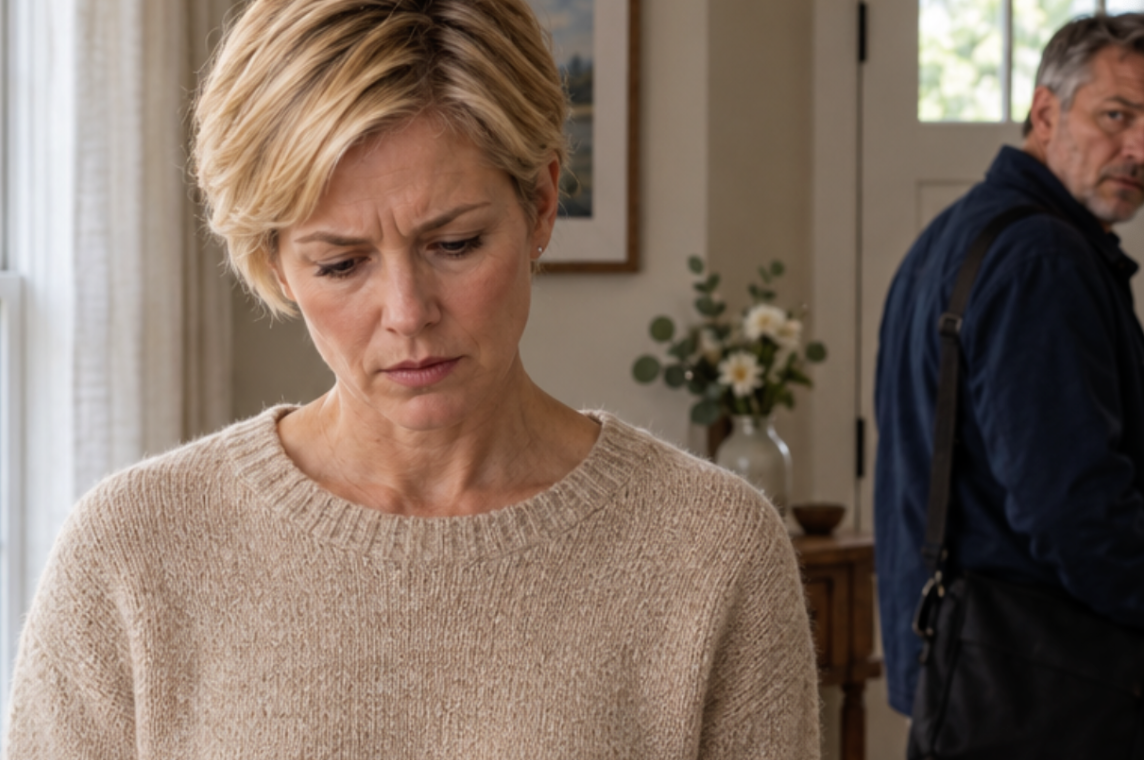
A few weeks later, I found a baby rattle in my husband’s jacket. Once again, he explained: it was a gift for someone else’s child.
I stood in the hallway holding this plastic thing with a worn-off bear and tried to remember if any of our friends even had small kids. I couldn’t recall anyone.
“Oleg, which child is this for?”
“It’s for my mother’s neighbor. Her granddaughter came to visit, and they didn’t have any toys. I just picked it up at the pharmacy next door, it cost next to nothing.”
He spoke calmly. Didn’t even look away. Took off his shoes, walked into the kitchen, poured himself some tea. I put the rattle on a shelf in the closet, next to the gloves.
The first time this happened was three weeks ago. I was sorting through his pants before washing them and found a receipt from a children’s store. Baby shoes, size twenty-one. Soft sole, Velcro strap. Four hundred eighty rubles.
Oleg and I have two grown sons. The oldest is thirty-one, the youngest is twenty-seven. Neither has kids yet. We’ve been waiting for grandkids, but still none. And yet, here’s a receipt for shoes that would fit a baby about a year and a half old.
“It’s for Lyosha’s coworker,” Oleg told me then. “Remember I mentioned it? His wife just had a baby, and they’re tight on money. I promised at work I’d get something.”
I nodded. These things happen. People help each other. Oleg isn’t stingy at all; he really could’ve just bought the shoes.
But the rattle, coming three weeks after the shoe receipt—this wasn’t just a coincidence anymore, it was becoming a pattern.
My name is Natalia, I’m fifty-three. I work as a dispatcher at a logistics company. Married to Oleg for twenty-nine years. He’s a technician servicing industrial equipment, great with his hands, even-tempered. He’s never raised his voice, never disappeared for the night, never gave me a reason to doubt him.
Every Saturday he’d go visit his mother. Zoya Andreyevna, seventy-eight, lives alone in a small apartment across the city. Her legs hurt, her blood pressure jumps, the faucet leaks, the curtain rod falls down. Oleg would visit, fix things, bring groceries. I always thought this was normal. I was even proud— not every man at fifty-five remembers to care for his mom.
And then these baby items started showing up.
After the rattle, I spent two weeks convincing myself there was nothing strange going on. It didn’t work. At night, I’d stare at the ceiling, replaying the same things in my head: the shoe receipt, the bear rattle, Oleg’s calm face. Each time, he had an answer. Simple, practical, nothing you could argue with.
And each time, the explanation was about someone else’s child.
On Wednesday, Lyudmila called. We’ve known each other about fifteen years, live in different neighborhoods, but run into each other at the market near Zoya Andreyevna’s. Lyudmila lives just two blocks away from there.
“Natalya, I don’t want to upset you,” she began, and my fingers went cold.
“Go ahead. Tell me.”
“I saw Oleg on Saturday. Not at his mother’s place. He was walking on Klenovaya Street with a woman. She looked young, maybe thirty-five, maybe forty. And there was a small child in a stroller.”
“Maybe they were just walking nearby by chance?”
Lyudmila was silent for a moment.
“Natalya, he was pushing the stroller. And they were talking. Not like random strangers.”
I said thank you and hung up the phone. I sat down on a kitchen stool. Outside, the rain was drizzling, the soup on the stove was getting cold, and the sound of the TV drifted from the other room. Oleg was watching football.
Pushed the stroller. Those two words kept echoing in my mind.
I didn’t make a scene. Not because I’m patient, but because in twenty-nine years I’ve learned one thing: if you want to know the truth, don’t shout. Yelling just gives someone an excuse to get offended and avoid giving an answer.
On Friday evening, when Oleg left for the garage, I dialed Zoya Andreyevna.
“Hello, Zoya Andreyevna. How are you feeling?”
“Oh, Natasha, thank you for calling. My blood pressure was acting up again last week, but it’s better now.”
“Did Oleg visit you on Saturday?”
There was a pause. Short, but I heard it.
“This Saturday? No, he didn’t come this time. He called and said he was held up at work. But he was here last week. Stayed for about forty minutes, checked the faucet.”
Forty minutes. Oleg left at nine in the morning and came back at five in the evening. Eight hours. Only forty minutes with his mother.
I also asked about the Saturday before last. Zoya Andreyevna thought for a moment and said he stopped by briefly, brought kefir and bread. Maybe stayed for an hour.
“Is everything okay?” she asked, sounding worried.
“Nothing, I just missed hearing your voice.”
She didn’t believe me, I could tell. But she didn’t ask any more questions.
Eight hours minus forty minutes. Or minus an hour. He spent the rest of the time somewhere else. With someone else. With a younger woman, and a small child.
I took a rattle out of the closet. Turned it over in my hands. A teddy bear looked up at me with one painted eye; the other was rubbed off.
‘A gift for someone else’s child.’ That phrase sounds different now. Not like an explanation, but like a formula. A universal excuse for any situation. Found a pacifier in the glove box? A gift for someone else’s child. Found an empty diaper package? A gift for someone else’s child.
But it looks like the child wasn’t someone else’s after all.
On Saturday, Oleg got up at half past eight. Shaved, put on a clean shirt. I’d noticed that before too, but it never seemed important. You can visit your mother in an old t-shirt.
“Going to see Mom, she’s not feeling well again,” he said in the hallway, tying his shoelaces.
“Say hi to her for me.”
“Of course I will.”
He left. I waited ten minutes and called a taxi.
No, I wasn’t planning to spy. I just wanted to check one fact. Lyudmila mentioned Klenovaya Street. There’s a children’s clinic nearby on Klenovaya. Saturday, open until two.
The taxi got me there in forty minutes. I got out at the corner by a grocery store with an awning. Bought some water. Positioned myself so I could watch the clinic entrance and the benches outside.
I didn’t have to wait long.
At 10:45, Oleg appeared around the corner. Walking beside him was a woman in a beige coat. She looked about thirty-eight, not very tall, with dark hair pulled back in a ponytail. Oleg was pushing a stroller. Inside sat a boy in a blue hat.
They strolled slowly. Oleg was saying something, the woman nodded. At the clinic entrance, they stopped. Oleg leaned over the stroller, adjusted the boy’s scarf. The woman pulled documents out of her bag.
I stood thirty meters away, watching my husband fix the scarf of someone else’s child. Or maybe not someone else’s.
They went inside.
I didn’t follow them. I turned around, walked to the bus stop, and took a minibus home. The whole ride, I stared out the window, counting each stop just to keep my mind off everything.
He came back at four o’clock.
«How’s your mom?» I called out from the kitchen.
«She’s alright. We checked her blood pressure—130 over 80. I put up the shelf in her bathroom for her.»
He lied so easily that it frightened me. Not for myself, but for all those years I believed his every word.
«Oleg, sit down.»
He looked at me. There must’ve been something in my voice, because he sat down immediately. No jokes, no questions.
«I was on Klenovaya Street today. By the children’s clinic.»
He didn’t turn pale or flinch. He just froze. As if someone switched off the sound inside him.
«Natash…»
«Wait. I’m not yelling, and I’m not going to. I want you to tell the truth. Just once. Who is that woman, and whose child is that?»
Silence. Next door, the neighbors’ drill was running. The clock on the windowsill ticked—the one Oleg fixed last year.
«Her name is Yana,» he finally said. «Misha is two years old.»
And he went quiet again. As if that was all that needed to be said.
«Is he yours?»
Oleg rubbed his face with his hands, then looked me in the eyes—for the first time during this whole conversation.
«I don’t know.»
«What do you mean, you don’t know?»
«She says he’s mine. I haven’t checked.»
I stood up and walked to the window. Outside, some boys were playing soccer. Just an ordinary Saturday evening, an ordinary courtyard, an ordinary life—which, ten minutes ago, had stopped being ordinary.
«How long has this been going on?»
«Three years.»
Three years. About a hundred and fifty-six Saturdays. Give or take.
«And does your mother know?»
«No. She doesn’t know. I always told her I was working late when I didn’t come by.»
So that’s how it was. He used his mother twice—told me he was visiting her, told her he couldn’t come because of work. Two mirrors facing each other, and each reflection held a convenient lie.
«Why didn’t you tell me?»
He was silent for a long time. Then he finally said:
«Because I didn’t want to lose what we have.»
«And what do we have, Oleg? Twenty-nine years, of which three you’ve split between two homes? You call that ‘what we have’?»
He lowered his head.
«Natash, I never meant for this to happen… That’s just how it turned out.»
«Things don’t just turn out that way. People make them that way. Every Saturday, for three years straight.»
I wanted to throw something—a cup, a plate. But I didn’t. Not out of nobility. My hands just wouldn’t obey me.
«Do you explain things to her, too? About us?»
«She knows I’m married.»
«And what do you tell her? That your wife doesn’t understand you? That your marriage has been just a formality for ages?»
He stayed silent. Which meant, that’s pretty much what he told her.
The next day, I called Zoya Andreyevna. Not to complain—just so she wouldn’t hear it from someone else.
«Zoya Andreyevna, I have to tell you something. It’s not about health. It’s about Oleg.»
She listened to me. Didn’t interrupt. Just breathed into the phone, slow and heavy.
«Natashenka,» she finally said, «I never sent him to you, and I’m not about to cover for him. I didn’t even know.»
Her voice trembled. Not from age, but from hurt.
«He called and said work was keeping him late. I believed him. What mother wouldn’t believe her own son?»
We sat in silence. Two women, both used as cover by the same person. Each, in her own way.
«It wasn’t the rheumatism that made me sick,» Zoya Andreevna said quietly. «But now, it just might.»
I couldn’t think of anything to say in response.
Oleg tried to talk for another three days. He explained, made excuses, suggested we ‘discuss everything calmly.’ I just listened, nodded, and packed my things in my travel bag. Not his things—mine.
Not because I was leaving my own apartment. I just needed to be anywhere but here. I went to stay with a friend for a week. During that week, I found a lawyer, asked my questions, and got all the answers I needed.
When I came back, Oleg was sitting in the kitchen. Dirty dishes were piled up in the sink, and an empty jar of instant coffee sat on the table. He looked like he hadn’t slept a minute in those seven days.
«Natasha, don’t let’s make any rash decisions.»
«Oleg, this isn’t a rash decision. I’ve spent a week thinking about it. That’s enough.»
He looked at me like he didn’t recognize me, because he was used to a different Natalia—the one who nodded, trusted, and never checked.
«I’m filing for divorce,» I told him. «The apartment belongs to both of us, so we’ll split it according to the law. Everything else, we’ll sort out with the lawyer.»
«Why? Over one mistake?»
«No, Oleg. Over three years of lies. That’s not a mistake. That’s a choice you made every Saturday.»
He opened his mouth to speak but closed it again. There was nothing left to say.
A month passed. The paperwork was with the lawyer, the apartment got appraised, and the viewing schedule was set. Oleg moved in with his real mother, not the one he pretended to have.
Zoya Andreevna called me once. She kept it brief:
«I told him everything I needed to. He stayed silent. When my son is silent, it means he has nothing to say back.»
We never discussed it again. But on Thursdays, she still called me, just like before. She’d ask about my blood pressure, about my work, about my sons—as if my divorce from her son hadn’t changed anything between us.
And the rattle was still sitting on the shelf in the closet. When I was sorting out my things before moving, I found it nestled between some gloves and an old scarf. The teddy bear was staring up at me with one eye.
I threw it in the trash. No anger behind it at all. There’s just no point holding onto gifts for someone else’s child anymore.