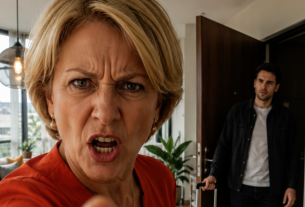
“The house will go to Vitya later. We’ve decided,” my mother-in-law said, placing the ladle across the pot and looking right at me. Not at her son. At me.
Who exactly is this “we,” I wonder?
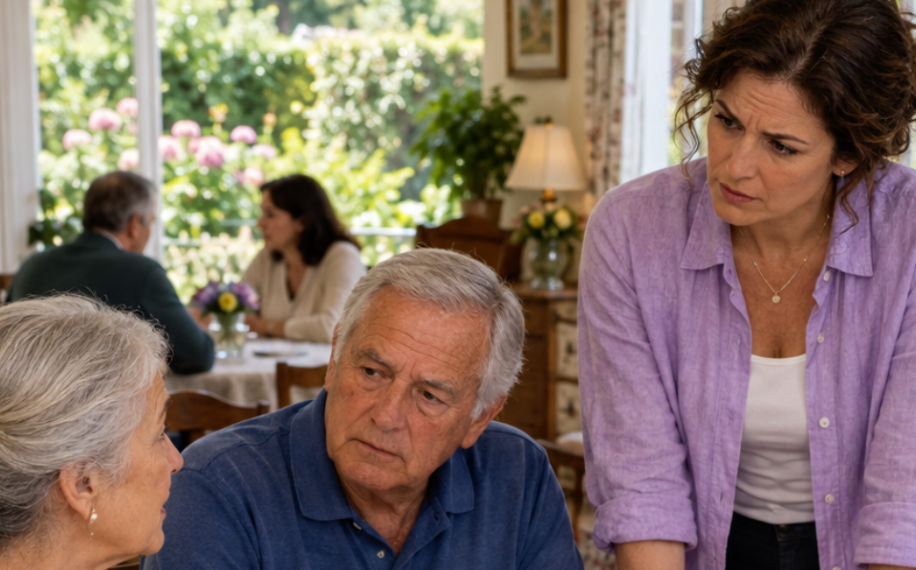
Everyone was squeezed together at her tiny six-meter kitchen table. Vitya, his older brother Slava with Tanya, nephew Denis with pregnant Alina. Elbows jostling in the plates. Zinaida Fyodorovna had called us over for dumplings on Saturday—she only makes dumplings when she has an announcement. Last time, it was about her upcoming surgery.
“What house?” I asked, though I knew what she meant.
“Your house, Larochka, on Lugovaya. I’m not planning on dying, and God willing, neither are you. But things need to be in order. Vitya has been working himself to the bone there for twenty-two years. He fixed the roof, built a sauna, got the gas connected. And your Lera has an apartment in Tula; she doesn’t need this house. She’ll just sell it—and Vitya will be out on the street.”
Slava kept his eyes on his plate. Tanya suddenly found the salt shaker fascinating. Alina stroked her belly. Vitya chewed and chewed, as if he’d bitten into gristle.
“Nothing’s decided, Zinaida Fyodorovna,” I said. “The house was left to me by my parents. I’ll decide who gets it after me. No meetings necessary.”
“That’s what I’m saying—later.”
“Then why am I sitting here, with dumplings, listening to people divide my home?”
“Because you’re stubborn. And I’m almost eighty. I want to know my son will always have his own place.”
“By the way, Lera comes every summer.”
“Twice a year,” the mother-in-law corrected. “For barbecues. And she calls Vitya by his name, like he’s just a neighbor.”
«Mom, seriously, could we maybe not talk about this at the table?» Slava spoke up.
«You stay quiet. You’ve got your own apartment, you’ve got it easy.»
Slava fell silent and started piling dumplings onto Tanya’s plate, even though she didn’t ask for them.
«Vitya,» I turned to my husband, «say something.»
He set down his fork.
«Mom, let’s not do this right now.»
Not a ‘no.’ Just not right now.
Behind my mother-in-law, there was a magnet on the fridge from Anapa—a dolphin with its tail broken off. Judging by the glue marks, they’d tried to fix it once already, and it had come off again. Strangely, I spent the rest of the evening staring at that dolphin.
Then they started talking about the summer kitchen. I can’t remember who brought it up first—Tanya or Denis himself.
«Aunt Lar, is the stove in your summer kitchen a real one?»
«It’s real. My dad’s. Why?»
«No reason,» Denis shrugged and reached for the sour cream.
Under the table, Alina nudged him with her knee. I saw it.
By the way, the sour cream was store-bought, even though my mother-in-law tells everyone she gets it from an acquaintance in the private sector. She poured it into a jar but forgot to throw away the store lid.
***
We walked home on foot, cutting through the field behind the school. The streetlight wasn’t working again, so we relied on memory, following the little path between the tall weeds. Somewhere past the garages, a dog was howling—long, on the same note. Vitya smoked, even though he quit back on New Year’s.
«You could’ve at least finished your dumplings,» he said. «Mom got upset.»
«Mom got upset,» I repeated. «So I was supposed to thank her for that?»
He didn’t answer, just took a deeper drag on the cigarette.
«Did you know?» I asked him.
«Know what?»
«That she was going to say that.»
He was quiet for about ten steps.
«Yeah, I knew. Lar, she’s old. It helps her feel at ease.»
«And what about me? Am I supposed to feel comfortable while my home gets torn apart at the dinner table?»
«Nobody’s tearing anything apart. It’s just talk.»
«Then tell her tomorrow that there’s not going to be any more talk.»
«I’ll tell her,» he muttered.
And of course, he didn’t say anything.
At home, I went to the closet, to the shoebox from Mom’s boots where I kept the house documents. The extract, the technical passport, the inheritance certificate. Everything was still there. I held them in my hands for some reason and put them back. As if they could vanish after one evening. Silly.
Then I sat in the kitchen for a long time. On Monday, I had three crowns and a bridge to make for a difficult retired colonel, but at one in the morning, I was sitting there smelling my own fingers—they always smelled like plaster after the lab, no matter how much I washed them—and counting how many years our roof had lasted. Nine. We redid it with what was left from Mom, and the receipts are still in her jewelry box under my name. But it was Vitya who did the reroofing, with his own hands, all through August in the heat. That’s true, and I wasn’t about to argue with her about that.
Dad built the house when I was still in school. He built the summer kitchen himself, brick by brick, and redid the stove twice because the first one smoked. The second one is still a pleasure to fire up: the draft is so strong it could pull a match right out of your fingers.
The door creaked on the porch. Vitya came out to smoke for the second time. He spoke quietly on the phone, but every sound carries at night in our house.
«Yeah, Mom. Got it. Next Saturday.»
No one told me what was happening next Saturday.
Guests with a measuring tape
On Monday, I took an hour off work and went to see a lawyer. The office was above a pharmacy, the stairs were steep, and the railing felt sticky from so many hands. The lawyer’s name was Margarita, probably about thirty, with a ficus plant and two phones on her desk—both ringing constantly.
She listened to me quickly. While I was talking, she answered the phone twice with questions about someone’s property boundary and a fence. Thirty years old, but her face looked like she could see right through everyone. Honestly, it was a bit unpleasant. But maybe that’s how it’s supposed to be.
«The house is your personal property, inherited. It isn’t considered jointly acquired,» she said. «No one can force you to give it away or sell it. If you want clarity, write a will. Maybe for your daughter, for example. As for your husband, you can give him the right to live in the house for life. That’s called a testamentary refusal. Your daughter would own it, but she couldn’t force him out while he’s alive.»
«What if he’s retired by then?»
«Then he’s entitled to a mandatory share. Half of what he would have gotten without a will. That’s just the law—there’s nothing you can do about it.»
I wrote everything down on the back of a gas bill because I couldn’t find my pen—I used hers, blue and chewed up. I ended up taking it with me because it felt awkward to bring it back.
That evening, I asked Vitya to go out to the bathhouse. Not to bathe—just because it’s cool there in summer and nobody can overhear us. We sat on the bench.
«Vitya, let’s be straightforward. I’ll write a will for Lera. And for you—the right to live here for as long as you want. The notary will put it in writing. Nobody will kick you out, not Lera, not her future husband, nobody.»
He stared at his hands. They’re big, cracked, and there’s always something black under his nails, no matter how much he scrubs.
«So, I’m a tenant, then.»
«Why a tenant? Nothing changes for you. You’ll live here just like before. It’ll just be officially Lera’s house on paper.»
«In this house where I know every board. Where this bathhouse, with these, —he raised his palms and let them fall on his knees— I built myself. Lera never once called me dad in twenty-two years. Not once. I taught her to ride a bike. I went all the way to Tula to buy her shoes for graduation because you were working a shift.»
His voice wavered and he fell silent. He stood up, bumped his head on the doorway like always, and walked out. Didn’t even wait for me to finish, the jerk.
I stayed on the bench. Honestly, I’d forgotten about the shoes. They were white, with a small heel.
I sat there a bit longer. The bathhouse smelled like last year’s oak branches—Vitya ties them himself every July. Then I went inside. He was already in bed, turned to the wall, pretending to sleep. But I’ve been listening to him snore for twenty-two years; I can tell the difference.
***
On Saturday at ten in the morning, Denisova’s car stopped by the gate.
I happened to be weeding the strawberries. First, my mother-in-law got out, then Alina, holding onto the door carefully. Denis came out last with a yellow tape measure in his hand. Vitya went to let them in—he knew they were coming. He’d shaved that morning.
«We’ll just be a minute,» said Zinaida Fyodorovna. «The kids want to see the summer kitchen.»
«Why?»
«Because they pay half their salary for a one-room place on Lenina. Here they’d have a stove, water, electricity. They can stay the winter until the baby gets older. Vitya doesn’t mind.»
Denis was already running the tape along the wall, muttering to himself. Alina had mismatched laces on her sneakers—one green, one white. For some reason, that stuck in my mind too.
«Denis, put the tape away,» I said.
«Aunt Lara, we’re just here to take some measurements.»
«No need to measure anything. No one’s going to live here. Not this winter, not ever.»
My mother-in-law threw up her hands.
«You’re kicking a pregnant woman out onto the street?»
«She’s not on the street. They have an apartment. And I won’t let anyone live in my dad’s kitchen – that’s final, we’re not discussing it.»
«Aunt Lara, we’d pay,» Denis said. «For electricity, for gas.»
«It’s not about the electricity.»
«Vitya is officially registered here, you know,» my mother-in-law raised her voice. «He has the right to have guests.»
«Guests, sure. But not tenants. And no one can register anyone here without me, Zinaida Fyodorovna. Not even if they really want to.»
«Vitya! Are you the man of the house or what?»
Everyone turned to look at him. Vitya was standing by the woodpile, picking at the bark of a birch log with his fingernail.
«Mom, let’s go,» he finally said.
Alina blushed, red as a beet, and headed to the car first. Honestly, I felt sorry for her. It wasn’t her fault; she’d been brought here like a measuring tape. Denis muttered a quick «sorry» and followed her.
My mother-in-law turned back at the gate.
«You’ll see, Lara. If you won’t listen to reason, it’ll happen another way.»
Vitya closed the gate behind them and went into the garage. He didn’t come out until evening, busy sawing away at something.
That night, I went rummaging in the closet for the electricity bill. The shoebox from my mom’s old boots was there, but the folder with the house documents was missing.
A paper signed in April.
«Mom has the folder,» Vitya said without taking his eyes off the TV. «She wanted to show it to the notary. Just to ask about a possible transfer. Just for advice.»
«You took my documents without asking me.»
«Why are you so upset? It’s not like I sold anything.»
«Those documents better be back in their place by tomorrow.»
The next day he said his mom was at the clinic. Later, he ‘forgot.’ A week went by like this. On Friday, I went to the garage to look for some jars for cucumbers and noticed a brand new padlock on his metal cabinet. There’d never been one before.
The key was right there, hanging on a nail by the door, next to the cellar key. Vitya never was any good at hiding things.
The folder was on top. Mine, blue, with Mom’s label on the spine: «House.» Underneath it—a sheet of paper folded into quarters with a stamp. I unfolded it right there, sitting on an upturned bucket.
A will. The official stamped copy from the notary. Everything he owns at the time of his death, Viktor Nikolaevich leaves to his nephew, Denis Vyacheslavovich. Signature. Stamp. Dated April 23rd.
Two weeks before the dumpling incident.
I reread the date three times. The garage smelled of gasoline and last year’s apples, with a mouse rustling in the corner. If the house had been signed over to Vitya, it would have gone to Denis after him. So much for the summer kitchen. So much for the «roulette.»
I snapped a photo of the paper with my phone and put it back exactly as it was. I took the folder. Locked the padlock, hung the key back on the nail.
I didn’t talk to Vitya about it. Margarita told me over the phone exactly what I already knew: he can rewrite his will tomorrow if he wants, ten times over—a fight won’t undo it. First, I need to make my own arrangements. The notary only saw clients on Thursdays.
I couldn’t sleep at all last night. I just lay there thinking—what if this is my fault? I never told Lera, ‘Call him dad.’ I always thought it wasn’t my place, that she’d decide on her own. And maybe he’s been waiting for twenty-two years. Maybe that’s why he wrote this letter, out of hurt. People do all kinds of things when they’re feeling hurt.
At two in the morning, I picked up my phone and dialed Lera’s number. I hung up before it even started ringing.
In the morning, Vitia headed off to his shift like nothing had happened. He even washed his own cup—which hasn’t happened since Easter.
***
On Wednesday, my mother-in-law showed up at my work. She came by herself, took the bus, and brought a pie wrapped in a bag.
Our lab is in a semi-basement, with windows high up near the ceiling—you can only see the legs of people passing by. Nina, my coworker, immediately went out for a smoke. That’s her way of being tactful. We once spent half a year debating about this old man who claimed his prosthesis only bothered him on Wednesdays. Nina said he was lying, I said he wasn’t. We never did find out; he moved to Lipetsk to live with his son. But that’s not really the point.
«With cabbage,» my mother-in-law said, setting the bag at the edge of the table, far from the plaster casts. «You love it, don’t you?»
I liked cabbage pies about twenty years ago. Oh well.
She sat on the stool and stared at the box of teeth molds for a long time, as if she’d never seen such a thing before.
«Lara, I didn’t mean any harm. I lived in dorms until I was forty. First by myself, then with Vitia and Slavka—one room for all three of us, the bathroom at the end of the hall. They only gave me a place of my own after the boys had already gone off to the army. I just want my kids to have their own space. Not like I did.»
Her voice became hoarse, and she started adjusting her headscarf, even though it was perfectly in place. I had never seen her not know what to do with her hands before.
«Vitia has his own space,» I said. «Twenty-two years.»
«As long as you’re alive.»
She straightened up, and it’s like everything passed, like nothing had happened.
«We’ll get together at your place on Sunday. All of us. We’ll have a family talk. And on Tuesday at eleven, Vitia has an appointment with the notary. You’ll sign the transfer, and that will settle the matter. You’re a smart woman.»
«Come on Sunday,» I said.
Nina ended up eating almost the whole pie. My mother-in-law really does make good pastry, can’t argue with that.
On Thursday, I sat in the notary’s office alone. Lera didn’t even know where I’d gone. There was someone’s wet umbrella on the chair by the door, though it hadn’t rained since Monday. I kept expecting someone to come back for it. No one did.
The notary read the document aloud to me, slowly. The house and the land on Lugovaya—left to my daughter, Valeria. No mention of Vitia. Even the right to live in the house—the one I’d offered him in the bathhouse—wasn’t there.
«Ready to sign?» she asked.
I took the pen and held it over the paper for a minute. Then I signed. One copy stayed at the office, the other they gave me to keep.
There were three days left until Sunday.
After we finished our tea
I set the table out on the veranda: okroshka, chicken with potatoes, pickled cucumbers, and rhubarb pie. My mother-in-law was the first to arrive—she walked around the yard with the air of an inspector, even tugging on the summer kitchen door.
Everyone gathered: Slava and Tanya, Denis and Alina, and Vitia at the head of the table, in dad’s chair. He seemed in a festive mood since morning—he wore the plaid shirt I’d given him on our twentieth wedding anniversary.
My mother-in-law talked nonstop all evening. She went on about the price of medicine, Alina’s test results, and Slava’s aching back. After about two hours, she finally raised her glass of cherry liqueur.
“Let’s drink to everything going well on Tuesday. To Vitya. To the man of the house.”
We all had a drink. I took a sip too. Tanya looked at me over the rim of her glass, as if expecting me to throw a plate at someone. She was disappointed.
But I was waiting for something else. Waiting for everyone to finish eating. For Slava to lean back in his chair, for Tanya to say her usual, “Oh, I’m going to burst.” I poured tea, sliced the pie. And only after the last piece went to Denis, I pulled a sheet of paper from the buffet drawer and placed it on the tablecloth, right between the teapot and the little jam dish.
“What’s that?” my mother-in-law asked.
“A will. Mine. I signed it on Thursday.”
I read one line out loud: the house and the plot of land on Lugovaya go to my daughter, Valeria. I didn’t read any further.
It got so quiet, you could hear the neighbor’s dog barking at a cyclist.
“What are you doing?” my mother-in-law said. She didn’t even ask—it was a statement.
“We’re not going anywhere on Tuesday,” I turned to my husband. “By the way, Dad’s not in the garage anymore. And, Vitya, I saw another paper in the cabinet. Dated April 23rd. In Denis’s favor.”
Slava slowly put down his cup.
“What other paper? Mom, did you know about this?”
My mother-in-law pursed her lips.
“What’s so wrong with it? Denis is blood. Who is Lera to him?”
“You convinced Vitya, and didn’t even tell me, his father,” Slava stood up. “Didn’t tell me.”
Denis sat there red-faced, Alina stared into her cup. Vitya was silent the whole time, just rubbing his neck as if it was stiff.
“In May, I offered Vitya the right to live here for the rest of his life,” I said. “He refused. He’s not mentioned in this will. If I die when Vitya is already retired, by law he gets a mandatory share—a quarter. I won’t argue with the law. He can let that quarter go to whoever he decides.”
“You threw him out onto the street after twenty-two years,” my mother-in-law breathed out.
“As long as I’m alive, he lives here as before. No one is kicking him out.”
My mother-in-law asked for the blood pressure monitor. Tanya rummaged in her bag for pills, Slava went out to start the car. Vitya got up from the table and went outside to the woodpile. He stood there with his back to the veranda until everyone had left.
***
On Wednesday, he left for his mother’s. He took a bag, his razor, and the phone charger. The drill stayed in the shed.
By the way, the spare key to the shed disappeared that same Sunday. It used to hang on a nail by the front door, but the next morning it was gone. I searched the whole yard, even checked the compost pile. I never found it.
Nineteen days later, Vitya came back for the drill. He didn’t come into the yard—just stood by the gate.
“You could have told me yourself,” he muttered. “Without Slava. Without Tanya.”
“And you could have told me about April.”
He nodded, as if I’d just told him the weather forecast. I waited for him to say if he’d changed his own document or not. He didn’t say. I didn’t ask. I brought him the drill, he tucked it under his arm, and left.
Lera called that evening. Now Tanya won’t even say hello to me, yet she found time to call her.
«Mom, did you even ask me?» Her voice was sharp and tired at the same time. «I don’t need this house. I live in Tula. You dragged me into this whole war, Alina deleted me from everywhere, Aunt Tanya keeps saying I’m ungrateful.»
«I was protecting you.»
«From who? From Vitya? He taught me how to ride a bike. He bought me shoes for my graduation.»
She fell silent for a while, and then suddenly said something I never expected from her:
«I never called him dad because you always said ‘Vitya’. ‘Ask Vitya.’ ‘Vitya will pick you up.’ I thought that was how it was supposed to be.»
In the evening, I lit my father’s stove in the summer kitchen, even though it was twenty-six degrees outside. I don’t know why. I just sat on the doorstep and watched the smoke rise straight up, not like with his first stove.
The will is in the buffet, in the same drawer as always. It can be rewritten any day, the notary works on Thursdays. For now, I haven’t changed anything.
What would you do in my place: would you let Vitya keep the right to live in the house after you’re gone—even after that paper from April—or would you cross him out too? Continued in the comments.
All written materials on this page are protected by copyright. Copying, distributing (including uploading to other sites or online resources), or any use of these materials without the copyright holder’s prior permission is forbidden. Commercial use is strictly prohibited.
At the request of a reader, place names have been omitted and names have been changed.