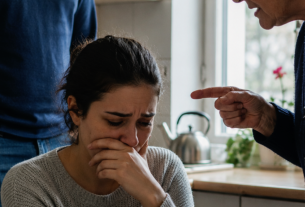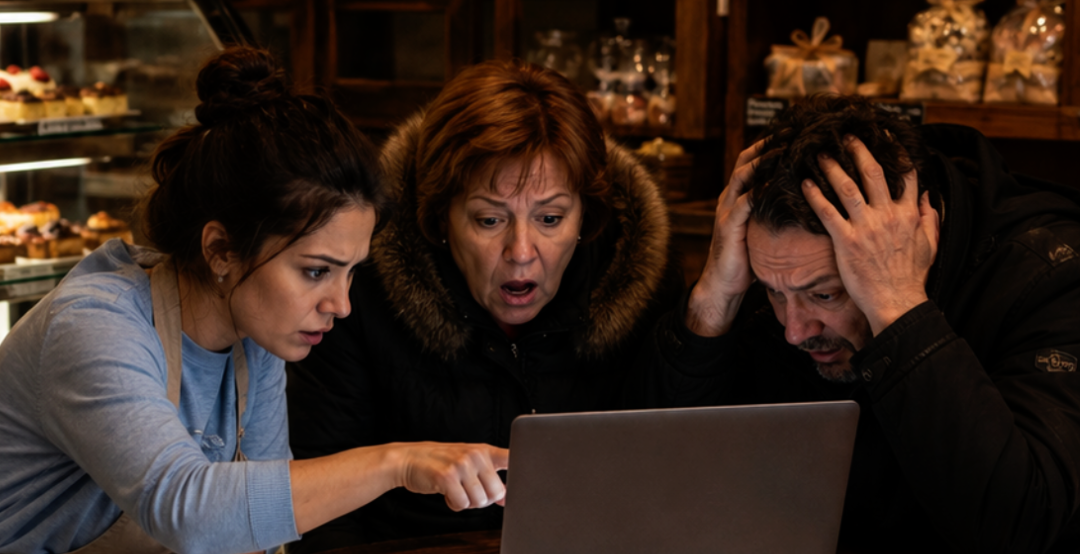
“Either you sign over half of the pastry shop to Yulia, or we’ll ruin you!” Denis shouted, slamming a sheet of paper folded in four onto the glass display case.
I instinctively pressed the pastry bag to my chest — the one I had just been using to pipe lemon curd onto parchment.
“This is a loan agreement for two million,” Marina Eduardovna said, stepping out from behind her son and triumphantly adjusting her collar. “Three years ago, I gave you that money in cash to start your business. Is that your signature? It is. If you don’t hand over a share, we’ll drag you through the courts as a fraud.”
I looked at the paper. On the thick sheet, a sweeping blue scribble stood out — my signature. An exact copy, right down to the characteristic slant of the last letter. My throat instantly went dry. Suddenly there wasn’t enough air in the stuffy workshop of my pastry shop, Lemon Pie.
“Denis, you know perfectly well your mother didn’t give me a single kopeck.”
He looked away.
“Mom helped you, Alla. Don’t try to make her look like a fool now.”
The man I had shared a bed with for four years was now dragging me through the mud to save his lazy sister.
And yet everything had started so differently.
I grew up in Samara, in a corner Khrushchev-era apartment on the outskirts of the city. Ever since I was a child, my parents repeated the same phrase to me: “You’re a girl. Your job is to cook borscht. Let Lyonka handle business.” Lyonka was my older brother, the family favorite. He was forgiven for everything. My parents sold my grandfather’s dacha and got into debt just to sponsor his endless startups. Lyonka successfully went bankrupt three times, leaving our parents with nothing.
And I simply worked in silence.
I baked at night in a tiny home kitchen. At first, the neighbors placed orders, then word of mouth took over. After two years of working without days off, I opened Lemon Pie: a small pastry shop on the ground floor of a residential building. I developed the recipes myself and stood by the oven fourteen hours a day while my husband slept in front of the television.
The business took off.
And then my mother-in-law appeared on the horizon.
From the very first day, Marina Eduardovna considered my business “a girlish hobby.”
“It’s all nonsense,” she would say, contemptuously brushing flour dust from her sleeve whenever she stopped by my workshop. “Childish foolishness. You’d be better off staying home, cooking cabbage soup, and pleasing your husband.”
However, she never refused free “foolishness.” Every celebration for my sister-in-law Yulia came with a categorical demand: “Allochka, we need a cake. Our Yulechka has an anniversary, there will be many guests, make it three-tiered, with natural berries. You’re a pastry chef, it costs you nothing.”
The fact that the cake required expensive farm cream, Belgian chocolate, and a sleepless night of my labor did not concern my mother-in-law. She had no intention of paying for the ingredients.
Soon Yulia lost yet another job. She had been kicked out of a clothing store for constant lateness and rudeness to customers.
Marina Eduardovna rushed into the pastry shop while I was arranging fresh croissants in wicker baskets.
“Take Yulechka on as an administrator,” my mother-in-law said, settling into a customer chair and pushing aside a stack of cardboard cake boxes. “She’s a delicate girl. She knows how to handle a cash register. You have to help your own, Alla.”
I made a stupid mistake and agreed under pressure from my husband.
Yulia showed up for work at noon instead of eight in the morning. Fake nails, a displeased face, gum in her teeth. In two months, she managed to scare away half of my regular customers. She sat behind the counter, buried in her phone. When customers asked questions, she answered through clenched teeth: “The display case is right there. Look for yourselves.”
The last straw was a cash shortage. I carried out an inventory check and discovered that fifteen thousand rubles had disappeared from the register. When I asked Yulia directly, she merely shrugged.
“So what? I took a little for cosmetics. You’re rolling in money here anyway. Are you really going to be stingy with your own sister-in-law?”
That same day, I threw her out.
That evening at home, Denis yelled so loudly that the wine glasses in the sideboard rang.
“You’ve gotten fat on your pies!” he shouted, kicking the kitchen cabinet hard. “You threw my own sister out onto the street! Mom’s blood pressure spiked, Yulka is crying. You’re heartless, Alla! You only think about your precious money!”
A month later, Yulia got herself into serious trouble. She had taken out microloans at insane interest rates, believing an advertisement for yet another online pyramid scheme.
Her debt quickly surpassed half a million. Debt collectors kept calling the entire family and covered my mother-in-law’s entrance hall with insulting graffiti.
Marina Eduardovna came running straight to my home. Her face was gray, her lips were trembling, and her fingers were clutching a faux-leather handbag convulsively.
“Alla, save us!” she wailed, trying to grab my hands. “Take out a bank loan using the pastry shop workshop as collateral. You’ll pay it off quickly, customers come to you in crowds!”
“No,” I cut her off, freeing my fingers from her tight grip. “I will not take out a loan against my business because of someone else’s stupidity.”
From that moment on, Denis demonstratively stopped speaking to me, slammed doors, and then moved on to direct accusations.
“Where are you hiding the income?” he hissed in the evenings while I filled out invoices in the kitchen. “The pastry shop is expanding, but we have nothing at home. Are you taking money to some secret sponsor? That berry supplier of yours, Igor? Do you think I’m blind?”
Igor Vladimirovich was an elderly farmer from near Syzran, from whom I bought sea buckthorn and blueberries. Accusing me of having an affair with him just to get money for his sister was the height of cynicism.
I stayed silent, and then they decided to play dirty.
Denis filed for divorce and division of property. To prove that the pastry shop had been built with family money, my mother-in-law presented an interest-free loan agreement for two million rubles. Supposedly, I had taken cash from her three years earlier to open the business. The signature on the paper looked frighteningly similar to mine.
And now they were standing in the middle of my workshop, smiling triumphantly.
“Well, Allochka?” my mother-in-law narrowed her eyes, nodding at the fake document. “Either you sign over half of Lemon Pie to Yulia, or we’ll ruin you.”
I looked at Denis. The man with whom I had planned to build a future was nodding in agreement.
“Agree, Alla. Mom is serious.”
I placed the pastry bag on the metal table.
“Get out of here!”
After they left, I didn’t shed a single tear.
I understood one thing: if I gave in, they would take away the work of my entire life. The first thing I did was hire a lawyer and pay for an independent handwriting examination. But the most important trump card fell into my hands completely by chance.
On Saturday, Denis came to collect his things. He silently loaded boxes into the trunk of a gray Lada Vesta, bought on credit — a loan I was still paying off. A dashboard camera sat black on the front panel of the car. I had given it to my husband for the previous New Year: an expensive model with loop recording and a sensitive microphone that captured every sound inside the cabin.
While Denis carried boxes of shoes from the hallway, I walked over to the car, pretending I was taking my old sunglasses from the glove compartment. With one quick motion, I clicked the tiny memory card out of the dashcam and slipped it into the pocket of my jeans.
That night, after locking the apartment with every lock, I inserted the memory card into my laptop. My fingers were numb from cold and tension. I scrolled through endless hours of road footage until I came across a file recorded three weeks earlier.
From the speakers came the hum of the engine, followed by Marina Eduardovna’s clear, venom-filled voice:
“…Deniska, what other choice do we have? I found old receipts in her notebook and spent half a day practicing tracing her signature. You won’t be able to tell the difference! And in court, you’ll confirm under oath that I took those two million out of my safe and handed them to her personally. Either she signs the share over to Yulka, or we’ll drag her through the courts.”
Then came my husband’s quiet, agreeing voice:
“All right, Mom. As long as the debt collectors leave Yulka alone. There’s no other way.”
On Monday evening, after the last customer left the pastry shop, I turned the sign on the door to “Closed.” An open laptop and a blue folder of files were already lying on the round table by the window.
I dialed my husband’s number.
“Come to Lemon Pie. Bring the whole family. We’ll divide the property.”
Two hours later, they arrived as a group, confident in their quick victory.
Marina Eduardovna smiled triumphantly, Yulia twisted her lips, and Denis frowned, hiding his hands in the pockets of his jacket. They sat down at the table without even taking off their outerwear.
“Well, have you come to your senses?” my mother-in-law declared from the doorway, leaning back lazily in her chair. “Realized you can’t go against the law? Sign the agreement and we’ll part peacefully.”
I silently slid the first document from the folder toward them.
“This is the conclusion of an independent handwriting expert,” I said in an even voice. “The expert clearly determined that the signature on your fake agreement is a high-quality forgery. He is ready to confirm this in court.”
My mother-in-law snorted contemptuously without even looking at the sheet.
“Your experts will write anything for money! We’ll see in court who wins. Deniska will confirm that the money existed. Judges believe witnesses, not bought papers.”
“Yes, Alla,” Yulia added lazily, admiring her fresh manicure. “Don’t be stupid. Give up half the business and go on with your life.”
I smirked, turned the laptop toward them, and pressed play.
From the speakers came the distinct noise of the road, followed by Marina Eduardovna’s loud voice: “I found receipts in her notebook and spent half a day practicing tracing her signature…”
My mother-in-law’s face instantly fell. Denis jerked sharply, his mouth opened slightly, and his frightened eyes darted around the workshop. Yulia froze, staring blankly at the screen.
The recording played to the end.
“This is a recording from your dashcam, Denis. The original memory card is already in my lawyer’s safe.”
“You had no right!” my mother-in-law shrieked, jumping up from her chair.
I closed the laptop lid with a quiet click.
“The dashcam was bought with my money. The car is my premarital property. But what you did is pure criminality. Falsification of evidence and fraud on an especially large scale. By a group of people acting in prior conspiracy. Marina Eduardovna is facing up to ten years of real prison time. And you, Denis, as an accomplice, won’t get off lightly either.”
“What do you want?” Denis asked.
“Your divorce petition on my terms and a full waiver of any claims to the pastry shop. Tomorrow morning at the notary’s office. Otherwise, the recording and the fake document go straight onto an investigator’s desk.”
My mother-in-law silently sank back into her chair, breathing heavily. Wild fear of prison froze in her eyes. Yulia quietly sobbed, pressing her palms to her face.
The next day, all the papers were signed. Denis disappeared from my life.
Six months passed.
My Lemon Pie flourished. I hired a professional technologist and a competent manager, and expanded the assortment. Now I finally sleep at night instead of standing by the oven for days on end. After getting rid of those parasites, I breathed freely for the first time in four years.
And my former relatives received their well-deserved portion of karma. A mutual acquaintance who lives in the same courtyard told me about it over coffee.
To avoid criminal prosecution for document forgery and to cover Yulia’s endless debts to debt collectors, Marina Eduardovna had to sell her well-kept dacha in the suburbs. Everything.
Denis, furious, blames his mother and sister for destroying his comfortable, peaceful life with their own hands. And Marina Eduardovna, in response, screams through the entire apartment entrance, calling her son “a spineless loser who couldn’t hold on to a rich woman.”
I listened to all this and only smiled, stirring the foam on my cappuccino with a spoon. Everyone got exactly what they had earned.