Taisiya came home earlier than usual on December thirtieth and immediately noticed that Stepan’s jacket was missing from the coat rack. Nina Pavlovna’s downy shawl was gone too—the one her mother-in-law had spent the whole autumn drying on the radiator, then complained about because the fluff kept falling off it. On the kitchen table lay a note, held down by the salt shaker.
“Mom and I flew to a resort in Armenia. Celebrate with your own people. Don’t call. We’ll be busy. Stepan.”
She reread the last two lines several times. Her parents had passed away long ago, and Stepan had been by her side when she cleared out their apartment and signed the papers for her father’s garage. She carefully put the salt shaker back in place, took off her coat, and went into the bedroom. There, behind a box of winter boots, stood a small safe. Inside it was the money from the sale of the garage, which had been registered in her name before the marriage: one million six hundred thousand rubles, which Taisiya was supposed to pay after the holidays for a small house in a village near Kostroma. The seller had agreed to wait four days, and for some reason she had decided the money would be safer at home than in a bank deposit box.
Nina Pavlovna had moved in with them two years earlier, after repairs were done in her room. Stepan was still registered at his mother’s address. He said it was more convenient for the utility bills and that there was no need to re-register anything. At first, she occupied only the folding sofa in the living room. Then she moved boxes of dishes into the bedroom, cleared a shelf for herself in the wardrobe, and began checking how much Taisiya spent on groceries.
A week before the holiday, her mother-in-law placed the last piece of baked fish on Stepan’s plate and said, “Taya likes counting so much, so let her count who actually makes an effort in this house.”
Stepan lowered his eyes to his phone and said nothing. Taisiya washed the dishes, even though her hands were trembling with anger, and for the first time she thought that it was not the menu she needed to change, but her life.
The safe door was ajar. Inside, only the folder with the sale contract and the paper bag that had once held the bundles of banknotes remained. Taisiya picked up the bag, smoothed it with her fingers, and absurdly remembered that there was a container of pie dough in the freezer. The thought was so ridiculous that she sat down right on the floor by the wardrobe and could not get up for a while.
Six months earlier, Nina Pavlovna had already been rummaging through that room, looking for “her” blanket. Back then, Taisiya had not argued, but she had bought a small camera and fixed it to the bookshelf opposite the wardrobe. She almost regretted it now: the recording showed her mother-in-law entering the code while Stepan held a travel bag. Nina Pavlovna packed the money quickly, without counting it. Stepan asked whether it would be enough for the studio apartment, and his mother replied, “It’ll be enough for the studio. Once Taya signs the receipt, everything will be clean.”
Stepan’s hand appeared on the screen. He adjusted the handle of the bag and said, “She’ll sign. As long as there’s no scene.”
After that they left, and the camera continued filming the closed wardrobe door for several more minutes.
Taisiya closed the app. Until that day, she had thought Stepan was simply a weak man who had listened to his mother all his life. Now it was clear: he had decided in advance that her silence could be placed beside his signature, and that both could be used as he pleased.
She called the bank, removed Stepan from the additional card, and closed access to her account. Then she called Yulia, a friend from her university days who worked as a lawyer.
Fifteen minutes later, a message came from Stepan.
“The card isn’t going through. Are you seriously leaving us stranded here?”
No greeting. No question about why Taisiya had come home early. The second message was followed by a third:
“Mom’s hands are shaking because of you. We’re standing at the reception desk.”
Taisiya read them, placed the phone face down, and only then noticed that she was still holding the empty paper bag in her hand.
In Armenia, Stepan really was standing at the reception desk of a small hotel. Nina Pavlovna was holding a suitcase and quietly cursing while the administrator repeated that the card had been declined. They had very little cash: most of it was meant to be given to the seller of the studio apartment the next day. Stepan wanted to exchange the remaining rubles, but his mother would not allow it.
“Don’t you dare lose money on the exchange rate. Call Taisiya. She’ll cry a little and then transfer everything.”
“And what if she doesn’t?”
Nina Pavlovna adjusted the strap of her bag and said that Taisiya had always valued peace, and peace cost more than any vacation. Stepan dialed the number again. His wife did not answer. For the first time, he looked at his mother not as someone who would solve everything, but as the reason they were standing with suitcases at a stranger’s reception desk.
Yulia arrived late that evening with a folder and a thermos of tea. She watched the recording, asked Taisiya to save the file to a flash drive and to another phone, and then asked where the copy of the power of attorney was—the one Taisiya had made for her husband for utility-related matters. The copy was in a drawer of the dresser. Yulia read it, raised her eyes, and said that in the morning the power of attorney needed to be revoked, and until then Taisiya should not open the door to anyone.
The kettle whistled softly on the stove. Taisiya put out two cups, then put one back into the cupboard. Yulia did not say that everything would be fine. She simply spread clean sheets of paper on the table and wrote down everything Taisiya remembered minute by minute: what time she had returned, where the note had been, when she had opened the recording. With each neat line, the room seemed to regain a little order, even though it was already getting dark outside.
In the morning, the doorbell rang. Oleg, a friend of Stepan’s, was standing on the landing in a new coat, a thin folder tucked under his arm. He entered too confidently, without taking off his shoes, and placed a sheet of paper with a prepared text on the table. According to him, Nina Pavlovna had made an advance payment for a small studio apartment, and all Taisiya had to do was confirm that she had given the money voluntarily, as a family loan.
At the bottom was the amount: one million six hundred thousand rubles. Lower still was the date by which Taisiya was supposedly obligated to return the money if the “family agreement” turned out to be violated.
Oleg spoke softly, almost sympathetically, reminding her that Nina Pavlovna had lived for many years on a folding sofa at her son’s place and had long dreamed of closing a door with her own key. Taisiya found nothing wrong with that desire. The wrong part was something else: for that door, they had chosen her safe.
The pen lay beside the sheet. Taisiya picked it up, read the first line, and for a second thought that it would be easier to sign, get the money back later, close the matter, and never see any of them again. Oleg waited silently, looking off to the side. Then she noticed that he had already taken out his phone and was holding it screen up, as if ready to inform Stepan of her agreement.
Taisiya placed the pen on the table.
“Tell Nina Pavlovna that I will not put her actions in order with my signature.”
Oleg smirked and asked if she understood that after this, Stepan would no longer live with her. Taisiya’s fingers went cold at the phrase, although the issue had long since stopped being about the marriage. She opened the door to the hallway and asked him to leave. He did not argue. He only took the folder and threw out, as he left, that the holidays were not over yet.
As soon as the door closed behind him, Taisiya leaned her forehead against the wardrobe in the hallway. She wanted to call Stepan and ask how much the room he was staying in cost, and why it had been easier for him to run away than to talk. Instead, she put on her jacket, called a taxi, and went to the notary. The power of attorney was revoked that same day, and after lunch she filed a theft report, attaching the recording, the garage sale contract, and a copy of the sheet Oleg had brought.
That evening, Stepan finally called. People were humming in the background, unfamiliar voices could be heard, and he spoke quietly, as though trying to preserve the appearance of decency.
“Taya, don’t overreact. We didn’t take everything. Part of it went toward the housing, part of it is with Mom. We’ll come back and sort it out.”
“You wrote that I should celebrate with my own people.”
“I was angry.”
“No. You were busy.”
Stepan fell silent, then began speaking faster. His mother had spent her whole life living in other people’s apartments; she was tired of asking permission to put a cup on a shelf; and Taisiya was going to buy a house anyway. She would have both the house and the apartment, while Nina Pavlovna only needed a small studio.
“She does,” Taisiya agreed. “But not with my money.”
She hung up before Stepan had time to answer.
At first, it seemed to her that after filing the report and revoking the power of attorney, she could breathe out. That night, she even took the dough out of the refrigerator, rolled it out, and baked a small apple pie, although she had no desire to eat. In the morning, Yulia found her at the kitchen table: Taisiya was cutting the pie into even pieces and placing them in containers, as if preparing for someone else’s arrival.
“They’ll come back earlier,” Yulia said after reading a message from Oleg that had come to Taisiya’s phone. “He writes that Stepan is looking for a flight tomorrow.”
The message was short:
“Nina Pavlovna says that if you don’t open the door, she’ll explain to the neighbors herself who is unnecessary in that apartment.”
Taisiya reread it, then took plastic boxes out of the cupboard and began packing her husband’s things. Shirts, chargers, an old razor, a folder with his documents. Nina Pavlovna’s shawls, her magazines, and the jars of grains she had for some reason kept in Taisiya’s room went into a separate box.
Yulia suggested calling a locksmith to change the lock. At first, Taisiya refused. It seemed to her that this would already be too much, that Stepan would come, talk, return the money, and everything would become familiar again, even if empty. Then she saw the note on the table with the salt shaker and realized there was no “familiar” left anymore.
The locksmith arrived by evening. The new lock was installed in forty minutes. Taisiya placed the old keys in an envelope and wrote Stepan’s surname on it.
The investigator called the next day and said that Stepan and his mother had come to the police station themselves after returning. Oleg, after learning about the report and the recording, refused to take part any further and handed over a copy of the receipt that Nina Pavlovna had asked him to bring. Taisiya did not feel relieved. She asked whether the money had been returned.
“Stepan brought one million two hundred thousand,” the investigator replied. “The rest, according to him, went toward the advance payment and the trip. We’ll look into it.”
Nina Pavlovna came to the building that evening, without waiting for the conversation at the station. Stepan was dragging a large bag, and she followed behind, loudly complaining about the road, the transfer, and the fact that they had had to pay cash at the hotel.
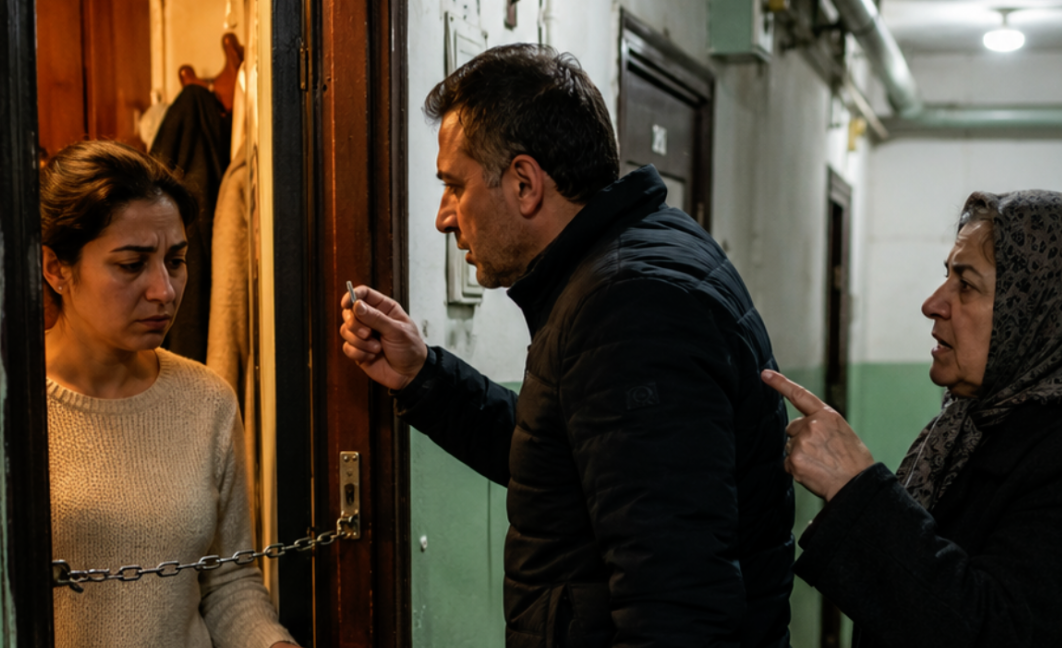
Their key would not turn in the lock. Stepan tried again, then pressed the doorbell. Taisiya did not come to the door right away. She looked through the peephole, made sure there was no one else on the landing besides them, and opened the door only as far as the chain allowed.
Stepan saw her and immediately began talking about the money: he had returned almost all of it, his mother was ready to give up the studio, Oleg would not come again, and they just needed to stop turning family into strangers.
Nina Pavlovna pushed her face closer to the gap.
“Taya, open the door. I’m freezing. I have my things.”
Taisiya looked at Stepan’s bag, then at the boxes she had taken to a storage locker that morning. She had paid for a month and left there everything that belonged to the two of them. On her phone was the locker number and code.
“Your things are in a storage locker at the train station,” she said. “The receipt will be with the investigator, along with the locker key. You will not enter the apartment.”
Stepan went pale, but did not step back.
“You can’t do this to me. I’m your husband.”
“You were my husband until the note on the kitchen table.”
Nina Pavlovna straightened sharply. Her voice became thin and angry.
“I wanted one room for myself, and you turned me into a criminal. After all my years beside you!”
“You were not beside me,” Taisiya replied. “You were beside my cupboards, my money, and my decisions.”
Stepan gripped the handle of the bag and asked his mother to be quiet. She turned to him so quickly that her shawl slipped down onto her shoulder.
“So now you’re against me? I did it for you.”
“For yourself, Mom,” Stepan said. “And I allowed it.”
Taisiya saw him searching her face for the old readiness to pity, explain, and give in. She left the chain in place and did not open the door any wider.
“Tomorrow you will collect your things and sign the divorce papers. The remaining money will be handed over to the investigator according to an inventory. Nina Pavlovna, you will receive a notice as well. There is nothing more to discuss here.”
She closed the door. Voices could still be heard on the other side for several minutes, then the wheels of the suitcase rustled across the landing and faded away.
The next day, Nina Pavlovna came to the police station with her son and sat across from Taisiya without removing her shawl. She insisted that the money had always been considered family money and that the camera had been installed deliberately to make her look guilty. Stepan nodded along with his mother at first, but fell silent when the investigator placed in front of them a copy of the sheet Oleg had brought. In that document, Taisiya was supposed to acknowledge a debt she had never taken.
“I wanted to live separately,” Nina Pavlovna said. “Is that a crime?”
Taisiya looked at her neat fingers, at the ring with the dark stone, and at the same shawl her mother-in-law had left in the hallway before the trip.
“People live separately when they look for housing with their own money. Not when they take someone else’s and suggest that the owner sign a paper saying that’s how it was.”
Nina Pavlovna turned away. Stepan sat with his lips pressed together and no longer tried to explain his mother’s actions as care for the family. He placed his car key on the table himself and said he would sell it to return the rest. Taisiya said nothing. Something else mattered to her: for the first time, he said it not for her and not for his mother, but because there was nowhere left to hide.
The divorce was finalized in spring. Stepan sold the car, gave up any claims to the apartment, and paid off the remaining amount. Nina Pavlovna lost the advance payment for the studio: the seller did not wait while she searched for the money and chose another buyer. For several months, she lived with a distant relative, because her son rented a room near his new job and no longer invited his mother to live with him.
In May, Taisiya finally bought a small house near Kostroma. It was smaller than the one she had looked at before, but it had a long veranda and old apple trees. On the first weekend, Yulia came with paint. Together they washed the windows, and then they sat for a long time on the porch, listening to the branches moving in the garden.
Before leaving, Yulia asked whether Taisiya was afraid to stay there alone.
Taisiya took a bunch of keys from her pocket, chose one, and placed it in her friend’s palm.
“Keep this one. Just in case.”
Yulia nodded and put the key in her bag. One empty cup remained on the porch, and the door of the house quietly closed behind Taisiya.