The Guest Who Became the Mistress of the House
My mother-in-law moved in with us “just for a couple of months” while repairs in her apartment dragged on at a snail’s pace. I gritted my teeth, but I tolerated it for my husband’s sake. After all, that spacious three-room apartment had been bought entirely with my money, even though we were married. Naively, I believed I was the woman of the house, and putting up with a relative temporarily was not such a big problem. But Anna Nikolaevna had completely different plans.
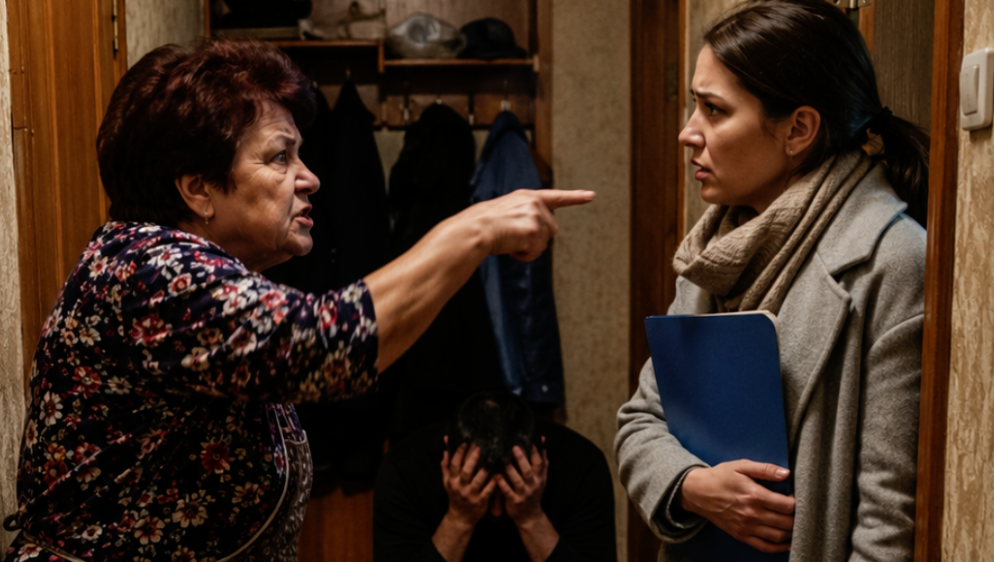
That evening, my mother-in-law slammed the kitchen cabinet door shut with a bang. She did not even look in my direction when she threw out that phrase, as casually as if she were asking someone to pass the salt.
“Pack your things. You’ll go stay with your parents for a few days.”
A ringing silence hung in the kitchen, so sharp that I suddenly clearly heard the autumn rain beating heavily and rhythmically against the metal windowsill outside. I froze. The warmth from the mug of tea in my hands suddenly felt scalding.
I slowly placed it on the table. Then I looked at the face of the woman who, ever since moving in, had been systematically pushing me out of my own territory.
“Excuse me, what did you say?” My voice sounded surprisingly calm, even though everything inside me was collapsing.
My mother-in-law rolled her eyes theatrically and sighed heavily, the way elementary school teachers look at hopelessly slow pupils.
“Don’t pretend you didn’t understand. In two days, three of our relatives are coming from another city. They need this room. They’ll stay here, and you’ll temporarily stay with your parents. They probably haven’t seen you in a while anyway.”
Betrayal Stirred into Cold Coffee
Instinctively, I turned my eyes to my husband. To the man with whom I had sworn to be together in sorrow and in joy. The man who had promised to be my stone wall.
Andrey was sitting across from me. He carefully avoided my gaze, hunched over his cup. His fingers nervously stirred coffee that had long gone cold. It seemed as if he wanted to dissolve into that brown sludge, just so he would not have to take part in the conversation.
“Andrey?” I called softly, almost in a whisper.
His shoulders twitched. Reluctantly, he raised his eyes to me. There was no support in them. Only sticky fear of his mother and irritation that his peace had been disturbed.
“Well… Mom is right,” he muttered, looking away again. “It’s only for a few days. You’ll stay with your parents. What’s the big deal?”
“Only.”
Those two short words hit me like a slap. More painful than shouting, more painful than scandals. We had lived in that apartment for almost five years. That was where we had begun our family. I remembered how we had crawled across that very floor, covered in paint, arguing about what color the wallpaper should be. How I had lovingly chosen every curtain, every plate. How we had laughed while sitting on boxes. And now I was being calmly informed that I did not even have the right to my own bed.
“There’s no need to turn nothing into a tragedy!” my mother-in-law’s voice grew sharper; she had already gone on the attack. “Family should help family. Relatives, you know, don’t visit us every day. You could show some understanding.”
And I stayed silent. Then, suddenly, I realized something astonishing: I was not hurt. I was not angry either. Instead of suffocating tears, a crystal-clear, cold calm began spreading inside me. The puzzle I had refused to put together for years came together in a single second.
Dozens of scenes flashed before my eyes. My mother-in-law rearranging my things on the shelves without asking: “It should be arranged here in the way that is convenient for me.” Her opening the doors of our private closets without knocking. And then her sweetly smiling as she gave my friend the brand-new tea set I had bought for Andrey and me. When I timidly protested, she had simply snorted, “Oh, you’ll buy yourself another one. Don’t be greedy!”
And always, after every scene like that, my husband would look away and sing the same old song: “Don’t pay attention. She’s my mother. Why should we quarrel?”
So I did not pay attention. I worked like a slave, almost without days off. I paid the lion’s share of the bills. I filled the fridge with groceries myself. And every time, I still turned out to be not good enough.
The Smile That Frightened Them More Than Screaming
I looked at my husband again. He had already stopped stirring his coffee and was simply waiting for me to surrender.
“Do you really think this is normal?” I asked, looking straight into his soul.
He exhaled loudly, demonstrating the highest degree of universal exhaustion from “these female hysterics.”
“Why are you starting a conflict again? Just pack your things.”
And then I smiled. Sincerely. For the first time in a long while. No one in that kitchen was going to defend me. And if a woman does not stand up for herself, she will simply be trampled.
“All right,” I said, slowly rising from my chair. My voice rang clear and firm. “Yes. I’ll go.”
My mother-in-law raised her eyebrows in confusion. According to her script, I was supposed to burst into tears, start screaming, cling to the doorframes. She clearly had prepared lines about my ingratitude and selfishness. But I stood there and smiled. Calmly and coldly.
“That’s the right thing,” she muttered hastily, trying to hide her confusion behind the mask of a wise mentor. “A smart girl should always give way to her elders.”
What I Took With Me
I did not dignify her with an answer. I turned around, went up to our bedroom, and shut the door tightly behind me. I took a large suitcase down from the overhead storage. There was no panic. I packed my favorite dresses, books, and cosmetics. With every item I placed inside, it became easier for me to breathe. It was as if I were gathering, piece by piece, the remains of my own dignity from the bottom of that wardrobe.
The door creaked. My mother-in-law’s face appeared in the crack.
“Listen… don’t take too many things,” nervousness seeped through her voice. “You’ll be back in two or three days.”
I raised my eyes to her without stopping folding my sweaters.
“Of course.”
She shifted from foot to foot at the doorway. My silence made her physically uncomfortable.
“You’re not offended, are you?” she squeezed out her signature manipulative phrase.
“No,” I smiled at her again.
And that smile made her quickly close the door.
When the suitcase was almost full, my gaze fell on the bottom drawer of the dresser. I pulled it open and carefully took out a thick blue plastic folder. It did not contain poems or love letters. Inside were dry, boring papers. The mortgage agreement, paid off ahead of schedule. Receipts. Payment slips for construction materials. Bank statements. The contract for the purchase of that very expensive built-in kitchen, next to which my mother-in-law was now standing like the mistress of the house.
All those years, money for this celebration of life had steadily gone out from my salary card. They had grown so used to my silent contribution that they had started treating me like a free accessory to my own bank card. I carefully snapped the blue folder into the pocket of my suitcase.
Forty minutes later, I was standing in the hallway with my shoes on. My mother-in-law was bustling past me with new sets of bed linen, preparing to welcome her precious guests. My father’s old car pulled up to the entrance.
“You will come back in a few days, won’t you?” Andrey suddenly asked as he carried my heavy suitcase down to the car. Notes of confusion had crept into his voice.
I looked him straight in the eyes. For a long time. Studying him. As if he were a stranger passing by.
“I don’t know.”
My father did not ask unnecessary questions. He simply silently threw my suitcase into the trunk, then gripped my shoulder tightly, bear-like. There was more protection in that gesture than my husband had been able to give me in all five years of marriage.
I sat in the passenger seat, and the car gently pulled away.
The Bill for Hospitality
Sometimes the greatest human stupidity is starting to celebrate too early. My mother-in-law enjoyed her triumph for exactly two weeks.
Right up until the day a registered letter from my lawyer appeared in the mailbox. The demand for the division of property, supported by bank statements proving that the apartment had been paid for exclusively with my personal funds, had the effect of an exploding bomb.
Andrey blew up my phone day and night. At first, he tried to appeal to my pity. Then he threatened me. And in the end, he cried, begging me to come back and “talk normally.”
My mother-in-law also quickly changed her tune. Through mutual acquaintances, she tried to pass along that “there had been a misunderstanding” and that the guests had left long ago. Of course — the prospect of ending up on the street or forcing her empty-pocketed son to pay me an enormous share turned out to be far less pleasant than bossing around a silent daughter-in-law.
But there was nothing left to talk about. The court sided with me. The apartment had to be sold in order to divide the shares, but thanks to the receipts in the blue folder, I kept most of the money. Andrey and his mother moved into a cramped rented two-room apartment on the outskirts of the city. I bought myself a new, bright apartment. And now only one person has the keys to it — me.
What would you have done in my place? Is it worth trying to forgive a husband if he betrayed you in the most important matter, or are such things never forgiven?