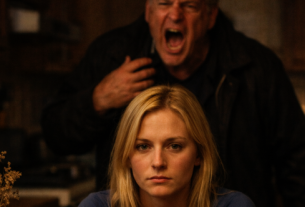
“Stop playing director, Nina!” Tamara Borisovna said, lifting my work laptop above the table. “At your age, women should already be sitting at home, not ordering men around.”
“Put it back,” I said.
“Too late,” Arthur replied.
The laptop hit the edge of the conference table, then the floor. The casing cracked. The screen flickered and went dark.
Tamara Borisovna stood in the middle of the closed conference room of KedrSoft LLC, wearing a light-colored jacket and a visitor badge on a lanyard. She was seventy-four. In someone else’s office, she carried herself as if she had come to inspect the order in her own home.
Arthur, my husband and deputy, did not even move.
He merely adjusted the cuff of his shirt and looked at me as if he expected me to start making excuses.
“Mom broke your stupid laptop,” he said. “It’s too late to cry.”
I looked at the dented lid. At the broken hinge. At the information security sticker, which now stuck out from the side at a crooked angle.
That laptop contained materials for patent applications. A closed branch of source code. Technical descriptions of the modules we were preparing to demonstrate to investors.
There were no keys on it without a second factor. There were backups too. I was not some girl carrying the only flash drive in her purse.
But that did not change the main point.
Company property had just been damaged in front of me.
And it had not happened during an argument at home. Not in the entryway. Not by accident.
In a conference room. Under cameras. With the recording system on. In the presence of my deputy, who had personally brought an unauthorized person into a restricted area.
“Arthur,” I said. “Who arranged visitor access for your mother?”
He shrugged.
“I did. So what?”
“Who brought her here without a request to security?”
“I brought her. Nina, don’t start with your instructions. Mom wanted to talk.”
“She talked.”
Tamara Borisovna snorted.
“At last, someone has shown you that you’re not a queen. Arthur has been carrying everything on his shoulders for a long time. And you sit in your chair pretending to be the boss.”
I nodded once.
“I see.”
That short phrase changed everything.
Arthur still did not understand. He was used to me arguing. Explaining. Reminding him that I had opened the company before he ever came into it. That I had signed the first contracts myself. That the first server had stood under my own desk. That I had paid the team’s salaries before paying my own.
He was used to me holding together the home, the office, the reports, the clients, and his pride.
And at that moment, I stopped holding him together.
I picked up the internal phone from the table.
“Invite security, the company lawyer, and Roman Valeryevich to the conference room. Urgently. Yes, right now. And prepare an emergency board meeting for eleven forty. Agenda: damage to corporate property, blocking the deputy director’s access, termination of Arthur Olegovich’s option package.”
Arthur stopped looking calm at the word “option.”
“What the hell are you talking about?”
“I’m formulating the agenda.”
“Nina, you’re acting on emotion.”
“No.”
That was true. There were no emotions, in fact. There was only a straight line of action.
Tamara Borisovna lifted her chin.
“What board meeting? I’m your husband’s mother. I have the right to say what I think.”
“To speak, yes. To damage company property, no.”
“Oh, property. A piece of metal.”
“Corporate equipment with restricted access.”
“Do you hear her, Arthur?” she turned to her son. “Does she talk like that at home too? Like she’s speaking to subordinates?”
Arthur stepped closer to me.
“Nina, cancel this circus. Right now.”
I looked at his right hand. In it was my old project manager badge. The black one. The same one that had disappeared a week ago.
Back then, I had decided it was lying in the car.
“Give me the badge.”
“What badge?”
“My old badge. It’s in your hand.”
He squeezed the plastic card.
“It doesn’t matter.”
“Now everything matters.”
The door opened. Pavel, the security guard, came in. Behind him was Darya Igorevna, the company lawyer, holding a tablet and a slim folder. Then Roman Valeryevich, the technical director, appeared. He immediately looked at the floor.
“Is that Nina Andreevna’s work laptop?” he asked.
“It was,” I said. “Ask the administrators to immediately block all sessions, reissue tokens, and audit access for the past seven days.”
“I’m already doing it.”
He took out his phone and went into the corridor without asking a single unnecessary question.
Arthur sharply turned to me.
“Are you making me look like a thief in front of your people?”
“I am documenting an incident.”
“I’m your husband.”
“And my deputy. In this room, that matters more.”
That sentence struck him harder than an argument would have. Because at home, he could still play the offended husband. In the office, there were positions, regulations, and signatures.
Tamara Borisovna picked up her bag from the neighboring chair.
“Arthur, we’re leaving. Let this important lady deal with her pieces of metal herself.”
“You are not leaving yet,” Darya Igorevna said. “We need to record your explanations.”
My mother-in-law spun around sharply.
“And who are you?”
“The company lawyer.”
“You’re all on her leash here.”
Darya Igorevna opened her tablet.
“Pavel, please ensure the presence of witnesses and preserve the camera recordings.”
The guard stood by the door. Not rudely. He simply stood there.
Arthur looked at me now without his former confidence.
“Nina, you’re crossing a line.”
“No. I’m putting it back where it belongs.”
At eleven forty, we gathered in the large conference room. Not the one where the laptop was lying. A specialist was already working there: photographing the damage, checking the inventory number, placing small pieces of the casing into a transparent bag.
Our charter provided for a board of directors separately: for investors, the option program, and access issues concerning closed developments. Arthur used to call it bureaucracy. Now that bureaucracy had become a wall.
Five people sat in the large conference room.
Me. Roman Valeryevich. Darya Igorevna. Lev Mikhailovich, a minority investor. And Anton, the head of information security.
At first, Arthur refused to come in.
Then he came in after all. He placed his chair separately, as if he wanted to show that he was not part of this table. Tamara Borisovna remained in the corridor. She had been asked to leave after her second attempt to interrupt Darya Igorevna.
“The agenda is known,” I said. “Let’s begin.”
Arthur scoffed.
“Nina has decided to arrange a family trial.”
“A corporate meeting,” Darya Igorevna corrected him. “Family judgments will not be entered into the minutes.”
Lev Mikhailovich raised his eyes from the printout.
“Arthur, do I understand correctly that you arranged visitor access for your mother?”
“Yes. What’s the big deal?”
“Did you know the conference room was restricted?”
“She’s my mother.”
“That is not an answer,” Roman Valeryevich said.
Arthur shifted his gaze to me.
“Everyone suddenly got brave.”
I said nothing.
Darya Igorevna played a short clip from the recording on the screen. No unnecessary details. Just the walk through the corridor, the entrance into the conference room, the movement of Tamara Borisovna’s hand, the laptop falling. Then a freeze-frame.
“The fact of damage to corporate property has been recorded,” she said. “Visitor access was arranged by Arthur Olegovich. Nina Andreevna’s badge was used to enter a restricted area at nine fifty-two. According to the access log, it was an old manager’s badge that should have been surrendered and annulled.”
Anton added:
“At ten oh four, from Arthur Olegovich’s account, there was a request to export the repository list. The system rejected the request because he did not have sufficient rights. One minute before Tamara Borisovna entered the conference room, he attempted to open the section containing patent application materials.”
Arthur straightened.
“That’s work access. I’m the deputy director.”
“A deputy director has no right to bypass clearance levels,” Anton said.
“You’re against me now too?”
“I’m for the security perimeter.”
Arthur pressed his lips together.
I opened the folder in front of me. Inside lay the corporate agreement from March 2023. And the option agreement.
Arthur had signed both documents himself. With a smile. Back then, he said it was just a formality. Back then, he badly wanted to be a “partner,” but did not want to invest any money. I offered a transparent scheme: a stake in the business through an option package after five years of work and provided there were no culpable actions against the company.
He called those eighteen percent “my stake.” He bragged about them at meetings. He told my team, “Soon Nina will get tired, and I’ll take everything over myself.” I had heard it more than once.
And I had stayed silent for too long.
“Arthur Olegovich,” Darya Igorevna said, “clause seven point two of the option agreement. A bad actor event. Intentional damage to, or assistance in damaging, company property. Violation of access protocols. Attempted unauthorized acquisition of confidential materials. Consequence: termination of the right to accept the option and cancellation of all unpaid bonuses tied to the future stake.”
“They’re just pieces of paper,” Arthur snapped.
“That is your signature,” I said.
He looked at me. For the first time that morning, genuine confusion appeared on his face. Not remorse. Just a calculation that had failed.
“You can’t,” he said quietly.
“It isn’t me who can. The contract can. And the board of directors can.”
“You prepared this on purpose.”
“I prepared the company for growth. And all this time, you thought it was a cage for me.”
Lev Mikhailovich tapped his pen on the table.
“I’ll clarify for the minutes. We are not talking about removing a registered share from the charter capital. We are talking about terminating Arthur Olegovich’s option right and his managerial participation in the partnership program. Correct?”
“Correct,” Darya Igorevna answered. “Arthur Olegovich does not have a registered share in the charter capital. He has the right to receive it in the future if the conditions are met. The conditions have been violated.”
Arthur jumped to his feet.
“So for years you called me a partner, and now you’re saying I’m nobody?”
I closed the folder.
“For years, I gave you the chance to become a partner. You brought your mother into a restricted area, gave her my badge, allowed her to damage work equipment, and tried to use it as pressure. That is not partnership.”
“Mom just lost her temper!”
“The minutes will state: an unauthorized person damaged company property. The deputy director provided access and failed to prevent the incident.”
“Don’t pretend to be my wife. You won’t keep this company without me.”
Roman Valeryevich raised his head.
“I have worked here for twelve years. Nina Andreevna is the one holding this company together. Not family conversations.”
Arthur stared at him.
“Traitor.”
“Employee,” Roman Valeryevich replied.
I put the matter to a vote.
First: to block Arthur Olegovich’s access to all internal systems until the internal investigation is complete.
Second: to suspend Arthur Olegovich from his position as deputy director as of today.
Third: to recognize the occurrence of a bad actor event under the option agreement.
Fourth: to terminate his right to receive the eighteen-percent option package.
Fifth: to send a claim for compensation for the company’s damages.
Sixth: to transfer the incident materials to external counsel for further action.
We voted on each point.
In favor. In favor. In favor. In favor.
Arthur was silent. He only watched my hands. Apparently, he was waiting for them to tremble.
They did not.
After the meeting, Darya Igorevna printed the minutes. I signed. Lev Mikhailovich signed. Roman Valeryevich signed. Anton attached the technical report.
A few minutes later, a standard system banner appeared on the monitor at Arthur’s workstation in his office:
“Account disabled by administrator.”
He saw it himself.
I stood in the doorway of his office. I did not rush him. I did not raise my voice.
On his desk lay three business card holders, an expensive pen, a paperweight with the company logo, and a stack of presentations in which he had arbitrarily changed his title to “operating partner.” Before, I had pretended not to notice. Too busy. Too many projects. Too much habit of smoothing things over.
Now every little thing like that became evidence.
“You’re destroying the family over a laptop,” Arthur said.
“No. Because of the laptop, I saw the whole scheme.”
“What scheme?”
“Pressure at home. Pressure at the office. Conversations with employees behind my back. An attempt to obtain confidential materials. And today’s performance with Tamara Borisovna.”
He slapped his palm on the desk. Not hard. Mostly for the sound.
“She’s an elderly person!”
“She is a legally competent person who was in the office using your access.”
“You want to sue her?”
“I want to protect the company.”
“The company is me too!”
“Not anymore.”
That was when he understood.
Not when the laptop was lying on the floor. Not when Pavel stood by the door. Not when the lawyer read the clause from the contract.
He understood at those two words.
Not anymore.
His phone began to vibrate. Once. Twice. Three times. He looked at the screen and sharply turned away. Then he opened the notification after all.
An email from the corporate secretary.
“Notice of termination of participation in the option program.”
Then came an email from security.
“Accesses blocked.”
Then one from HR.
“Order of suspension from duties for the duration of the internal investigation.”
Arthur slowly sat down in the chair. Without a dramatic scene. Simply because standing had become uncomfortable.
“Nina,” he said in a different voice now. “Let’s talk at home.”
“We’ll talk through lawyers.”
“Are you serious?”
“Yes.”
“I’m your husband.”
“For now, yes. The divorce papers will be filed separately.”
He tried to smile, but his face could not hold it.
“So you’ve decided everything.”
“You decided it this morning when you said, ‘Mom broke your stupid laptop.’ You just didn’t understand that what was broken wasn’t the laptop.”
He did not answer.
In the corridor, Tamara Borisovna was arguing with Pavel. Snatches of words carried through.
“I’m the deputy director’s mother!”
“Please proceed to the exit.”
“I’m an elderly woman!”
“Please proceed to the exit.”
I went out to her.
She saw me and immediately straightened.
“Well? Finished playing? Arthur will deal with you now.”
“Arthur is no longer deputy director.”
Her face froze.
“What?”
“He has been suspended. The option package has been terminated. Accesses have been closed. A claim will be prepared for you regarding the damaged equipment.”
“Over some piece of metal?”
“Over actions. The piece of metal only helped document them.”
She clenched the strap of her bag.
“You wouldn’t dare treat family like this.”
“There is no family in the office. In the office, there are positions, property, accesses, and responsibility.”
“And who are you without my son?”
I looked at the sign on the wall. KedrSoft LLC. Beneath it was a small metal plaque:
“General Director — Nina Andreevna Mironova.”
Not for decoration. Not out of vanity. Simply a fact.
“The general director,” I said.
Pavel opened the door to the elevator hall for Tamara Borisovna. She wanted to say something else, but Arthur came out of the office carrying a box.
Inside the box were his personal belongings: two management books, a charger, headphones, a wooden phone stand. On top lay that same business card holder with the inscription “operating partner,” which he had ordered without approval.
Tamara Borisovna looked at the box. Then at her son.
“Arthur?”
He did not look at her.
“Let’s go, Mom.”
In the elevator hall, he turned back to me.
“You’ll regret this.”
“All claims in writing,” I said.
The elevator doors closed.
I returned to the conference room. The same one. The fragments were already gone from the table. The security specialist had placed a temporary reserve laptop there. Roman Valeryevich had opened the project recovery panel on the screen.
“The code is intact,” he said. “The repositories are clean. The keys have been reissued. The patent materials have been restored from storage. We lost only the casing and a couple of hours of work.”
“Not only the casing,” I replied.
He understood and did not ask for clarification.
By evening, the external lawyer arrived. A calm man with a narrow folder and a habit of asking short questions. He reviewed the recording, the access logs, the board minutes, the option agreement, and the report on the damaged equipment.
“The position on the option is strong,” he said. “On the damages too. The labor part needs to be handled carefully: suspension, investigation, explanations, order. No unnecessary words.”
“There will be no unnecessary words.”
“Good. And the family part?”
I took out another folder. It contained copies of the apartment documents, bank statements from personal accounts, and a draft divorce petition.
“Separately,” I said. “No connection to the company.”
The lawyer nodded.
“Correct.”
That evening, Arthur sent me his first message.
“We need to calm down.”
I did not answer.
A minute later, the second one came.
“Mom is upset.”
I did not answer.
Then the third.
“You can’t just erase twenty years like this.”
I looked at the screen and turned off notifications until morning. Not the number. It was too early for that. But notifications, yes.
After that, Darya Igorevna called me.
“Nina Andreevna, the minutes have been sent to the participants. Arthur Olegovich has confirmed receipt. An email came to the corporate address demanding that the meeting be annulled because ‘a family conflict has nothing to do with business.’”
“Reply with the template.”
“Already done. I wrote that the subject under review was damage to company property, violation of access protocols, and the terms of the option agreement.”
“Thank you.”
“And one more thing. The employees are asking whether tomorrow’s planning meeting will happen.”
I looked at the calendar. The investor demonstration was scheduled for ten in the morning. The world had not stopped. The project had not disappeared. The team was waiting for a decision.
“It will. At the usual time.”
The next day, Arthur came anyway.
At eight forty-eight, he stood at the turnstile in the business center lobby and tapped his badge. Once. Twice. Three times.
Red indicator.
The guard at the desk politely said:
“Your access is inactive.”
Arthur saw me by the elevator.
“Nina!”
I stopped. Two developers and a project manager were standing nearby. Everyone pretended to be reading their phones.
“I do not discuss corporate matters in the lobby,” I said.
“Are you trying to humiliate me?”
“I came to work.”
“So did I.”
“You do not have clearance.”
“This is my company!”
“You had the right to receive an eighteen-percent option package. That right was terminated by decision of the board of directors under the terms of the agreement you signed.”
He stepped closer, but the guard immediately rose from behind the desk.
Arthur noticed.
“Did you set security on me?”
“I am observing access control.”
“Nina, enough. I lost my temper. So did Mom. But you understand, she’s old school. She has a difficult character.”
“A difficult character does not give anyone the right to damage corporate property.”
“I’ll buy you a new laptop.”
“For the company. And that will not close the issue.”
He lowered his voice.
“What do you want?”
“Written explanations. Return of all badges. Transfer of work storage devices. And no contact with employees without approval from the lawyer.”
“You’re talking to me like I’m a stranger.”
“In business, you are now a counterparty in a dispute.”
He looked at the people nearby. Then at the guard. Then at the turnstile.
Yesterday, he had still thought I would protect the family’s image. Today, he had to protect his own.
He took a badge from his pocket and placed it on the desk.
“Take it.”
“The second one too,” I said.
He froze.
“What second one?”
“The old black one. The one you were holding yesterday in the conference room.”
The guard looked at him more attentively.
Arthur reached into the inside pocket of his jacket and took out the badge. Silently. He placed it beside the first one.
Two pieces of plastic. All his power over the past few months.
I took the elevator. Went up to the ninth floor. The team was already waiting in the conference room. The test environment was open on the screen. The investors were connecting through a secure link.
Roman Valeryevich asked:
“Shall we begin?”
“We begin.”
The presentation went smoothly. Without Arthur. Without his loud interruptions. Without his favorite phrases about “female management” and “Nina’s soft power.” The people who had actually made the product spoke: developers, an analyst, the implementation manager. I closed the meeting with an agreement on the next stage.
After the call, a few seconds of working silence remained in the room. Focused. Necessary.
“Nina Andreevna,” Anton said, “I’ve prepared a new access matrix. This time without exceptions for management’s relatives.”
“Excellent. We’ll submit it for approval.”
By lunchtime, Arthur sent a long email. It contained grievances, accusations, hints about our life together, a separate line about “disrespect toward his mother,” and a demand that his “lawful share” be returned to him.
Darya Igorevna forwarded me a draft response.
Dry. Precise. Emotionless.
“Arthur Olegovich does not have a registered share in the charter capital of the company. The right to receive the option package has been terminated due to the occurrence of the conditions stipulated by the agreement. Please direct all further communications through a representative.”
I read it and wrote: “Approved.”
That evening, I went into my office. Not home. My office. I needed to pick up the paper copy of the investor agreement.
A new reserve laptop stood on the desk. Black, without stickers, clean. Anton had already configured the accesses. Beside it lay a card:
“Materials restored. Risks closed.”
I ran my finger along the edge of the lid. Just to check whether it closed evenly. Then I opened the calendar.
Tomorrow — meeting with the divorce lawyer.
The day after tomorrow — participants’ meeting on changing the visitor access regulations.
In a week — damage assessment and claim against Tamara Borisovna.
In a month — audit of all managerial powers.
Before, I would have called this a difficult period. Now I called it something else: restoring order.
Arthur had wanted to take my place through exhaustion, kinship, and someone else’s hands. He thought that if his mother threw my laptop onto the floor, I would start making excuses, beg him not to mix home and work, persuade him not to bring family matters into the office.
He was wrong about one thing.
I had known how to separate the personal from the corporate for a long time. I had simply failed to apply it to my own husband for too long.
His last message came late that evening.
“You left me with nothing.”
I looked at that phrase and, for the first time that day, exhaled calmly.
I was not the one who had left him with nothing. He had put his own future stake on the floor himself when he decided that my work could be shattered by someone else’s hands.
I turned off the work screen, took the contract, and left the office for the elevator. Behind the glass wall remained a company that no longer pretended to be a family kitchen.