Elena had spent almost six months choosing the apartment. Every evening after her shift at the design bureau, she sifted through listings on her phone while dinner went cold, went to view one place after another—and every time, something was wrong. One apartment faced a noisy avenue. Another had upstairs neighbors who had flooded the previous owners. With another, the price suddenly jumped right in the middle of the conversation.
But this one—a two-room apartment on the fifth floor of a quiet brick building—felt right immediately. High ceilings. A kitchen large enough for a real dining table instead of a tiny folding table pushed against the wall. And most importantly, it was hers. Completely hers. No mortgage, no debts, no obligations to a bank for the next twenty years.
The money had come from her grandmother. More precisely, from her grandmother’s apartment in a small town near Ryazan, which Elena had sold a year after becoming the sole heir. Her grandmother had left everything to Elena alone. That was simply how things had turned out in the family—the granddaughter had been closer to her than many others.
Elena had kept the money in an account for two years and had almost been afraid to touch it, as though it were not money but a part of someone who was no longer alive.
And now it had turned into walls, windows, and a key that felt pleasantly heavy in her pocket.
“Can you imagine? There’s even a separate storage room,” Elena told Vladislav on their first evening there, when they arrived as owners, carrying a bottle of inexpensive wine and two plastic cups because they had not moved their dishes yet. “I’ve dreamed of having a storage room my whole life. A stupid dream, right?”
“It’s a perfectly normal dream,” Vladislav said.
He walked around the empty room, knocked on the wall with his knuckles, and listened.
“They built things properly back then. Not like the garbage they throw together now.”
The light from a streetlamp came through the curtainless window and stretched across the bare floor in a long yellow stripe. The apartment smelled of fresh paint and something else—something cool, empty, not yet lived in.
Elena sat directly on the windowsill, pulled her knees to her chest, and watched her husband walk around their new home.
Back then, it still seemed like theirs.
“Listen, a corner sofa would fit here,” Vladislav said, pointing toward the corner of the living room. “Remember the one we looked at? The gray one.”
“It would fit. But wallpaper first.”
“Wallpaper later. First the sofa, so we have somewhere to sit.”
They laughed and argued about trivial things, and everything felt good.
Vladislav worked as a supervisor at a plastic-window manufacturing plant. He earned a decent salary, but he never had much in the way of savings. Whatever came in disappeared just as quickly—on his car, on fishing trips, or helping his relatives.
Before this, they had lived in a rented one-room apartment, and moving into their own place was a celebration for both of them.
But for Elena, the celebration had meaning. At last, she was standing on land that belonged to her.
For Vladislav, as she later discovered, it was apparently a celebration in which there was no need to keep track of who owned what.
The first few weeks passed in a frenzy of renovations. After work, Elena did not go home to rest. She went from one home-improvement store to another, choosing tiles, paint, cabinet handles—all those little things that gradually turn a space into a home.
Vladislav helped too. He drilled, screwed things into place, and carried boxes.
Everything seemed warm and friendly enough, but at some point, there was a subtle, almost imperceptible shift in the way he spoke.
“We should get a better chandelier for this room,” he would say. “How much money do we have left after the renovation?”
We.
Ours.
At first, Elena heard those words and paid no attention. He was her husband. He was happy. He spoke the way married people usually did. What was wrong with that?
Sometimes she caught herself saying “our apartment” too, because it felt more natural. Warmer.
But somewhere around the third or fourth week, something pricked at her.
It happened when Vladislav was looking at the spare room, the one they had planned to turn into an office or, perhaps someday, a nursery.
“What if we don’t do anything with this room yet?” he suddenly said. “You never know. It might come in handy.”
“Come in handy for whom?” Elena asked without looking up from the curtain catalog.
“Well, you never know,” Vladislav repeated, and for some reason looked away toward the window.
At the time, she let it pass.
Perhaps she should not have.
Because in hindsight, everything fits together into a picture that, in the moment, you stubbornly refuse to see.
Her mother-in-law, Adelina Romanovna, came to see the new apartment during the second week.
She arrived with a cake, a smile, and loud exclamations of admiration from the moment she stepped through the door.
“Oh, how lovely! Lenochka, you’ve done such a wonderful job! What taste!” Adelina Romanovna walked down the hallway, peered into the rooms, and ran her palm over the new wallpaper. “And it’s so bright! My place is always dark, but this is absolutely beautiful.”
Elena calmly accepted the compliments, poured tea, and cut the cake.
Her mother-in-law was an impressive, well-groomed woman who always spoke sweetly and smoothly—the sort of person you trusted immediately, only to wonder much later where that trust had gone.
And as they drank tea, Adelina Romanovna kept glancing around the apartment.
Not the way a guest looks around casually, out of politeness.
She looked like someone calculating something.
How many wardrobes were there?
What kind of balcony?
Where could this fit?
Where could that go?
“And what are you planning to do with that little room?” her mother-in-law asked, nodding toward the empty one.
“We haven’t decided yet,” Elena replied.
“So it’s just sitting empty,” Adelina Romanovna said thoughtfully, stirring her tea. “All that space going to waste.”
Vladislav’s sister, Alisa, visited less often, but her comments were sharper.
She was seven years younger than her brother, worked somewhere as an administrator, lived with her mother, and had a firm opinion about absolutely everything.
One day, sitting on their new sofa—the very gray corner sofa that Vladislav had insisted on buying before they put up the wallpaper—Alisa stretched out her legs, looked around the living room, and drawled:
“You’re lucky. So much space. Mom and I can barely turn around in our place, while you have an entire empty room.”
“It’ll be an office,” Elena said.
“An office,” Alisa scoffed without open hostility, but with some strange pressure in her tone. “Who needs an office these days? You’d be better off helping people who are struggling with housing.”
Elena said nothing.
She did not want to turn a family gathering into an argument. She poured everyone more tea, changed the subject, and asked Alisa about work.
But a residue remained.
Something murky and fine, like sand at the bottom of a glass. It does not exactly stop you from drinking, but you can feel it.
At first, Vladislav stayed out of those conversations. He sat there looking at his phone, pretending that his mother and sister were speaking for themselves and that he had nothing to do with it.
But Elena noticed something.
He never objected.
Not once.
When his mother admired how spacious the apartment was, when Alisa hinted about the empty room—her husband remained silent.
And over time, that silence became louder than any words.
Then one evening, he finally spoke for himself.
“Lena, you have to understand,” Vladislav said one night after they had gone to bed. Somehow, talking in the dark was easier. “That’s what family is for—to help one another. Including with housing. It’s normal.”
“It is normal,” Elena agreed. “But you and I are a family. The two of us. This apartment was bought with my grandmother’s money, with my inheritance. I bought it for us. For two people.”
Vladislav fell silent.
Then he turned onto his side with his back to her.
“Documents, money, inheritance,” he muttered into the pillow. “A husband and wife don’t divide square meters according to paperwork.”
“Then according to what?”
There was no answer.
Only his breathing became even and deliberately calm—the way a person breathes when he is not asleep at all but is pretending the conversation is over.
From that evening onward, Elena began noticing a change in herself.
Her irritation accumulated slowly, drop by drop.
She caught herself coming home from work and immediately checking whether anything new—anything foreign—had appeared in the apartment.
And, as it turned out, she was right to worry.
Adelina Romanovna began visiting more often.
Sometimes she arrived without even calling. There would simply be a ring at the door, and there she was, standing on the threshold with a bag, homemade pastries, and another round of compliments.
And every time, as though by accident, she wandered into the same spare room.
“Lenochka, this wardrobe is so spacious,” her mother-in-law would say, opening the doors. “So deep, too. That’s good. When a wardrobe is deep, you can fit a lot in it.”
“Adelina Romanovna, can I help you with something?”
“Oh no, dear, I’m just looking.”
Her mother-in-law would close the wardrobe and stroke the door with her palm.
“And where could someone sleep in here? Would a little sofa fit?”
“Probably. Why?”
“I’m just asking.”
And all those “just asking,” “just looking,” and “you never know” phrases gradually accumulated inside Elena into something heavy and unpleasant, something that ached beneath her ribs in the evenings.
She understood that her mother-in-law was not measuring the room with her eyes out of idle curiosity.
Adelina Romanovna was trying it on for size.
Imagining herself in something that belonged to someone else, without yet saying a single direct word.
Meanwhile, Alisa pursued her own agenda.
Elena accidentally overheard part of a conversation between Alisa and her mother. The two women were sitting in the kitchen, while Elena came out of the bathroom and stopped in the hallway.
“Mom, what are you waiting for? I’m moving in with my boyfriend anyway,” Alisa said quietly. “You can rent out your apartment. That’s money every month. And you can live here. There’s plenty of space. Vlad doesn’t mind. I talked to him.”
“Keep your voice down,” Adelina Romanovna hissed.
Elena froze in the hallway.
So that was it.
Vlad doesn’t mind.
I talked to him.
Blood rushed to her face, betraying the emotions she was desperately trying to suppress. Fortunately, the hallway was dark and no one saw her.
She quietly returned to the bedroom, sat on the edge of the bed, and stared at one spot for a long time, trying to process what she had heard.
It was not going well.
Apparently, almost everything had already been decided behind her back.
Apparently, her apartment—the one bought in memory of her grandmother, with the only tangible thing her grandmother had left her—was nothing more to them than convenient living space.
Unused square meters that would be a shame to leave empty.
She tried to speak to her husband directly.
No hints. No beating around the bush.
“Vlad. Is your mother planning to move in with us?”
Vladislav, who was fixing something in the kitchen, did not look up.
“Where did you get that idea?”
“From the fact that I’m not deaf.”
“Lena, stop imagining things.”
The screwdriver slipped, and Vladislav cursed under his breath.
“A person comes over to visit and suddenly you think she’s moving in. You’re getting paranoid.”
“I heard Alisa talking about renting out the apartment. Vlad, tell me right now. Yes or no?”
Finally, he looked at her.
And in that glance—brief and evasive—was everything.
He did not say no.
Instead, he said:
“Why are you making problems out of nothing? Go rest. You’re tired.”
Elena frowned and tilted her head, trying to understand what she had just heard—or rather, what her husband was trying so hard not to say.
A person with nothing to hide answers directly.
A person who is dodging the truth talks about exhaustion, paranoia, and imaginary problems.
She had known Vladislav for eight years.
And for the first time in those eight years, she felt that he was hiding something from her.
A week later, everything revealed itself.
It was an ordinary Thursday.
Elena got off work early. Her boss let her leave ahead of schedule because of some problem with the timetable.
Delighted by the unexpected free evening, she stopped at a store, bought groceries, and planned what she would cook for dinner. She imagined sitting down peacefully with her husband, just the two of them.
No mother.
No sister.
No unwanted conversations.
She climbed to the fifth floor, unlocked the door, and stopped on the threshold.
There were unfamiliar bags in the hallway.
Large checked bags. Bulky bundles wrapped in tape.
And shoes.
Not hers.
Not Vladislav’s.
Women’s shoes with low, sturdy heels—the same ones she had seen a hundred times in her mother-in-law’s hallway.
Elena put the grocery bags directly on the floor and walked deeper into the apartment without even taking off her shoes.
Sounds were coming from the spare room.
Rustling.
Cupboard doors creaking.
Quiet grunts of effort.
Elena pushed the door open.
Adelina Romanovna, wearing a housecoat—in Elena’s apartment, wearing a housecoat—was putting away her belongings.
Piles of underwear on the shelves.
Dresses hanging in the wardrobe.
A framed photograph had already been placed on the windowsill beside some little porcelain dog.
Her mother-in-law was settling in.
Thoroughly.
Calmly.
Like the owner of the place.
“Oh, Lenochka,” Adelina Romanovna said, turning around without the slightest embarrassment. “You’re home early today. I’m just getting myself settled.”
Elena stood frozen, blinking, not knowing how to react.
The simplest question would not fit together in her mind.
How?
How had her mother-in-law entered the apartment?
She did not have keys.
Only Elena and Vladislav had keys.
“Adelina Romanovna,” Elena said, her voice quieter than she intended. “How did you get in here?”
“Oh, Vladik gave me the keys,” her mother-in-law replied, hanging up another dress and smoothing out the folds. “My son. He couldn’t refuse his mother. It’s only natural to help your mother.”
Now everything fell into place.
Vladislav had given her the keys.
Himself.
Secretly.
Whether he had made a duplicate or handed over his own did not matter.
What mattered was that behind Elena’s back, her husband had let his mother into Elena’s apartment.
They had made the decision in advance.
Discussed it.
Agreed on it.
And deliberately said nothing to Elena so that they could simply present her with a fait accompli, when it would be too late to object.
“I’m renting out my apartment,” Adelina Romanovna continued, as though discussing the weather. “The tenants are nice, a married couple. They’re moving in this weekend. And I’ll stay here with you for a while. You have plenty of room. That room was just sitting empty.”
“It was,” Elena echoed.
“Well, then it’s a good thing it was empty. Now it’ll be put to use.”
Elena walked to the window and moved the porcelain dog from the windowsill to a small cabinet, simply to have something to do with her hands, something other than standing there frozen like a statue.
Then she turned around.
“Adelina Romanovna. This is my apartment. I bought it. With my money. And I did not give you permission to move in.”
For one second, her mother-in-law stopped smiling.
Only for a second.
“My dear child,” she said, her voice becoming softer and firmer at the same time, in the way only older women accustomed to getting their way seem to manage. “What difference does it make who bought it? You’re a family. What, your husband doesn’t have his own place in his own apartment? Don’t get worked up. We’ll live together and get used to each other.”
The lock clicked in the hallway.
Vladislav had come home.
Elena went to meet him, and from his face—too calm, too carefully prepared—she immediately understood that he knew she had already seen everything.
“Vlad. Explain to me what’s going on.”
“What’s going on?” Vladislav removed his jacket and hung it on a hook with exaggerated calm. “Mom will stay with us for a while. Temporarily. What’s the big deal?”
“You gave her keys.”
“I did. She’s my mother.”
“This is my apartment.”
Vladislav grimaced as though she had said something obscene.
“There you go again with your apartment. Lena, enough already, okay? Especially in front of Mom. Don’t make a scene over nothing.”
“Over nothing,” Elena repeated slowly.
“We’re dealing with a family matter. Mom is renting out her place. She’ll make a little extra money. She’ll live with us and help around the house. It’s actually better for you. You’ll come home and dinner will be ready.”
Elena looked at her husband and did not recognize him.
Or rather, she recognized him too well, only she had never allowed herself to follow the thought to its conclusion before.
Here he was—the man who lost all willpower in front of his mother.
The man who nodded along to everything she said.
The man incapable of telling her no, even when she was wrong.
The man who had long ago converted the joy of moving into a new apartment into a simple, convenient right to control something that did not belong to him.
Adelina Romanovna stepped into the hallway and stood beside her son, shoulder to shoulder.
A united front.
“Lenochka isn’t happy,” her mother-in-law complained. “And I came with the best intentions. I came to help.”
“Mom, don’t pay attention to her,” Vladislav said. “She’s tired. Unpack your things. Stay as long as you need. Stay forever, for all I care.”
And that phrase—stay as long as you need—in Elena’s home, without her consent, over her head—was the final drop.
Something inside her clicked.
Coldly.
Finally.
She no longer felt hurt or confused.
Only a very clear, very calm determination.
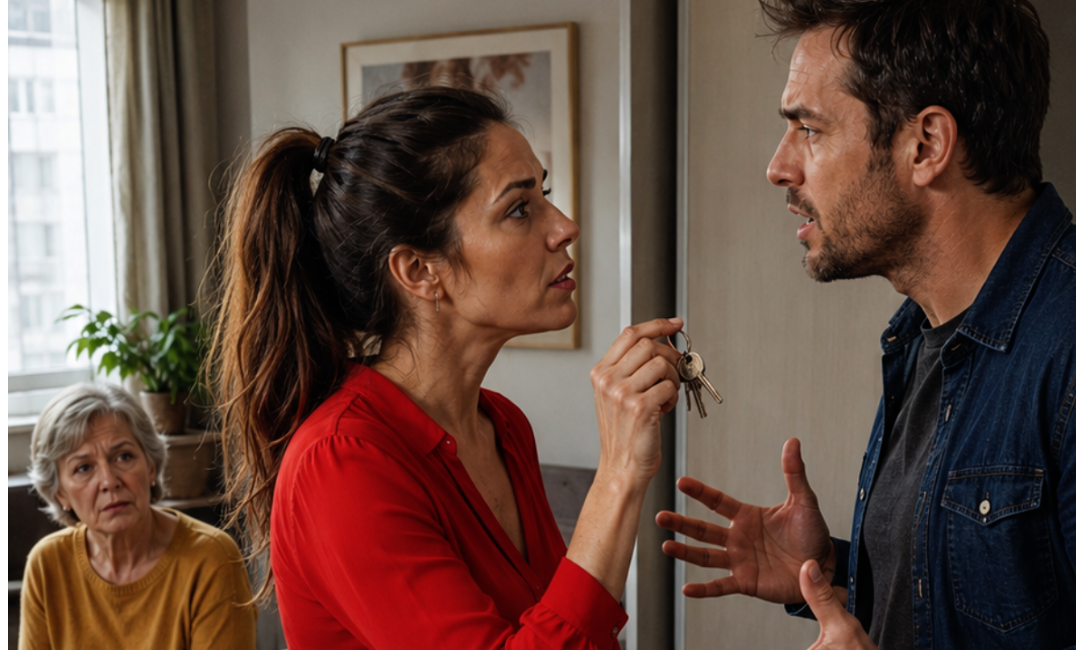
“Give me back the keys. Today. Or tomorrow you’ll be sleeping on the staircase!” the wife said coldly to her husband.
The hallway fell silent.
Adelina Romanovna was the first to break the pause.
“What is the meaning of this!” the mother-in-law cried, throwing up her hands. “Who talks to a mother like that? Ungrateful woman! I raised my son, and now I’m supposed to sleep on the staircase?! Do you hear that, Vladik? Do you hear what your wife is saying?!”
“Lena, have you completely lost it?” Vladislav took a step toward her. “What keys? What staircase? She’s my mother. I’m not taking any keys away from her. Are you out of your mind?”
“You won’t?”
“No.”
“Fine.”
Elena did not continue arguing.
She did not try to prove anything, scream, or explain the obvious.
She took out her phone, stepped aside, and dialed a number.
“Pavel? Good evening, this is Elena. Remember me? You gave me your business card when you changed the locks for the neighbors upstairs. Yes. I urgently need to change my lock. The front door. Today. I don’t care how much you charge for an emergency call—I’ll pay. Write down the address.”
Vladislav stared at her as though she had transformed into a different person before his eyes.
“What are you doing? What locks?”
“My locks. In my apartment.”
“Have you lost your mind?”
“Possibly,” Elena said, putting away the phone. “But the locksmith is already on his way.”
Adelina Romanovna began rushing nervously between the spare room and the hallway, unsure whether to continue unpacking or start packing everything again.
“Vladik, do something! She’s throwing me out! I’ve rented out my apartment. I have nowhere to live!”
“Renting it out was your decision,” Elena said evenly. “No one consulted me. I’m not responsible for other people’s decisions.”
Pavel arrived quickly, about forty minutes later, carrying a toolbox. He was businesslike and not much of a talker.
He examined the door and nodded.
“Do you want just the cylinder changed, or the entire lock?”
“The whole thing. And I want to be the only person with keys.”
“Understood.”
While Pavel worked—drilling, adjusting, installing the new mechanism—the final scene unfolded in the apartment.
At first, Adelina Romanovna screamed about ingratitude, her sacrificed youth, and how she had raised a son only for him to marry such a snake.
Then she started crying.
Then she went back to shouting.
Vladislav paced from one corner to another, reaching alternately for his phone and his head, trying first to calm his mother and then to persuade Elena to come to her senses.
“Lena, let’s talk like normal people. Why change the locks immediately? Mom has already rented out her apartment. She really has nowhere to go. Let her stay temporarily, at least.”
“Vlad.”
Elena looked at him tiredly.
“You let an outsider into my home. Secretly. You made duplicate keys behind my back. You made all the decisions without saying a word to me. Tell me honestly—did you even think you had to ask me?”
Vladislav was silent.
“That’s exactly the point,” Elena said.
Adelina Romanovna was packing her suitcase, accompanying every movement with complaints.
She folded back the same dresses she had confidently hung in the wardrobe only an hour earlier.
She removed the framed photograph from the windowsill and pressed it to her chest.
“Remember this,” her mother-in-law snapped as she passed Elena on the way to the door. “You’re destroying your family. You’ll regret this later. You’ll lose your husband over an apartment. You’ll see.”
“Maybe,” Elena replied. “But at least the apartment will still be mine.”
Pavel finished his work and handed Elena the new keys.
“Done. The old keys won’t work anymore, so don’t worry. Here’s your receipt.”
“Thank you. So much.”
When the door closed behind Adelina Romanovna, Vladislav stood in the middle of the hallway looking at his wife.
Then he silently picked up his jacket.
“I’m going with Mom. She needs help carrying her things.”
“Go.”
“I’ll come back, and we’ll talk.”
Elena did not answer.
She watched her husband walk out after his mother, watched him make his choice in that exact moment, on that very threshold—between Elena and Adelina Romanovna.
His choice was so obvious that there was nothing left to discuss.
The door slammed shut.
Silence descended over the apartment.
Real silence.
Thick silence.
The kind that had not existed there for many weeks.
Elena walked through the rooms.
She found a forgotten towel belonging to her mother-in-law and carried it to the door.
She placed the porcelain dog—Adelina Romanovna had forgotten it after all—on the hallway cabinet so she could return it later.
Then Elena sat down on the same gray corner sofa that Vladislav had been so determined to buy before they finished the wallpaper.
Outside, darkness was falling.
The light from the streetlamp stretched across the floor in a long yellow stripe, exactly as it had on that first evening when they arrived with a bottle of cheap wine and two plastic cups.
Only now, no one was walking through that stripe of light.
No one was knocking his knuckles against the walls.
No one was enthusiastically talking about solid construction.
It was quiet.
And strangely enough, it did not feel as painful as she had expected.
Her phone vibrated.
A message from Vladislav.
It was long and rambling, telling her that she had gone too far, that his mother was hurt, that they would definitely talk everything over once Elena had calmed down.
She started reading it, did not finish, and placed the phone face down.
The next morning, before work, she stopped at a legal consultation office.
She brought all her documents with her—the registry extract, the purchase agreement, the inheritance papers, everything proving that the apartment was hers and hers alone, purchased with money to which neither Vladislav nor, certainly, his mother had any claim.
The lawyer, an older woman wearing glasses, flipped through the documents and nodded.
“Everything is clear regarding the apartment. It is separate property, purchased with inherited funds, and is not subject to division. There is nothing to challenge here. As for divorce, if there are no children and no property dispute, the court process should not take long.”
“We don’t have children,” Elena said. “And there is no dispute.”
She left the office and stepped onto the street.
The morning was cool and clear. The air smelled of wet asphalt and, from somewhere nearby, fresh bread—probably from the bakery on the corner.
Elena stood there for a moment, turning her face toward the pale sunlight.
Her phone vibrated again somewhere inside her bag.
She did not even check who it was.
Vladislav.
His mother.
His sister.
Now they were people she would be speaking to through lawyers and in a courtroom, not over tea in her own kitchen.
She had thought it would be harder.
She had thought she would mourn eight years of marriage, the familiar routines, the shared memories, that first evening with wine in the empty apartment.
And she did feel sad about those things.
But the sadness stayed somewhere at the edges, separate from what truly mattered.
Because she had understood the most important thing back in the hallway, watching her husband walk away.
A person who cannot protect you even in your own home, who chooses someone else’s convenience over your rights, will never become the support you need, no matter how desperately you cling to him.
The keys belonged only to her now.
Two brand-new keys, still smelling faintly of metal, pleasantly heavy in her pocket—just like the key she had carried in the very beginning.
Elena closed her hand around them and walked toward the bus stop.
Ahead of her was an ordinary workday.
And for the first time in a long time, she looked forward to coming home in the evening—to her own home, where no one would ever again unpack someone else’s belongings onto her shelves or expect her permission to live her own life.