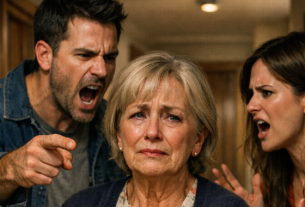
“— My parents gave the apartment to me, not to you or your relatives. What part of that is so hard to understand? So stop coming here as though this were your own home.”
The words fell into the silence of the entryway like something heavy and made of glass.
Anna Sergeyevna froze, gripping the corner of the sideboard that the movers had just hauled up to the eighth floor. Her fingers, covered in gold rings, turned white. Lyolya, standing by the door, opened her mouth and forgot to close it. The movers exchanged glances and pretended they were not there at all.
But I am getting ahead of myself.
It did not begin with those words. It had started much earlier—with a button, the smell of menthol cigarettes, and a key that would not turn properly in the lock.
That day, I was coming home from the supermarket. Two heavy grocery bags pulled painfully at my arms. Glass jars of tomato paste clinked inside one of them, while the other held everything I needed for dinner. I was planning to make seafood pasta. Kirill loved it when the kitchen smelled of garlic and basil.
We had bought this apartment—or rather, my parents had given it to me—and I had personally chosen every detail inside it. The pale suede sofa. The stained-glass window in the living room, which had taken me three months to find based on my sketches. The silence. The smell of cleanliness.
The elevator smelled of menthol cigarettes.
My heart gave a sudden jolt and seemed to drop into my stomach.
That was how Lyolya, Kirill’s younger sister, smelled.
I told myself there were two hundred apartments in the building. Anyone could have been smoking in the elevator. But when I reached my door, the key did not turn smoothly. Something seemed to catch inside the lock.
That sometimes happened when the door had been opened with another key and then locked from the inside with the deadbolt.
Anna Sergeyevna had a duplicate.
“For a fire or a flood,” she had said when she held out her hand for a spare set.
I had not wanted to give her one, but Kirill had looked at me with such hope that I gave in.
Now I regretted it.
There was a foreign smell in the entryway—a mixture of tobacco, sweet perfume, and something fried.
Lyolya’s denim jacket hung on the coat rack. A pair of size thirty-seven sneakers lay carelessly on the floor.
I took off my shoes and walked into the living room.
The first thing I saw was a greasy stain on the pale suede sofa.
It was orange, obviously tomato sauce.
Beside it, on the coffee table I had brought back from Milan, stood two cups marked with bright pink lipstick. Cigarette butts lay in my favorite handmade saucer.
Menthol cigarettes.
I heard running water from the bathroom and Lyolya’s voice. She was laughing, splashing around, and chatting with someone on the phone.
I opened the door and saw her removing her makeup with my micellar water. The bottle had cost three thousand rubles and was already almost half empty.
“Oh, hi,” Lyolya said when she noticed me in the mirror. “Mom and I came over. We thought we’d surprise you. You don’t mind, do you?”
I did not answer.
I turned around and went to the kitchen.
Dirty plates stood in the sink. Bread crumbs covered the countertop, and the syrniki I had made the previous evening were gone from the refrigerator.
The empty bowl stood nearby, covered with plastic wrap bearing someone else’s fingerprints.
They had simply eaten them.
The bedroom was quiet.
I went inside to change clothes and noticed Kirill’s blazer hanging over the back of a chair. It was hanging neatly, and a button had been pinned to it with a safety pin.
The same button I had sewn on two nights earlier.
It had been deliberately cut off. Loose threads stuck out around it, and attached to the safety pin was a note.
Anna Sergeyevna’s handwriting—tidy and slanted:
“Sonny, sew it on yourself. That half-wife of yours doesn’t take proper care of you.”
I stared at the note for a minute. Maybe two.
The letters blurred, but not because of tears.
Because of rage.
I had sewn that button on two days ago.
I remembered threading the needle. I remembered Kirill standing beside me and hurrying me because we were late for the cinema.
The button had been sewn on securely.
It could not possibly have fallen off by itself.
Someone had deliberately cut it off.
Anna Sergeyevna had come into our apartment, found her son’s blazer, cut off the button, then pinned it back on with a note.
To humiliate me.
To show me: You are nobody here. You cannot even sew on a button properly.
I slipped the button into the blazer pocket.
My hands were trembling, but I refused to cry.
Then I heard Anna Sergeyevna’s voice in the hallway.
She came out of the guest room, which I had not even entered yet, and stood in the entryway holding a measuring tape.
“Alisa, darling,” she said with a smile, “Lyolya and I have been thinking, and we decided you need our sideboard. Mahogany. An antique. Fifty years old. It will look monumental in your corridor. We’ll bring it tomorrow.”
Lyolya came out of the bathroom with a towel wrapped around her head.
“Oh yes, that would be great. It’s so empty in here, like a museum.”
I stood there silently.
The sideboard.
That same dark mahogany monster that stood in Anna Sergeyevna’s living room and took up half the space.
I had seen it once—massive, with carved legs and glass doors behind which old Soviet-era dinner sets gathered dust. It smelled of mothballs and other people’s memories.
And now they wanted to put it in my apartment, where every square meter had been planned down to the millimeter.
“Anna Sergeyevna, we never discussed this,” I said calmly, although I was boiling inside.
“What is there to discuss?” She threw up her hands. “It’s excellent furniture, it’s free, and you’re still unhappy. When Kiryusha comes home, he’ll decide.”
Kirill.
She always waited for Kirill to come home.
Because Kirill would take her side.
He always did.
He had grown up in a cramped two-bedroom apartment where Anna Sergeyevna, Lyolya, sometimes Aunt Raya from the Urals, and nephew Dima whenever he was studying at university all lived together.
There was no concept of personal boundaries in that apartment.
Everything was shared.
Everything belonged to “the family.”
Kirill was accustomed to his mother walking in without knocking, his sister taking his things, and guests sleeping on a folding bed in the walk-through room.
To him, that was normal.
To me, it was hell.
That evening, Kirill came home from work tired and angry. He had had a terrible day—some failed tender, his bosses shouting at him.
I had dinner waiting, but Lyolya was sitting in the living room watching television at full volume.
“Hi,” I said quietly when he entered the kitchen. “Your mother wants to bring her sideboard here.”
“So what?” Kirill shrugged. “We can put it in storage for now.”
“In storage? Do you understand that they ate my syrniki without asking, stained the sofa, and tomorrow they plan to drag that old junk in here?”
Kirill rubbed the bridge of his nose wearily.
“Alis, don’t start. They’re just trying to help. Mom has dreamed all her life of me having that sideboard. It belonged to Grandma.”
“Your grandmother’s memory can stay in your mother’s house. Not ours.”
“This is our shared home, Alis.”
“This home was given to me, Kirill. By my parents. We have discussed this a hundred times.”
He fell silent.
I could see two emotions fighting inside him: his reluctance to quarrel with me and his fear of hurting his mother.
Fear won.
“You’re overreacting,” he finally said. “It’s just furniture. Don’t be selfish.”
Selfish.
He called me selfish.
Me, who had spent six months saving money from freelance jobs to buy him a Swiss watch for his birthday.
Me, who tolerated Lyolya in my home.
Me, who smiled when Anna Sergeyevna criticized my haircut, my career, my interests.
Selfish.
I did not answer.
I simply went to bed, lay on the very edge of the mattress with my back to him, and stared for a long time at the shadows cast by the stained-glass window.
It was beautiful—an abstract pattern made of blue and yellow glass.
I remembered choosing the design with the decorator. I remembered how happy I had been that I would finally have a home where I alone decided what was beautiful and what was not.
Now someone was trying to take that home away from me.
The next morning, I woke early.
Kirill left for work without breakfast, and the apartment was silent.
I decided that perhaps our conversation the night before had changed something.
Maybe he had called his mother and asked her not to bring the sideboard.
Maybe everything would be fine.
At half past ten, the doorbell rang.
I was not expecting anyone, so I immediately became wary.
I looked through the peephole and saw Anna Sergeyevna’s distorted face. Behind her stood two movers in blue overalls and Lyolya holding some kind of box.
The sideboard was already being brought up in the freight elevator. I could hear the machinery humming and men talking on the landing.
I opened the door.
“Good morning,” I said without stepping aside. “We did not agree on today.”
Anna Sergeyevna pushed past me with her shoulder and entered the hallway.
“Why put it off? It’s an excellent piece, and the movers happened to be free today. Come on, boys, bring it in carefully.”
I stood in the doorway, blocking the entrance.
The movers stopped, unsure whom to obey.
The sideboard had already been taken out of the elevator. It towered like a dark boulder against the white wall.
“Anna Sergeyevna,” I said slowly and distinctly, “I did not give you permission to bring this furniture into my apartment.”
“Your apartment?”
She raised an eyebrow.
“I thought it was my son’s apartment.”
“Your son is registered here, but I own the property. It was a gift from my parents.”
“Oh, nonsense.” She waved dismissively. “What difference does it make who owns it? We’re family. Everything is shared.”
Lyolya had already slipped inside and placed the box on the floor.
“There’s jam from Aunt Raya in there,” she explained. “And pickles. Mom says you two don’t eat properly, so she thought you needed some homemade food.”
The movers began carrying in the sideboard.
It was enormous, dark, and smelled of dust and age.
Anna Sergeyevna started directing them.
“Over here, against this wall. And what is this junk?”
She pointed to my designer table made of pale wood.
“This needs to go. The sideboard will stand here.”
“Stop,” I said loudly.
The movers froze.
Anna Sergeyevna turned toward me, and an expression of astonished superiority appeared on her face—as though I were a spoiled child interfering while adults handled important matters.
“The sideboard is going back right now,” I said.
“Alisochka.” She smiled, but her eyes remained cold. “You’ll thank me later. This is an antique, not some junk from your IKEA.”
“This is my home, Anna Sergeyevna.”
“And I thought it was my son’s home,” she repeated, her smile disappearing.
And then I said those words.
The very words that would echo in my mind for many days afterward.
“My parents gave the apartment to me, not to you or your relatives. What part of that is so hard to understand? So stop coming here as though this were your own home.”
Silence hung in the entryway like a cloud of dust.
Lyolya froze, clutching the box of jam to her chest.
The movers exchanged glances and started edging toward the exit.
Anna Sergeyevna stared at me, and her expression changed—from surprise to anger, from anger to pain.
She grabbed her chest and slowly began sliding toward the floor.
“Mom!” Lyolya screamed. “You’ve given her a heart attack!”
At that exact moment, the front door flew open.
Kirill had forgotten a folder of documents and turned back halfway to work.
He saw his mother sliding down the wall, the sideboard blocking the hallway, his pale wife standing with clenched fists, and his sobbing sister.
Horror spread across his face.
“What is going on here?!” he shouted.
Anna Sergeyevna did not answer.
She was breathing rapidly and shallowly, one hand pressed against her chest.
Kirill rushed toward her, took her under the arms, and helped her into a chair.
Lyolya darted around the hallway, grabbing first water, then a phone, then smelling salts.
“Call an ambulance! Call an ambulance!” she screamed.
I stood with my back against the stained-glass window and felt everything inside me turn to ice.
I had told the truth.
But the truth made it look as though I had just killed someone.
The ambulance arrived fifteen minutes later.
The doctor examined Anna Sergeyevna, checked her blood pressure, and performed an ECG.
They found no serious abnormalities. Her blood pressure had spiked because of emotional stress.
The older woman had become extremely upset.
She was advised to rest and take valerian.
Kirill drove his mother and sister home.
The movers, quietly cursing under their breath, dragged the sideboard back into the elevator.
I remained alone in the empty apartment, which suddenly felt foreign.
The orange stain still marked the pale suede sofa.
Cigarette butts still lay in the saucer.
The refrigerator was still empty of syrniki.
I sat down on the floor in the hallway and burst into tears.
I was thirty years old.
I had a prestigious career as an architect, a loving husband, and my own apartment in a good neighborhood.
Yet in that moment I felt like the little girl who had broken her grandmother’s cup and was waiting to be punished.
The little girl who was never hugged simply because someone wanted to hug her.
The little girl who received expensive toys but was never asked what she actually wanted.
My parents were good people.
Intelligent, educated, successful.
They simply did not know how to express love except through material things.
The apartment was their way of saying: We care about you.
But I had never spent my life dreaming of an apartment.
I dreamed of a home where I would be respected.
Where no one would walk in without knocking.
Where no one would deliberately cut off a button just to prove that I was a bad wife.
My phone beeped.
A message from Kirill:
“That was cruel, Alis. She practically went gray tonight.”
I read it and did not reply.
What could I have said?
That I had not wanted to hurt her?
That she had bulldozed her way into my life and expected me to thank her?
Kirill did not understand.
He had grown up in a hive where invasion was treated as love.
An hour later, one of Kirill’s distant aunts called me. I had seen her only once in my life—at our wedding.
She spoke for a long time in a slow, mournful voice.
“Alisa, how could you? Anna Sergeyevna is an elderly woman, a respected woman. She devoted her whole life to her son. You cannot be so greedy about space. Family means being cramped but happy together.”
I listened with the phone pressed against my ear and understood that my mother-in-law had activated the family grapevine.
Now every relative was discussing me, including people whose existence I had never even known about.
Kirill came home late.
He was sober, but he looked as though he had drunk an entire bottle of vodka alone.
His face was gray. His eyes were red.
He took off his shoes, entered the kitchen, and sat across from me.
“She cried for three hours,” he said quietly. “She says you threw her out of my home.”
“Out of my home, Kirill. Mine.”
“Are you serious right now? My mother almost had a heart attack, and you’re talking about property rights?”
I stared at him and did not recognize the man I had married.
He was intelligent, sensitive. We used to talk all night about architecture, travel, and how to build a home in which everyone would feel comfortable.
But now the person sitting in front of me was little Kiryusha, the boy who was afraid of his mother and did not know how to say no.
“She cut the button off your blazer,” I said. “The one I sewed on two nights ago. She cut it off and pinned it back with a note saying, ‘That half-wife of yours doesn’t take care of you.’ I am not imagining this, Kirill. It happened.”
He fell silent.
He pulled the button—the same one I had slipped into his pocket that morning—out of his blazer and stared at it for a long time.
I could see two desires fighting within him: to admit that his mother had done something wrong, or to defend her at any cost.
“Maybe you simply don’t know how to love?” he finally said.
Those words hurt more than any slap could have.
“You’re always so distant. You hate my family. I can see it. But they are my family. You married me knowing that.”
“I married you, not your family. And I never promised that they would be allowed to run my home.”
“Our home.”
“I didn’t buy it so people could come here without permission, eat my food, and rearrange my furniture. These are basic things, Kirill. Basic respect.”
He stood up from the table and walked into the living room.
I heard him making up a bed on the sofa—the same sofa with the orange stain.
We did not sleep together that night.
Or the next.
Two days later, I met Rita.
We sat in a small café near Patriarch’s Ponds. The air smelled of cinnamon and freshly ground coffee as I told her everything—the button, the sideboard, the ambulance, the family gossip network.
Rita listened while stirring her cappuccino, and at some point her expression hardened.
“Do you know what your apartment is?” she asked.
“What?”
“A metaphor. Your mother-in-law is trying to fill your personal space with herself. With her rules, her furniture, her relatives. She is like a cuckoo laying eggs in somebody else’s nest and expecting you to hatch them.”
“Maybe I really am selfish,” I said. “Maybe I should have just agreed to the sideboard. Put it in storage and forget about it.”
“No.”
Rita set down her cup.
“This isn’t about the sideboard. It’s about the fact that she cut off that button, Alis. That was a symbolic act. She walked into your home, found something you had repaired, deliberately broke it, and said, ‘Look, your work is worthless.’ That is abuse in its purest form, simply wrapped in the pretty packaging of maternal concern.”
“She isn’t evil,” I said, remembering Anna Sergeyevna’s face as she slid toward the floor. “She just… doesn’t understand.”
“Of course she doesn’t understand. She has suffocated her son with her love his entire life, and nobody ever told her to stop. Now she is suffocating you.”
Rita took a sip of coffee and added something that completely changed the way I saw the situation.
“You’re an architect, Alis. You design spaces in which people live. You know that light in a home is not simply about windows. It is about how a person feels. She brought in a sideboard that would have blocked your favorite stained-glass window. That is not a coincidence. It is a metaphor for your entire family life. She blocks the light.”
I drove home thinking about Kirill.
He had once dreamed of becoming an architect like me.
He had talent. He used to draw sketches when we first met.
But Anna Sergeyevna had told him architecture was an unreliable profession and that he should go into management because it was stable.
So he did.
She had devoured his dream and seasoned it with maternal love.
Now she was trying to devour our family.
A week passed.
Kirill and I barely spoke, exchanging only short practical remarks about everyday matters.
I worked constantly, accepting additional projects to keep my hands and mind occupied.
On Saturday morning, Kirill went to his mother’s house. She had called and said she felt unwell and needed help around the house.
I stayed home alone and decided to clear out the storage cupboards.
A great deal of junk had accumulated there—boxes we had brought from Kirill’s old apartment after the wedding and had never unpacked.
Among the old boxes, I found a cardboard folder tied with string.
It was heavy and stuffed with papers.
I opened it and found old letters tied with a faded ribbon.
The handwriting was unfamiliar—ornate and slanted to the left.
“Anya, stop tormenting your husband. He is a good man, and he loves you. You have tied the boy to yourself too tightly. You will suffocate him with your love just as I once suffocated you. Let Kiryusha go. Let him breathe freely. Send my grandson to me for the summer. Stop keeping him tied to your skirts. He needs air.”
I read the letter three times.
It had been written by Kirill’s grandmother to Kirill’s mother.
A mother-in-law writing to her daughter-in-law.
I went through the yellowed pages, and the story of a family curse unfolded before me.
Kirill’s grandmother had controlled Anna Sergeyevna in exactly the same way Anna Sergeyevna now controlled Kirill.
And Anna, after escaping the grip of her own mother, had become exactly like her—overprotective, suffocating, incapable of recognizing boundaries.
She was not a villain in the traditional sense.
She was a wounded woman who knew no other way to love except to consume a person entirely.
I sat on the floor surrounded by letters and cried.
Not because I pitied her.
Because I pitied all of us.
Kirill, who never became an architect.
Anna Sergeyevna, who had been suffocated in childhood just as she now suffocated us.
And myself, because I had entered this war without understanding its true scale.
The doorbell interrupted my thoughts.
I wiped away my tears, returned the letters to the folder, and went to open the door.
A local police officer stood on the landing—a young man in uniform holding a tablet.
Beside him was our neighbor from the ground floor, a curious old woman who always knew everything about everyone.
“Alisa Andreyevna?” the officer asked. “We received a complaint from Anna Sergeyevna Samoylova concerning missing family jewelry. Could you clarify the situation?”
I froze.
Jewelry.
Family heirlooms.
A police report.
It was revenge.
Revenge for the public humiliation, for the sideboard, for the fact that I had dared to say no.
My mother-in-law had not merely activated the family gossip network.
She had gone to the police.
She wanted me charged with theft.
“Come in,” I said calmly, although something inside me seemed to collapse. “I’ll explain everything.”
I seated the officer in the kitchen and offered him tea.
My hands were steady. My voice was even.
I surprised myself.
Several days earlier, I had cried on the floor from helplessness. Now that the threat had become real, some cold, calculating part of me had taken control.
“This is my apartment,” I said, taking out the documents. “The property is registered in my name. I have a prenuptial agreement. Anna Sergeyevna is neither registered nor living here. She has a duplicate set of keys, but they were given to her strictly for emergency purposes. I have never seen the jewelry she is referring to. If anything was stolen, it did not happen on my property.”
The officer typed something into his tablet.
“And where were you on the afternoon of such-and-such a date?”
“At home. Working. I can show you computer files with timestamps.”
The neighbor from the ground floor, who had come in with the officer “to provide witness testimony,” suddenly spoke up.
“I saw that woman who filed the complaint. She came here last week with her daughter and some movers. They were bringing in a sideboard. There was so much shouting that the entire building could hear.”
The officer raised an eyebrow.
“A sideboard?”
“Yes,” I said. “Anna Sergeyevna wanted to bring her furniture into my apartment without my consent. We argued, she had an ambulance called, and then she left. I believe the theft complaint is an extension of that conflict.”
I do not know what exactly made the difference—my calm certainty, the neighbor’s testimony, or the fact that Anna Sergeyevna had no evidence whatsoever.
But the officer closed his tablet and said he would conduct a formal review, although the matter was unlikely to proceed.
I asked him to formally record the possibility of a false accusation.
He nodded and left.
When the door closed behind him, I leaned against the wall and slowly slid to the floor.
I was shaking.
She had tried to send me to prison.
Not metaphorically.
Literally.
Behind bars.
Because I refused to let her put a sideboard in my home.
Kirill came home that evening.
I was sitting in the kitchen waiting for him.
Two things lay on the table before me: the folder of old letters and a copy of the police complaint that I had requested from the officer.
“Sit down,” I said.
He sat.
I told him everything—about the officer, the complaint, his grandmother’s letters.
He listened in silence, and with each word, his face seemed to become more drawn.
Then he picked up the letters and began reading.
I watched the expression in his eyes change—from disbelief to understanding, from understanding to pain.
“My mother called the police and accused you of theft?” he asked quietly.
“Yes.”
“Because of the sideboard?”
“Because I said no. For the first time in her life, someone in this family told her no.”
He covered his face with his hands and sat that way for a long time.
His shoulders trembled.
I did not touch him or try to comfort him.
He needed to experience that moment for himself.
“Your grandmother did the same thing,” I said when he finally raised his head. “She controlled your mother. Took away her ability to make her own decisions. And your mother escaped that control, only to become exactly the same. She doesn’t know any other way. But that doesn’t mean we have to accept it.”
“What do you want?” Kirill asked.
“I want you to choose. Either you are an adult man with his own home and his own wife, or you are little Kiryusha, afraid of his mother and allowing her to run our lives. The two cannot coexist.”
I spoke calmly, although everything inside me was trembling.
I knew that everything was being decided in that moment.
Either he chose me, or in a month we would be filing for divorce.
“I will never demand that you abandon your mother,” I continued. “But she will return the keys to our apartment. She will visit only when invited, not whenever she feels like it. And if she crosses this threshold without permission again, I will call the police, and this time I will be the one filing a complaint for trespassing on private property.”
Kirill remained silent.
Then he gathered his grandmother’s letters, placed them back in the folder, and stood up.
“I’m going to see her.”
“Now?”
“Yes. I can’t put this off.”
He left.
I remained alone in the empty apartment, with silence pressing against my ears.
I stared at the stained-glass window glowing in the sunset and thought that everything might end right now.
He might not come back.
His mother knew how to persuade him—with tears, pressure, pleading.
She had raised him.
She knew every one of his weaknesses.
But he came back.
Three hours later.
Tired, red-eyed, but with his back straight.
He held a set of keys in his hand.
“Here,” he said, placing them on the hallway cabinet. “My mother’s keys. She won’t come here again without an invitation.”
I hugged him.
We stood in the entryway, holding each other in silence.
The stained-glass window cast blue and yellow patches of light across the floor.
A month passed.
Kirill and I went on vacation for a week in Tuscany, a trip we had dreamed about for years.
We returned tanned, carrying a bottle of Chianti and an album full of photographs.
The apartment welcomed us with silence and cleanliness.
We had the suede sofa professionally cleaned, and the stain was removed.
I installed a new stained-glass window—this time made with green and amber glass, like the hills of Tuscany at sunset.
One morning, the phone rang.
The screen displayed:
“Anna Sergeyevna.”
In the past, I would have flinched at the sight of her name.
Now I simply looked at the screen.
Kirill was in the shower.
I answered and turned on the speaker.
“Hello, Anna Sergeyevna,” I said calmly.
There was a pause.
She had clearly not expected me to answer so casually, as though nothing had happened.
“Hello, Alisa,” she said.
Her voice was dry, but the old aggression was gone.
“I wanted to ask whether I could come over on Sunday. Kiryusha said he has the day off. I’ll bake a pie.”
I almost laughed.
A pie.
After everything that had happened—the police officer, the button, the sideboard—she was asking permission.
For the first time in her life.
“We’re free on Sunday afternoon,” I said. “Let’s coordinate our schedules. Come at three if that works for you.”
Another pause.
I could hear her breathing through the phone—quick, uneven.
She had expected me to say no.
She had expected revenge.
She had expected me to humiliate her the way she had tried to humiliate me.
But I did not need revenge.
I needed boundaries.
“All right,” she finally said. “Three o’clock, then.”
I ended the call.
Kirill came out of the bathroom wrapped in a towel and looked at me questioningly.
“Your mother called,” I said. “She’s baking a pie. She’ll come over on Sunday. I told her three o’clock.”
Kirill smiled.
Not the guilty smile of a frightened boy worried that two women might start fighting again.
The calm, confident smile of a grown man.
“Great,” he said. “I’ve missed her pies.”
And in that moment, I understood.
We had made it.
Not immediately.
Not easily.
But we had finally built what we should have built from the very beginning—not merely an apartment with stained-glass windows and Italian furniture, but a real home.
A home where people entered by invitation.
A home where everyone had the right to say no.
Outside, the sun was shining, and the stained-glass window cast green and amber reflections across the floor.
I stood barefoot on the warm parquet and thought about boundaries.
Boundaries are not walls.
They are doors.
And now, only we had the keys.