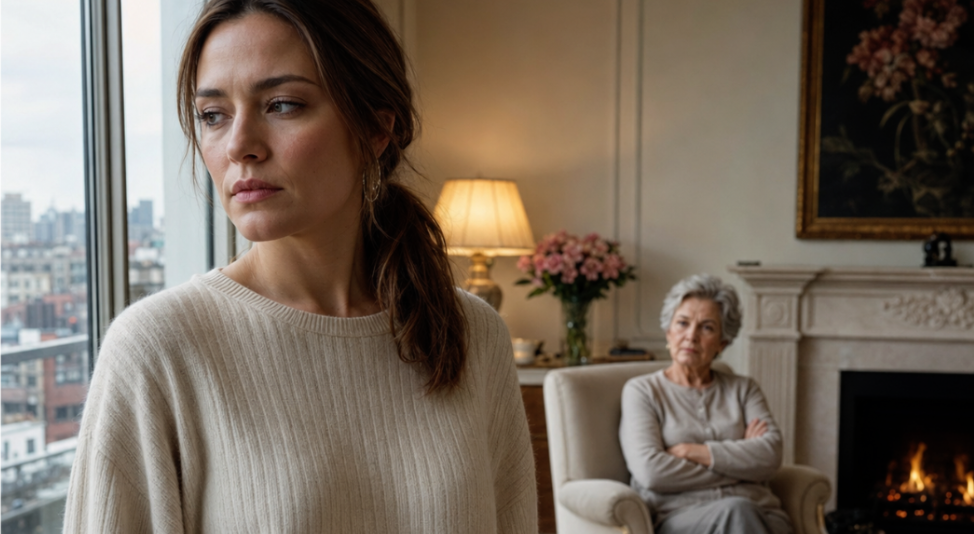
Three years earlier, Artyom and Polina had gotten married quietly, almost in a rush, still carrying the scent of university lectures and cheap coffee from vending machines. They believed that a perfectly smooth road lay ahead of them, without a single stone in the way. Reality greeted them with the rent bill for their apartment, which swallowed almost everything they earned.
“Polina, just don’t panic,” Artyom said as he studied the figures in his notebook. “I’ve done the calculations. If we stop eating, we’ll have enough money for curtains by the time we retire.”
“Brilliant,” she snorted. “Should we stop breathing too?”
“We can keep breathing. That’s still free.”
They laughed because there was nothing else they could do. In the evenings, Polina put on her headphones and recorded audiobooks. Her voice was soft and enveloping, and other people’s stories sounded warmer in it than real life ever did. Artyom, meanwhile, took any work he could find, just to bring a little more money home.
Galina, his mother, did not visit them often and never interfered in their affairs. Polina appreciated this as though she had been unexpectedly blessed with good fortune.
“Honestly, I’m really lucky,” she admitted to a friend over the phone. “Everyone else is at war with their mother-in-law, but we have peace. She doesn’t even ask why my borscht is red.”
“Don’t jinx it,” her friend advised.
“Oh, come on.”
One day, as Galina was leaving, she paused in the doorway and said something strange.
“Blood will have its way, Artyom. Remember my words.”
“What is that supposed to mean?” he asked, confused.
“It means that one day you’ll understand,” she replied with a cold smile.
Six months later, their daughter was born. Little Mira slept peacefully, as though she understood that her parents already had enough to worry about without her adding tantrums to the list. And their worries grew along with her.
“I’ve added everything up,” Polina said one day, putting down her phone. “We don’t have enough money. Not even close.”
“I’ll find another job,” Artyom replied.
She looked at him. He was pale, with dark circles under his eyes, surviving on stubbornness alone.
“You’re already burning out like a match. Don’t look for a second job. Find one decent job instead. It’s better to earn with your head than with your back.”
“I’m already working on it,” he muttered. “But for now, there’s another option. A temporary one. We could move in with my mother.”
Polina was silent for a moment.
“I don’t like the sound of that idea. But ideas don’t print money, so I’ll agree.”
Artyom called his mother. She did not react enthusiastically to the news, but she did not cause a scene either.
“Your old room is empty anyway,” she said. “You can stay here.”
“Thank you. It won’t be for long.”
“If you say it won’t be long, then it won’t be long.”
Polina called her afterward and thanked her warmly and sincerely.
“Thank you so much. Mira is a quiet baby. She won’t cause any trouble, I promise.”
“I don’t mind looking after my granddaughter,” Galina replied. “It gets lonely here by myself.”
They moved in, and at first everything went smoothly. Polina cleaned, washed clothes, ironed, cooked, found time to buy groceries, and even managed to record a couple of audiobook chapters while Mira slept. Her mother-in-law occasionally took her granddaughter for walks in the courtyard and seemed content.
“I’m lucky to have you,” Polina whispered to her husband one night. “And I’m lucky with her too. Do you hear me?”
“I hear you,” Artyom replied sleepily. “Just knock on wood.”
“You’re so superstitious.”
Sometimes, however, Polina felt a quiet sting of resentment. Her mother-in-law adored her younger daughter, Karina, who had married before they had. Karina’s son, Timur, was already five, and Galina took him for weekends, helped them financially, and positively glowed whenever he was around.
“You don’t help your son like that,” Polina cautiously pointed out one day.
“A daughter is closer,” Galina replied simply. “Blood will have its way.”
“There’s that blood of yours again,” Polina said with a smile. “It sounds like some kind of spell.”
“Live long enough and you’ll understand.”
Polina dismissed it as a mother’s weakness for her daughter and did not attach much importance to it. She boasted to her friends on the phone:
“My mother-in-law is worth her weight in gold. You may envy me in silence.”
And they did.
One evening, Galina approached her son wearing a grave expression.
“Artyom, I have bad news.”
“Is something wrong with your health?” he asked anxiously.
“My health is fine. Karina is getting divorced.”
Artyom sank into a chair. In the next room, Polina froze. She had heard everything.
“Well, that’s unexpected,” he exhaled. “They never argued in public. But that’s life. These things happen. We’ll make room for them. Let her come here, and we’ll figure something out.”
He looked through the doorway at his wife. Polina silently nodded in agreement.
But Galina had been expecting a different answer.
“You don’t understand,” she said sharply. “Karina has a son. They need a separate room of their own.”
“What’s wrong with the third bedroom?” Artyom asked. “They can stay there. There’s enough room for everyone.”
“That’s not how it should be!” her voice rose. “A child needs proper space to grow up, not to be under everyone’s feet in the hallway!”
“And what exactly are you suggesting?” Polina asked as she stepped into the room.
“You’ll have to move out,” her mother-in-law said bluntly.
A heavy silence descended, a silence that somehow contained too much noise.
“You’re throwing us out?” Artyom said slowly. “Are you serious?”
“I’ve given you a place to live for almost six months!” Galina began breathing faster, and the words spilled out of her, angry and venomous. “Your girl is already a year old, you’re a grown man, you’ve changed jobs, and now you’re earning money! Stop living off me! What am I to you, a free hotel?”
“Mother, you invited us yourself,” he reminded her quietly.
“I did! And now I’m inviting Karina! She’s my own daughter, my own blood, and you’ll manage somehow! Don’t like it? Go live on the street!” she was almost shouting now, leaning toward him. “You’re young and healthy. You have legs, so use them and walk!”
Polina stared at her, unable to recognize the gentle woman who had taken walks with Mira in the courtyard.
“Why can’t Karina share a room with her son?” she asked calmly. “Mira shares a room with us.”
“Because Karina is Karina!” her mother-in-law roared. “And who are you to tell me what to do? You’re a stranger in my house! I did you a favor, and now you have the nerve to argue with me!”
Artyom stood up. His voice became calm and cold.
“I understand. Thank you for letting us stay. We won’t impose on you any longer.”
He went into their room. Polina was already taking their belongings off the shelves and packing them into a bag.
“Where are you going?” he asked.
“To my parents. Their place is cramped, but they’ll take us in. We’ll stay there for a few days and then rent our own place. I’m not the kind of person who stands around waiting to be kicked a second time.”
“Maybe we could just put up with it for a while?” he asked, hesitating for a moment.
“No,” Polina said firmly as she dialed her parents’ number. “It’s better to walk away on your own feet than to wait until someone carries you out.”
Her parents answered immediately.
“Of course you can come. We’ll figure something out.”
After cooling down, Galina suddenly began to fuss.
“Where are you going at this hour? At least let me give you money for a taxi.”
“No, thank you,” Artyom said without turning around.
“I’ll pack some food for you, and…”
“Galina,” Polina said gently but firmly as she zipped the bag shut. “We’ll carry what belongs to us ourselves. And we’ll build something of our own ourselves.”
“You misunderstood me!” Galina said, sounding offended. “I’m only thinking of what’s best for you!”
“We understood you perfectly,” Artyom replied with a quiet, bitter laugh. “Blood had its way. You warned me, after all.”
They left, leaving behind an apartment where they had been tolerated but never truly wanted.
Artyom did not forgive her. He understood perfectly well that the apartment belonged to his mother and that six months with a roof over their heads had been a gift. But the hurt ran deeper than housing. All his life, he had been loved halfheartedly, second in line behind his sister, receiving whatever affection was left over.
“She could have asked me like a human being,” he told Polina. “‘Son, this is the situation. Please help your sister.’ I would have offered to leave myself. But instead, she kicked us out like a cat.”
“At least people feed a cat,” Polina remarked. “All right. Let’s not keep chewing on the past. The past is a terrible cook. It serves the same dish over and over, and it’s never fresh.”
They did not call Galina. Their daughter continued to grow and was approaching her second birthday. A few months later, Artyom received a promotion, and they finally had enough money for rent, everyday expenses, and a few small pleasures.
“Look,” Polina said, spreading real estate brochures across the table. “This one is on the third floor. The windows face the quiet side.”
“It’s expensive,” Artyom said, narrowing his eyes.
“Expensive is when you pay and get nothing in return. This would be ours.”
They chose an apartment, took out a mortgage, and made the down payment. The empty apartment contained nothing yet except the three of them, but they were happy.
“Right,” Polina said, making notes on a long list. “A bed, a table, curtains… It’ll take at least six months to buy everything.”
“We’ll manage,” he nodded. “We’ve survived worse than this.”
She smiled mischievously and placed a hand on her stomach.
“Then we’d better manage it in five months. Because in five months, there will be four of us.”
Artyom froze. Then his face broke into a smile, and he gently wrapped his arms around her.
“Now that’s news better than all the bad news put together,” he whispered.
Later, when a mutual acquaintance told them that Galina had been asking about them and felt offended by their silence, Polina merely shrugged.
“Tell her we understood what she meant about blood. But everyone has their own blood. And now our own family keeps us warm all by itself, without anyone else’s rooms or anyone else’s reluctant tolerance.”
Galina remained alone with her sense of righteousness in the half-empty apartment. Before long, her daughter found a place of her own, and as her grandson grew older, he visited less and less often.
Galina had won that argument.
And lost everything else.