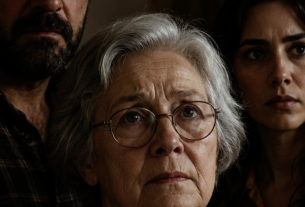
The new department greeted Olya with a steady hum of voices and a bewildering maze of desks. There were so many of them that her eyes kept wandering without finding anything to settle on. Olya stopped in the doorway, clutching a folder to her chest, and felt like someone who had walked through the wrong door.
“Lost?” A short woman of about sixty-five appeared beside her, with cropped hair and glasses hanging from a chain. “You’re Olya, right? I’m Raisa Pavlovna. Come on, your desk is by the window—the best one here.”
“Thank you. Why is it the best one?” Olya followed her, trying not to bump anyone with her shoulder.
“Because there’s a draft and nobody wants it. But you’re young—it’ll do you good,” Raisa Pavlovna smirked. “Stick with me. I’ve been here longer than this linoleum.”
Olya sat down, arranged her things, and tried to breathe normally. It seemed to her that the entire department was watching her without lifting their heads, casting sideways, appraising glances in her direction. Raisa Pavlovna placed a glass of water beside her and tapped the desk with her knuckle.
“Smile, but don’t suck up to anyone. People here can smell flattery the way dogs smell fear,” she said quietly. “And don’t promise anyone anything during your first week.”
“Can I start making promises in the second?” Olya finally exhaled and smiled.
“By the second week, you’ll already know who you can promise things to and who you’re better off giving a wide berth.” Raisa Pavlovna adjusted her glasses. “Don’t be scared. They’re not animals. There are just a lot of people here.”
At home, Olya kicked off her shoes, curled up on the sofa with her legs tucked beneath her, and began talking as though she had returned not from an office department but from an expedition.
“Denis, there are as many desks there as check-in counters at an airport! And everyone stares. Silently. Like wolves.” She widened her eyes dramatically. “I even drank some water and felt like I was doing it wrong.”
“Like wolves, huh?” Denis sat beside her and put an arm around her shoulders. “A little sheep has wandered into a wolf pack. Hang in there, sheep. By Friday, you’ll be leading the pack.”
“Yeah. Or they’ll eat me by Wednesday,” Olya snorted. “But there’s Raisa Pavlovna. She took me under her wing immediately.”
“Well, that’s great. So you’ve already got your own wolf.” Denis laughed. “And an experienced one at that.”
He was in a good mood, slightly tired, his nose sunburned from being outdoors. His income had been steady for the past few months, with no sudden drops, and it showed in him—in the way he walked, in how easily he picked up shopping bags. His phone vibrated in his pocket. Denis glanced at the screen and stood up.
“It’s Mom. I’ll run over there quickly. It’s only a ten-minute walk.” He kissed Olya on the lips. “They won’t eat you. You’re capable of eating anyone you want yourself.”
“Only if he’s tasty,” Olya called after him.
The door slammed shut, and the apartment became quiet. Olya reached for her phone—and it immediately rang. Karina, her friend since their first year at university, always seemed to know exactly when to call.
“Well?! Tell me everything! How’s the new place? Have they accepted you, or are they testing how tough you are?” she blurted out without even saying hello.
“Testing me,” Olya announced solemnly. “Listen to the report. Women who gave me suspicious looks: Raisa Pavlovna—she’s nice, that’s just her face. Irina Sergeyevna—she looked at me like a customs officer. And another woman whose name I don’t know sighed at me twice.”
“How old are they?”
“All over forty. Way over,” Olya giggled. “They’re competing with me for the chair by the window, not over my beauty.”
“Okay, forget the women. Tell me about the men,” Karina demanded.
“There are three men. One with a beard, one without a beard, and one with a thermal mug that he holds like a knight holding a shield,” Olya reported. “They each looked at me for exactly two seconds and then went back to their screens.”
“Two seconds is a long time!” Karina declared. “That’s it, I want to work in your department. Put me anywhere, even in the draft.”
“The draft belongs to me,” Olya laughed. “But I can make room.”
“Olya, seriously, though. How are you?” Her friend’s voice softened.
“I’m fine. Scared, but fine.” Olya pulled her knees closer. “I’ve noticed something: things are only scary for the first three days. After that, it’s just work.”
On Thursday evening, Denis came home different. Not tired—gloomy. He silently took off his shoes, silently walked into the room, and silently sat down.
“Okay.” Olya stood in front of him. “Either you tell me what happened, or I start inventing explanations, and you know my imagination can be vicious.”
“Olya, not now.”
“Exactly now.” She sat beside him and took his hand. “You came home looking like someone stole your last sandwich. I want to know who stole it.”
Denis rubbed his knees with his palms and began.
“Natasha’s parents—you know, Artyom’s wife’s parents—their house burned down. In the village. Faulty wiring. During the night.”
“The people?” Olya asked quickly.
“Everyone survived. They got out in time. Even the cat made it.” He shook his head. “But there’s nothing left of the house except the walls.”
“My God.” Olya covered her mouth with her hand. “That’s… that’s an entire life gone in one night.”
“They’re moving into a one-room apartment in the city. And Artyom, Natasha, and their two children are moving in with my parents,” Denis said. “And that’s where the second problem begins.”
“What second problem?”
“Artyom’s apartment has been mortgaged as collateral for loans for a long time.” Denis looked up at her. “He borrowed money for the kids. Classes, treatment for the younger one, then something else. It just snowballed.”
Olya was silent for a moment, processing it.
“Wait. Artyom wasn’t unemployed, and neither was Natasha.” She frowned. “Two adults, both working. Why put the only roof over their heads up as collateral?”
“It just happened.”
“‘It just happened’ is what you say when you step in a puddle,” Olya replied. “This isn’t a puddle, Denis. It’s an ocean. Someone made that decision. Someone sat down and signed the papers.”
“You’re harsh.”
“I’m honest. They’re different breeds, though people often confuse them.” She squeezed his fingers. “I genuinely feel sorry for Natasha’s parents. But mortgaging the apartment wasn’t a fire. That was a choice.”
A week later, Denis came through the door and immediately began speaking, as though he were carrying the news in outstretched hands and was afraid of dropping it.
“Artyom missed a payment. The bank added penalties and fines. The amount is… bad.”
“How bad is ‘bad’?”
“Bad enough that Mom hasn’t slept for three nights.” Denis tossed his keys onto the cabinet. “There are six people in their two-bedroom apartment now. Six, Olya! And Dad is recovering from a stroke. It’s chaos. The kids are screaming, Natasha is crying, Dad is bedridden.”
“That’s hard,” Olya said quietly. “It really is.”
She sat down, placed her hands on her knees, and fell silent. Denis waited. He was waiting so obviously that the silence became thick as felt.
“And?” he finally asked.
“And what?” Olya shrugged.
“You don’t want to say anything else?”
“I said it’s hard. I’m not refusing to sympathize with them.” She looked straight at him. “I’m refusing to invent a solution for them that nobody has asked me for.”
“You don’t understand!” Denis sprang to his feet. “If Artyom loses the apartment, Natasha’s parents will end up on the street! Do you understand? On the street! Their house burned down, and now this!”
“I understand. I feel sorry for them,” Olya replied evenly. “But I don’t have a spare apartment in my pocket that magically falls from the sky every time someone overestimates what they can afford.”
“You just don’t give a damn about my family,” he breathed.
“I do care. I’m simply not ashamed.” Olya looked at him. “Those are different things too, and people confuse them just as often.”
Denis went into the other room and slammed the door. Olya remained sitting there, listening to water rushing through the neighbors’ pipes. She already understood where all of this was heading, and she didn’t want to believe it.
Four days later, Denis came home composed and determined, wearing the expression of a man who had made a decision for both of them.
“Olya, sit down. Times are hard. We’re selling your apartment and moving in with my parents,” he announced.
“Say that again,” Olya said.
“What is there to repeat?” He spread his hands. “Artyom will rent a place for his family. The money from selling your apartment will pay off his debt, and the rest will go toward building materials for Natasha’s parents’ house. They’ll pay us back later.”
“‘They’ll pay us back later,’” Olya repeated thoughtfully. “You know, that’s the longest road in the world. Nobody has ever reached the end of it.”
“So you refuse?”
“No.”
“No?” Denis brightened.
“‘No’ is my answer,” she said. “The apartment is not being sold. Not in one piece, not in parts, and not on some family installment plan.”
“At least think about it!”
“I did. While you were talking, I had enough time to think about it twice.” Olya stood up. “My apartment wasn’t given to me by some kindly wizard. And it isn’t an emergency relief fund for other people’s mistakes.”
Without a word, Denis pulled out his phone, dialed a number, and shoved it toward her.
“Talk to her. At least hear her out.”
Olya took the phone, raised it to her ear, and before the other person could say a word, said:
“I’m not selling the apartment. Have a good evening.”
Then she hung up.
“You didn’t even listen!” Denis exploded. “She didn’t get to say a single word!”
“I’m not obligated to spend ten minutes listening to someone explain why I should give up the roof over my own head.” Olya handed him the phone. “Persuasion is just the packaging. Inside it, there’s always the same thing: ‘Give it to us.’”
The next morning, Denis froze as he walked into the room. About a dozen cardboard boxes stood in the middle of the floor. Some were already filled, with packing tape lying on top.
Something inside him relaxed.
So she had changed her mind.
She understood.
Family had won after all.
He stepped into the hallway, called his brother, and spoke quickly and cheerfully.
“Artyom, everything’s fine. Olya agreed. She’s already packing boxes—I saw them myself. You’ll be able to pay off your debt soon.”
Half an hour later, Olya’s phone rang. Artyom spoke excitedly and breathlessly, thanking her and making promises.
“Olya, you have no idea. You’re saving us. I’ll pay back every cent, I swear, I…”
“You’re welcome,” Olya said calmly. “I’ll give it back. I don’t mind anymore.”
She didn’t specify exactly what she intended to give back.
Artyom didn’t notice.
Her mother-in-law called next. Her voice was warm, syrupy, enveloping, and she talked for a long time.
“Olenka, I always knew you were a good person. I told Denis you would understand our situation. Family is what supports you, after all, and when one person is struggling, everyone should…”
“Nina Ivanovna,” Olya interrupted gently, “are you thinking about the money right now?”
“What money? I’m talking about kindness!”
“Then let me explain. I’m not giving you money. I’m giving you your son back.”
Denis walked into the room at that exact moment and didn’t understand what she meant. Then he saw Olya placing his shirts into a box—neatly, folded into a stack, the way you fold someone else’s belongings.
He snatched the phone from her and ended the call.
“What kind of circus is this?” His voice cracked.
“No circus. I’m packing.” Olya straightened up. “I’m not selling the apartment. And a husband who sets his sights on my property isn’t really much of a husband anymore.”
“I’m saving the family!”
“You’re saving someone else’s family,” she snapped. “Your family is you and me. The two of us. Artyom is your brother—an adult man who signed those papers himself. Nobody twisted his arm.”
“He borrowed the money for his children!”
“He put the roof over those same children’s heads up as collateral. Brilliant decision.” Olya tore off a strip of packing tape. “And I’m not going to rescue that man. Or his wife’s parents. I sympathize with them, but sympathy isn’t measured in square meters.”
“There’s nobody else to help them!”
“There is. Your parents have a two-bedroom apartment too.” Olya looked him in the eye. “Why don’t they sell theirs? Why don’t they move into a rental so they can save their son? No, of course not. Nobody wants to lift a finger when it involves their own property, but sacrificing the daughter-in-law? Now that’s perfectly convenient.”
Denis opened his mouth but couldn’t find an answer.
“You already promised all of them,” Olya continued. “You told them your wife agreed and that she was packing boxes. Well, you were right. I am packing boxes.”
She looked at him.
“Yours.”
An hour later, the doorbell rang. Nina Ivanovna marched inside, furious, her lips pressed tightly together. She had already understood everything.
“So that’s how it is! So you…”
“Stop.” Olya raised a hand. “Not one word about my apartment. Not one. Otherwise, this conversation ends right here at the door.”
“Why, you…”
“Not one word,” Olya repeated in the same calm voice.
Denis watched his wife pick up his jacket from the chair and place it on top of one of the boxes.
And that was when it finally hit him.
One more sentence—and he would walk out of this apartment with those boxes, and it would be forever.
“Enough!” He stepped forward, took his mother by the shoulders, and guided her toward the door. “Enough. Go home. Artyom got himself into debt. He signed those papers himself, and Olya has nothing to do with it. Nothing!”
“Denis!”
“Natasha’s parents have relatives in the village! Let them help each other—they’ve got half the village full of relatives!” he nearly shouted as he pushed his mother out onto the landing. “Olya and I are at the very bottom of the list. The very bottom! Understand?”
The door closed. Nina Ivanovna continued muttering something on the other side, but gradually her complaints faded as she went downstairs.
Denis was shaking. He stood with his forehead pressed against the door, counting the seconds until the feeling passed.
He had almost destroyed his own life—and for what?
Because of someone else’s foolish decisions and someone else’s signatures.
He returned to the room and spoke loudly, as though pronouncing a sentence on himself.
“That’s it. No sale. Do you hear me? No sale. I’m an idiot. Something short-circuited in my head. I lost all perspective. I decided that if I didn’t save them, I’d be a bad son and a bad brother.”
Olya silently closed the first box containing his books and ran her palm over the packing tape.
“But you’re my family,” he said. “You. Not them. Forgive me. Change your mind.”
She took a second box, unfolded the bottom, and began placing his sweaters inside. Her hands moved quickly while tears ran down her cheeks. She didn’t even wipe them away.
Denis approached her from behind, wrapped his arms around her, pulled her close, and gently stopped her hands.
“You don’t really want to pack them, do you?” he asked quietly.
Olya nodded.
She sobbed.
Then nodded again.
“My husband is an idiot,” she managed to say.
“An idiot,” Denis agreed. “A complete one. Stupid. Hollow as a bucket. But I understand now. And thank you for showing me with boxes instead of words how this would end. I don’t want to be without you.”
“I don’t want that either,” Olya whispered.
They stood silently for a while.
Then he said:
“I was wrong. I promise nobody will touch your apartment. Ever. If you can, forgive me.”
Olya pulled away, wiped her face with the back of her hand, and looked up at him for a long moment.
“Listen carefully. If you ever go against the two of us like this again, I’ll leave. It will hurt, but I’ll leave,” she said. “I’ve never tolerated things for years, and I’m not about to start.”
“I won’t,” he answered. “I swear.”
Denis pulled out his phone, called his brother, and spoke calmly, without apologizing.
“Artyom, listen to me. The apartment isn’t being sold. No. It won’t happen. Find other options. Talk to the bank. Ask for restructuring. No. I said no.”
Then he called his mother and repeated the same thing, word for word.
She tried to persuade him for a long time. He didn’t interrupt her. He simply waited for a pause and said:
“Goodbye.”
Then he hung up.
Olya looked at him and understood that he wasn’t a villain.
He had simply gotten lost. He had wanted to be good to everyone at once and had nearly ended up meaning nothing to anyone.
She walked over, wrapped her arms around him, and rested her cheek against his shoulder.
After all, he was still hers.
And she still loved him.