“Mom, you’re retired anyway. What are you supposed to do, sit at home all day?”
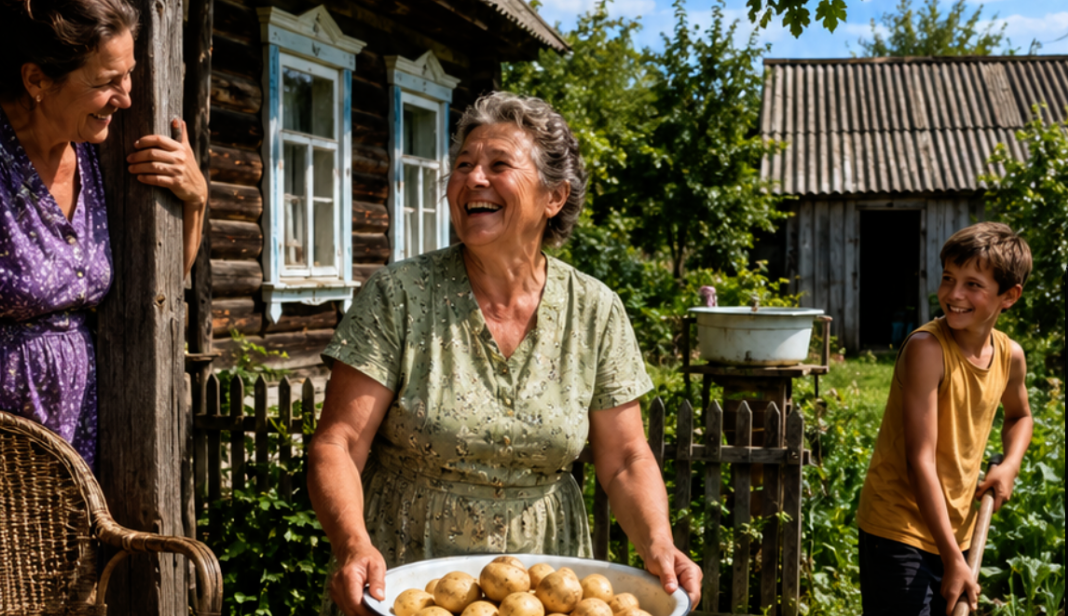
Tamara Leonidovna lowered her hoe into the furrow and straightened up. Her daughter was standing on the porch of the country house, holding a phone in one hand and a glass of berry drink Tamara had made that morning in the other. It was half past eleven. The children had already been running around the property unsupervised for two hours.
“I’m not sitting around, Olya. I’m hilling the potatoes.”
“That’s exactly what I mean. You’re keeping busy. Do you have any idea how much a nanny costs these days?”
Olya knew. Olya knew the exact price of everything involving money, down to the last ruble.
Tamara stuck the hoe into the ground and went toward the house to wash her hands. Under the awning, three plates with breakfast leftovers sat on the table—the omelet she had made at seven in the morning while everyone else was asleep. Her son-in-law, Vitalik, was sitting nearby in a wicker chair, absorbed in some fishing forum on his tablet. He did not look up.
“Grandpa, Grandpa, where should I dig for worms?” the younger boy, Artyom, shouted.
“Ask Grandma,” Vitalik replied without taking his eyes off the screen.
Grandma. Of course.
Grandma knew where the worms were, where the shovel was, where the bandages were, where lunch was, and where everyone’s conscience was—although the last thing had not been seen in this household for quite some time.
Tamara dried her hands on a towel and began peeling potatoes for four adults and three children. For the seventh year in a row.
She and her late husband had bought this country property in 1998: fifteen hundred square meters of land, a house, and a bathhouse. Everything had been registered solely in her name. Her husband had insisted.
“Toma, let it be in your name. You never know what might happen.”
And something had happened.
She buried her husband in 2017, but the country house remained. Since then, it had stopped being a country house and become a free family resort for her daughter’s household—with a cook, gardener, and nanny all rolled into one.
“Grandma, when is lunch?” the eldest girl, Kristina, asked, peeking under the awning.
“In an hour.”
“That’s so long!”
Long. But Kristina was not the one peeling the potatoes.
During lunch, Olya ate while scrolling through her phone. Vitalik praised the cold soup—the only thing he knew how to compliment without interrupting his meal.
“Mother-in-law, you’ve got golden hands,” he mumbled with his mouth full.
Golden hands.
The previous weekend, he had asked those golden hands, “as a favor to family,” to weed his strawberry plants as well—the ones he had decided to plant along her fence in the spring.
Repairing their washing machine, which had been rinsing properly only every other time for almost a year, was apparently too expensive. But he had bought himself an eighteen-thousand-ruble fishing rod for his birthday. It was now standing in the entryway in its case, never once used.
“Mom, can you watch the children after lunch? Vitalik and I wanted to go into town, to the shopping mall,” Olya said without looking up from the screen.
“I have garden beds to tend.”
“You can do them in the evening. They’re not going anywhere. The stores close at eight.”
Tamara placed the ladle on its holder.
“And what about me?”
“What about you?” Olya finally raised her head.
“I’m a person too. Maybe I want to go into town as well.”
Olya laughed. Lightly, almost kindly, as though her mother had made a joke.
“Mom, come on. You’re sixty-two. What do you need a shopping mall for? You’re perfectly happy here.”
Vitalik snorted into his bowl.
Tamara said nothing. She gathered the empty plates and carried them to the washbasin.
Behind her, she heard Olya calling someone—her distant cousin Zhanna, who lived on the next street and occasionally dropped by “for tea.”
Olya never turned off the speakerphone. She said it was uncomfortable holding the phone to her ear when her hands were busy. Her conversations blasted across the entire yard.
“No, Zhanna, we’re having an amazing vacation,” Olya chirped. “Mommy’s here with us, and she does everything. We’re living like royalty. Can you imagine? It doesn’t cost us anything at all! A nanny in the city costs about two thousand a day, and a cook is even more expensive, but here everything is free. The old woman is retired—what else is she going to do? She gets bored alone, and here at least she has something to keep her busy. The best part is, we don’t even have to cook separately for her. She eats with everyone else. It’s nothing but savings!”
Zhanna croaked something in response.
“That’s exactly what I tell her—stay here, Mom, you’re free!” Olya laughed. “It’s her country house, her cooking, and she watches the children. Meanwhile, we have the perfect life. We save at least forty thousand a month on a nanny and a cook. You could say she even contributes half her pension to our household.”
Tamara turned off the water.
Everything became quiet.
So quiet that she could hear a fly striking the veranda window.
Half her pension.
Forty thousand in savings.
Free.
No need to cook separately for her.
She dried her hands, went into the house, and opened the chest of drawers. In the bottom drawer, beneath a piece of oilcloth, lay a cardboard folder tied with ribbons. That was where she kept the property documents, utility bills, and electricity contract.
She took out the folder and returned to the awning.
Olya had finished her call and was once again lost in her social media feed. Vitalik was picking his teeth with a matchstick.
Tamara placed a sheet of paper on the table in front of her daughter—the agreement with the gardening association and receipts for electricity, water, and waste collection. On top, she placed an extract from the property registry that she had ordered in the spring while updating the land survey documents.
There was only one owner listed.
Her.
“What’s this?” Olya glanced sideways at the papers.
“This is how much ‘free’ costs,” Tamara said evenly.
“Mom, what are you doing?”
“Electricity costs two thousand a month when you’re here. Water is another thousand. Waste collection is six hundred. Food for seven people—I calculated it from the receipts—costs twelve hundred a day. Thirty-six thousand for June. All paid from my bank card.”
“Well, we give you…” Olya began.
“Give me what?” Tamara looked directly at her. “Not one ruble in three years. I checked.”
Vitalik stopped picking his teeth. The matchstick froze halfway to his mouth.
“Come on, Mother-in-law. Why are you getting so worked up?” he attempted.
“Forty thousand in savings, Olya. That’s what you told Zhanna. On speakerphone. I heard you.”
Olya opened her mouth, then closed it again.
The glass of berry drink in her hand tilted, and a thin stream spilled onto the tablecloth, spreading into a pink stain across the white fabric. Olya stared at the stain without wiping it.
“I didn’t mean it like that…I mean…”
“You meant exactly what you said,” Tamara replied. “An old woman on a pension. Free. No need to cook separately for her.”
As it happened, Zhanna was already approaching the gate. She had heard from the street that something was happening at the neighbors’ house and had come running toward the scent of scandal like a cat toward valerian.
She stopped behind the fence and pretended to water her phlox with a watering can, although the can was empty.
“Vitalik, say something to her!” Olya turned toward her husband.
Vitalik stood up.
Very slowly.
He took his cigarettes from the table.
“I’m going to…have a smoke. By the river.”
And he left. He walked across the entire property toward the gate, passed Zhanna, and looked at no one.
Twenty minutes earlier, the son-in-law had been praising his mother-in-law’s golden hands. Now he was carrying himself as far away from those golden hands as possible before trouble began.
“Where are you going?” Olya shouted after him.
“I’ll be back soon!” came his voice from the gate.
In about an hour and a half.
Or by dinner.
Once it was ready, naturally.
Tamara sat down. Slowly and carefully, she placed the papers back into the folder, one sheet at a time.
“Mom, forgive me. I didn’t think,” Olya began speaking quickly, lowering her voice. “It just slipped out. It was only Zhanna—we were just chatting. You know I love you. You’re my mother…”
“I am your mother,” Tamara nodded. “Not your cook.”
“Mom, please!”
“From today onward, you cook for yourselves. You handle the firewood yourselves. The children are your responsibility. In July, I’m going to Kostroma to stay with my friend Lidia Sergeyevna for three weeks. I’ve already bought the ticket.”
That was not true.
She had not bought a ticket.
But she would buy one that very day, from her phone. It would take five minutes.
“What about us? What about the children?” Olya jumped to her feet. “Who’s going to watch them?”
“A nanny,” Tamara said. “Two thousand a day. You know the rates.”
Kristina, who had been standing in the veranda doorway listening the entire time, quietly walked over to her grandmother and sat beside her.
She said nothing.
She simply moved closer.
The girl was ten years old, and she was the only person at that table who understood who made her cocoa every morning.
Tamara put one arm around her granddaughter’s shoulders.
In her other hand, she held the folder.
Two weeks later, Tamara truly left for Kostroma—the first trip she had taken for herself in seven years.
Lidia met her at the train station and took her to see the monastery and the embankment. Tamara walked around, looked at everything, and at first kept catching herself wondering whether the children had eaten lunch or whether the stove had been turned off.
Then she stopped.
She learned what was happening back home through Lidia, whose daughter-in-law worked at the same company as Olya and passed along the latest news over the phone.
Olya and Vitalik lasted at the country house for exactly five days.
On the sixth day, Vitalik burned a pot of buckwheat, the children threw a tantrum because “Grandma’s soup tastes better,” and there was no one to weed the strawberry plants.
They returned to the city.
They locked the country house.
The eighteen-thousand-ruble fishing rod, according to rumor, was still standing unused in the entryway. Now it was locked inside because Tamara had taken the key with her.
Olya called twice.
The first time, she cried.
The second time, she demanded the keys and asked when her mother was “finally going to come to her senses.”
Tamara replied that she had already come to her senses and ended the call.
According to neighborhood gossip, Zhanna and Olya had a terrible falling-out. Olya blamed her cousin for letting everything come to light because of their conversation, although, as everyone knew, Zhanna had not been the one doing the talking.
Kristina sent her grandmother a voice message.
“Grandma, come back. I learned how to make cocoa the way you do.”
Tamara listened to it three times.
When she returned from Kostroma, Tamara took the ribbon-tied folder from the chest of drawers and placed a new document inside—an application to the gardening association stating that access to the property was permitted only to the registered owner.
She tied the ribbons.
Then she returned the folder to the bottom drawer beneath the oilcloth.